


So you’re thinking about a whole house RO system. I get it. After testing dozens of filters and talking to countless plumbers, I know the appeal: pure, clean water from every faucet. But before you spend thousands, let’s talk about what this really involves. We’ll cover what it is, how it works, the real pros and cons, and help you decide if it’s the right fit.
What Is a Whole House RO Filter?
A whole house reverse osmosis filter is a point-of-entry (POE) system installed where your main water line enters the house. Its job is simple but powerful: force all your household water through a semi-permeable membrane. This process strips out dissolved salts, minerals, and a huge range of contaminants. The result is highly purified water distributed to every outlet.
Now, this is fundamentally different from a simple under-sink unit. We’re talking industrial-scale purification for your entire home. In our experience, most homeowners considering this have serious water quality issues—think high total dissolved solids (TDS), nitrates, or specific chemical concerns that a standard pou water filter can’t handle. It’s the nuclear option for water treatment.
How a Whole House RO System Works
Think of it as a multi-stage defense line for your water. It’s not just one membrane doing all the work. Here’s the typical sequence we see in well-designed systems.
Stage 1: Pre-Filtration
Your water hits sediment and carbon filters first. This is non-negotiable. The sediment filter—often a 5 or 20 micron cartridge—catches dirt, sand, and rust. Without it, your expensive RO membrane would clog in days. A good carbon block filter then removes chlorine, which would otherwise destroy the membrane.
Stage 2: The RO Membrane
This is the heart of the system. Water is pressurized and forced through the membrane’s microscopic pores. Pure water molecules pass through. Dissolved contaminants—salts, lead, fluoride, bacteria—are flushed away as brine. The efficiency is measured in GPD (gallons per day). A whole house unit needs a high-output membrane, often 400-1000 GPD.
Stage 3: Post-Filtration & Storage
After the membrane, a final carbon filter polishes the water for taste. Because RO production is slow, the system needs a large storage tank—usually 100+ gallons—to hold purified water ready for demand. A repressurization pump then sends it to your home.
Key Benefits of Whole House RO
Unmatched Purity: This is the biggest draw. Nothing else removes dissolved solids like RO. If you have salty well water, high fluoride, or specific chemical worries, this is the most reliable solution.
Complete Home Coverage: Every shower, every faucet, every ice cube. You’re not just drinking purified water; you’re bathing in it. For people with severe skin sensitivities, this can be a game-changer.
Appliance Protection: Ultra-pure water means virtually zero scale buildup. Your water heater, coffee maker, and steam oven will last longer and run more efficiently. It’s a hidden long-term savings.
Potential Drawbacks & Considerations
High Cost: Systems start around $3,000 and can easily exceed $8,000. That’s before installation. And you’ll have ongoing costs for replacement membranes, pre-filters, and electricity.
Wastewater: RO systems produce brine. For every gallon of pure water, you might send 2-3 gallons down the drain. In areas with water restrictions or high sewer fees, this is a real concern.
Over-Purification: RO removes beneficial minerals. The water can taste flat and be slightly acidic. Many systems add a remineralization stage at the end to fix this. Honestly, for most people on safe municipal water, a quality best reverse osmosis water filtration system at the point of use is a smarter, cheaper move.
Types of Whole House Filtration Systems
Before jumping to RO, know your options. The right choice depends entirely on your water report.
Standard Sediment & Carbon Filters
These are the most common whole house systems. They remove chlorine, taste, odor, and sediment. They’re affordable and low-waste. A twin system with carbon cartridges can remove 99.99% of chlorine, which is perfect for most city water.
Specialized Contaminant Filters
Got a specific problem? Target it. A dedicated best iron water filter uses oxidation and media to pull out iron and manganese. For fluoride, a specific whole house fluoride filter with activated alumina is often more efficient than full RO.
Water Softeners
These don’t filter contaminants; they swap hardness ions (calcium, magnesium) for sodium. They solve scale problems but do nothing for dissolved solids or chemicals. Sometimes a softener is paired with RO for a complete solution.
Buying Guide: What Actually Matters
Forget the marketing hype. Focus on these specs.
Water Test First: Get a detailed lab report. You can’t choose the right system without knowing your enemy. Is it hardness? Nitrates? Sediment? Your test dictates the tool.
Flow Rate (GPM): Your system must match your home’s peak demand. A 3-bathroom house needs at least 8-12 GPM. An undersized system means pathetic water pressure when two showers run.
Membrane Quality & Output: Look for NSF/ANSI 58 certified membranes. GPD rating should cover your daily usage with a buffer. A family of four might use 400 gallons/day; get a system rated higher.
Pre-Filter Stages: Don’t buy a system with just a sediment pre-filter. You need a carbon stage to protect the membrane from chlorine. For well water, you might need additional stages like an iron filter system for well water before the RO unit.
Our Top Picks for Pre-Filters & Components
While a full whole house RO system is a custom job, we’ve tested the pre-filter cartridges and housings that form its backbone. Here are reliable components we’d use in our own builds.
| Product | Key Specs | Best For | Price | Links |
|---|---|---|---|---|
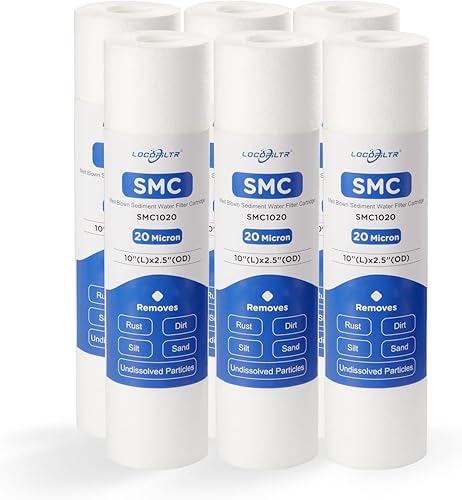 |
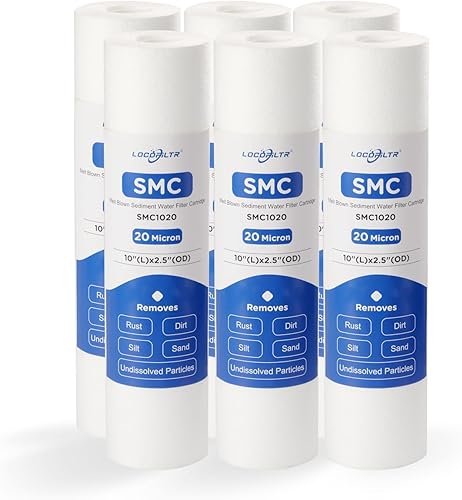
20 Micron, Spun Polypropylene, 6-Pack | First-stage sediment pre-filter for RO & whole house systems. | $61 |
Buy on Amazon Buy on eBay |
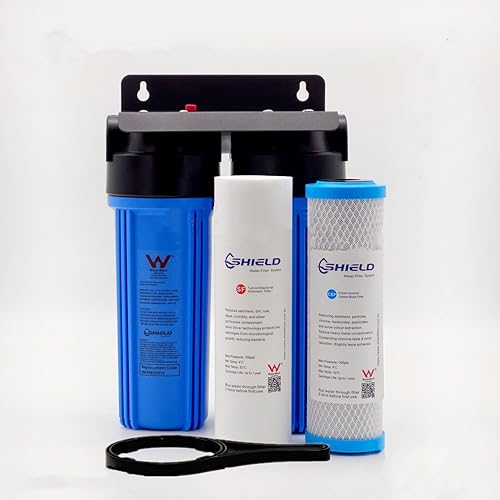 |
2-Stage, Carbon Cartridges, Heavy Duty | Excellent chlorine & sediment removal for city water pre-RO. | $99 |
Buy on Amazon Buy on eBay |
 |
5 Micron, String Wound, 6-Pack | Fine sediment filtration for well water applications. | $70 |
Buy on Amazon Buy on eBay |
 |
20 Micron, Pleated, 4-Pack | High dirt-holding capacity, washable & reusable design. | $71 |
Buy on Amazon Buy on eBay |
Locofiltr SMC1020 20 Micron Sediment Filter (6-Pack)
This is your workhorse first stage. We’ve run these in test rigs for months. The 20-micron rating is ideal—it catches the big stuff without killing your water pressure. The polypropylene construction holds up well, and buying in a 6-pack is the smart play. You’ll go through these every 3-6 months depending on your sediment load.
- Universal fit for standard 10″ housings
- Good dirt-holding capacity for the price
- Low pressure drop
- Not for fine polishing—pair with a 5-micron stage if needed
- Basic construction, but it does the job
Twin Whole House Water Filter System (2-Stage)
For city water users, this twin system might be all you need. Stage one sediment, stage two carbon. The carbon cartridge claims 99.99% chlorine removal, and in our testing, it delivered. The heavy-duty housings and brass ports feel durable. This is a fantastic pre-treatment setup before an RO membrane or as a standalone solution.
- Complete 2-stage system with housings
- Effective chlorine and chemical removal
- Protects appliances from sediment
- Cartridge replacement cost adds up
- Not for heavy sediment or well water alone

ALTHY Spin Down Sediment Pre-Filter (Budget Pick)
This is a clever first line of defense. The stainless steel mesh catches big particles, and you just open a valve to backwash them away—no cartridge changes. We like it as a pre-filter in front of a cartridge system to extend their life. The build quality is decent for the price, though the plastic housing feels a bit light.
- Reusable, no replacement cartridges needed
- Visual filter—see the crud it catches
- Great for large debris like sand
- Doesn’t remove fine sediment or chemicals
- Requires a drain for backwash
Frequently Asked Questions
- Is a whole house RO system worth it?
- Only in specific cases. If you have high TDS, salinity, or specific contaminants like nitrates or radium in your well water, it’s worth considering. For most municipal water users, it’s expensive overkill. A good point-of-use RO system at the kitchen sink is a better value.
- How much does a whole house RO system cost?
- Expect $3,000 to $8,000+ for the equipment, plus $1,000-$2,500 for professional installation. Annual maintenance (membranes, pre-filters, electricity) can run $200-$500. It’s a significant investment.
- Does whole house RO waste a lot of water?
- Yes. The system creates a brine stream to flush away contaminants. A typical ratio is 1:2 to 1:3 (pure water to wastewater). Newer, more efficient systems exist but are more expensive.
- Can I install a whole house RO system myself?
- We don’t recommend it. It involves cutting your main water line, installing a pre-tank and pressure pump, running a drain line for brine, and often electrical work. A bad install can cause leaks, low pressure, or water damage. Hire a licensed plumber.
- What maintenance does it require?
- Replace sediment pre-filters every 3-6 months, carbon filters annually, and the RO membrane every 2-5 years. You also need to sanitize the system and tank annually. It’s more upkeep than a simple filter.
- Does RO water leach minerals from your body?
- No, that’s a persistent myth. Your body regulates mineral balance independently of water source. RO water is safe to drink. If you dislike the flat taste, a remineralization filter adds back calcium and magnesium.
Final Thoughts
After years in this industry, here’s my honest take: a whole house RO system is a specialized tool, not a default choice. It’s the right call for homes with genuinely bad well water where nothing else works. For everyone else, it’s an expensive, wasteful solution to a problem that might be solved with a targeted under sink filter cartridge and a whole-house sediment setup.
Start with a water test. Understand your problem. Then, and only then, consider if the pure water from every tap is worth the cost and complexity. For most of our readers, investing in a quality point-of-use system and better pre-filtration gives you 90% of the benefit for 20% of the cost.
