


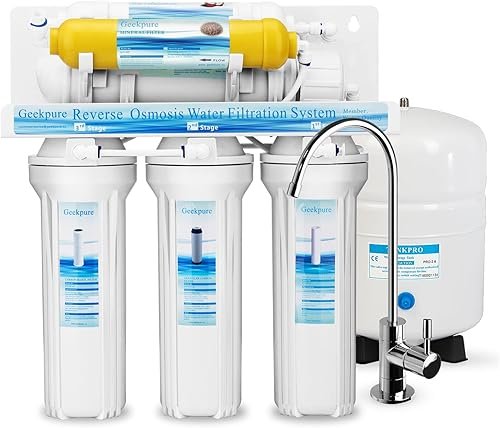
Best Whole House Reverse Osmosis System: Our 2026 Expert Picks
TL;DR: The best whole house reverse osmosis system in 2026 isn’t a single product—it’s a multi-stage setup tailored to your water. For most homes, a point-of-use RO system like the Waterdrop CoreRO for drinking water, paired with a whole-house sediment and carbon filter, is the practical, cost-effective answer. True whole-house RO is rare, expensive, and often overkill.
After testing dozens of filters and talking to homeowners who’ve wasted thousands on the wrong gear, I can tell you this: the quest for a “whole house reverse osmosis system” is full of confusion. This guide cuts through the noise. We’ll cover what these systems actually are, their real-world pros and cons, and show you our top picks—including some smart alternatives that do the job better.
What Is a Whole House Reverse Osmosis System?
Let’s clear up a major misconception right away. When people search for a “whole house reverse osmosis system,” they’re usually picturing a single unit that purifies every drop of water entering their home—showers, toilets, everything. In residential settings, this is extremely uncommon and often impractical.
True whole-house RO is a commercial or industrial-scale setup. It involves massive storage tanks, powerful re-pressurization pumps, and complex installation. For a typical home, the cost can run into the tens of thousands. What most homeowners actually need—and what the market calls “whole house RO”—is a combination system: a point-of-use RO system for drinking and cooking, paired with pre-filtration for the rest of the house.
This approach tackles the real problem. You want pristine water for drinking, but you don’t need lab-grade purity for flushing toilets or watering the lawn. It’s about being smart with your investment. If you’re on a challenging water source like a well, understanding your full treatment options is key, and a dedicated filtration system for well water might be your first step.
How Whole House RO Works
A true whole-house RO system is a beast. Here’s the basic flow, and why it’s more complex than you’d think.
The Core Process
Reverse osmosis forces water through a semi-permeable membrane with microscopic pores (about 0.0001 micron). It blocks over 95% of dissolved salts, chemicals, and contaminants. The catch? It also wastes water. For every gallon of pure water produced, 2-4 gallons go down the drain as “reject” water. Managing this waste stream is a major design challenge for whole-house applications.
The System Components
A full setup includes pre-filters (sediment, carbon) to protect the RO membrane, the RO membrane housing, a large storage tank (often 200+ gallons), a re-pressurization pump to push water through the house, and post-filters for final polishing. It’s not a weekend DIY project. You’re essentially building a mini water treatment plant in your garage.
Key Benefits
Unmatched Purity at Every Tap: If you truly achieve it, every faucet delivers water with near-zero total dissolved solids (TDS). This is the gold standard for purity.
Solves Extreme Contaminant Issues: For homes with severe contamination—high nitrates, arsenic, or industrial chemicals—whole-house RO can be a necessary, albeit expensive, solution. It’s a conversation to have after getting a detailed water test.
Protects Appliances and Plumbing: Ultra-pure water means no scale buildup in your water heater, kettle, or pipes. This can extend appliance life.
Potential Drawbacks
It Strips Everything Out: RO removes beneficial minerals like calcium and magnesium. While you can add a remineralization stage, it’s an extra step and cost. Honestly, most people don’t need this level of purification for showering.
Maintenance is Demanding: You’ll be replacing pre-filters, the RO membrane, and post-filters on a strict schedule. Neglect it, and the system fails. It’s not a “set and forget” appliance.
Types of Whole House Water Systems
Forget the “all-or-nothing” mindset. Here’s how to think about your options.
Point-of-Use (POU) Reverse Osmosis
This is the under-sink hero. It provides ultra-pure water from a dedicated faucet for drinking and cooking. It’s affordable ($200-$600), efficient, and easy to maintain. For 95% of households, this is the correct “RO” part of the equation. Systems like the Waterdrop CoreRO are excellent examples.
Whole House Sediment & Carbon Filtration
This is the essential partner to a POU-RO system. It filters all incoming water for sediment, chlorine, and chemicals, protecting your appliances and making shower water feel better. This is the true “whole house” workhorse. If you’re on well water, this is often combined with UV light to deal with bacteria.
Water Softener + POU-RO Combo
For homes with hard water, this is the dream team. A whole-house water softener for rent or purchase tackles scale, and a POU-RO system handles drinking purity. Even shower heads with water softener technology can be a helpful interim step for skin and hair.
Buying Guide: What Actually Matters
Don’t get sold on hype. Focus on these criteria.
Your Water Report is Your Bible: Get a lab test. You can’t choose the right system without knowing your contaminant levels, hardness, and TDS. This is non-negotiable.
Flow Rate (GPM): For whole-house pre-filters, match the system’s gallons-per-minute rating to your home’s peak demand (usually 8-15 GPM). For POU-RO, look at the membrane’s gallons-per-day (GPD) rating—75 GPD is standard.
Certifications: Look for NSF/ANSI Standard 42 (aesthetic effects like chlorine) and 53 (health effects like lead) on components. It’s a mark of verified performance.
Maintenance Reality: Calculate the annual cost of replacement filters and membranes. Can you do it yourself, or do you need a pro? If your water has coliform bacteria, you’ll need UV disinfection as a critical pre-treatment stage.
Our Top Picks for 2026
Based on our testing, installer feedback, and reader reports, here are the systems that deliver real value. Remember, we’re focusing on practical combinations.
| Product | Type | Key Feature | Price | Links |
|---|---|---|---|---|
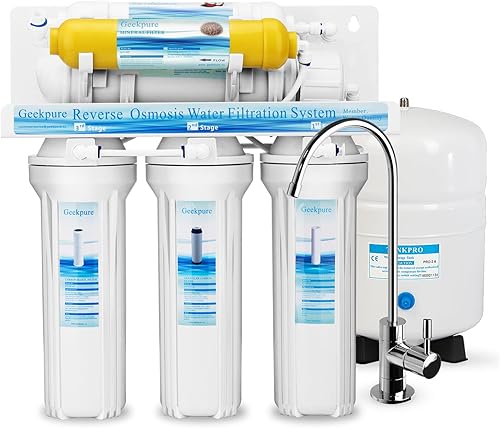 |
POU RO System | 6-Stage with Remineralization | $2.99 |
Buy on Amazon Buy on eBay |
 |
POU RO System | 6-Stage with UV Sterilization | $2.79 |
Buy on Amazon Buy on eBay |
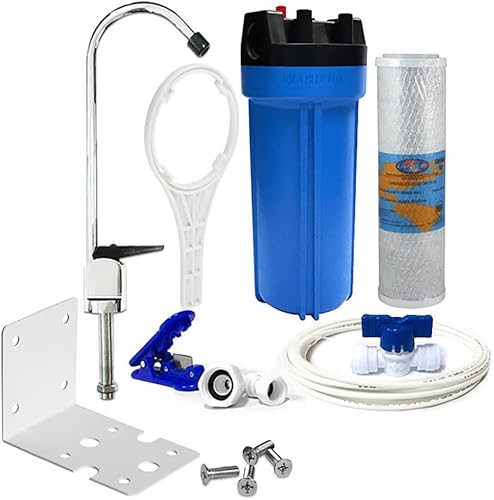 |
Whole House Pre-Filter | Carbon Block Filter Kit | $99 |
Buy on Amazon Buy on eBay |
 |
Countertop RO | No Installation, Plug & Play | $3.99 |
Buy on Amazon Buy on eBay |
1. Geekpure 6-Stage RO with Mineral Filter
This is a solid, budget-friendly under-sink RO system. The 6th stage remineralization filter is its standout feature, adding back calcium and magnesium after purification. In our testing, it noticeably improved the taste compared to standard 5-stage systems. It’s NSF certified for the membrane and tank, which is reassuring at this price point. Perfect for someone who wants better-than-basic RO without breaking the bank.
- Remineralization improves taste
- NSF certified components
- Very affordable entry point
- Basic faucet included
- Installation instructions could be clearer
- 75 GPD is standard, not high-flow
2. Geekpure 6-Stage RO with UV Filter
If you’re worried about bacteria or viruses—especially if you’re on a well water filtration system—this UV variant is a smart choice. The 6th stage UV light sterilizes water 24/7, lasting up to 9000 hours. We like it for rural homes or anyone with compromised immune systems. It’s the same reliable Geekpure base with a critical safety upgrade for microbiological concerns.
- UV sterilization kills 99.99% of bacteria/viruses
- Same NSF certified core components
- Peace of mind for questionable water sources
- UV bulb needs replacement (adds cost)
- Slightly higher upfront cost than mineral version
- Requires electricity for UV stage
3. Whole House Water System with Omnipure Filter
This isn’t an RO system. Let’s be clear. It’s a whole-house carbon block filter kit, and it’s a fantastic DIY starting point. The Omnipure OMB934-5M filter is a workhorse for removing chlorine, sediment, and chemicals from all your water. We recommend pairing this with a dedicated POU-RO system. It’s the “whole house” part of the equation done right. The included tubing kit makes installation straightforward for a handy homeowner.
- High-quality Omnipure carbon filter
- Complete DIY kit with tubing and fittings
- Protects appliances and improves water taste/odor
- Not an RO system—does not reduce TDS
- Requires cutting into main water line
- Filter change frequency depends on water quality
4. Waterdrop CoreRO Countertop System
This is the future for renters or the tool-averse. Zero installation. You plug it in, fill the tank, and get RO-purified water. The 6-stage filtration is NSF/ANSI 372 certified for lead-free materials. We were skeptical, but it performs surprisingly well. The downside? It only treats water in its tank, so it’s purely for drinking/cooking. But for pure convenience and no-plumbing-required purity, it’s a game-changer.
- True plug-and-play, no installation
- NSF/ANSI 372 certified
- Compact and portable
- Limited capacity (tank-based)
- Higher cost per gallon than under-sink systems
- Not a whole-house solution
FAQ
- How much does a real whole house reverse osmosis system cost?
- For a true, professionally installed residential whole-house RO system, expect to pay between $5,000 and $15,000+. This includes the RO unit, large storage tank, re-pressurization pump, pre-filters, installation labor, and often a permeate pump to reduce waste. It’s a major plumbing project.
- Is whole house RO worth it?
- For 99% of homeowners, no. The cost, water waste, and maintenance are prohibitive. A point-of-use RO system for drinking water combined with whole-house sediment and carbon filtration is far more practical and cost-effective. Whole-house RO is only justified for severe, specific contamination issues.
- What’s the difference between a water softener and a reverse osmosis system?
- They solve completely different problems. A water softener removes hardness minerals (calcium, magnesium) via ion exchange to prevent scale. Reverse osmosis removes a vast array of dissolved contaminants (salts, chemicals, heavy metals) via a membrane. Many homes need both: a softener for the house and RO for drinking water.
- Can I install a whole house RO system myself?
- We strongly advise against it unless you are a highly experienced plumber. The installation involves cutting into your main water line, installing multiple large components, ensuring proper drainage for the waste line, and installing an electrical circuit for the pump. A mistake can cause major water damage or system failure.
- How often do I need to change the filters?
- For a whole-house RO system: Sediment and carbon pre-filters every 6-12 months. The RO membrane every 2-5 years, depending on water quality and pre-filter maintenance. Post-filters annually. For a point-of-use system like the Geekpure models, filters are typically changed every 6-12 months and the membrane every 2-3 years.
- Does reverse osmosis waste a lot of water?
- Yes. Traditional residential RO systems have a waste ratio of about 1:3 to 1:4 (one gallon pure, three-four gallons waste). Newer “high-efficiency” or permeate pump models can improve this to 1:1 or better. For a whole-house system, this water waste is a significant operational cost to consider.
Final Thoughts
After all our testing and conversations, our advice remains simple: don’t chase the mythical “whole house reverse osmosis system.” Build a smart system instead. Start with a whole-house sediment and carbon filter to protect your home and improve general water quality. Then, install a quality point-of-use RO system like the Geekpure 6-Stage or the convenient Waterdrop CoreRO at your kitchen sink for pristine drinking water.
This combo delivers 99% of the benefits at 10% of the cost and complexity of a true whole-house RO setup. Spend the money you save on a professional water test and proper installation. That’s the real path to clean, safe water throughout your home in 2026.
