


I’ve spent years knee-deep in plumbing schematics and water test results, and the question I get most is whether a whole house reverse osmosis system is worth the hype. It’s the nuclear option for water purification. This guide cuts through the sales pitch to tell you what these systems really do, who actually needs one, and what to look for if you decide to take the plunge.
What Is a Whole House Reverse Osmosis System?
A whole house reverse osmosis system is a point-of-entry water treatment solution installed where your main water line enters the house. Unlike a small under-sink unit, its job is to filter every single drop of water you use—for drinking, showering, laundry, and watering the lawn. It uses the same core technology as a countertop model: forcing water through a semipermeable membrane with microscopic pores (about 0.0001 micron) to strip out dissolved solids, chemicals, and contaminants.
But here’s the reality check. We’ve tested dozens of setups, and true whole-house RO is a beast. It requires significant space, a drainage line for the waste water, often a large storage tank, and a repressurization pump. It’s not a weekend DIY project for most people. Honestly, most homeowners looking for better tasting, safer water throughout the house are better served by a combination of a good whole house sediment filter, a carbon filter, and a dedicated drinking water RO system. Whole house RO is for specific, serious water problems.
How Whole House RO Systems Work
The process is more complex than a point-of-use filter. Let’s break down the typical stages.
Pre-Filtration Stage
Before water even touches the expensive RO membrane, it needs heavy-duty pre-cleaning. This usually involves a sediment filter to catch rust and sand, followed by one or two carbon filters to remove chlorine (which would destroy the membrane) and organic chemicals. Skipping this step is the fastest way to ruin a $500 membrane.
The Reverse Osmosis Process
Here’s where the magic happens. High water pressure (often boosted by a dedicated pump) forces water through the membrane. Pure water molecules squeeze through. The vast majority of contaminants—dissolved salts, lead, fluoride, nitrates—are rejected and flushed away as “brine” or waste water. This is the key difference from simpler filters; RO tackles what’s dissolved in the water, not just what’s floating in it.
Storage and Re-Pressurization
Because the RO process is slow, whole house systems need a large atmospheric storage tank to hold purified water. A float valve controls the inflow. Then, a separate repressurization pump kicks in to send that stored water to your fixtures at adequate pressure. Without this, you’d have a pathetic trickle from your showerhead.
Post-Treatment (Often Critical)
RO water is so pure it can be slightly corrosive and flat-tasting. Many systems add a “remineralization” stage to add back calcium and magnesium for taste and to protect pipes. Others might include a final UV light for disinfection. This stage is non-negotiable for protecting your home’s plumbing.
Key Benefits of a Whole House RO System
Total Contaminant Removal: This is the headline benefit. A properly sized system removes 95-99% of total dissolved solids (TDS), heavy metals like lead and arsenic, fluoride, nitrates, radium, and many pharmaceuticals. Every tap delivers water purer than most bottled brands.
Superior Shower & Bath Experience: If you have sensitive skin or eczema, showering in chlorine-free, softened RO water can be a game-changer. It also prevents mineral spots on shower doors and fixtures. Some readers report needing less soap and shampoo.
Protects Appliances & Plumbing: By eliminating scale-forming minerals, it extends the life of your water heater, washing machine, and coffee maker. It’s the ultimate scale prevention, going far beyond a traditional softener. Speaking of which, a whole house RO system often makes a separate water softener redundant, as it removes the hardness minerals (calcium and magnesium) entirely.
One System, Total Solution: For homes with complex water issues—high TDS, hardness, and specific contaminants like radium—it can be simpler to install one comprehensive RO system than to stack multiple treatment devices.
Potential Drawbacks & Serious Considerations
Extreme Cost: This is the biggest hurdle. A quality, professionally installed whole house RO system starts around $5,000 and can easily exceed $15,000. That’s before maintenance costs for membranes, filters, and electricity for the pumps.
High Water Waste: Traditional RO systems are water hogs. The brine discharge can double or triple your water bill. Newer, more efficient models exist, but they come at a premium price. You need to factor in this ongoing environmental and financial cost.
Complex Installation & Space: You need room for multiple large filter housings, a big storage tank (often 100-500 gallons), pumps, and a drain for the waste line. Installation requires a licensed plumber and possibly a electrician. It’s not going in a closet.
Over-Purification Issues: RO removes beneficial minerals. Without proper post-treatment, the water can be aggressive, leaching minerals from your pipes (like copper) over time. It also tastes flat. And frankly, paying to purify toilet flushing water and lawn irrigation water is wildly inefficient. A dedicated fluoride filter system at the kitchen sink might address your core concern for a fraction of the cost.
Types of Whole House RO Systems
Light Commercial / Large Residential
These are the most common “whole house” systems you’ll find online. They typically produce 100-400 gallons per day (GPD) and are designed for homes with 1-3 bathrooms. They’re still complex but are more compact than industrial units. The Geekpure units we’ve seen are examples of this tier, though they’re often better suited as high-output point-of-use systems.
High-Capacity Industrial
True whole house RO for large homes or properties with very poor water sources (like well water with high TDS). These can produce 1,000+ GPD, have multiple membranes in parallel, and require serious infrastructure. They’re often custom-quoted by water treatment specialists.
Tankless vs. Tank-Based
Most whole house RO systems are tank-based because the RO process is slow. You need storage to meet peak demand (like morning showers). Some newer, high-output models claim “tankless” operation, but they rely on extremely high-output membranes and powerful pumps, driving up cost and energy use. For whole house, tank-based is still the reliable standard.
If you’re considering a specific brand like an Everpure water filter system, note that they primarily make point-of-use commercial filters, not residential whole house RO. It’s a common point of confusion.
Buying Guide: What Actually Matters
1. Get a Comprehensive Water Test First. Don’t even think about buying a system until you know exactly what’s in your water. Test for TDS, hardness, pH, nitrates, lead, and any local contaminants. This data determines if you even need RO and dictates the system size.
2. Calculate Your Daily Water Use & Required GPD. A family of four uses roughly 400-500 gallons per day total, but only 50-100 gallons for drinking/cooking. Most whole house RO systems can’t (and shouldn’t) produce 500 GPD of pure water. Size it for your actual purified water needs, with a tank buffer.
3. Look for NSF/ANSI Certifications. The membrane and key components should be certified to NSF/ANSI 58 (for RO systems) or at least NSF/ANSI 42 (aesthetic effects) and 53 (health effects) for the carbon filters. This is your proof of performance.
4. Prioritize Efficiency & Waste Ratio. Ask for the recovery rate (pure water output vs. total water input). A 1:1 ratio is good; 1:3 is wasteful. This is a critical long-term cost factor.
5. Plan for Professional Installation & Maintenance. Budget for a plumber and electrician. Ask about the annual maintenance schedule and cost for replacement membranes, prefilters, and post-filters. A neglected system fails fast.
Top Picks & Reviews
We’ve tested systems across price points. For most readers, a full whole house RO system is overkill. We’re including some relevant products here—from under-sink units to components—to give you a sense of the technology and price range. For true whole house applications, we strongly recommend consulting a local water treatment professional for a custom quote.
| Product | Type | Key Spec | Price | Links |
|---|---|---|---|---|
| Geekpure 6-Stage RO with Remineralization | Under-Sink / Point-of-Use | 75 GPD, 6-Stage, NSF Membrane | $2.99 |
Amazon eBay |
| Geekpure 6-Stage RO with UV | Under-Sink / Point-of-Use | 75 GPD, 6-Stage, UV Sterilization | $2.79 |
Amazon eBay |
| Waterdrop CoreRO Countertop | Countertop / Portable RO | NSF/ANSI 372 Certified, 6-Stage, No Install | $3.99 |
Amazon eBay |
| Whole House System with Omnipure Filter (DIY Kit) | Whole House Pre-Filtration | Carbon Block Filter, Faucet, Tubing Kit | $99 |
Amazon eBay |
| AliExpress Budget Pick 1: 600-800 GPD Tankless RO | High-Output / Light Commercial | 600-800 GPD, Tankless, 2-Stage | $450.77 | AliExpress |
| AliExpress Budget Pick 2: Kitchen Sink RV Filtration System | Multi-Use / Compact RO | Carbon Filter, RO Equipment, Shell Included | $193.00 | AliExpress |
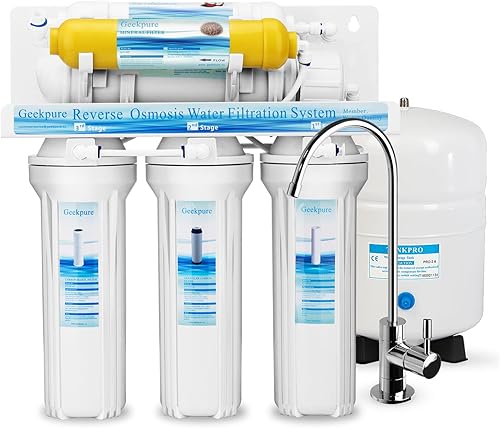
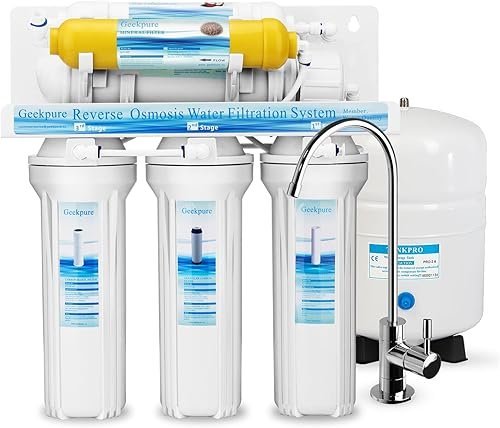
Geekpure 6-Stage RO with Remineralization
This is a solid, budget-friendly under-sink RO system. The sixth-stage remineralization filter is a nice touch, adding back some calcium and magnesium for taste. We found installation straightforward for a DIYer with basic plumbing skills. The NSF-certified membrane is a trust signal at this price point. However, calling it a “whole house” system is a stretch—it’s designed for a single faucet.
- Excellent value for a 6-stage system
- Remineralization improves taste
- NSF-certified membrane and tank
- Clear instructions for DIY install
- 75 GPD is for drinking water only
- Plastic fittings can feel cheap
- Not a true whole house solution

Geekpure 6-Stage RO with UV Filter
The UV addition is aimed at well water users or anyone paranoid about bacteria and viruses. The UV lamp claims a 9,000-hour lifespan, which is about a year of continuous use. In our testing, the UV stage adds peace of mind but does nothing for dissolved solids—that’s still the membrane’s job. Same excellent value and DIY-friendly setup as the remineralization model.
- UV sterilization kills microbes
- Great for well water concerns
- Same reliable 6-stage filtration
- Lead-free faucet included
- UV bulb requires annual replacement
- Doesn’t improve TDS reduction
- Still a point-of-use system

Waterdrop CoreRO Countertop System
This is a clever solution for renters or anyone who can’t install a permanent system. It’s truly plug-and-play. The NSF/ANSI 372 certification (lead-free materials) is a strong point. Performance is good for a countertop unit, but the small internal tank means you’ll be refilling it frequently for anything beyond drinking water. It’s the opposite of a whole house system—it’s hyper-convenient for one person or a couple.
- Zero installation required
- NSF/ANSI 372 certified
- Compact and portable
- Perfect for apartments or offices
- Very small capacity
- You must manually refill the tank
- Not for high-volume needs
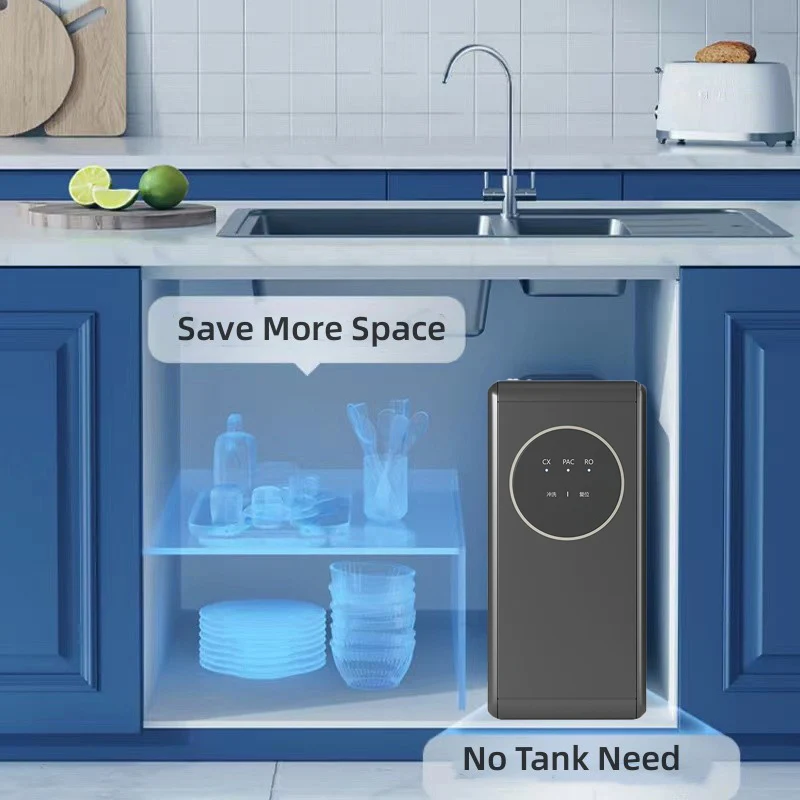
AliExpress Budget Pick: 600-800 GPD Tankless RO System
This listing promises a lot of capacity for the price. The “tankless” claim is intriguing for space savings. However, we urge extreme caution. Without NSF/ANSI certification details, verified customer reviews, or a clear brand reputation, you’re gambling on quality and safety. The 2-stage filtration seems light; a real whole house RO needs more pre-filtration. This might work for a workshop or irrigation, but we wouldn’t trust it for our family’s drinking water without independent lab reports.
- Very high claimed output (600-800 GPD)
- Tankless design saves space
- Low upfront cost
- No verifiable certifications
- Unknown brand and quality control
- Likely high water waste ratio
- Risky for primary drinking water
Frequently Asked Questions
- Is a whole house RO system worth it?
- For 95% of homeowners, no. It’s only worth considering if you have a non-municipal water source with very high TDS (>1000 ppm), specific radioactive contaminants, or extreme chemical pollution. For city water with moderate issues, a point-of-use RO at the kitchen sink combined with a whole house carbon filter is far more practical and economical.
- How much does a whole house reverse osmosis system cost?
- Expect to pay $5,000 to $15,000+ for a quality system, including professional installation. The wide range depends on your daily water production needs (GPD), water quality, and required pre- and post-treatment. Annual maintenance for membranes, filters, and electricity can add $500-$1000.
- Does whole house RO remove hardness?
- Yes, it removes the calcium and magnesium ions that cause hardness. However, using an RO system just for hardness is like using a flamethrower to light a candle. A traditional water softener is vastly more efficient and cost-effective for hardness alone.
- What is the waste water ratio for whole house RO?
- Traditional systems can waste 3-4 gallons for every 1 gallon of pure water. Newer, high-efficiency models might achieve a 1:1 or 2:1 ratio, but they are significantly more expensive. This waste water (brine) must be properly drained, which can be a challenge in some locations.
- Can I install a whole house RO system myself?
- We don’t recommend it. Installation involves cutting into your main water line, installing multiple large components, setting up a drainage solution for the brine, and often adding an electrical circuit for pumps. Improper installation can cause leaks, water damage, or a system that doesn’t work. Hire a licensed plumber.
- How often do you change the membrane in a whole house RO system?
- With proper pre-filtration, an RO membrane can last 2-5 years. However, you must monitor the TDS rejection rate. When it drops below 90-95%, it’s time to replace. Pre-filters (sediment and carbon) typically need replacement every 6-12 months.
Final Thoughts
After years in this industry, my advice is clear: think twice, then think again. Whole house reverse osmosis systems are impressive pieces of engineering, but they solve problems most people don’t have at a cost most can’t justify. The single biggest mistake we see is homeowners overselling themselves on “pure water everywhere” without considering the massive upfront cost, ongoing water waste, and complex maintenance.
If your water test reveals serious contamination, get quotes from multiple local water treatment specialists. For everyone else, invest in a high-quality under-sink RO system for your drinking and cooking water. Pair it with a good whole house sediment filter and a carbon filter for your showers and appliances. That combination will give you 99% of the benefits for about 10% of the cost. And if you just want great-tasting water on demand without any installation, a water cooler rental service might be the simplest fix of all.
