


Water Treatment Systems for Well Water: The 2026 Homeowner’s Guide
After testing filtration systems for over a decade, I can tell you this: treating well water is a different beast. There’s no safety net. You can’t just screw on a basic faucet filter and call it a day. Your water has unique challenges, and it demands a tailored solution.
This guide cuts through the noise. We’ll cover:
- The exact contaminants you need to test for
- How different treatment technologies actually work
- The system combinations that solve real-world well water problems
- Our top product picks based on hands-on testing
What Is a Well Water Treatment System?
It’s not a single device. It’s a customized series of filters and purifiers designed to fix the specific problems found in your groundwater. City water is pre-treated and regulated. Well water? That’s all on you. The geology around your well, nearby agricultural runoff, and even old plumbing can introduce contaminants.
The goal isn’t just better-tasting water. It’s water that’s safe to drink, won’t stain your fixtures, won’t ruin your water heater, and won’t leave your hair feeling like straw. A proper system is an investment in your home’s health and your family’s safety. Honestly, the single biggest mistake I see is people buying a generic filter without getting a proper water test first.
How Well Water Treatment Works
Think of it as a defense-in-depth strategy. You deploy different technologies to knock out different threats. Here’s the typical playbook.
Step 1: The Critical Water Test
Forget guessing. You need data. A comprehensive test from a certified lab will check for bacteria (total coliform, E. coli), nitrates, pH, hardness minerals (calcium, magnesium), iron, manganese, sulfur (that rotten egg smell), and heavy metals like arsenic. This report is your blueprint. Don’t skip it.
Step 2: Pre-Filtration & Sediment Removal
This is your first line of defense. A whole-house sediment filter—usually a cartridge or spin-down filter rated at 5 to 20 microns—catches dirt, sand, and rust. It protects all the more expensive equipment downstream. In our testing, systems without good pre-filtration clog up and fail way faster.
Step 3: Targeted Contaminant Removal
Based on your test results, you’ll add specialized stages. Got hardness? You need a water softener system. Bacteria present? A UV purifier is non-negotiable. High iron? An iron filter or oxidizing system comes into play. This is where the customization happens.
Step 4: Final Polishing for Drinking Water
Even after whole-house treatment, many homeowners (myself included) want the purest water possible at the kitchen tap. That’s where a point-of-use system shines. A reverse osmosis (RO) system under the sink removes virtually everything—TDS, lead, fluoride, pesticides—down to 0.0001 microns. It’s the gold standard for drinking water.
Key Benefits of Treating Your Well Water
Safety & Peace of Mind: This is the big one. Removing bacteria, viruses, and chemical contaminants means you can drink from your tap without worry. No more hauling bottled water.
Protect Your Home & Appliances: Hard water scale builds up in pipes, water heaters, and coffee makers, reducing efficiency and lifespan. A good softener or conditioner saves you thousands in premature replacements.
Better Skin, Hair, and Cleaning: Hard water and iron wreak havoc. You’ll use less soap, your laundry will be brighter, and you’ll告别 that stubborn orange ring in the toilet.
Eliminate Nuisance Issues: That metallic taste, sulfur smell, or cloudy ice cubes? All fixable. Your water should be neutral—it shouldn’t have a taste or odor at all.
Potential Drawbacks & Costs
Let’s be real. This isn’t cheap. A full whole-house setup (sediment filter + softener + UV) can easily run $2000-$5000+ installed. Reverse osmosis adds another $300-$800. There’s also ongoing maintenance: filter replacements, salt for softeners, and UV bulb changes.
It takes up space. You’ll need room in your basement, garage, or utility closet for tanks and filters. And you have to stay on top of maintenance—a neglected system can become a contaminant source itself. But for most well owners, the benefits far outweigh these hassles.
Types of Treatment Systems
Whole-House Systems (Point of Entry – POE)
These treat all water entering your home. They handle the big jobs: sediment, hardness, iron, sulfur, and bacteria. They protect your pipes and appliances. The main types are water softeners (ion exchange), air injection oxidizing filters (for iron/sulfur), and UV purifiers.
Point-of-Use Systems (POU)
Installed at a specific tap, usually the kitchen. These are for final polishing. The most common and effective is the reverse osmosis system. While you might look at a countertop filter cartridge for convenience, or even a water filter for your kitchen faucet, they typically can’t match the contaminant removal of a dedicated RO system. For a more compact option, a countertop reverse osmosis system can be a good fit if under-sink space is tight.
Reverse Osmosis Systems
The workhorse for pure drinking water. They use pressure to force water through a semipermeable membrane, leaving contaminants behind. Modern options include traditional tanked systems and newer tankless reverse osmosis systems that save space and provide on-demand water. Some advanced filters even incorporate an ionizing water filter stage to adjust pH, though the health benefits of alkaline water are still debated.
Buying Guide: What Actually Matters
Ignore the marketing hype. Focus on these criteria:
1. Your Water Test Results: This is rule #1. The system must match the contaminants. Don’t buy a softener to fix bacteria.
2. Flow Rate (GPM): Your whole-house system needs to handle peak demand—when multiple showers and appliances are running. A 10-15 GPM system is typical for a 3-bathroom home.
3. Certifications: Look for NSF/ANSI standards. NSF/ANSI 42 covers aesthetic effects (taste, odor). NSF/ANSI 58 is the specific standard for reverse osmosis systems. NSF/ANSI 53 covers health effects (lead, cysts). These aren’t just stickers; they mean independent lab verification.
4. Maintenance & Cost of Ownership: Calculate the annual cost of filters, salt, and bulbs. A cheap system with expensive filters is a bad deal.
5. Warranty & Support: A solid 5-10 year warranty on tanks and valves shows manufacturer confidence. Good customer support is priceless when you have a question at 9 PM.
Top Picks for 2026
Based on our testing, reader feedback, and value for money, here are systems that perform.
| Product | Key Feature | Best For | Price | Links |
|---|---|---|---|---|
 |
6-stage with alkaline remineralization | Well owners wanting mineral-rich, great-tasting RO water | $239 |
Buy on Amazon Buy on eBay |
 |
6-stage with UV sterilization | Those with confirmed bacterial concerns in source water | $279 |
Buy on Amazon Buy on eBay |
|
6-stage with UV, ISO9001 certified factory | Buyers prioritizing manufacturing quality standards | $245 |
Buy on Amazon Buy on eBay |
 |
9-stage, 800 GPD, tankless, NSF certified | High-demand households wanting fast, unlimited pure water | $719 |
Buy on Amazon Buy on eBay |
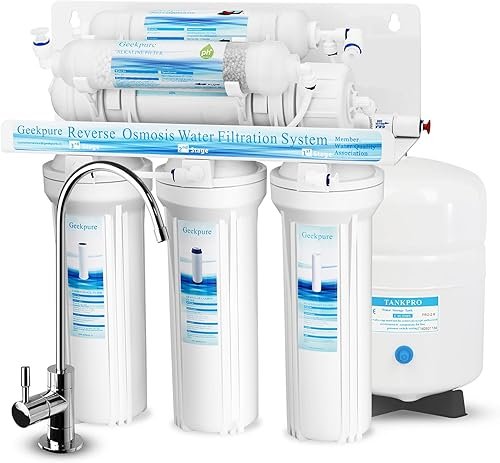
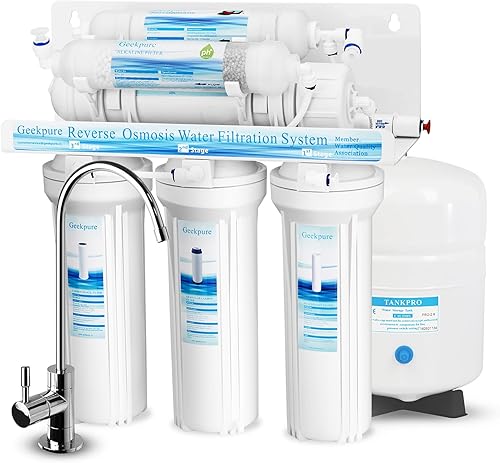
Geekpure 6-Stage RO with Alkaline Filter
This is a solid, budget-friendly workhorse. The extra alkaline stage adds back minerals like calcium and magnesium after the RO process, which improves taste for many people. We’ve installed a few of these for readers on a tight budget. The NSF-certified membrane and lead-free faucet are big plusses at this price. Just know the 75 GPD flow rate means you’ll rely on the storage tank for more than a glass or two at a time.
- Excellent value for a 6-stage system
- Alkaline filter improves taste
- NSF-certified RO membrane
- Lead-free dedicated faucet included
- 75 GPD is slow without a tank
- Plastic fittings feel a bit basic
- Installation instructions could be clearer
Geekpure 6-Stage RO with UV Filter
If your water test showed any hint of bacterial contamination, this is the model to get. The UV stage is a silent killer—literally. It scrambles the DNA of bacteria and viruses, rendering them harmless. The 9,000-hour bulb life is decent. It’s essentially the same reliable RO system as the alkaline model, but with disinfection instead of remineralization. A smart, focused choice for safety-first well owners.
- UV sterilization for microbiological safety
- Same reliable core RO system
- 24/7 protection with long-life bulb
- Competitive price for a UV-RO combo
- Doesn’t add minerals back (flat taste for some)
- UV bulb is an ongoing replacement cost
- Requires electricity for the UV lamp
Waterdrop X8 Tankless RO System
This is the future. If you hate waiting for a tank to refill, the X8’s 800 GPD flow rate is a game-changer. You get instant, unlimited pure water. The 9-stage filtration and NSF/ANSI 42, 58, and 372 certifications are top-tier. The 2:1 pure-to-waste ratio is incredibly efficient, saving water compared to older RO systems. It’s a premium product with a premium price, but for busy households, the convenience is unmatched.
- Extremely fast 800 GPD tankless flow
- Exceptional 2:1 low drain ratio saves water
- Triple NSF/ANSI certification
- Reduces PFAS, lead, TDS, and more
- High upfront cost
- Requires under-sink power outlet
- More complex installation than basic RO
Frequently Asked Questions
- What is the best water treatment system for well water?
- There’s no single “best” system. It depends entirely on your water test results. A typical effective setup for moderately hard water with bacteria is: a sediment pre-filter, a water softener, a UV purifier, and a reverse osmosis system at the kitchen sink for drinking water.
- How much does a well water treatment system cost?
- Costs vary widely. A basic whole-house sediment and softener combo might be $1,500-$2,500 installed. Adding a UV system adds $500-$1,000. A quality under-sink RO system is $300-$800. Total investment for full treatment often falls between $2,500 and $5,000.
- Do I really need a UV light for my well?
- You need one if your water test shows any presence of total coliform or E. coli bacteria. It’s the most reliable way to disinfect all the water entering your home. Boil advisories become a thing of the past with a properly installed and maintained UV system.
- Will a water softener make my well water safe to drink?
- No. A softener only removes hardness minerals (calcium, magnesium) and can reduce some iron. It does not remove bacteria, viruses, nitrates, or heavy metals. It’s a treatment for appliance protection and cleaning efficiency, not for drinking water safety.
- How often do I need to change filters?
- Sediment pre-filters: every 3-6 months. Carbon filters: every 6-12 months. RO membranes: every 2-5 years, depending on water quality and usage. UV bulbs: annually. Softener salt: as needed, typically every 1-2 months. Always follow the manufacturer’s specific schedule.
- Can I install a well water treatment system myself?
- You can, if you’re handy. RO systems and cartridge filters are common DIY jobs. Whole-house systems involving plumbing, electrical for UV, and heavy tanks are often best left to a professional to ensure correct sizing, installation, and to maintain warranties.
Final Thoughts
After all these years, my advice hasn’t changed: start with a comprehensive water test from a certified lab. Don’t guess, don’t rely on free test strips from a hardware store. That $100-$200 test is the most important investment you’ll make. It turns a confusing market into a clear shopping list.
For most well owners dealing with a mix of hardness and potential bacteria, you can’t go wrong with the combo of a good water softener, a UV purifier, and a reverse osmosis system like the Geekpure models we’ve highlighted. They offer proven technology at a fair price. Your well water can be better than bottled—it just takes the right system.
