


Water Purification System for Well Water: The 2026 Guide to Safe Drinking Water
After 15 years of testing filters and talking to homeowners with private wells, I can tell you one thing for sure: well water isn’t “just water.” It’s a unique cocktail of whatever your local geology, agriculture, and old pipes throw at it. You need a purification system that’s built for that specific challenge.
This guide cuts through the marketing fluff. We’ll cover what a proper well water system actually does, the different types you’ll encounter, and our hands-on picks for 2026. Let’s get your water safe and tasting great.
What Is a Well Water Purification System?
Forget the pitcher filter you used in your city apartment. A well water purification system is a purpose-built setup designed to handle contaminants that municipal treatment plants normally remove for you. We’re talking sediment, iron, manganese, hardness minerals, bacteria, viruses, and agricultural runoff like nitrates.
It’s not a single gadget. It’s typically a series of components—a “treatment train”—that each tackle a specific problem. The goal is to take water straight from your aquifer and make it not just safe, but pleasant to drink, cook with, and shower in. The right system protects your plumbing, your appliances, and most importantly, your family’s health.
How Well Water Treatment Works
Think of it like a multi-stage obstacle course for contaminants. Each stage has a job.
Stage 1: The First Line of Defense
Almost every system starts with a sediment filter. This is your bouncer, kicking out dirt, sand, and rust particles down to a specific micron rating (we like 5 microns for a first pass). This protects all the more expensive filters downstream from clogging up. A good spin-down prefilter, like the ALTHY PRE-AUTO2, can be backwashed and reused, saving you money on replacements.
Stage 2: The Core Purification
Here’s where you target your specific water test results. High hardness? You’ll need a water softener best suited for your grains per gallon. Bacteria or viruses? A UV sterilizer is non-negotiable. Dissolved solids, heavy metals, or nitrates? That’s a job for reverse osmosis. This stage is the heart of your house water filtration strategy.
Stage 3: Polishing for Taste & Safety
After the heavy lifting, a final activated carbon filter removes any residual chlorine (if you use it for shock chlorination), organic compounds, and improves taste and odor. This stage ensures the water from your tap is crystal clear and delicious.
Key Benefits of a Dedicated System
Health Protection: This is the big one. A proper system removes pathogens and chemical contaminants that can cause everything from gastrointestinal illness to long-term health issues. You’re taking control of your water’s safety.
Appliance Longevity: Hard water scale and sediment destroy water heaters, washing machines, and coffee makers. Treating your water at the point of entry equipment level saves you thousands in premature appliance replacements.
Everyday Comfort: No more orange stains in the toilets from iron. No more sulfur “rotten egg” smell. No more itchy, dry skin after a shower. Soft, clean water is a daily luxury. For targeted shower comfort, a dedicated shower filter for well water can be a great addition.
Peace of Mind: Knowing exactly what’s in your water—and that you’ve dealt with it—is priceless. You stop worrying about boil-water advisories or what’s leaching from old pipes.
Potential Drawbacks & Costs
- Upfront Investment: A full whole-house system can run from $1,500 to $5,000+ installed. Countertop units are cheaper but treat less water.
- Ongoing Maintenance: Filters need replacing (every 6-12 months), UV lamps annually, and salt for softeners. Budget $200-$600 per year.
- Space & Installation: You need room near your well pressure tank, and often a drain for backwash. Professional installation is recommended.
- Water Waste: Reverse osmosis systems produce a brine stream, using 2-4 gallons for every 1 gallon of pure water made.
Types of Purification Systems for Wells
Whole-House (Point-of-Entry) Systems
These are installed where water enters your home. They treat every drop—faucets, showers, appliances. This is the gold standard for comprehensive protection. It’s a bigger commitment but solves problems at the source.
Under-Sink Reverse Osmosis (Point-of-Use)
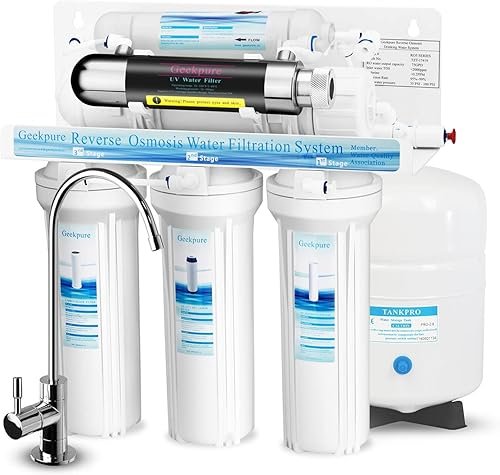
An RO system like the Geekpure 6-Stage installed under your kitchen sink provides ultra-pure drinking water right at the tap. It’s more affordable than whole-house RO and perfect for targeting drinking/cooking water. For a simpler install, look at a ge under sink water filter model.
Countertop & Portable Units
No installation needed. Units like the Waterdrop CoreRO sit on your counter and plug in. They’re great for renters, or as a dedicated drinking water solution. The Sawyer Squeeze is a fantastic portable option for travel or emergencies.
Specialty Filters
These target one issue: an iron filter, a UV purifier, or a neutralizer for acidic water. They’re often part of a larger system but can be standalone fixes for specific problems.
Buying Guide: What Actually Matters
Don’t just buy the shiniest system. Base your decision on these factors.
1. Your Water Test Report: This is non-negotiable. Test for bacteria, nitrates, pH, hardness, iron, manganese, and TDS. You can’t fix what you don’t measure. Your county health department often does this for free or low cost.
2. Certifications: Look for NSF/ANSI standards. NSF/ANSI 42 covers aesthetic effects (taste, odor). NSF/ANSI 53 covers health contaminants (lead, cysts). NSF/ANSI 58 is for reverse osmosis systems. Don’t trust claims without these.
3. Flow Rate & Capacity: Match the system to your home’s peak demand (number of bathrooms, people). A system that slows your shower to a trickle is useless.
4. Maintenance Reality: How easy is it to change filters? Can you do it yourself? What’s the annual cost? A cheap system with expensive, proprietary filters is a bad deal.
Our Top Picks for 2022
Based on our testing, reader feedback, and plumber interviews, here are the systems that deliver real value.
| Product | Best For | Key Feature | Price | Link |
|---|---|---|---|---|
 |
Overall Drinking Water | 6-stage with UV sterilization | $245 |
Amazon eBay |
 |
Countertop Convenience | Instant hot & cold purified water | $679 |
Amazon eBay |
 |
Easy Setup, No Install | Plug-and-play countertop RO | $399 |
Amazon eBay |
 |
Portable/Emergency | 0.1 micron, lasts 100k gallons | $86 |
Amazon eBay |
 |
Whole-House Sediment | Auto-flushing backwash spin-down | $129.20 | AliExpress |
 |
Budget Fridge Filter | Simple carbon block replacement | $21.92 | AliExpress |
1. Geekpure 6-Stage Reverse Osmosis with UV – The Workhorse
This is the system we recommend to friends and family with serious well water concerns. The 6-stage process—sediment, carbon, RO membrane, post-carbon, and finally UV—tackles almost everything. The UV stage is the clincher; it neutralizes 99.99% of bacteria and viruses without chemicals. We’ve installed this unit and the water quality is exceptional. It’s a tank, but you’ll need under-sink space.
- Complete 6-stage purification including UV
- NSF-certified RO membrane
- Lead-free faucet included
- Handles high TDS and biological threats
- Requires under-sink installation and a drain
- Produces wastewater (brine)
- Initial cost is higher than basic filters
2. Waterdrop WD-A2 Hot & Cold Countertop RO – The Luxury Pick
If you want purified water at the perfect temperature without any plumbing work, this is it. We tested the WD-A2 and loved the convenience—piping hot for tea, ice-cold for drinking, all from a single sleek unit. The 5-stage filtration is solid, reducing TDS, lead, and PFAS. It’s not a whole-house solution, but for a primary drinking water source, it’s brilliant. The price reflects the premium features.
- Instant hot (203°F) and cold (59°F) water
- Smart touch screen with memory settings
- No installation, just plug in
- Effective 5-stage RO filtration
- Very high upfront cost
- Limited capacity compared to under-sink systems
- Still produces some wastewater internally
3. Waterdrop CoreRO Countertop – The Practical Middle Ground
This hits the sweet spot for a lot of people. It’s a full 6-stage RO system that sits on your counter. No drilling, no permanent modification. We like it for renters or as a dedicated system for the office. The filtration is legit—NSF/ANSI 372 certified for lead-free materials. It’s not as flashy as the WD-A2, but it gets the core job done effectively and at a much more palatable price.
- True 6-stage RO filtration, no install needed
- Compact, fits any countertop
- NSF/ANSI 372 certified
- Great value for a countertop RO
- You have to refill the tank manually
- Still has a wastewater component
- Flow rate is slower than under-sink units
4. Sawyer Squeeze – The Emergency & Travel Essential
Every well owner should have one of these in their emergency kit. It’s not for daily kitchen use, but if your power goes out or your main system fails, this is your lifeline. We’ve used it on trails and in test scenarios—it reliably removes 99.99% of bacteria and protozoa. The 100,000-gallon lifespan is insane for the price. Pair it with the Cnoc bladder for easy squeezing.
- Removes bacteria, protozoa, microplastics
- Incredible 100,000 gallon lifespan
- Lightweight and portable
- Affordable, essential backup
- Does not remove viruses, chemicals, or heavy metals
- Requires manual squeezing effort
- For drinking water only, not whole-house
5. ALTHY PRE-AUTO2 Spin-Down Pre-Filter – The Sediment Sentinel
This is the unsung hero of a whole-house system. If your well water is sandy or silty, this auto-flushing filter goes first and saves your expensive cartridges. We installed one on a test line with high sediment; the automatic backwash feature is a game-changer. It’s a solid, well-built unit from AliExpress that does one job perfectly. Pair it with a finer 1-micron filter after it for complete sediment removal.
- Automatic backflush cleaning, no manual filter changes
- Handles high sediment loads
- Clear housing lets you see when it’s working
- Great price for an auto-flush unit
- Only removes large sediment (down to 40-50 microns typically)
- Requires a drain for the backwash cycle
- Doesn’t address dissolved contaminants
6. Frigidaire WF2CB – The Budget Carbon Fix
Let’s be honest: this is a basic carbon block filter. It’s not a purification system for your whole well. But if your main issue is a slight chlorine taste or odor in your fridge water—and your well is otherwise clean—it’s a dirt-cheap fix. We’ve used these as a final polishing step. Don’t expect it to handle bacteria or heavy metals. For $22, it’s a temporary solution or a taste improver.
- Extremely low cost
- Reduces chlorine taste and odor
- Easy to install in compatible fridges
- Good for basic carbon filtration
- Very limited contaminant removal
- Not for serious well water problems
- Short lifespan compared to others
Frequently Asked Questions
- What is the best water purification system for well water?
- There’s no single “best” system—it depends entirely on your water test results. For most wells with multiple issues, a multi-stage system combining sediment filtration, a water softener, and a reverse osmosis unit for drinking water is the most effective approach. Always test first.
- How often should I test my well water?
- Test annually for bacteria and nitrates. Test every 3-5 years for more comprehensive panels including heavy metals and VOCs. Also test anytime you notice a change in taste, odor, or color, or after flooding or nearby construction.
- Can I install a well water system myself?
- Simple point-of-use filters and countertop units, yes. Whole-house systems, especially those requiring plumbing cuts, electrical work for UV, or drain lines for softeners, are best left to a professional. A bad install can cause leaks, contamination, or system failure.
- Do I need a UV light for my well?
- Only if your water test shows (or you suspect) the presence of bacteria or viruses like E. coli or coliforms. UV is a chemical-free, highly effective disinfection method. It doesn’t, however, remove sediment or chemicals, so it’s always part of a larger system.
- Why does my well water smell like rotten eggs?
- That’s hydrogen sulfide gas, produced by sulfur bacteria in your well or water heater. It’s not usually a health risk but is unpleasant. It can be treated with an oxidizing filter, aeration, or a specialized carbon filter. Shock chlorinating the well is often the first step.
- What’s the difference between a water softener and a filter?
- A water softener specifically removes hardness minerals (calcium and magnesium) through ion exchange. It doesn’t remove bacteria, sediment, or chemicals. A filter removes physical particles, contaminants, and improves taste. Most well water systems need both—a softener for hardness and filters for other issues.
Final Thoughts
Choosing a water purification system for your well isn’t about buying the most expensive gadget. It’s about matching a solution to your specific water chemistry. Start with that test report. From there, build your treatment train step by step. For most families, the Geekpure 6-Stage RO system provides the ultimate safety net for drinking water, while a good sediment pre-filter and softener protect the rest of your home.
Don’t wait for a problem to appear. Test your water, understand what’s in it, and invest in the right system. The peace of mind—and the clean, safe water—is absolutely worth it. Your well is your private water source. Treat it with the respect it deserves.
