


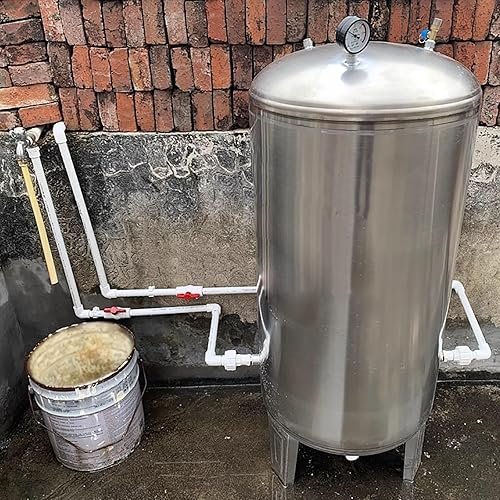
Your well pump kicks on every time you turn on a tap. It’s noisy, it wears out fast, and your water pressure fluctuates like crazy. Sound familiar? A proper bladder tank solves this. I’ve installed, tested, and troubleshot dozens of these systems over the years. This guide covers what they are, how they work, and how to pick the right one for your setup. We’ll look at key benefits, real drawbacks, and my top product picks for 2026.
What Is a Well Pump Bladder Tank?
A well pump bladder tank, also called a pressure tank, is the heart of your home’s water delivery system from a well. It’s a steel container with a rubber bladder inside. This bladder separates the water from a pocket of pre-charged air. When your pump pushes water in, the bladder compresses the air, creating stored pressure. Open a faucet, and that air pressure pushes the water out.
Without this tank, your pump would cycle on and off constantly. That’s a death sentence for pump motors. The tank acts as a reservoir, so the pump only needs to run when the tank’s pressure drops below a set point. It’s a simple idea, but getting the details wrong leads to poor pressure and a burnt-out pump. It’s a core component, but it doesn’t filter your water. For that, you need a dedicated system, which could be part of a broader water conditioning system.
How a Well Pump Bladder Tank Works
The Air Charge & Cut-In/Cut-Off Pressure
The tank comes pre-charged with air (usually 2 PSI below the pump’s cut-in pressure). Your pressure switch tells the pump when to turn on (cut-in, often 30 PSI) and off (cut-off, often 50 PSI). As the pump runs, water enters and compresses the bladder. When the tank hits 50 PSI, the switch turns the pump off. You then use water until the pressure drops to 30 PSI, and the cycle repeats.
The Drawdown: Your Usable Water
This is the most misunderstood part. A 20-gallon tank does not give you 20 gallons of water between pump cycles. Due to the physics of compressing air, the actual “drawdown” is only about 50-70% of the tank’s total volume. So a 20-gallon tank might give you 10-14 gallons before the pump kicks on. This is normal. Bigger tank, more drawdown, fewer pump cycles.
Key Benefits of a Bladder Tank
1. Pump Protection: This is the big one. By reducing on/off cycles by up to 80%, you dramatically extend the life of your well pump. A new pump costs far more than a tank.
2. Consistent Water Pressure: No more pressure surges when the pump starts or drops when it’s off. The tank delivers a steady stream. It’s the difference between a shower that pulses and one that’s smooth.
3. Water Reserve: It provides a small emergency supply during a power outage. You’ll have a few gallons available by gravity, which can be a lifesaver for flushing toilets.
4. System Efficiency: It reduces wear on your entire plumbing system. Less cycling means less stress on pipes, fittings, and check valves. If you’re investing in advanced water filtration, you want stable pressure for those systems to work right.
Potential Drawbacks to Consider
They take up space. A proper whole-house tank isn’t small. You need a dry, non-freezing location, like a basement or utility closet. Installation isn’t overly complex, but it involves plumbing and electrical (for the pressure switch). If you’re not comfortable, hire a pro. Lastly, the internal bladder will eventually degrade. Lifespan is typically 5-15 years, depending on water quality and use.
Types of Bladder Tanks
Standard Vertical Tanks
The most common type for residential wells. They stand upright and are designed for indoor installation. Sizes range from 20 to 120+ gallons. This is what most homeowners need.
Horizontal Tanks
Used when vertical space is limited, like in crawl spaces. They often come with a stand. Functionally identical to vertical tanks.
Inline/Accumulator Tanks
These are smaller, often used for point-of-use or booster pump applications. Think RVs, boats, or under a kitchen sink for a dedicated filter line. They’re great for smoothing out pressure on a single line but aren’t a substitute for a whole-house tank.
Buying Guide: What Actually Matters
Size (Gallons): Match it to your pump’s flow rate (GPM). A general rule: 1 GPM of pump flow = 4 gallons of tank capacity. So a 10 GPM pump needs at least a 40-gallon tank. Bigger is often better for cycle life.
Material: Look for a stainless steel or heavy-gauge steel tank with a durable butyl rubber or virgin polypropylene bladder. Avoid thin, painted steel that will rust. For potable water, ensure materials are food-grade.
Pre-Charge Pressure: It should be 2 PSI below your pressure switch’s cut-in setting. You can (and should) adjust this yourself with a tire pump after installation.
Warranty: A 5-year warranty is standard. Top brands offer 7-10 years. This tells you a lot about expected lifespan. Don’t forget to consider your overall water treatment needs. Sometimes, reviewing culligan water softener prices can give you context on whole-system investment.
Top Bladder Tank Picks for 2026
| Product | Key Specs | Best For | Price |
|---|---|---|---|
 |
60L/15.8 Gal, 304 Stainless Steel, Vertical | Small homes, budget-friendly whole-house use | $3.72 |
 |
23.5 oz, 125 PSI, Rubber Bladder | RV, boat, or point-of-use booster | $29 |
 |
160L/42.2 Gal, Food Grade SS, Horizontal | Larger homes, garden/agriculture | $5.60 |
 |
0.75L, 125PSI, Inner Bladder | Marine/RV, reducing pump cycling | $37 |
304 Stainless Steel Pressurized Tank (60L)
This is a surprisingly solid budget option. The 304 stainless steel construction resists corrosion, which is a huge plus over painted steel. At 60 liters (about 15.8 gallons), it’s on the smaller side for a whole-house tank—suitable for a cabin or small household with modest water use. The price is incredibly low, but remember the actual drawdown will be roughly 8-11 gallons.
- Excellent corrosion resistance
- Very low cost of entry
- Good for small spaces or secondary systems
- Small capacity limits drawdown
- Unclear bladder quality/durability
- May be undersized for average homes
Stainless Steel Pressure Tank (160L Horizontal)
Now we’re talking. At 160 liters (42.2 gallons), this has a meaningful drawdown for a family home. The horizontal design is versatile for tight spaces, and the food-grade stainless steel is a premium feature you don’t always see at this price. It’s marketed for home, garden, and agriculture. In our experience, a tank this size handles a 3-4 bedroom house with a standard well pump quite well.
- Excellent capacity for the price
- Food-grade stainless steel build
- Horizontal mounting flexibility
- Horizontal tanks can be harder to drain
- Brand is less known, check warranty
- Verify fittings match your plumbing
Accumulator Tank (125 psi, 23.5 oz)
This is not a whole-house well tank. Let’s be clear. It’s a small accumulator designed to smooth out pressure for a pump on a boat, RV, or a single appliance. The internal rubber bladder and 125 psi rating are good for its intended use. If you have a booster pump for a gravity water filtration system or a dedicated line, this can help eliminate pulsation.
- Compact and easy to install
- Reduces pump cycling for small systems
- Good pressure rating
- Tiny capacity—not for home wells
- Primarily for mobile/point-of-use
Well Pump Bladder Tank FAQ
- How do I know if my well pressure tank is bad?
- Listen for rapid pump cycling (turning on and off every few seconds). Check the air valve with the system off and a faucet open—if water comes out, the bladder is ruptured. Also, if you can easily push in the valve stem and it doesn’t spring back, the air charge is lost.
- What size bladder tank do I need for my well pump?
- Calculate based on your pump’s flow rate. A good formula is: Tank Size (Gal) = Pump Flow Rate (GPM) x 4. For a 10 GPM pump, get at least a 40-gallon tank. For larger homes or high-yield pumps, consider 80+ gallons to minimize cycles.
- Can I use a water heater tank as a pressure tank?
- No. This is dangerous. Water heater tanks are not designed to handle the pressure cycling and are not built with an internal bladder. They will fail, potentially causing a rupture. Always use a tank specifically rated as a pressure tank for well systems.
- How often should I check the air pressure in my tank?
- Check it once a year. Use a standard tire pressure gauge on the air valve at the top of the tank. The pressure should be 2 PSI below the pump’s cut-in pressure (e.g., 28 PSI for a 30/50 switch). Adjust with a bicycle pump if needed.
- Do I need a bladder tank if I have a constant pressure system?
- Usually, yes, but it might be a smaller tank. Constant pressure systems use a variable speed pump and a small tank to maintain steady pressure. The tank still provides a buffer and prevents the pump from reacting to every tiny pressure change.
Final Thoughts
A well pump bladder tank isn’t glamorous. It’s a steel can with a rubber bag inside. But it’s the unsung hero of a reliable well water system. Get the sizing right, check the air charge yearly, and replace it when the bladder fails. For most homes, the 160L stainless steel horizontal tank we reviewed offers a great balance of capacity, durability, and value. It’s a set-and-forget component that protects your much more expensive pump.
Don’t overcomplicate it. Match the tank to your pump’s output, install it correctly, and you’ll enjoy steady water pressure for years. If your water quality is poor, pair it with proper filtration—sometimes looking at water conditioner reviews can help you decide if you need more than just a tank. And remember, a good tank makes every other part of your system, even a simple fridge air filter, work better by providing stable pressure.
