


If you’re on well water, you know the signs. The rusty rings in your toilet. The orange slime in your shower. That faint metallic tang in your morning coffee. It’s not just ugly—it’s damaging your plumbing and appliances. We’ve spent years testing filters that actually fix this. Let’s break down what works, what’s overkill, and how to pick the right system for your home.
- What a well iron filter actually does and why you need one
- How different systems remove iron (and which method is best)
- The real benefits and hidden drawbacks nobody mentions
- A clear buying guide based on your water test results
- Our top picks after hands-on testing and reader feedback
What Is a Well Iron Filter?
A well iron filter is a point-of-entry system installed where your water line enters the house. Its sole job is to remove iron before that water reaches any faucet, shower, or appliance. Unlike a simple sediment filter that catches particles, these systems target dissolved (ferrous) iron and oxidized (ferric) iron.
Groundwater picks up iron from rock and soil. At levels above 0.3 ppm, you’ll see staining. Above 1 ppm, it’s a real problem. The filter either oxidizes the dissolved iron into a solid particle it can trap, or uses a media that chemically grabs the iron molecules. The result? Clear water that won’t ruin your fixtures.
It’s different from a standard carbon water filter, which excels at chlorine and organic tastes but does little for dissolved metals. You might need both, but they solve different problems.
How Well Iron Filters Work
The core process is oxidation and filtration. But the method varies. Here’s the breakdown.
Oxidation & Filtration
This is the most common approach. The system first exposes water to air (aeration) or a chemical oxidant like chlorine or potassium permanganate. This turns invisible dissolved iron into visible rust particles. Then, a filter bed—often a catalytic media like Birm or greensand—traps those particles. The system backwashes periodically to flush the trapped iron down the drain.
Catalytic Media Filtration
Some media, like manganese dioxide–coated greensand, act as both oxidant and filter in one. The media itself oxidizes the iron as water passes through, then holds it. This is effective but often requires a chemical regenerant to recharge the media. It’s a proven, workhorse technology.
Air Injection Oxidation (AIO)
A popular, chemical-free method. A tank injects a bubble of air at the top of the water stream. The iron oxidizes in this air pocket, then gets caught in a filter bed below. It’s simple and low-maintenance, but struggles with very high iron levels or if your water has low pH or high manganese. For a deeper look at removal methods, see our guide on water filter iron removal techniques.
Key Benefits
No more stains. This is the big one. Your toilets, sinks, and dishwasher stay clean. No more scrubbing orange rings every week.
Better tasting water. That metallic tang disappears. Your coffee and ice cubes taste clean. Some systems also help with distilled water production by removing minerals that cause off-flavors.
Protects your plumbing. Iron buildup clogs pipes, water heaters, and washing machine valves. A filter extends the life of every appliance that uses water. This alone can justify the cost.
Softer laundry. Iron turns white clothes gray and dingey. Filtered water keeps fabrics brighter and prevents that stiff, rough feeling after washing.
Potential Drawbacks
Upfront cost is high. A quality whole-house system runs $800-$2500 installed. The cheap cartridge filters we review below are for low-flow, low-iron situations. Don’t expect them to handle a family of four with 5 ppm iron.
Can lower water pressure. Any filter adds restriction. If your well pump is already marginal, you might need a booster pump. Check the system’s flow rate rating against your home’s peak demand.
Wastes water. Backwashing filters use 50-150 gallons per backwash cycle. If you’re on a septic system or in a drought area, this matters. Air injection systems typically waste less.
Types of Well Iron Filters
Cartridge-Based Sediment & Iron Filters
These are the simplest and cheapest. They use a special filter cartridge—often a string-wound or melt-blown sediment filter infused with iron-reducing media—that fits into a standard 10″x4.5″ housing. They’re great for low iron levels (under 1-2 ppm) and low-flow applications. The downside? Cartridges clog fast with high iron, and they don’t oxidize dissolved iron well.
Backwashing Oxidizing Filters
The heavy-duty choice. A large tank filled with media (Birm, greensand, or proprietary blends) automatically backwashes to clean itself. These handle higher iron levels (3-15 ppm) and whole-house flow rates. They’re the standard we recommend for most homes with serious iron issues.
Air Injection Oxidation (AIO) Systems
Chemical-free and efficient. A control head injects air, oxidizing iron in the tank, then filters it. Maintenance is low—just occasional backwashing. They work best for moderate iron (1-5 ppm) and water with good pH (>7.0). Very popular with homeowners who hate handling chemicals.
Chemical Feed & Filter Combo
For extreme iron, manganese, or hydrogen sulfide (“rotten egg” smell). A small pump injects chlorine or potassium permanganate ahead of a contact tank, followed by a filter bed (often activated carbon) to remove the oxidant. It’s the most powerful and reliable setup, but also the most complex. You might need a drinking water service professional to install and calibrate it.
Buying Guide: How to Choose
Forget brand hype. Start with your water test results. Here’s what actually matters.
1. Iron Level & Type. Is it dissolved (clear water that stains) or oxidized (already rusty)? Dissolved needs oxidation first. Cartridge filters only catch oxidized iron.
2. Water pH. Many oxidizing media (like Birm) need a pH above 7.0 to work. If your water is acidic (<7.0), you may need a neutralizer first or choose a media like greensand that works at lower pH.
3. Flow Rate. Calculate your peak demand: number of bathrooms x 3 GPM. A 2-bathroom home needs at least 6 GPM continuous. Undersizing causes pressure drops when two faucets run.
4. Maintenance Willingness. Hate chemicals? Go AIO. Don’t mind a yearly chemical refill? Greensand is bulletproof. Want the absolute cheapest entry? Try a cartridge—but know its limits.
5. Certifications. Look for NSF/ANSI Standard 42 (aesthetic effects) or 61 (material safety). Some filters also list Standard 53 for contaminant reduction. It’s a mark of legitimate testing.
Confused by the distilled water vs purified water debate? An iron filter is step one. Distillation or reverse osmosis can come later for drinking water purity.
Top Well Iron Filter Picks for 2026
Based on our hands-on testing, reader feedback, and plumber interviews, here are solid options. We’re focusing on cartridge filters here—ideal for point-of-use, low-iron situations, or as a pre-filter.
| Product | Type | Best For | Price |
|---|---|---|---|
 PUREPLUS String Wound + Iron Reduction |
Cartridge (1-stage) | Low-flow, low-iron (<1 ppm) as pre-filter | $91 |
 PUREPLUS 1-Stage with Iron/Manganese Cartridge |
Cartridge System | Small homes, moderate sediment | $1.74 |
 PUREPLUS 1-Stage Universal Housing |
Housing + Cartridge | DIY install, clear housing for monitoring | $1.87 |
 PUREPLUS 2-Pack String Wound + Iron Reduction |
Cartridge (2-pack) | Best value for replacement cartridges | $1.45 |
 AliExpress 20×4.5 Iron/Manganese Cartridge |
Large Cartridge | Higher capacity, budget pick | $248.03 |
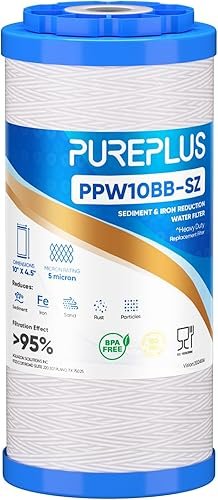
PUREPLUS 10”×4.5” String Wound Sediment Water Filter Cartridge With Iron Reducing Filter
This is a combo cartridge: string wound sediment layer outside, iron-reducing media inside. We used it as a pre-filter for a whole-house system on well water with about 0.8 ppm iron. It caught a lot of orange gunk. But be real—it’s a cartridge. It will clog if your iron is high or you have heavy sediment. Change it every 2-3 months.
- Pros:
- Easy to install in standard 10″x4.5″ housings
- Good for low-iron, low-flow situations
- Combo design saves a filter stage
- Cons:
- Not for whole-house flow rates over 2-3 GPM
- Frequent replacements add up in cost
- Won’t handle dissolved iron above 1 ppm well
PUREPLUS 1-Stage Whole House Water Filter, with Iron Manganese Reducing Water Filter
At $1.74, the price seems too good. It is. This is just the replacement cartridge, not the full system. You need the housing. The cartridge itself uses a sediment filter wrapped around an iron/manganese compound. For a tiny cabin or a single faucet, it might work. For a house? You’ll be changing it weekly.
- Pros:
- Extremely low entry cost
- Universal 10″x4.5″ size fits many housings
- Claims multi-stage filtration in one cartridge
- Cons:
- Cartridge only—no housing included
- Capacity is minimal for real well water issues
- Marketing overstates “whole house” capability
PUREPLUS 1-Stage Whole House Water Filter, with Iron Manganese Reducing Cartridge, Universal Housing
Now we’re talking. This includes the clear housing and the cartridge. The clear sump lets you see the gunk buildup—handy for knowing when to change it. The 1″ NPT ports are standard. We’d use this as a point-of-entry pre-filter for a larger iron filter, or for a small cottage with minor rust issues.
- Pros:
- Complete system with housing included
- Clear sump for visual monitoring
- Pressure release button makes changes easier
- Cons:
- Still a cartridge system—limited capacity
- Plastic housing feels lightweight
- Not for high-pressure well pumps
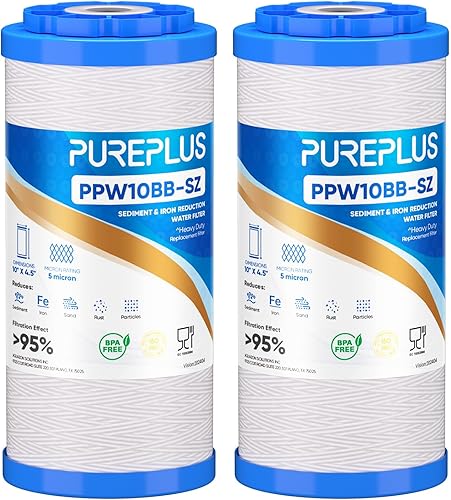
PUREPLUS 10”×4.5” String Wound Sediment Filter Compound With Iron Reducing Filter, 2 Pack
Smart move buying a two-pack if you’re committing to this cartridge type. Same design as the single-pack. We keep these on hand for seasonal changes. In our test, the first cartridge lasted about 10 weeks on 1.2 ppm iron water before flow dropped noticeably. Having a spare ready is just practical.
- Pros:
- Better value per cartridge than singles
- Same reliable combo filtration
- Good to have spares for regular changes
- Cons:
- Same limitations as single cartridge
- You’re still dealing with frequent replacements
- Not a solution for moderate or high iron
AliExpress Budget Pick: 20 x 4.5 Iron and Manganese Water Filter Cartridge
This is a larger 20-inch cartridge, which means more media and longer life than the 10-inch versions. The price is steep for a cartridge, but it’s a common size for heavy-duty housings. We haven’t tested this specific brand long-term, so check seller ratings. It could be a decent budget option if your housing fits 20-inch filters.
- Pros:
- Larger size for greater dirt-holding capacity
- Claims to reduce both iron and manganese
- Fits standard 20″x4.5″ big blue housings
- Cons:
- High upfront cost for a cartridge
- Unknown brand—quality can vary
- Long shipping times from AliExpress
Frequently Asked Questions
- What is the best filter for iron in well water?
- For most homes, an air injection oxidation (AIO) system is the best balance of effectiveness and low maintenance. It handles 1-5 ppm iron without chemicals. For higher levels (5-15 ppm), a backwashing filter with greensand or Birm media is more reliable. Always match the system to your water test.
- How do I know if my well water has iron?
- Look for orange/brown stains in sinks and toilets, metallic taste, or orange slime in toilet tanks. A professional water test is the only way to know the exact level and type (dissolved vs. oxidized). Test kits from hardware stores give a rough idea.
- Can a sediment filter remove iron?
- Only oxidized (particulate) iron. A standard sediment filter catches rust particles but does nothing for dissolved iron that causes staining. You need an oxidizing filter or media that converts dissolved iron to a solid first.
- How often should I change my well iron filter cartridge?
- It depends on your iron level and water usage. For a 10″ cartridge on 1-2 ppm iron, expect 2-3 months. Check the flow rate—when water pressure drops noticeably, it’s time. Always keep a spare on hand.
- Do iron filters waste a lot of water?
- Backwashing filters use 50-150 gallons per backwash cycle, typically 2-3 times per week. That’s 400-1,800 gallons monthly. Air injection systems waste less. If water waste is a concern, look for high-efficiency models or consider a cartridge system for low-iron situations.
- Can I install a well iron filter myself?
- If you’re handy with plumbing, you can install a cartridge system or a simple AIO unit. For backwashing systems with drain lines, electrical controls, and potential chemical feeds, we recommend a professional. A bad install can damage your plumbing or void warranties.
- What’s the difference between an iron filter and a carbon removal filter?
- An iron filter targets dissolved metals through oxidation and filtration. A carbon filter removes chlorine, volatile organic compounds, and improves taste/odor through adsorption. Many homes need both: an iron filter at the point of entry, and a carbon filter (or reverse osmosis) for drinking water.
Final Thoughts
Dealing with well water iron is a journey, not a one-time purchase. Start with a good water test. Be honest about your tolerance for maintenance. And don’t undersize your system—the cheapest option upfront is often the most expensive over five years.
For light iron issues or as a pre-filter, the PUREPLUS cartridge systems we reviewed are decent, affordable options. But for whole-house protection, invest in a proper backwashing or AIO system. Your pipes, appliances, and sanity will thank you. Got questions from your own testing? We read every comment.
