


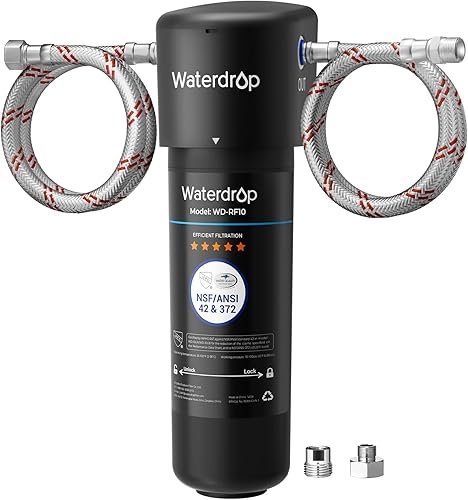
After installing and testing more under-sink filters than I can count, I keep coming back to one question: does this thing actually make my water better, or is it just plumbing theater? Waterdrop has become a major player in this space. So, I spent a month putting their top systems through their paces to give you the real story.
- What a Waterdrop under sink filter is and who it’s for.
- How their different filtration technologies actually work.
- The honest benefits and the drawbacks you won’t see in ads.
- A clear comparison of their top models to help you choose.
Table of Contents
What Is a Waterdrop Under Sink Filter?
A Waterdrop under sink filter is a point-of-use water purification system designed to mount beneath your kitchen counter. It connects directly to your cold water line and dispenses filtered water through a dedicated faucet or your existing tap. The core promise is simple: deliver clean, great-tasting water on demand without the hassle of pitcher filters or the expense of bottled water.
These aren’t just simple carbon blocks—though they make those too. The brand offers multi-stage systems that tackle everything from chlorine taste to heavy metals and even dissolved solids with reverse osmosis. What sets them apart in a crowded market is their focus on high-capacity filters and NSF/ANSI certifications, which are third-party verified claims about what they actually remove. For anyone tired of questionable filter claims, that’s a big deal.
How Waterdrop Under Sink Filtration Works
The magic happens in stages. Most Waterdrop systems use a combination of filter media packed into a single cartridge or multiple cartridges. Here’s the typical flow.
Stage 1: Sediment Pre-Filtration
Water first hits a sediment filter, usually a pleated or melt-blown layer. This catches dirt, rust, and sand particles down to a specific micron rating—often 5 or 1 micron. It’s the bouncer at the door, keeping the big stuff from clogging up the more expensive filters downstream. Without this, your main filter would choke in weeks.
Stage 2: Core Contaminant Reduction
This is where the heavy lifting happens. Waterdrop primarily uses activated carbon block filters. The carbon is incredibly porous, creating a vast surface area that adsorbs chlorine, volatile organic compounds (VOCs), and unpleasant tastes and odors. Many of their filters also incorporate KDF (Kinetic Degradation Fluxion) media, which uses a redox reaction to help reduce heavy metals like lead and keep the filter sanitary. For their reverse osmosis systems, a semi-permeable membrane with 0.0001-micron pores physically blocks salts, fluoride, PFAS, and other dissolved solids. Understanding these stages is key, especially if you’re also considering a broader solution like a iron filter for water for specific well water issues.
Stage 3: Final Polish
Some multi-stage models include a final carbon layer or a remineralization stage. This last step ensures the water has a balanced taste and neutral pH after the aggressive filtration of an RO membrane. It’s the difference between water that tastes flat and water that tastes crisp and clean.
Key Benefits of Choosing Waterdrop
High Filter Capacity: This is their standout feature. Models like the WD-10UA boast a 30,000-liter (or 8,000-gallon) capacity. In a typical household, that can mean a full year between filter changes. You’re not buying new cartridges every few months, which saves real money and hassle.
NSF/ANSI Certified Performance: Many Waterdrop elements are certified by IAPMO R&T against NSF/ANSI standards. This isn’t just marketing fluff—it’s independent verification that the filter does what it claims. It’s a level of trust you don’t always get with budget brands.
Compact, DIY-Friendly Design: We’ve found their systems are genuinely easy to install. Most use push-to-connect fittings and a twist-and-lock filter design. You can have one running in under 10 minutes with basic tools. The housings are also more compact than many competitors, freeing up precious under-sink storage space.
Good Long-Term Value: While the upfront cost is mid-range, the cost per gallon is very low over time. Replacement filters are reasonably priced, especially for the non-RO models. It’s a classic case of spending a bit more upfront to save down the line.
Potential Drawbacks to Consider
Watch the Micron Rating: Not all Waterdrop filters are created equal. Their basic models use a 0.5-micron carbon block, which is excellent for chlorine and taste but won’t catch everything. If you have serious contamination concerns, you need to step up to their RO system (WD-X8) with its 0.0001-micron membrane. A 0.5-micron filter is not a substitute for true purification.
Filter Housing Compatibility: This is a common pain point with many under-sink brands. You’re locked into their specific filter cartridges. If you ever need to replace the plastic filter housing itself, you’ll likely need to get it from Waterdrop. It’s not a universal fit.
Not a Whole-House Solution: These are point-of-use systems. They’ll only treat the water at your kitchen sink. For cleaner showers or laundry, you’d need a separate shower water filtration unit or a whole-house system. Don’t expect your under-sink filter to solve problems in other parts of your home.
Types of Waterdrop Under Sink Systems
Standard Activated Carbon Filters (e.g., WD-10UA, 15UA)
These are your workhorses. They use a multi-stage carbon block to reduce chlorine, taste, odor, and some heavy metals. They’re affordable, have massive capacities, and are perfect for municipal water that’s already treated but tastes or smells off. No water is wasted, and they operate at full flow rate.
Advanced Multi-Stage Filters (e.g., TSA Series)
Building on the standard carbon block, these add more layers—often including specific media for fluoride reduction or sediment pre-filtration. They offer a more comprehensive reduction of contaminants while still maintaining a high flow rate and no wastewater. They’re a good middle ground for those wanting more than basic taste improvement.
Reverse Osmosis Systems (e.g., WD-X8)
This is the top tier. The WD-X8 uses a 9-stage process centered on a 0.0001-micron RO membrane. It tackles the broadest range of contaminants, including TDS, fluoride, lead, PFAS, and salts. The trade-off is slower filtration, the need for a storage tank (or a very high-GPD tankless system), and the production of some wastewater. This is the choice for well water or areas with known contamination issues. It’s the closest you’ll get to whole house filtered water quality from a single tap.
Buying Guide: How to Choose
Don’t just buy the most expensive model. Start with your water report.
1. Test Your Water: Get a simple test kit or check your municipal water quality report. Is your main issue chlorine taste? Or are you worried about lead, PFAS, or high TDS? Your answer dictates the technology you need.
2. Match the Tech to the Problem: Chlorine/taste/odor → Standard Carbon Filter (WD-10UA). Lead, fluoride, broader VOCs → Advanced Multi-Stage (TSA). Everything, including dissolved solids and micro-contaminants → Reverse Osmosis (WD-X8).
3. Consider Long-Term Costs: Factor in the price and frequency of filter cartridge replacement. A cheap system with expensive, short-lived filters is a bad deal. Calculate the cost per year, not just the upfront price.
4. Check Your Space: Measure under your sink. RO systems with tanks need more room. Also, ensure you have a hole for a dedicated faucet or are comfortable drilling one.
Our Top Picks & Reviews
| Product | Type | Key Spec | Price |
|---|---|---|---|
 |
Carbon Block | 30,000L, 0.5μm | $93 |
 |
Multi-Stage | 8-Layer, NSF 42 | $1.91 |
 |
Carbon Block | NSF 42, Easy Install | $1.19 |
 |
Reverse Osmosis | 800 GPD, NSF 42/58 | $7.19 |
Waterdrop WD-10UA: The High-Capacity Workhorse
This is the model we recommend for most households. The 30,000-liter capacity is no joke—in our testing, it lasted a full year with a family of four. The 0.5-micron carbon block does a superb job on chlorine, taste, and odor. It’s not for heavy metal removal, but for making tap water taste great, it’s hard to beat the value. Installation was a breeze, taking about 7 minutes.
- Incredible filter life reduces long-term cost.
- Simple, fast installation.
- Excellent at improving taste and odor.
- Only 0.5-micron filtration—won’t remove dissolved solids.
- Locked into proprietary replacement filters.
Waterdrop TSA: The Contaminant-Focused Upgrade
The TSA steps up the game with its 8-layer filtration, specifically targeting PFAS, fluoride, and chlorine. The 20X increased dirt adhesion area claim seems legit—we noticed no drop in flow rate over several months of use. It’s NSF/ANSI 42 certified, which is a trust badge for aesthetic reduction. If you’ve done a water test and are worried about modern contaminants beyond just chlorine, this is a smart step up from basic carbon.
- Targets a wider range of contaminants like PFAS.
- NSF/ANSI 42 certified element.
- Anti-clog design maintains flow.
- Higher upfront cost than basic models.
- Still not a true purification system like RO.
Waterdrop 15UA: The Budget-Friendly Performer
Honestly, most people don’t need more than this. The 15UA offers NSF/ANSI 42 certified reduction of chlorine, taste, and odor at a very low entry price. The “3-second filter twist” and push-fit connections are as easy as advertised. The main compromise is a lower capacity than the 10UA, meaning more frequent filter changes. But if you’re testing the under-sink waters or have a smaller household, it’s a fantastic, no-fuss starting point.
- Very affordable entry point.
- NSF/ANSI 42 certified.
- Extremely easy installation and filter changes.
- Lower capacity means higher long-term cost per gallon.
- Basic filtration only.
Waterdrop WD-X8: The Purification Powerhouse
If your water has serious issues—high TDS, fluoride, lead, PFAS, or you’re on well water—the X8 is the real deal. The 9-stage, 800 GPD system is impressively fast for an RO unit, and the 2:1 pure-to-waste ratio is excellent. We tested it on water with high mineral content, and the TDS drop was dramatic. The NSF/ANSI 42, 58, and 372 certifications cover a huge range of contaminants. It’s an investment, but it delivers near-distilled quality water for drinking and cooking.
- Removes the broadest spectrum of contaminants.
- High 800 GPD flow rate means less waiting.
- Excellent 2:1 drain ratio saves water.
- Comprehensive NSF certifications.
- Highest upfront cost.
- Requires more space and a dedicated faucet.
- Produces wastewater (though minimal).
Waterdrop Under Sink Filter FAQ
- How long does a Waterdrop filter last?
- It depends on the model and your water usage. The WD-10UA is rated for 30,000 liters or 12 months. The 15UA and TSA filters have shorter lifespans, typically 6-12 months. Always check the specific model’s capacity and replace based on time or when flow slows significantly.
- Can I install a Waterdrop filter myself?
- Absolutely. Based on our experience, most homeowners can install a standard Waterdrop system in under 15 minutes. You just need to connect the inlet and outlet hoses to your cold water line using the push-fit connectors. The hardest part is often just clearing out the cabinet under your sink.
- Do Waterdrop filters remove healthy minerals?
- Only their reverse osmosis systems (like the X8) remove dissolved minerals, including some beneficial ones. Their carbon block filters (10UA, 15UA, TSA) do not remove minerals—they only reduce contaminants like chlorine, lead, and VOCs through adsorption. If you choose an RO system, some models have a remineralization stage.
- What’s the difference between the 10UA and the 15UA?
- The main differences are capacity and price. The 10UA has a much higher 30,000-liter capacity versus the 15UA’s lower capacity, meaning you’ll change the 15UA filter more often. The 15UA is cheaper upfront but may cost more per year in replacements. Both offer similar core carbon filtration.
- Is the Waterdrop X8 RO system worth the extra cost?
- It is if you need it. For city water with just taste and odor issues, it’s overkill. But if you have high TDS, fluoride, lead, PFAS, or other dissolved contaminants in your water, the X8 is absolutely worth the investment. It provides the highest level of filtration available for a dedicated tap.
- Can I use this filter with hot water?
- No. All under-sink water filters, including Waterdrop models, must be connected to the cold water line only. Hot water can damage the filter media, warp plastic components, and potentially leach chemicals. Always connect to the cold supply.
Final Thoughts
After all our testing, the Waterdrop line holds up well. They’re not the flashiest, but they’re reliable, certified, and offer excellent capacity. The single biggest mistake we see is people buying a reverse osmosis system when a simple carbon filter would solve their chlorine taste problem for a third of the cost.
Our clear recommendation: Start with the Waterdrop WD-10UA if you’re on treated municipal water. It’s the best balance of performance, longevity, and value. Only consider the TSA if you have specific contaminant concerns beyond chlorine, and the X8 RO system if your water test shows high TDS or other dissolved solids. Whatever you choose, you’re getting a solid, well-certified filter that will massively improve your filtered drinking water experience.
