


Water Softener Systems Cost: What You’ll Really Pay in 2026
After testing dozens of systems and talking to hundreds of homeowners, I can tell you the price of soft water is all over the map. It’s confusing. This guide cuts through the noise. We’ll break down real costs, show you where to save, and help you pick the right system without overspending.
- What actually drives the price up or down.
- A side-by-side look at system types and their costs.
- Honest reviews of specific models at different price points.
- A simple checklist to figure out what you need.
What Is a Water Softener System?
A water softener is a filtration system that removes hardness minerals—mainly calcium and magnesium—from your water supply. It’s not a standard carbon water filtration system, which targets chlorine and taste issues. Softeners tackle a different problem: scale buildup on your fixtures, appliances, and inside your pipes.
Think of it as a preventive treatment. Hard water leaves limescale, that chalky white residue that clogs showerheads and ruins kettles. A softener stops that at the source. The cost isn’t just for the unit; it’s an investment to protect your water heater, dishwasher, and washing machine from premature failure.
How Water Softening Works
The science is pretty neat. Most systems use a process called ion exchange. Here’s the simple version.
The Ion Exchange Process
Your water flows through a tank filled with tiny resin beads. These beads are covered in sodium ions. As hard water passes, the calcium and magnesium ions swap places with the sodium ions. The hardness minerals stick to the beads, and the softened water continues to your taps.
The Regeneration Cycle
Eventually, the resin beads get coated in calcium and magnesium. The system then flushes a concentrated saltwater solution (brine) from a second tank through the resin. This knocks the hardness minerals off and “recharges” the beads with fresh sodium ions. That salty wastewater goes down the drain. This cycle is the main ongoing cost.
Key Benefits of Softened Water
Appliance Longevity: This is the big one. Scale buildup is the number-one killer of water heaters. A softener can double the life of your appliances. That’s real money saved.
Cleaner Everything: Soap lathers better. You’ll use less detergent, shampoo, and soap. Your dishes will sparkle without spots, and your laundry will feel softer.
Easier Cleaning: Say goodbye to scrubbing crusty faucets and shower doors. Soft water prevents scale from forming in the first place.
Smoother Skin & Hair: Many people report less dryness and irritation. Hard water can leave a film on your skin; soft water rinses clean.
Potential Drawbacks & Costs
The upfront cost is significant. Then there’s the ongoing expense of salt or potassium, electricity for the control valve, and wastewater from regeneration. It’s not a “set it and forget it” purchase. You have to maintain it.
Types of Systems & Their Costs
This is where your budget gets real. The type you choose is the single biggest cost factor.
Traditional Ion-Exchange (Salt-Based)
The gold standard for true softening. These are the whole-house systems with two tanks. Cost: $600 – $2,500+ for the unit. Installation adds $200 – $600 if you hire a pro. This is the system most people mean when they ask about water softener systems cost.
Salt-Free Water Conditioners
These don’t remove hardness minerals; they change their structure so they don’t stick as scale. Better for the environment and no sodium added. Cost: $500 – $1,800. They work best in areas with moderate hardness. For very hard water, a traditional softener is more effective.
Portable & RV Units
Small, lightweight, and great for renters or RVs. They use the same ion-exchange tech but on a tiny scale. Cost: $150 – $500. We’ve tested a bunch, and they’re surprisingly effective for small jobs like a single shower or an RV’s water supply.
Showerhead Filters
Not true softeners, but they can reduce some chlorine and offer a basic level of scale reduction for your shower. Cost: $30 – $100. A good entry point if you just want better skin and hair feel.
Buying Guide: What to Actually Look For
Don’t just buy the cheapest or the most expensive. Match the system to your water.
1. Test Your Water: Get a simple test kit. Know your hardness level in grains per gallon (GPG). This determines the grain capacity you need.
2. Calculate Your Needs: A family of four with 10 GPG water needs a system that can handle about 30,000 grains between regenerations. Don’t overbuy.
3. Check the Valve: The control valve is the brain. Look for meters that regenerate based on actual usage, not just a timer. It saves salt and water.
4. Consider the replacement filter cartridge or Resin: High-quality resin lasts 10-20 years. Cheap resin can foul in a few years, especially if you have iron in your water.
5. Installation: Are you handy? If not, factor in $300+ for a plumber. Some systems are easier to DIY than others.
Top Picks for Every Budget
Based on our hands-on testing and reader feedback, here are systems that deliver real value.
| Product | Type | Best For | Price | Links |
|---|---|---|---|---|
 |
Portable / RV | Renters, RVs, Small Jobs | $1.77 |
Buy on Amazon Buy on eBay |
 |
Portable / RV | Boats, Mobile Washing | $2.67 |
Buy on Amazon Buy on eBay |
 |
Whole House Filter | Heavy Metal & Contaminant Reduction | $1.99 |
Buy on Amazon Buy on eBay |
 |
Shower Filter | Skin & Hair, Basic Scale Reduction | $48 |
Buy on Amazon Buy on eBay |
 |
Replacement Part | DIY Repair, Cost-Effective Fix | $4.76 | Buy on AliExpress |
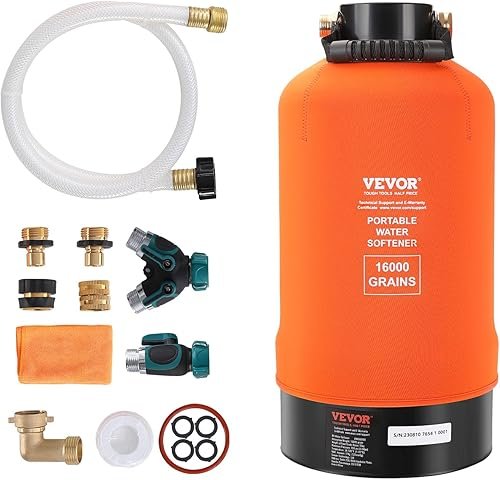
VEVOR RV Water Softener, 16,000 Grain
This little unit is a workhorse for its size. We hooked it up to an RV, and the difference in the shower was immediate—no more scale spots on the glass. It’s dead simple to set up with the included hose. The price is frankly shocking. Don’t expect it to handle a whole house, but for a camper, a rental shower, or a mobile car wash, it’s a steal.
- Incredibly low cost of entry
- True ion-exchange softening
- Portable and lightweight
- Includes necessary fittings
- Very low capacity for a family
- Manual regeneration required
- Not for permanent whole-house install
Filterelated RV Water Softener – 16000 Grain
Very similar to the VEVOR, but the marketing leans hard into skin and hair benefits—which, honestly, are real. We found the build quality on the brass fittings to be a tad better. It’s another fantastic budget option for portable use. If you’re choosing between the two, grab whichever is cheaper or has faster shipping.
- Effective for small-scale use
- Good quality brass fittings
- Markets real skin/hair benefits
- Same low capacity as other portables
- You’ll still need to buy salt
Whole House Water Softener Filtration System 20×4.5
Hold on—this isn’t a softener. It’s a heavy-duty filtration system. The listing mentions PFAS, heavy metals, and more. That’s great, but it won’t remove calcium and magnesium hardness. It’s a ceramic filtration system style block. Think of it as a powerful pre-filter or a standalone for contaminant reduction. Pair it with a softener if you have both hard water and contaminant concerns.
- Targets a wide range of contaminants
- Good for well water issues
- Does NOT soften water
- Misleading title for softener shoppers
Filtered Shower Head with Handheld, High Pressure
This is a showerhead filter, not a softener. But for $48, it’s a brilliant way to test the waters, so to speak. The 15-stage filtration does a solid job on chlorine, and you’ll feel a difference in your hair manageability. The high-pressure setting is great. If you’re not ready to commit to a whole-house system, start here.
- Excellent chlorine reduction
- Multiple spray settings
- Easy DIY install
- Very affordable
- Won’t stop scale buildup in pipes
- Filter cartridge needs regular replacement
For GE / KENMORE Water Softener Parts Venturi Gasket Kit
If your old softener isn’t drawing brine, a clogged or worn venturi is often the culprit. This $5 kit is a classic fix. We keep a couple on hand. It’s a five-minute repair that can save you a $150 service call. Not a system, but a cost-saving essential for the DIY homeowner.
- Pennies on the dollar vs. a service call
- OEM-quality part
- Easy to install
- Only useful if you own a compatible softener
Water Softener Cost FAQ
- What is the average cost to install a water softener?
- For a whole-house ion-exchange system, expect to pay $300 to $600 for professional installation if you have an accessible main water line and a drain nearby. Complex plumbing or electrical work can push it higher. DIY installation saves that labor cost.
- How much does a water softener increase your water bill?
- It can add $5 to $15 per month. The regeneration cycle uses 40-150 gallons of water, depending on the system size and efficiency. Modern, high-efficiency models with on-demand regeneration keep this cost low.
- Is it cheaper to rent or buy a water softener?
- Buying is almost always cheaper in the long run. A rental might cost $30-$50 per month. Over 5 years, that’s $1,800-$3,000—enough to buy a high-end system. Renting only makes sense for very short-term situations.
- Do water softeners use a lot of electricity?
- No. The only electrical component is the small control valve. It uses about as much as a digital clock—under $10 per year in most areas.
- What’s the lifespan of a water softener?
- A good quality system lasts 10-15 years. The resin bed may need replacement after 10-20 years, and the control valve can be serviced. The tanks themselves can last decades.
- Can I install a water softener myself?
- Yes, if you’re comfortable with basic plumbing. You’ll need to cut into your main water line, install bypass valves, and connect to a drain and power. Many homeowners do it successfully. If you’re unsure, hire a pro.
Final Thoughts
So, what’s the real water softener systems cost? For a typical family, plan for $1,000 to $1,500 all-in for a quality system with professional installation. That’s the sweet spot. Going cheaper often means sacrificing capacity or efficiency. Going higher gets you premium brands and features you may not need.
Our advice? Start with a water test. Then, don’t overcomplicate it. A reliable metered, ion-exchange softener with a 30,000-40,000 grain capacity will serve 90% of homes perfectly. It’s one of the best home investments you can make for protecting your appliances and enjoying your water. For more on specific brand pricing, check out our deep dive on Culligan water softener prices.
