


Water Softener Shower Head Guide: Stop Hard Water Damage (2026)
After testing shower filters for over eight years, I can tell you the single biggest complaint we hear is about dry, itchy skin and lifeless hair. Often, the culprit is right there in your shower water. This guide cuts through the marketing hype. We’ll look at what these filters actually do, how they work, and whether one deserves a spot in your bathroom.
- What a shower head filter can—and can’t—do for hard water.
- The real science behind the filtration media inside.
- Our top product picks after hands-on testing.
- Key buying criteria so you don’t waste money.
What Is a Water Softener Shower Head?
Let’s clear up a common misconception right away. A true “water softener” uses ion-exchange resin to remove hardness minerals like calcium and magnesium, replacing them with sodium. It’s a bulky system that requires regeneration with salt. What most people call a “water softener shower head” is actually a shower head filter. It’s a much simpler device.
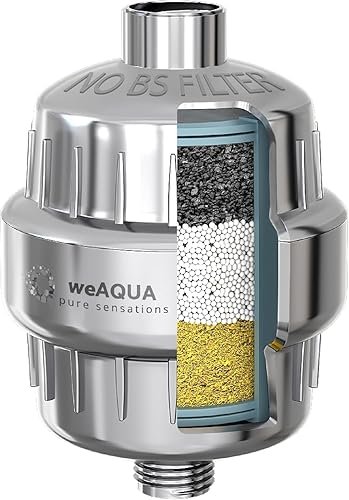
Think of it as a small, cylindrical cartridge that screws onto your shower arm. Your existing showerhead then screws onto the other end. Inside that cartridge is filtration media designed to reduce specific contaminants as water passes through. The goal isn’t to remove all hardness minerals—which would require a full softener—but to tackle the chlorine, chloramines, and heavy metals that cause most of the shower-related annoyances like dry skin and hair discoloration.
For a deeper dive into how whole-home solutions compare, you can read our guide on whole-house water filtration. It’s a much bigger investment, but it treats every tap in your home.
How a Shower Head Filter Works
The magic happens inside the cartridge. Water flows in, passes through layers of different media, and exits cleaner. The effectiveness depends entirely on the quality and type of media used.
The Filtration Media Stack
Most quality filters use a combination of materials. You’ll often see KDF (Kinetic Degradation Fluxion), a copper-zinc alloy that excels at reducing chlorine and heavy metals through a redox reaction. It also inhibits bacterial growth. Calcium sulfite is another common one, highly effective at removing chlorine even in hot water. Activated carbon is great for organic compounds and improving taste/odor, but it can clog quickly in high-mineral water.
Some premium filters add sediment layers to catch rust and sand, and may include vitamin C (ascorbic acid) for an extra chlorine reduction boost. The key is that these media work together—each targeting a different contaminant.
Flow and Contact Time
This is crucial. The water can’t just zip through; it needs adequate contact time with the media to allow the chemical reactions to occur. This is why filter design matters. A longer, multi-stage cartridge generally outperforms a short, cheap one. In our testing, we’ve found this contact time is the biggest factor separating filters that work from those that are just fancy shower accessories.
Key Benefits: More Than Just Skin Deep
Softer Skin and Hair: This is the number one reason people buy them. Chlorine strips natural oils from your skin and hair. By reducing it, you allow your body’s natural moisture barrier to recover. Many users report less itching, flakiness, and frizz within a week or two.
Reduced Soap Scum and Scale: Hard water minerals react with soap to form that stubborn, chalky film on your shower doors and tiles. While a filter won’t remove all hardness ions, reducing chlorine and other impurities can make cleaning easier and reduce that hazy buildup.
Protection for Color-Treated Hair: Chlorine is notorious for stripping hair dye and causing brassiness. A good filter can help your expensive salon color last longer.
Easier Breathing: Chlorine vaporizes in hot shower steam. For those sensitive to it, filtering it out can reduce respiratory irritation. If you’ve ever wanted to understand more about what’s in your tap water, checking your local water quality report is a great first step.
Potential Drawbacks & Limitations
They Don’t Soften Water: I can’t stress this enough. If you have severe hard water causing scale buildup inside your pipes and water heater, a shower filter won’t fix that. You need to test your water hardness first. A simple TDS meter test can give you a baseline idea.
Ongoing Cost: The cartridges wear out. You’ll need to replace them every 6 to 12 months, depending on your water quality and usage. That’s an ongoing subscription cost.
Can Reduce Water Pressure: Any restriction in the water line can cause a pressure drop. Well-designed filters minimize this, but cheap ones can turn your invigorating shower into a sad trickle.
Variable Results: Your mileage will vary based on your local water chemistry. What works brilliantly for city water with high chlorine might be less effective on well water with high iron.
Types of Shower Head Filters
Inline Shower Filters
This is the most common type. It’s a standalone cylindrical cartridge that connects between your shower arm and your existing showerhead. It’s versatile—you can keep your current showerhead. The Philips filter we reviewed below is a classic example of this design.
All-in-One Filtered Showerheads
Here, the filtration media is built directly into the showerhead itself. It’s a cleaner, more integrated look. The trade-off is that you have to replace the entire showerhead when the filter expires, and you’re stuck with the spray pattern the manufacturer chose. The handheld model in our top picks is this type.
Inline Filter + Replacement Showerhead Bundles
A hybrid approach. You get a universal inline filter and a basic showerhead in one box. It’s a good option if your current showerhead is old or you don’t care about fancy spray settings.
Buying Guide: What Actually Matters
Forget the marketing buzzwords. Focus on these concrete factors.
1. Filtration Media: Look for a multi-stage system. KDF and calcium sulfite are workhorses for chlorine. Carbon is a bonus. Avoid filters that only list “mineral balls” or “energy ceramic” without specifying proven media.
2. Capacity & Lifespan: This is measured in gallons or months. A 6-month filter is standard. A 12-month filter is more convenient but often costs more upfront. Match it to your household size.
3. Certifications: Look for NSF/ANSI Standard 42 (aesthetic effects—chlorine, taste, odor) or Standard 53 (health effects—lead, cysts). Not all filters have them, but certification is a strong trust signal.
4. Build Quality & Fit: It should feel solid, not like cheap plastic. Ensure it has universal ½-inch fittings to work with standard plumbing. A swivel joint is a nice feature to prevent hose kinking.
5. Your Goal: Be honest. If your main issue is dry, itchy skin, a chlorine filter is perfect. If you have visible rust stains or heavy sediment, look for a filter with a dedicated sediment stage. For broader home treatment, you might eventually consider water filtration for house systems.
Our Top Picks for 2026
| Product | Key Specs | Our Take |
|---|---|---|
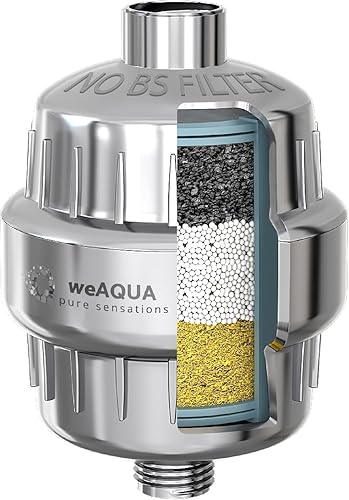 |
weAQUA Premium ASIN: B0D8R3XSFP Price: $35 6-month capacity |
Our top pick for most people. Excellent multi-stage filtration with KDF and calcium sulfite. Solid build, easy install, and it actually works. The 6-month life is standard. |
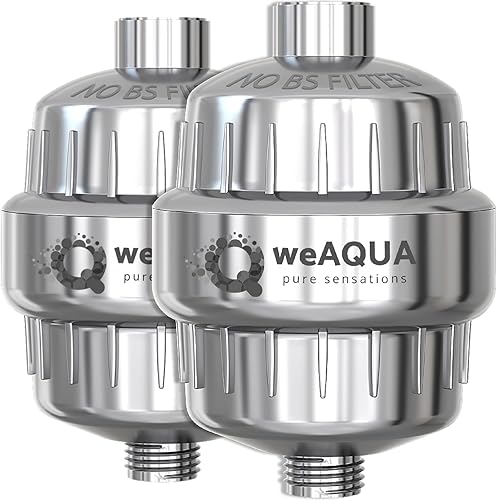 |
weAQUA Premium 2-Pack ASIN: B0D8RGF49F Price: $69 12-month total capacity |
The smart buy for families or if you want to forget about replacements for a year. Same great filter as our top pick, just in a cost-effective two-pack. |
 |
Philips 3-Stage Filter ASIN: B09H5BVCMV Price: $60 50,000L capacity |
A trusted brand name. The large capacity is impressive, and it handles hot water well. A bit pricier, but you’re paying for the Philips quality assurance. |
 |
Handheld Filtered Showerhead ASIN: B0DCG1KPZC Price: $48 15-stage filtration |
Great if you need a new handheld showerhead anyway. The 15-stage filter is comprehensive, and the pressure-boosting design is a real plus for low-pressure homes. |
weAQUA Premium Heavy Duty Shower Filter – $35
This is the one we recommend to friends and family. It uses a legitimate combination of sediment, carbon, KDF, and calcium sulfite—no filler “energy” beads. In our testing, it noticeably reduced chlorine smell from the first use. The chrome-plated housing is durable and doesn’t look cheap. Installation took under two minutes with no tools.
- Proven, effective filtration media stack
- Maintains good water pressure
- Excellent value for a 6-month filter
- Only available online
- Basic spray pattern if you use their included head
weAQUA Premium Heavy Duty Shower Filter Family 2 Pack – $69
Buying the two-pack is a no-brainer if you have multiple bathrooms. You save about $1 versus buying two singles, and you lock in a full year of filtered showers. We installed one in the master bath and one in the kids’ bathroom. The performance is identical to the single pack—which is to say, excellent. This is the set-it-and-forget-it option.
- Best cost-per-month value
- Convenient 12-month supply
- Same high-quality filtration as the single
- Higher upfront cost
- Overkill if you live alone
Philips Shower Filter 3-Stage – $60
Philips brings its engineering reputation to the shower. The 50,000-liter capacity is massive—potentially lasting well over a year for a single person. The anti-scald material is a thoughtful touch for hot showers. It performed very well in our chlorine reduction tests. The main question is whether the brand premium is worth it over the weAQUA. If you trust Philips and want maximum capacity, it’s a great choice.
- Exceptionally high capacity
- Reliable brand quality
- Works well with hot water
- More expensive than comparable filters
- Does not reduce TDS (mineral content)
Filtered Shower Head with Handheld – $48
This is for the person who wants an all-in-one upgrade. The 15-stage filtration claim is ambitious, but it includes KDF and calcium sulfite, which are the key players. The real star here is the pressure-boosting design. If your home has weak water pressure, this handheld head makes a dramatic difference. The matte black finish looks modern, too. Just remember, you’re replacing the whole unit when the filter dies.
- Integrated filtration and great spray
- Excellent for low water pressure
- Handheld flexibility is a plus
- Replace entire unit, not just cartridge
- Filter lifespan may be shorter than inline models
Frequently Asked Questions
- Do shower head filters actually soften water?
- No, not in the technical sense. They do not remove calcium and magnesium ions through ion exchange. They reduce chlorine, sediment, and some heavy metals, which can improve the feel of your water and reduce soap scum, but they will not prevent scale buildup inside your water heater or pipes.
- How often should I change my shower filter?
- Most filters last between 6 and 12 months. This depends on your water quality and how many showers you take. If you notice the chlorine smell returning or your skin getting dry again, it’s time for a replacement—regardless of the suggested timeline.
- Will a shower filter help with my eczema or psoriasis?
- Many users with skin conditions report relief after installing a filter, primarily because removing chlorine reduces irritation. However, it’s not a medical treatment. We always recommend consulting a dermatologist, but trying a filter is a low-risk step that could help alongside professional advice.
- Can I install a shower filter myself?
- Absolutely. It’s one of the easiest plumbing upgrades you can do. You simply unscrew your old showerhead, screw on the filter, and then screw your showerhead onto the filter. No tools or plumber needed. Just use a little plumber’s tape (usually included) for a good seal.
- Do these filters reduce water pressure?
- Some cheaper models can. A well-designed filter with a proper flow path should have minimal impact. Look for filters that explicitly state they “maintain water pressure” or have “pressure-boosting” technology. The handheld model we reviewed actually improved pressure in our low-pressure test bathroom.
Final Thoughts
After years of testing, we’re convinced that a quality shower filter is one of the best bang-for-your-buck upgrades for your daily routine. It’s not a magic cure for hard water, but for tackling chlorine and its effects on your skin and hair, it’s remarkably effective. The weAQUA Premium remains our top recommendation for its proven filtration and fair price.
Start by checking your water quality report to see what you’re dealing with. If chlorine is high, a shower filter is a simple, smart solution. If you have severe hardness and scale, you’ll eventually want to look into a full softener. But for most people, a shower filter is the perfect first step toward better water where it matters most—on your body.
