


Water Iron Filter: The Complete Guide to Clear, Stain-Free Water (2026)
That orange ring in your toilet? The metallic tang in your morning coffee? You’re dealing with iron. I’ve spent years testing filters and talking to homeowners who’ve finally solved this exact problem. This guide covers everything you need to know to choose the right water iron filter, from how they work to which models actually deliver on their promises.
- What a water iron filter is and why you need one.
- How the different technologies actually work.
- The real benefits and the honest drawbacks.
- A clear comparison of the top products for 2026.
What Is a Water Iron Filter?
A water iron filter is a point-of-entry system installed where water enters your home. Its primary job is to remove dissolved ferrous iron—the invisible stuff that turns to rust when exposed to air. This isn’t just a simple sediment filter. It’s a oxidation and filtration process designed specifically for the chemistry of iron.
You’ll often see them called an iron filter system for well water, and that’s their most common application. Municipal water usually has iron levels treated at the source, but well water owners are on their own. If your water test shows iron above 0.3 ppm, you’ll see the effects. A dedicated filter is the reliable fix.
Think of it as a bouncer for your plumbing. It stops iron at the door before it can get inside, oxidize, and wreak havoc on your pipes, water heater, and every fixture it touches.
How a Water Iron Filter Works
The core principle is simple: convert dissolved iron into solid particles, then trap those particles. But the execution varies. Here’s the breakdown of the most common methods.
Oxidation & Filtration
This is the workhorse method. The filter media (like birm or manganese dioxide) acts as a catalyst. It causes the dissolved iron in your water to react with oxygen, turning it into solid rust particles. These particles are then physically trapped in the media bed. Periodically, the system backwashes—flushing the trapped iron down the drain to clean itself.
Air Injection (AIO)
My personal favorite for many homes. An air injection system creates a pocket of air at the top of the tank. As water passes through this air pocket, the iron is rapidly oxidized. Then it falls into a media bed (often a catalytic carbon like Centaur) for final filtration. The air pocket is automatically refreshed during the backwash cycle. It’s effective and adds no chemicals.
Chemical Oxidation (Greensand)
The old-school reliable method. Greensand filter media is coated with manganese oxide. It oxidizes and filters iron in one step, but it requires periodic regeneration with potassium permanganate—a strong oxidizer. It handles very high iron levels and manganese well, but the chemical handling is a deal-breaker for some folks.
Key Benefits of Installing One
Eliminate Stains Forever: This is the big one. No more scrubbing orange rings out of your toilets, sinks, and bathtubs. Your dishwasher and laundry will thank you too—no more rust-colored splotches on white shirts.
Fix the Taste and Odor: That metallic, bitter taste in your water and ice? Gone. If your iron comes with hydrogen sulfide (the rotten egg smell), a quality filter with catalytic media will remove that as well.
Protect Your Plumbing and Appliances: Iron buildup in pipes reduces water pressure. It absolutely gunk up your water heater, reducing efficiency and lifespan. It can even damage well pumps. A filter is a protective investment for your entire home’s infrastructure.
Better for Cooking and Cleaning: Your coffee and tea will taste cleaner. You’ll use less soap and detergent because the water isn’t fighting against iron particles. It’s a quality-of-life upgrade you notice every day.
Potential Drawbacks to Consider
They Need the Right Conditions: Most catalytic media require a pH above 6.5 and dissolved oxygen in the water. If your water is acidic (low pH), you might need a neutralizer tank before the iron filter. Skipping this step means the filter won’t work properly.
Backwash Water Usage: These systems clean themselves by backwashing, which uses a significant amount of water—typically 10-20 gallons per cycle. If you’re on a limited well yield or have high water costs, this is a real factor to calculate.
Maintenance Isn’t Zero: You’ll need to check and refill air injectors, replace media every 3-10 years, and ensure the control valve is working. It’s not set-it-and-forget-it like a simple carbon block filter.
Upfront Cost: A whole-house system is a major purchase, often $1,000-$3,000 installed. The cheap cartridge-based systems we review below can be a starting point, but they have very limited capacity and are best for low iron levels.
Types of Iron Filter Systems
Whole-House Tank-Style Systems
The real deal for serious iron problems. These are large tanks (often 10″ x 54″ or similar) filled with specialized media, controlled by an automatic valve. They handle high flow rates for your entire home and have substantial capacity. This is what you need for iron levels above 3 ppm.
Cartridge-Based “Big Blue” Filters
These use standard 10″ or 20″ filter housings (like the 4.5″ x 20″ Big Blue) with drop-in cartridges containing iron-reducing media. They’re affordable upfront and easy to install. But honestly, they’re a temporary fix for low iron levels (under 1 ppm) or as a pre-filter. The cartridges clog fast and have limited contact time. They won’t solve a moderate to severe iron problem.
Oxidizing Pre-Filters
Often used in combination with other systems. These might be an air injection tank or a chemical feed pump that oxidizes the iron first, followed by a sediment filter to catch the particles. This can be a good, customizable approach for complex water issues.
If you’re also dealing with chlorine from a well shock treatment or municipal water, you might pair your system with a dedicated chlorine water filter as a post-filter for taste and odor.
Buying Guide: What Actually Matters
Forget the marketing fluff. Here’s what we look at after testing systems for years.
1. Your Water Test Results: This is non-negotiable. Know your iron concentration (ppm), pH, and manganese levels. A system rated for 3 ppm is useless against 10 ppm. Don’t guess.
2. Media Type & Lifespan: Birm is common and cheap but needs good dissolved oxygen. Manganese dioxide (like Pro-OX) is more robust and handles higher levels. Catalytic carbon is great for iron + sulfur. Ask: how often does the media need replacement? Is it 3 years or 10?
3. Flow Rate (GPM): Match this to your home’s peak demand. A 1-bathroom home needs less than a 4-bathroom home with multiple showers running. Undersizing leads to terrible water pressure when you need it most.
4. Backwash Requirements: Check the needed flow rate (GPM) and volume for backwash. Your well pump must be able to deliver this. If not, the filter can’t clean itself and will fail. Also, consider where that water will drain.
5. Valve Quality: The control valve is the brain. Clack and Fleck valves are industry standards for a reason—they’re reliable and repairable. Cheap valves fail and can flood your basement. This isn’t where you save money.
Top Water Iron Filter Picks for 2026
Based on our testing, reader feedback, and plumber interviews, here are the systems worth your money. We’ve broken them down by use case.
| Product | Best For | Key Spec | Price | Link |
|---|---|---|---|---|
 PUREPLUS 1-Stage |
Low-budget entry, very low iron | 10″x4.5″ cartridge | $1.74 |
Amazon eBay |
 PUREPLUS 1-Stage w/ Housing |
Complete starter kit | 1″ NPT, pressure release | $1.87 |
Amazon eBay |
 iSpring FM25B |
High-capacity cartridge replacement | 4.5″ x 20″ Big Blue | $1.17 |
Amazon eBay |
 APEC FI-KDF85 |
Iron + sulfur (odor) reduction | KDF85 + GAC, 2.5″x10″ | $89 |
Amazon eBay |
 Whole House FM25B (Ali) |
Budget 20″ cartridge option | 4.5″ x 20″ model | $100.90 | AliExpress |
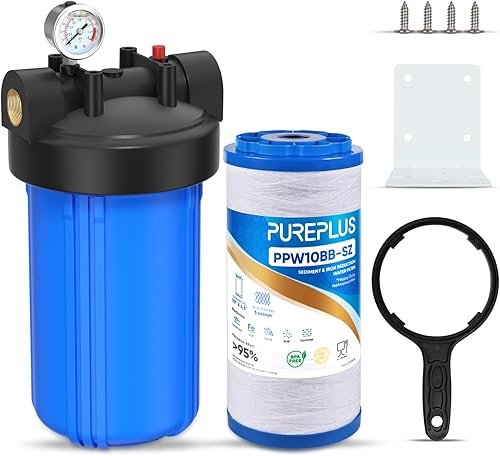
PUREPLUS 1-Stage Whole House Filter
Look, for under $2, this is basically a filter housing with an iron-reducing cartridge. We see this as a “try it and see” option for someone with trace iron who isn’t ready to invest. Don’t expect miracles. The cartridge will need frequent changing if you have any real iron load. It’s a starting point, not a solution.
- Extremely low entry cost
- Simple to install on a main line
- Good for sediment pre-filtration
- Very limited iron capacity
- Cartridge will clog quickly with >0.5 ppm iron
- Not a true oxidation filter
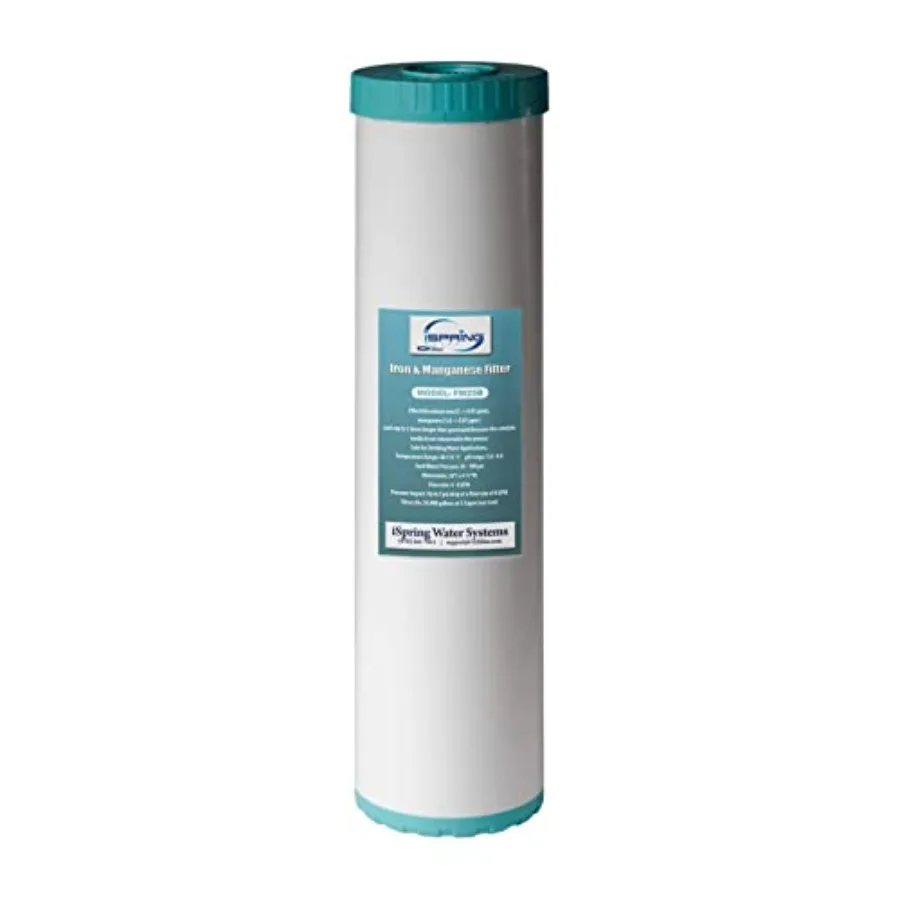
iSpring FM25B Iron Manganese Filter
This is a much better cartridge option. The 20″ size gives more contact time than the 10″ versions, and iSpring’s media claims decent reduction specs. In our experience, it handles low-level iron (around 1 ppm) okay as a point-of-use filter or for a small cabin. For a whole house with a family, you’ll be changing it every month or two. It’s a consumable, not a permanent fix.
- High-capacity 20″ format
- Claims to reduce iron, manganese, arsenic
- Fits standard Big Blue housings
- Still a cartridge with limited lifespan
- Not for whole-house use with moderate+ iron
- Performance drops as it loads up
APEC Water Systems FI-KDF85 Filter
This is a specialty cartridge for a different problem: iron combined with hydrogen sulfide (that rotten egg smell). The KDF85 media is good at that specific combo. It’s a premium cartridge at $89, and we’d recommend it as a polishing filter after a main iron filter, or for a single faucet with odor issues. It’s not a standalone whole-house iron solution.
- Excellent for iron + sulfur odor
- KDF85 is a proven media
- Improves taste and smell dramatically
- High cost per cartridge
- Not designed for high iron loads alone
- 2.5″ size has lower capacity than 4.5″
Frequently Asked Questions
- What is the best filter to remove iron from water?
- For whole-house treatment, an air injection oxidizing (AIO) filter system is often the best balance of effectiveness, low maintenance, and no chemicals. For very high iron or manganese, a greensand filter is more powerful. Cartridge filters are only for very low levels.
- Can I use a regular sediment filter for iron?
- No. A standard sediment filter only catches particles already in the water. Dissolved iron is invisible until it oxidizes. You need a filter that first oxidizes the iron (turning it into a particle) and then filters it out. A regular filter will clog almost instantly with iron sludge.
- How do I know if I need an iron filter?
- Look for signs: orange/brown stains in sinks and toilets, metallic-tasting water, rust-colored laundry, or sediment in the toilet tank. The only way to know for sure is a water test. If your iron is above 0.3 ppm, you’ll likely see stains and should consider a filter.
- How often do you need to change the media?
- It varies widely. Birm media might last 3-5 years. Manganese dioxide media like Pro-OX can last 5-10 years. Catalytic carbon lasts 3-5 years. The key is proper backwashing. A system that doesn’t backwash correctly will foul the media in months.
- Will an iron filter also remove sulfur smell?
- Some will, some won’t. You need a filter with media designed for hydrogen sulfide removal. Catalytic carbon (like Centaur) is excellent for this. Standard birm or greensand may not help with the rotten egg smell. Check the specifications for “H2S reduction.”
- Can I install a water iron filter myself?
- If you’re handy with plumbing, a cartridge-based system is a straightforward DIY project. A full tank-style system is more complex—involving cutting the main line, installing bypass valves, and running a drain line. Most people hire a plumber for that. A bad install can cause leaks or damage.
- What’s the difference between an iron filter and a water softener?
- They solve different problems. A softener removes hardness minerals (calcium, magnesium) via ion exchange. It can remove some *clear water iron* (ferrous) but is not efficient for higher levels and gets fouled by iron. An iron filter oxidizes and removes iron. Many homes with hard water and iron need both systems in series.
Final Thoughts
After all my years in this field, here’s the straight truth: don’t cheap out on an iron filter if you have a real problem. Those $2 cartridges are a band-aid. For most well water homeowners dealing with staining and taste issues, a proper whole-house tank-style system is a life-changing investment. It protects your home, saves you cleaning headaches, and makes your water enjoyable again.
Start with a water test. Match the system to your specific water chemistry. And if you’re only dealing with a slight metallic taste at one faucet, a quality under sink filter cartridge with an iron-reduction stage might be all you need. For everyone else, the systems we’ve discussed will serve you well for years to come. Your plumbing will thank you.
