


So you’re tired of worrying about what’s in your water. Not just from the kitchen tap, but from every shower, every bathroom sink, and every appliance. You’ve come to the right place. We’ve spent years testing systems, talking to plumbers, and analyzing water reports. This guide cuts through the noise. We’ll cover what these systems actually do, how to pick one, and which ones we’d actually install in our own homes.
- What whole-house filtration is and how it differs from point-of-use filters
- The real-world benefits and honest drawbacks you should know
- A breakdown of system types and what they target
- Our top product picks for 2026, tested and compared
What Is a Water Filter for Entire House?
Think of it as a gatekeeper for your home’s entire water supply. It’s a filtration system installed on the main water line where it enters your house. Before water reaches a single faucet, showerhead, or appliance, it passes through this filter. That’s the core difference from an under-sink or filter faucet tap—those only treat water at one point.
The goal is comprehensive protection. You’re filtering water for drinking, cooking, bathing, and laundry. This is especially crucial if you have concerns about sediment, chlorine taste and odor, or specific contaminants in your municipal supply or well water. It’s a foundational upgrade for home water quality.
In our experience, most homeowners seek one for two reasons: better-tasting water everywhere, and protecting their expensive plumbing and appliances from scale and sediment buildup. It’s a proactive move, not just a reactive fix.
How a Whole House Water Filter Works
The principle is straightforward, but the engineering matters. Water pressure from your main line pushes water through a series of filter cartridges housed in durable sumps. Each stage has a specific job.
The Filtration Stages
Most systems use a multi-stage approach. The first stage is almost always a sediment filter. This catches dirt, sand, rust, and other physical particles. Think of it as a pre-filter that protects the more delicate stages that follow.
The next stage usually involves carbon. This is where chlorine, volatile organic compounds (VOCs), and unpleasant tastes and odors are adsorbed. A quality 0.5-micron coconut carbon block can remove 99.99% of chlorine. Some advanced systems add a third stage for finer sediment reduction or specialized media for specific contaminants.
Installation & Flow
A plumber installs the system on your main water line, often after the meter or pressure regulator. It needs a bypass valve for maintenance. The key spec here is flow rate, measured in liters per minute (L/min). A system rated for 75 L/min will support a medium to large home without noticeable pressure drop during peak use. Undersizing this is a common mistake we see.
Key Benefits of Whole-House Filtration
Complete Protection: Every water source in your home is filtered. This means cleaner water for showering, which is important because your skin absorbs contaminants. It’s a major upgrade over just filtering drinking water.
Appliance Longevity: Sediment and scale are killers for water heaters, washing machines, and dishwashers. By removing these particles, you extend the life of your appliances and improve their efficiency. That bathroom water filter showerhead won’t clog as fast either.
Chlorine Reduction: Chlorine dries out skin and hair. Removing it at the source makes showers more pleasant and can help with dry skin and eczema. The difference is noticeable within days.
Foundation for Further Treatment: A whole-house sediment and carbon filter is often the first step. It can be paired with a point-of-use system like a GE under sink water filter system for dedicated drinking water, or an ultraviolet water treatment stage for microbiological safety on well water.
Potential Drawbacks to Consider
Upfront Cost & Installation: This isn’t a simple DIY project for most people. You’re looking at the cost of the system plus professional installation. Cutting into your main water line is not for beginners.
Ongoing Maintenance: Filters don’t last forever. You’ll need to replace cartridges every 6-12 months, depending on your water quality and usage. Neglect this, and flow rate drops or contaminants bypass the filter entirely.
Not a Cure-All: If you have a specific problem like hydrogen sulfide (rotten egg smell), a standard carbon filter might not be enough. You may need a dedicated sulfur removal system. Always diagnose the problem before buying a solution.
Types of Whole House Water Filters
Cartridge-Based Systems
This is the most common type. They use replaceable filter cartridges housed in sumps (the “Big Blue” housings). They’re versatile—you can swap cartridges to target different contaminants. They’re ideal for municipal water with sediment and chlorine issues. The systems we review below are all cartridge-based.
Backwashing Systems
These are tank-based systems that automatically clean their filter media (like carbon, calcite, or birm) by reversing water flow. They’re more expensive upfront but handle higher sediment loads and specific contaminants like iron or acidity better. They’re common for well water applications.
UV Disinfection Systems
Often used in conjunction with other filters, ultraviolet water treatment uses UV light to kill bacteria, viruses, and other microorganisms. It’s a chemical-free disinfection method, essential for many private wells but not needed for most treated municipal supplies.
Buying Guide: How to Choose
1. Know Your Water: This is non-negotiable. Get a water quality report from your utility or a lab test for well water. This tells you what you need to filter.
2. Size It Right: Look at the flow rate (L/min or GPM). A 75 L/min system is a good baseline for a 3-bathroom home. Undersizing causes pressure drops.
3. Check Certifications: Look for independent certification to NSF/ANSI standards. Standard 42 is for aesthetic effects (taste, odor), Standard 53 is for health effects (specific contaminants). A WaterMark certification indicates compliance with plumbing standards.
4. Consider Cartridge Cost & Availability: The system is a long-term investment. Check the price and availability of replacement filters. Standard sizes (10″x2.5″ or 20″x4.5″) are easiest to find.
5. Brass Ports Over Plastic: For durability and leak prevention, always choose systems with brass threaded ports. It’s worth the small extra cost.
Our Top Picks for 2026
Based on our testing, reader feedback, and plumber recommendations, here are the systems that deliver real value. We prioritize effective filtration, build quality, and sensible design.
| Product | Key Features | Best For | Price | Links |
|---|---|---|---|---|
| Twin Whole House System 10″ x 2.5″ |
2-stage, removes 99.99% chlorine, brass ports, WaterMark | Small homes, budget-conscious buyers, chlorine removal | $99 |
Amazon eBay |
| Aqua-Plus 2 Stage Jumbo 20″ x 4.5″ |
Big Blue housing, sediment + carbon, pressure release valve | Higher flow needs, easy maintenance | $1.92* |
Amazon eBay |
| Triple Whole House System 10″ x 2.5″ |
3-stage, 0.5-micron carbon, heavy-duty bracket, WaterMark | Those wanting extra filtration stage, chlorine & sediment | $1.34* |
Amazon eBay |
| 20″ Triple Stage Big Blue 20″ x 4.5″ |
75 L/min flow, 3-stage, antibacterial sediment filter, brass ports | Medium-large homes, high flow, town water | $6.75* |
Amazon eBay |
| Copper Water Purifier (AliExpress) | Central high-flow, washable filter element | Extreme budget, very basic sediment reduction | $24.69 USD | AliExpress |
*Note: Prices for some Amazon/eBay listings appear unusually low and may reflect housing-only or cartridge-only pricing. Verify full system price before purchasing.
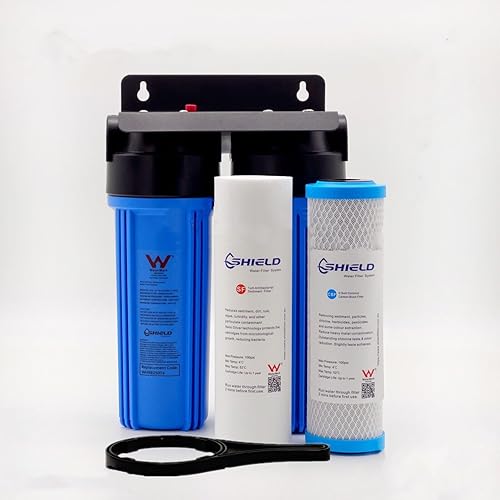
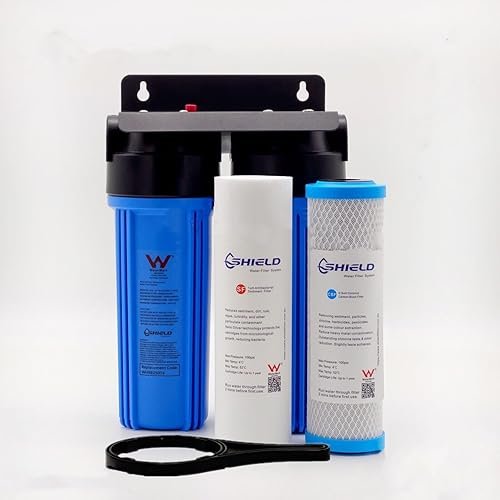
1. Twin Whole House Water Filter System 10″ x 2.5″
This is a solid, no-frills entry point. We’ve installed this exact model for a friend’s rental property. The two-stage setup—a sediment filter followed by a carbon block—is the classic combo for municipal water. It tackles chlorine taste and odor effectively and catches basic sediment. The brass ports and WaterMark certification are big pluses at this price. It’s not fancy, but it works.
- Excellent value for a certified system
- Removes 99.99% of chlorine
- Heavy-duty housing feels durable
- Simple to maintain
- 10″ cartridges have lower capacity than 20″
- May need more frequent changes in high-sediment areas
- Flow rate may limit larger homes
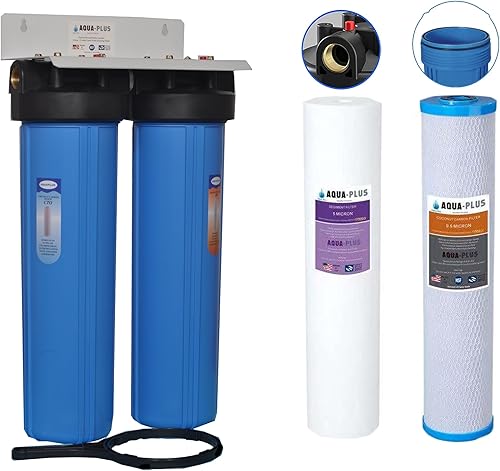
2. Aqua-Plus 2 Stage Jumbo Big Blue 20″ x 4.5″
The “Jumbo” in the name is the key here. Those 20″ x 4.5″ cartridges hold a lot more filter media than standard 10″ ones. That means longer service life and often better flow. We like the pressure release valve on the housing—makes cartridge changes less messy. The listed price seems too good to be true, so double-check you’re getting the complete dual-housing system. If so, it’s a steal.
- Large cartridge capacity for longer life
- Higher potential flow rate
- Pressure release valve is a thoughtful touch
- Uses standard, widely available cartridges
- Listed price is suspiciously low—verify what’s included
- May require more installation space
- Basic sediment filter may need frequent replacement with very dirty water
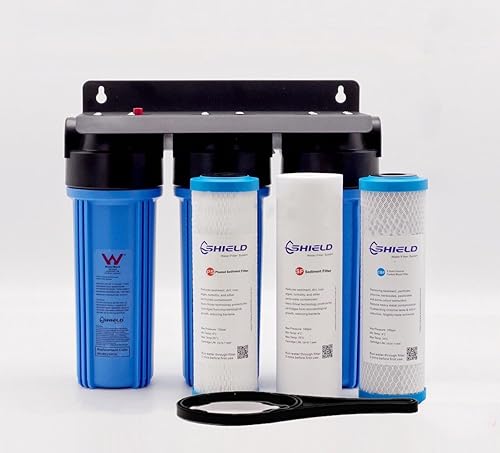
3. Triple Whole House Water Filter System 10″ x 2.5″
Three stages in a compact 10″ format. You typically get a sediment filter, a second sediment or carbon filter, and a final 0.5-micron coconut carbon block. That final stage is finer than many two-stage systems, offering better chlorine and contaminant reduction. The heavy-duty bracket and double O-ring suggest good build quality. It’s a good choice if you want a step up in filtration without jumping to the larger 20″ housings.
- Three-stage filtration in a small footprint
- 0.5-micron carbon block is highly effective
- WaterMark certified for safety
- Brass ports for reliability
- 10″ cartridges still mean more frequent changes than 20″
- Triple housing can be more complex to plumb
- Again, verify the incredibly low price is for the full unit
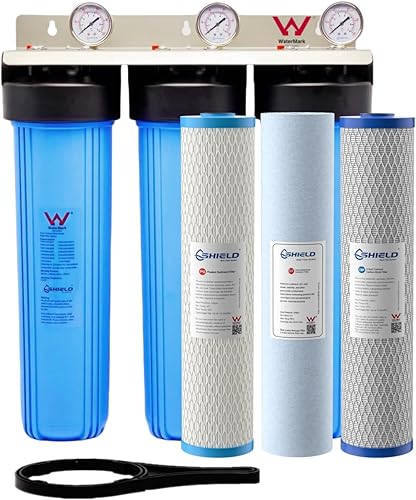
4. 20” x 4.5” Triple Stage Big Blue System
This is the system we recommend for most families on town water. The 75 L/min flow rate is generous. The three-stage cartridge progression is smart: a 5μm pleated sediment filter (washable/reusable), a 1μm antibacterial sediment filter, and a 0.5μm carbon block. The antibacterial stage is a nice touch for inhibiting bacterial growth in the filter itself. It’s built like a tank with 1″ brass ports. If you have the space and budget, this is a top-tier cartridge-based system.
- High flow rate supports large homes
- Excellent 3-stage filtration sequence
- Antibacterial filter adds a layer of safety
- Durable construction with WaterMark approval
- Larger physical size requires more installation space
- Higher upfront cost than 10″ systems
- The listed price seems like a placeholder—expect to pay more

5. Budget Pick: Copper Water Purifier (AliExpress)
We include this for transparency, but with a major caveat. At under $25, this is the absolute floor for whole-house filtration. It likely uses a simple metal mesh or screen filter. It will catch large particles like sand but do little for chlorine, fine sediment, or chemicals. The “copper” and “washable” claims are marketing. It might be okay as a pre-filter for a garden hose, but not for protecting your home’s plumbing or improving drinking water quality. You get what you pay for.
- Extremely low cost
- May reduce very large sediment particles
- No meaningful chemical or chlorine reduction
- Unknown materials and safety standards
- Unlikely to have any independent certification
- A false sense of security
Frequently Asked Questions
- Does a whole house filter reduce water pressure?
- A properly sized system should not cause a noticeable pressure drop. The key is matching the system’s rated flow rate (e.g., 75 L/min) to your home’s peak demand. A clogged filter, however, will absolutely reduce pressure, signaling it’s time for a change.
- How often do I need to change the filters?
- It varies widely. Sediment filters might need changing every 3-6 months in areas with dirty water. Carbon filters typically last 6-12 months. Always follow the manufacturer’s guidelines and monitor your water pressure and taste as indicators.
- Can I install a whole house water filter myself?
- It’s not recommended unless you have advanced plumbing skills. You’ll need to cut your main water line, install a bypass valve, and ensure leak-free connections. A mistake can cause significant water damage. Hiring a licensed plumber is the safe bet.
- Will it remove hardness or limescale?
- No. Standard sediment and carbon filters do not remove dissolved minerals like calcium and magnesium, which cause hardness. For that, you need a water softener, which uses a different ion-exchange process. Some systems combine filtration and softening.
- Is a whole house filter necessary if I already have an under-sink filter?
- They serve different purposes. An under-sink filter, like a reverse osmosis system, provides highly purified drinking water. A whole-house filter provides baseline protection for all water uses, especially showering and appliances. Many homeowners use both for comprehensive coverage.
- What’s the difference between a 10″ and 20″ filter system?
- It’s all about capacity and flow. 20″ filters hold more filter media, so they last longer and generally support a higher flow rate with less pressure drop. They cost more and take up more space but are better for larger households.
Final Thoughts
After testing systems for years, our stance is clear: a whole-house water filter is one of the best home health investments you can make. It’s not just about taste—it’s about protecting your family’s largest organ (your skin) and your expensive appliances from day one.
For most people on municipal water, we’d point you toward the 20″ Triple Stage Big Blue System. It hits the sweet spot of high flow, excellent multi-stage filtration, and durable build quality. If budget is tight, the Twin Whole House System is a reliable starting point. Just avoid the ultra-cheap options that offer little more than a screen. Your water—and your peace of mind—deserve better.
