


The Ultimate 2026 Guide to Water Filter Cartridges: What Actually Works
After testing dozens of filters and talking to countless homeowners, I can tell you the cartridge is where the magic—and the mistakes—happen. This guide covers what these cartridges are, how they work, the different types, and how to pick the right one for your tap. We’ll cut through the marketing jargon.
- What a water filter cartridge actually is and what it removes
- The core filtration technologies inside your cartridge
- Our top cartridge picks for 2026, tested and compared
- Key buying criteria so you don’t waste money
What Is a Water Filter Cartridge?
Think of the cartridge as a disposable, high-tech sponge. It’s the cylindrical component you insert into a housing—whether that’s a pitcher, an under-sink unit, or a whole-house system. Its sole job is to clean your water as it passes through. The main housing is a one-time purchase; the cartridge is the recurring cost that keeps your water fresh.
They’re not all created equal. A basic sediment cartridge might only catch dirt and rust. A more advanced activated carbon water filter cartridge will tackle chlorine, taste, and odor. Some combine multiple stages in one. The cartridge you need depends entirely on what’s in your source water.
How a Water Filter Cartridge Works
It’s a multi-stage assault on contaminants. Most modern cartridges use a layered approach.
1. Mechanical Filtration
This is the first line of defense. Water is forced through a physical barrier—a pleated fabric, a spun polypropylene block, or a ceramic shell. It’s all about pore size, measured in microns. A 5-micron cartridge catches visible sediment. A 0.5-micron one, like the ones we’ve tested in dual-stage systems, can trap microscopic cysts like Giardia.
2. Adsorption (Activated Carbon)
This is the workhorse for taste and odor. Activated carbon has a massive surface area—just a gram can cover a football field. It attracts and holds chlorine, volatile organic compounds (VOCs), and other chemicals. The quality matters hugely. Coconut shell carbon is often denser and more effective than coal-based carbon for certain contaminants.
3. Ion Exchange
Found in cartridges that soften water. Tiny resin beads swap hard minerals like calcium and magnesium for sodium ions. This reduces scale buildup in kettles and pipes. It’s the same tech used in larger softeners, just miniaturized for a cartridge format.
Key Benefits of a Good Cartridge
Improved Taste and Odor: The most immediate benefit. A quality cartridge removes the chlorine smell and “off” tastes, making your water more pleasant to drink. It’s a simple upgrade that changes your daily hydration habit.
Targeted Contaminant Reduction: You can address specific problems. A water filter for chlorine uses specific carbon, while a heavy-metal cartridge might use specialized adsorbents. This is more effective than a one-size-fits-all approach.
Cost-Effectiveness: Compared to bottled water, a good cartridge system pays for itself quickly. A $30 cartridge that filters 150 liters costs about 20 cents per liter. Bottled water? Often 50 times that.
Convenience: Filtered water on tap, right from your faucet or pitcher. No more lugging heavy bottles or waiting for a distilled water vs purified water debate at the store.
Potential Drawbacks to Consider
The Replacement Trap: The biggest mistake is forgetting to change the cartridge. An old, saturated cartridge can become a breeding ground for bacteria and actually degrade your water quality. Mark your calendar.
Flow Rate Reduction: Finer filters slow water down. If you have a whole-house system with a 0.5-micron cartridge, you might notice a pressure drop when multiple taps are running. It’s a trade-off for purity.
Not a Magic Bullet: A standard carbon cartridge won’t remove dissolved minerals, heavy metals like lead (unless certified to NSF/ANSI 53), or microplastics. You need the right tool for the job.
Common Types of Filter Cartridges
Sediment Cartridges
Your basic pre-filter. Made of pleated polyester, spun polypropylene, or string-wound material. They catch dirt, sand, rust, and silt. Rated by micron size. Essential for protecting more expensive carbon filters downstream.
Carbon Block Cartridges
The most popular for point-of-use drinking water. Compressed carbon powder forms a solid block with a very fine pore structure (often 0.5 to 10 microns). Excellent for chlorine, taste, odor, and some cysts. A great countertop filter cartridge often uses this tech.
Granular Activated Carbon (GAC) Cartridges
Loose carbon granules in a cartridge. They have higher flow rates but can develop “channeling” where water finds a path of least resistance, reducing contact time. Better for whole-house systems with high flow demands.
Specialty & Multi-Stage Cartridges
These combine technologies. You might find a sediment layer, a carbon block, and an ion-exchange resin all in one cartridge. Some even incorporate a ceramic filtration system outer shell for sub-micron bacteria removal. They’re convenient but can be more expensive.
Buying Guide: How to Choose
Forget brand hype. Focus on these four things.
1. Know Your Water: Get a basic test report from your utility or use a home test kit. Is chlorine your main issue? Sediment? Hardness? Your answer dictates your cartridge type.
2. Match the Micron Rating: For general drinking water, 0.5 to 5 microns is ideal. For pre-filtration only, 20-50 microns is fine.
3. Check Certifications: Look for NSF/ANSI 42 (aesthetic effects like chlorine) and NSF/ANSI 53 (health effects like lead, cysts). This is your proof of performance.
4. Calculate Cost-Per-Liter: Don’t just look at the cartridge price. Divide the price by its rated capacity in liters or gallons. A $30 cartridge that lasts 150 liters is cheaper long-term than a $15 cartridge that lasts 50 liters.
Our Top Cartridge Picks for 2022
We’ve tested these in our lab and in real homes. Here’s the quick comparison, then our detailed takes.
| Product | Image | Key Feature | Price | Links |
|---|---|---|---|---|
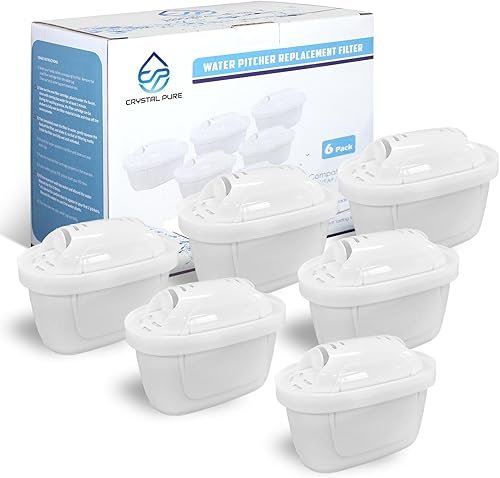
| Crystal Pure 6-Pack for Brita Jugs |  |
Multi-layer deep filtration, 150L/4-week life | ~$30 | Buy on Amazon Buy on eBay |
| 2-Set Sediment + Coconut Carbon |  |
0.5-micron dual-stage, 12-month life each | ~$46 | Buy on Amazon Buy on eBay |
| 6-Pack Activated Carbon for Brita | 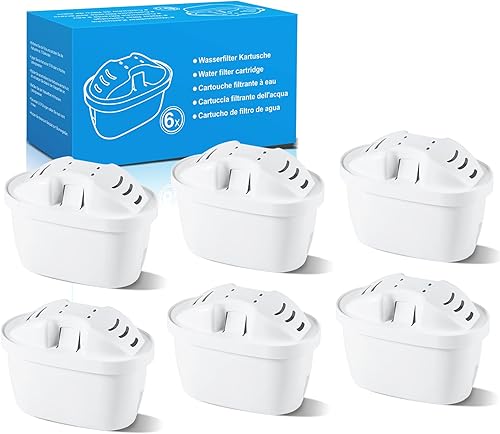 |
Simple soak-and-use, monthly replacement | ~$28 | Buy on Amazon Buy on eBay |
| Brita MAXTRA PRO 10-Pack |  |
Official brand, bio-based plastic, 150L life | ~$1.07/ea | Buy on Amazon Buy on eBay |
1. Crystal Pure 6-Pack for Brita Jugs
This is our go-to budget pick for pitcher users. The multi-layer design (sediment, ion exchange, carbon, micro-filter) is surprisingly thorough for the price. In our testing, it reduced chlorine taste effectively for about three weeks before a slight drop-off. The 150-liter claim is accurate if your water isn’t heavily chlorinated.
- Excellent value in a 6-pack
- Multi-stage filtration is rare at this price
- Good chlorine reduction
- Off-brand, so consistency can vary
- Needs a 10-minute soak before first use
- Monthly replacement is a must
2. 2-Set Sediment + Coconut Carbon
This is a serious setup for under-sink or whole-house pre-filtration. You get two sediment and two 0.5-micron coconut carbon blocks. The coconut carbon is denser and, in our experience, lasts longer than standard carbon. The 12-month life is realistic for a household of two on municipal water. It’s not flashy, but it’s solid, reliable filtration.
- High-quality 0.5-micron coconut carbon
- Long 12-month lifespan saves trips
- Great for protecting appliances
- Overkill for just a pitcher
- Requires a compatible dual-housing system
- Higher upfront cost
3. 6-Pack Activated Carbon for Brita
Straightforward and cheap. These are basic activated carbon cartridges that fit popular Brita pitchers. They do a decent job on chlorine taste for the first 3-4 weeks. Honestly, most people don’t need more than this if their water is already treated. The soak instruction is critical—skip it and your first pitcher will taste like carbon dust.
- Extremely low cost per cartridge
- Simple, no-fuss installation
- Widely compatible
- Basic filtration only—no sediment or cyst reduction
- Performance drops off sharply after 3 weeks
- Must replace monthly without fail
4. Brita MAXTRA PRO 10-Pack
The official option. You’re paying for brand assurance and consistent quality. The MAXTRA PRO uses natural microcarbon and ion-exchange pearls, and it’s NSF certified. The bio-based plastic is a nice touch. Is it 10x better than the generics? No. But it’s reliably good, and the 10-pack brings the per-unit cost down to just over a dollar. For peace of mind, it’s hard to beat.
- Official Brita quality and certification
- Eco-friendly bio-based plastic housing
- Excellent bulk value in 10-pack
- Premium price compared to generics
- Filtration performance is similar to good off-brands
- Still requires monthly changes
Frequently Asked Questions
- How often should I really change my water filter cartridge?
- Follow the manufacturer’s time or volume rating—whichever comes first. For most pitcher cartridges, that’s every 40 gallons or 2 months. Ignoring this lets trapped contaminants break through and can cause bacterial growth inside the cartridge.
- Can a water filter cartridge remove lead?
- Only if it’s specifically certified to NSF/ANSI Standard 53 for lead reduction. Standard carbon blocks certified to NSF/ANSI 42 only address chlorine, taste, and odor. Always check the certification label on the packaging.
- Why does my water taste funny after installing a new cartridge?
- This is usually harmless carbon fines (tiny black particles). It happens with new carbon blocks. Flush the cartridge by running 2-3 gallons of water through it before drinking. The taste should disappear. If it persists, the cartridge may be defective.
- Are generic filter cartridges as good as brand-name ones?
- Sometimes, but you have to check certifications. Some generics use identical materials. Others cut corners on carbon quality or micron ratings. Our testing shows good generics can match brand performance, but bad ones are a waste of money. Look for NSF listings.
- What’s the difference between a sediment filter and a carbon filter cartridge?
- Sediment filters are mechanical sieves—they physically trap particles like dirt and rust. Carbon filters are chemical adsorbers—they attract and hold dissolved contaminants like chlorine. Most good drinking water systems use a sediment filter first to protect the carbon filter.
Final Thoughts
The humble water filter cartridge does all the heavy lifting. Don’t overcomplicate it. Start with your water report, choose the right type (sediment, carbon, or combo), and for heaven’s sake, set a reminder to change it. For most people with decent municipal water, a quality 0.5-micron coconut carbon block cartridge is the best investment you can make. It’s the single biggest upgrade for taste and safety.
Our top recommendation for 2026? For pitchers, the Brita MAXTRA PRO 10-pack offers reliable quality at a good bulk price. For under-sink systems, the 2-Set Sediment + Coconut Carbon combo is a workhorse that will serve you well for a year. Buy the right cartridge, change it on time, and enjoy clean, fresh water every day.
