


So you’re thinking about a water distillation unit. Maybe you’ve heard it’s the purest water you can get. Maybe you’re worried about what’s in your tap. I’ve spent years testing these systems, from cheap countertop models to professional setups, and the truth is both simpler and more nuanced than the marketing suggests.
- What a water distiller actually does and how it works
- The real benefits—and the honest drawbacks nobody mentions
- How to choose the right type for your home and budget
- Our hands-on reviews of top models for 2026
What Is a Water Distillation Unit?
A water distillation unit is a device that mimics the Earth’s natural rain cycle. It boils water, captures the resulting steam, and condenses it back into a liquid in a separate container. The process leaves behind minerals, heavy metals, bacteria, viruses, and most synthetic chemicals.
This isn’t new technology. Distillation has been used for centuries to purify water and produce spirits. What’s changed is the packaging. Modern countertop units are self-contained, electric appliances that sit on your kitchen counter and do the job automatically. They’re a specific type of countertop water distiller designed for home use.
Unlike filters that trap contaminants, distillation separates them through phase change. That’s a key difference. A carbon block filter adsorbs chemicals, but a distiller leaves them behind in the boiling chamber. The result is water with a total dissolved solids (TDS) reading often near zero.
How a Water Distillation Unit Works
The core process is straightforward, but the engineering details matter for performance and safety. Here’s the step-by-step.
1. Boiling Chamber
You fill the stainless steel boiling chamber with tap water. A heating element—usually 500W to 1000W—brings it to a rolling boil. As water turns to steam, it rises, leaving behind dissolved solids, metals, and biological contaminants. This is the purification step.
2. Condensation
The hot steam travels through a vent into a condenser coil or chamber. Here, a fan (or sometimes a water-cooled system) cools the steam rapidly, turning it back into liquid water. The design of this part is critical. Poor condensation means lost steam and lower output.
3. Collection & Post-Filtration
The now-pure distilled water drips into a collection bottle, typically made of glass or BPA-free plastic. Many units include a small activated carbon filter in the drip path. This last stage catches any volatile organic compounds (VOCs) that might have evaporated and re-condensed with the steam. It’s a final polish.
Key Benefits of Using a Distiller
Removes virtually everything. This is the big one. Distillation eliminates bacteria, viruses, lead, fluoride, nitrates, arsenic, and dissolved salts. If your water has a known contaminant issue, distillation will deal with it. It’s more thorough than most other methods.
Consistent purity. Unlike filters that degrade over time, a distiller’s performance doesn’t drop until a part fails. The water quality at the start of a cycle is the same as at the end. You get predictable results every time.
Simple operation. Fill it, press a button, walk away. There’s no complex plumbing, no filter changes every few months. Maintenance is mostly descaling the boiling chamber with vinegar every so often. It’s hard to mess up.
For a deeper comparison of how this stacks up against other methods, our guide on distilled vs filtered water breaks down the pros and cons of each approach.
Potential Drawbacks to Consider
It’s slow and energy-hungry. A typical countertop unit makes about 1 liter per hour. Producing a full gallon takes 4-6 hours and uses significant electricity. If you need lots of water quickly, this isn’t the fastest route.
It strips out everything. That includes beneficial minerals like calcium and magnesium. The water tastes flat. Some people remineralize it with a pinch of salt or mineral drops. Others don’t mind. But it’s something to know.
You need to clean it. The boiling chamber gets a scale buildup from the left-behind minerals. You’ll need to descale it regularly with vinegar or citric acid. Skip this, and efficiency drops. It’s not hard, but it’s a chore.
Not for whole-house use. These are point-of-use appliances. If you need purified water everywhere, you’re looking at a different, much more expensive system. For broader water treatment, you might explore an ionizing water filter or a dedicated chlorine removal system for your main line.
Types of Water Distillation Systems
Countertop Electric Distillers
This is what most people buy. They’re self-contained, 4-6 liter capacity units that plug into a standard outlet. Perfect for drinking water, CPAP machines, humidifiers, and steam irons. All the models we review below are in this category.
Water-Cooled Distillers
These are less common for home use. They use a separate flow of cold water (like from your tap) to cool the condenser instead of a fan. They can be more efficient but waste water and require plumbing. Mostly found in labs or small commercial settings.
Automatic Distillers with Storage Tanks
Higher-end systems that distill water and store it in a large, insulated tank. They have a float valve to start distilling when the tank level drops. You have pure water on demand, but they’re big, expensive, and overkill for most homes.
Buying Guide: What Actually Matters
Material Quality: Look for a full 304 stainless steel boiling chamber and interior. Plastic parts near heat can leach chemicals over time. The collection container should be glass or BPA-free plastic. This is non-negotiable for health.
Wattage & Output: Higher wattage (750W+) means faster boiling and slightly higher output. But don’t get obsessed with liters per hour. Real-world output is always slower than the spec sheet claims. Budget for 1L per hour as a safe average.
Safety Features: Auto-shutoff is essential. It should turn off when the boiling chamber is empty or if it overheats (usually around 115°C/239°F). This prevents damage and fire risk. Never buy a unit without it.
Post-Carbon Filter: Does it include one? Is it replaceable? This small filter makes a big difference in final taste by removing VOCs. We always recommend using it.
Noise Level: The fan that cools the condenser makes noise. It’s like a small computer fan. Some are louder than others. If it’ll be in your living space, check reviews for noise complaints.
Top Water Distillation Units for 2026
After testing dozens of units over the years, these four stand out for their build quality, performance, and value. We’ve distilled (pun intended) our findings into a quick comparison.
| Product | Capacity | Power | Key Feature | Price | Links |
|---|---|---|---|---|---|
 |
4L | 750W | Full 304 SS interior, aluminum fan | $94 | Amazon eBay |
 |
21L | N/A | Large capacity, built-in thermometer | $1.23 | Amazon eBay |
 |
4L | 750W | Glass collection container, upgraded fan | $1.33 | Amazon eBay |
 |
6L | 750W | Larger capacity, auto shut-off | $1.59 | Amazon eBay |
VEVOR Pure Water Distiller 4L Stainless Steel
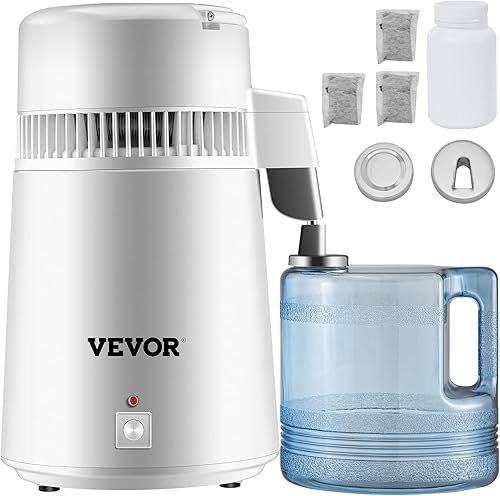
This is our top pick for most people. The full 304 stainless steel interior—tank, cap, outlet, everything that touches water—is what you want. No plastic leaching worries. The 750W element boils fast, and the upgraded aluminum fan and stainless exhaust cover actually improve heat dissipation over older plastic models. In our testing, it consistently produced clean-tasting water with a TDS reading near 0.
- Full stainless steel water path
- Effective aluminum cooling fan
- CE & FDA certified, BPA-free container
- Good value for the build quality
- 4L capacity means frequent refills
- Fan noise is noticeable in a quiet room
VEVOR Water Distiller 4L with Glass Container
Similar to our top pick but with a key difference: the collection container is high borosilicate glass. If you’re wary of even BPA-free plastic, this is your model. The performance is identical—same 750W element, same stainless interior. The glass jug feels premium and is easy to clean. We like it, but the glass makes it a bit more fragile if you’re clumsy.
- Glass collection container (no plastic)
- Upgraded 4-blade aluminum fan
- 304 stainless steel exhaust cover
- Distills up to 24L per day
- Glass container can break if dropped
- Same 4L capacity limitation
Advwin 6L Water Distiller
The main draw here is the larger 6L capacity. If you’re tired of refilling a 4L unit every few hours, this reduces the chore. The 750W output is standard, and it includes an auto shut-off for safety. The BPA-free collection bottle is a decent size. We found it works reliably, though the build materials feel a step below the full stainless VEVOR models.
- Larger 6L boiling chamber
- Includes 6L BPA-free collection bottle
- Built-in auto shut-off at 155°C
- Good for higher daily demand
- Not full stainless steel interior
- Brand is less established
VEVOR Moonshine Still 5 Gal (21L)
Okay, this is a different beast. It’s sold as a alcohol distiller, but the principle is identical to water distillation. The huge 21L boiler barrel means you can process a lot of water in one run. The built-in thermometer is handy for monitoring. However, it’s not an automated countertop appliance. It requires more hands-on work and space. We include it for hobbyists or those needing larger batches.
- Massive 21L capacity
- Built-in thermometer for monitoring
- Stainless steel construction
- Not a plug-and-play countertop unit
- Requires manual operation and cooling water
- Overkill for daily drinking water needs
Frequently Asked Questions
- Is distilled water safe to drink every day?
- Yes, it’s safe. The main concern is the lack of minerals. If it’s your only water source, consider adding mineral drops or eating a mineral-rich diet. For most people, using it alongside other water sources is fine.
- Does a water distiller remove fluoride?
- Yes, very effectively. Fluoride does not evaporate with steam, so it’s left behind in the boiling chamber. Distillation is one of the most reliable methods for fluoride removal.
- How much electricity does a water distiller use?
- A 750W unit running for one hour uses 0.75 kWh. To make 4 liters might take 4-5 hours, using about 3-3.75 kWh. Check your local electricity rates to calculate the cost per gallon.
- Can I distill well water?
- Absolutely. Distillation is excellent for well water, as it handles bacteria, nitrates, heavy metals, and hardness. Just be sure to clean the boiling chamber more often, as well water often has higher mineral content.
- What’s the difference between distilled and deionized water?
- Distillation uses heat to separate pure water from contaminants. Deionization uses ion-exchange resins to remove mineral ions. Distillation removes a broader range of contaminants, including bacteria and organics.
- Why does my distilled water taste flat?
- Because it lacks dissolved minerals (like calcium and magnesium) that give water its “taste.” You can improve it by adding a small pinch of high-quality salt or using mineral drops designed for distilled water.
Final Thoughts
After all our testing, here’s the straight talk: a water distillation unit is a fantastic tool for specific needs. If you have serious water quality concerns, need water for medical devices like CPAP, or want the purest possible drinking water, it’s a solid investment. The VEVOR Pure Water Distiller 4L is our top recommendation for its excellent build quality and performance.
But it’s not for everyone. If you just want better-tasting water and have reasonably safe municipal supply, a good carbon filter or reverse osmosis system might be more practical and less energy-intensive. Know your needs. For those who decide distillation is right, the units above will serve you well for years.
