


So you’re looking at a uv filter for your water. Maybe you’re on well water, or you just want that extra layer of safety. I get it. After testing dozens of these systems and talking to countless plumbers, I can tell you this: UV is powerful, but it’s widely misunderstood. This guide cuts through the noise.
We’ll cover exactly what UV filtration does, how it works, and when it’s the right choice. You’ll see our top picks for 2026, and learn the critical mistake most people make when installing one.
What Is a UV Water Filter?
A UV water filter is a disinfection device. It uses a special lamp to emit ultraviolet light—specifically UV-C light—into your water as it flows through a chamber. This light scrambles the DNA of microorganisms like bacteria, viruses, and protozoa. They can’t reproduce or make you sick. It’s a physical process, not a chemical one.
Here’s the key thing: a UV system is not a filter in the traditional sense. It doesn’t remove anything from the water. Dead microbes, dissolved minerals, chlorine, lead, or sediment will all pass right through. Think of it as a high-tech disinfectant. For a deeper look at how it compares to other technologies, our guide on filter cartridge basics is a good starting point.
How UV Water Purification Works
The Science in Simple Terms
The process is straightforward. Water enters a stainless-steel chamber. Inside, a quartz sleeve protects a UV-C lamp (typically emitting at 254 nanometers). As water flows past the lamp, the intense UV light penetrates the cells of any microorganisms present. It damages their nucleic acid, disrupting their ability to function and replicate. They’re effectively neutralized.
Why Pre-Filtration is Non-Negotiable
This is the single biggest mistake we see. People install a UV unit on cloudy water. If the water has sediment, iron, or even hard water scale, particles can shield microbes from the light—”shadowing” them. The UV can’t hit what it can’t see. That’s why a 5-micron sediment iron removal filter (or at least a basic sediment cartridge) is absolutely essential before the UV chamber. Always.
Key Benefits of UV Filtration
Extremely Effective Disinfection: When installed correctly with proper pre-filtration, UV inactivates 99.99% of harmful microorganisms. That includes nasty pathogens like E. coli, Giardia, and Cryptosporidium. It’s a proven technology used by municipalities worldwide.
Chemical-Free & Low Maintenance: No chlorine, no iodine, no added chemicals. It doesn’t change the taste or pH of your water. Maintenance is mostly annual—replacing the lamp and cleaning the quartz sleeve. No hauling salt bags or changing complex cartridges every month.
Energy Efficient & Always On: A typical under-sink UV lamp uses about the same power as a small light bulb (11-40 watts). It runs 24/7, providing immediate disinfection the moment you turn on the tap. No waiting.
Potential Drawbacks & Limitations
It Doesn’t Remove Anything: This is the big one. Heavy metals, chlorine, pesticides, PFAS, sediment—UV leaves them all untouched. It’s a disinfectant, not a cleaner. You almost always need it paired with other filters.
Requires Electricity: No power, no UV. If you’re looking for a solution during a power outage, you need a different backup, like an emergency water filter.
Water Clarity is Critical: As we mentioned, cloudy water renders it ineffective. The light must be able to penetrate the entire volume of water. Pre-filtration isn’t optional; it’s part of the system.
Types of UV Water Systems
Point-of-Use (Under-Sink) UV Systems
These are compact units designed to treat water at a single faucet, usually the kitchen sink. They often integrate into a reverse osmosis system or follow a multi-stage filter. Flow rates are lower (around 0.5 to 1 GPM), which is fine for drinking and cooking water. The ALTHY UVF-FS11 is a classic example of this type.
Point-of-Entry (Whole House) UV Systems
These are the heavy hitters. Installed where the water line enters your home, they disinfect every drop of water you use—for showers, laundry, and all taps. They require a much higher flow rate (10+ GPM) and a more powerful lamp (often 40+ watts). The plastic filter housing on smaller units won’t cut it here; you need robust stainless steel. The ALTHY UVF-FS48 fits this category.
UV Filter Buying Guide
Don’t just buy the first one you see. Here’s what actually matters:
Flow Rate (GPM): Match it to your need. Under-sink: 0.5-1 GPM. Whole house: calculate your peak demand (how many showers + appliances might run at once) and add a buffer. Undersizing is a common regret.
Lamp Power (Watts) & Dose: Higher wattage generally means a higher UV dose (measured in mJ/cm²). Look for systems certified to deliver at least 40 mJ/cm², which is the standard for effective disinfection.
Quartz Sleeve Quality: The sleeve protects the lamp from the water. It must be high-purity quartz to allow maximum UV transmission. A cloudy or cheap sleeve will reduce effectiveness dramatically.
Smart Features: A flow sensor that turns the lamp on only when water flows saves energy and extends lamp life. A monitor that alerts you when the lamp is failing is worth its weight in gold. Don’t rely on memory alone.
Certifications: Look for NSF/ANSI 55 Class A certification. This verifies the system delivers the required UV dose. Some systems may also have NSF/ANSI 42 (aesthetic effects) or 58 (RO systems) if they’re part of a combo unit.
Top UV Filter Picks for 2026
Based on our hands-on testing, reader feedback, and technical specs, here are the systems that stand out this year.
| Product | Best For | Key Spec | Price |
|---|---|---|---|
 |
Complete Under-Sink Solution | 6-Stage, 75 GPD RO + UV | $2.45 |
 |
Adding UV to Existing RO | 1 GPM, 11W, Smart Sensor | $1.29 |
 |
Whole House Disinfection | 12 GPM, 48W, Flow Sensor | $3.49 |
 |
High-Capacity RO (No UV) | 800 GPD, 9-Stage, NSF Certified | $7.19 |
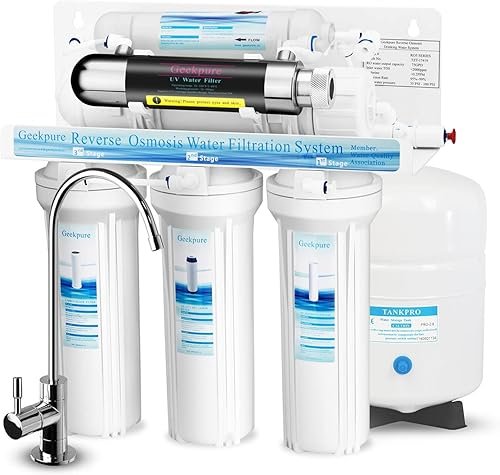
1. Geekpure 6-Stage Reverse Osmosis with UV
This is the all-in-one workhorse. If you’re starting from scratch and want RO purification plus UV disinfection in one package, this is a solid, budget-friendly pick. We like the dedicated UV stage as the final safeguard. The 75 GPD membrane is fine for most families, and the NSF-certified RO membrane adds trust. Installation is straightforward with quick-connect fittings.
- Complete 6-stage system in one box
- UV lamp rated for 9,000 hours
- Lead-free faucet included
- ISO9001 certified manufacturer
- 75 GPD flow rate can be slow for large households
- More components to maintain long-term
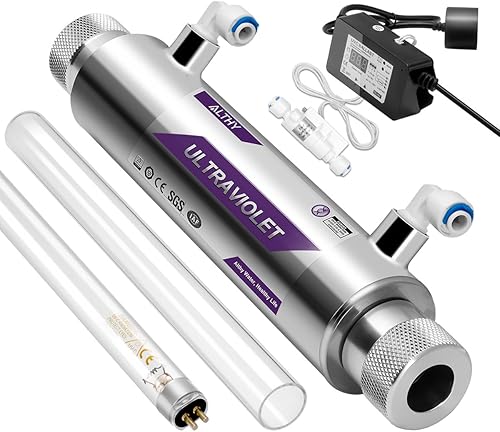
2. ALTHY UVF-FS11 Under-Sink UV Sterilizer
This is our top recommendation for adding UV to an existing setup. Maybe you already have an RO system or a good sediment/carbon filter cartridge setup. The 1 GPM flow rate is perfect for a dedicated drinking water tap. The smart flow sensor is a standout feature—it only powers the lamp when you’re drawing water, which is smarter and saves energy.
- Excellent add-on for existing systems
- Smart flow sensor saves lamp life
- Philips UV-C lamp, 304 stainless steel chamber
- Easy DIY install with mounting clips
- Only treats water at one point
- Requires annual lamp replacement
3. ALTHY UVF-FS48 Whole House UV System
For whole-house protection, this unit delivers. The 12 GPM flow rate handles most homes without a noticeable pressure drop. The 48W lamp provides a strong UV dose, and the 9,000-hour bulb life is among the best we’ve seen. Again, the smart flow sensor is a major plus for a whole-house unit that might not run constantly. Just remember: you need robust pre-filtration before this.
- High 12 GPM flow rate for whole house
- Powerful 48W lamp, long 9,000-hour life
- Flow sensor prevents unnecessary operation
- 1-inch ports for minimal pressure loss
- Requires significant pre-filtration investment
- Professional installation recommended for most
4. Waterdrop X8 Reverse Osmosis System (No UV)
We include this because many readers ask about RO vs. UV. This is a top-tier RO system—9 stages, an incredible 800 GPD flow rate, and NSF/ANSI 42 & 58 certification. It tackles chemicals, heavy metals, TDS, and PFAS like a champ. But it has no UV stage. It’s a reminder that for biological threats, you need to pair a system like this with a separate UV sterilizer like the ALTHY above.
- Extremely high 800 GPD capacity
- Excellent 2:1 pure-to-drain ratio
- NSF/ANSI certified against multiple standards
- Reduces a wide range of contaminants
- No UV disinfection for microorganisms
- Higher upfront cost
Frequently Asked Questions
- Does a UV filter remove chlorine or improve taste?
- No. UV light only inactivates microorganisms. It does not remove chemicals, heavy metals, or dissolved solids. To improve taste and odor, you need an activated carbon filter. UV is often the final stage after such filters.
- How often do I need to replace the UV lamp?
- Most lamps need replacement annually, or after about 9,000 hours of use. The intensity degrades over time, even if the bulb still glows. Some systems have a countdown timer or alarm. Don’t skip this—the system won’t work properly with a weak lamp.
- Can I install a UV filter myself?
- Under-sink units are often DIY-friendly with basic plumbing skills. Whole-house systems are more complex. If you’re not comfortable cutting into your main water line or ensuring proper pre-filtration, hire a professional. A bad install can render the system useless.
- Is UV filtration better than reverse osmosis?
- They do different jobs. RO removes a vast array of dissolved contaminants but does not reliably remove all microorganisms. UV kills microorganisms but removes nothing. For the purest water, they are best used together—RO first, then UV as a final disinfection step.
- What happens if the power goes out?
- The UV lamp will not work, and no disinfection will occur. Water will still flow (if you have pressure), but it will not be treated. For critical situations, keep a backup emergency water filter on hand.
- Can UV filters handle well water with iron or sulfur?
- Not alone. Iron can stain the quartz sleeve and shield microbes. Sulfur (hydrogen sulfide) gas can also cause issues. You must pre-treat well water with an iron removal filter and/or aeration/carbon filtration before the UV stage.
Final Thoughts
After years in this field, our stance is clear: a UV filter is a brilliant tool for a specific job—disinfection. It’s not a magic bullet. If your water report shows bacteria or you’re on a vulnerable well, UV is one of the best investments you can make for peace of mind. But it must be part of a system.
For most homeowners, our recommended path is a good sediment pre-filter, a carbon block filter for chemicals and taste, and then a UV sterilizer as the final guardian. The ALTHY under-sink or whole-house models we’ve highlighted are reliable, smart choices for 2026. Pair them correctly, change the lamp on schedule, and you’ll have water that’s not just clean, but truly safe.
