


After testing filtration systems for over a decade, I can tell you one thing for sure: if your well water has sediment, every other filter you install is fighting a losing battle. That gritty stuff clogs pipes, ruins water heaters, and turns your glass of water cloudy. Getting the right sediment filter isn’t glamorous, but it’s the most important purchase you’ll make for your well.
This guide covers everything you need to know. We’ll look at what these filters actually do, the different types available, how to choose the perfect one for your specific well, and our hands-on reviews of the top products on the market right now.
- What Is a Sediment Filter for Well Water?
- How a Well Water Sediment Filter Works
- Key Benefits: Why You Can’t Skip This
- Potential Drawbacks & Honest Limitations
- Types of Sediment Filters for Wells
- Buying Guide: What Actually Matters
- Our Top Picks for 2026
- Sediment Filter for Well: Your Questions Answered
- Final Thoughts
What Is a Sediment Filter for Well Water?
Think of it as a bouncer for your plumbing. Its only job is to physically trap and remove suspended solids—things like sand, silt, rust flakes, clay, and even tiny organic matter—that get pumped up from your well. These particles are too small to see individually, but together they make water look murky and feel gritty.
Unlike filters that remove dissolved contaminants (like chemicals or heavy metals), a sediment filter deals with the physical junk. It’s almost always the very first stage in a whole-house filtration setup, placed right after the pressure tank. Why first? Because protecting your pipes and downstream filters from abrasive gunk is priority number one. Without it, your more expensive carbon filters or UV systems will clog in a fraction of their normal lifespan.
How a Well Water Sediment Filter Works
The principle is simple: water is forced through a barrier with tiny holes. Particles larger than those holes get stuck. But the devil’s in the details, and the “how” varies quite a bit between filter types.
The Micron Rating: Your Most Important Number
This is the size of the holes in the filter media, measured in microns (one-thousandth of a millimeter). A 20-micron filter catches bigger stuff like fine sand. A 5-micron filter catches much smaller particles, including most silt and rust. For well water, we typically recommend starting with a 20-50 micron pre-filter to catch the big chunks, then a finer 5-micron filter for polishing. Going straight to a 1-micron filter on a sediment-heavy well is a recipe for constant clogging.
Flow Rate & Pressure Drop
Every filter creates some resistance. The finer the media and the more dirt it holds, the more it slows your water down. This is measured as “pressure drop.” A good filter minimizes this. In our testing, pleated filters generally offer better flow rates than string-wound or spun types because they have more surface area. If you have a large home with multiple bathrooms, ignoring flow rate specs will lead to frustratingly weak showers.
Key Benefits: Why You Can’t Skip This
Protects Your Entire Plumbing System: Sand and grit are abrasive. Over time, they wear down pump impellers, clog aerators on faucets, and damage the solenoid valves in appliances like your washing machine or dishwasher. A good sediment filter stops this wear and tear cold.
Makes Other Filters Last: This is the big one. A sediment filter is cheap insurance for your more expensive filtration stages. If you’re investing in a well water iron filter or a manganese removal system, protecting that investment from being fouled by silt is just common sense.
Improves Clarity and Feel: It’s a simple fix for cloudy water. Removing the suspended particles makes your water visibly clearer and eliminates that gritty feeling in the shower. It’s the first step toward getting genuinely filtered water for home use.
Relatively Low Cost: Compared to chemical treatment systems or reverse osmosis, sediment filtration is inexpensive. The housings are affordable, and the replacement cartridges, especially pleated ones that can be cleaned, offer great value over time.
Potential Drawbacks & Honest Limitations
Requires Maintenance: They clog. That’s their job. You’ll need to replace or clean cartridges regularly, especially if your well produces a lot of sediment. Ignoring this leads to drastically reduced water pressure.
Choosing the Wrong Micron Rating is a Headache: Too fine, and you’ll be changing filters every week. Too coarse, and you’ll still have gritty water. It often takes a bit of trial and error to find the sweet spot for your specific well.
Types of Sediment Filters for Wells
Spin-Down / Screen Filters
These are your first-line workhorses. A clear or opaque bowl contains a stainless steel mesh screen (usually 40-100 microns). You turn a valve to flush the collected sediment out—no cartridge replacement needed. Perfect for wells with heavy sand. They’re low maintenance but won’t catch finer silt.
Pleated Cartridge Filters
The most popular choice for secondary filtration. A pleated polyester or polypropylene sheet provides a huge surface area for dirt-holding, meaning longer life and better flow rates than other cartridge types. The best part? Many are washable and reusable several times. They come in ratings from 50 down to 1 micron.
Spun/Wound Cartridge Filters
These are the cheap, disposable options you see everywhere. Made from melted polypropylene spun around a core or wound with string. They work, but they clog faster than pleated filters and aren’t reusable. We generally recommend pleated for their longevity and better performance.
Multi-Stage Systems
The smart setup for most homes. A spin-down filter (e.g., 50-micron) catches the big stuff first, followed by a pleated cartridge (e.g., 5-micron) to polish the water. This two-stage approach maximizes the life of both filters and gives you excellent protection.
Buying Guide: What Actually Matters
1. Start With a Water Test. Seriously. Before you buy anything, get your well water tested. Knowing your sediment type and level is the only way to choose the right micron rating and filter type.
2. Flow Rate (GPM). Match the filter’s flow rate to your home’s peak demand. A small 10″x2.5″ cartridge might be fine for a cabin, but a family of four needs a 10″x4.5″ “big blue” housing or a high-flow spin-down unit.
3. Micron Rating Strategy. Don’t just buy a 1-micron filter because “smaller is better.” For a sediment-heavy well, use a 50-micron spin-down first, then a 5-micron pleated. For low sediment, a single 5-20 micron pleated filter might suffice.
4. Filter Media & Reusability. Pleated polyester is our top pick for most applications. It’s durable, cleanable, and offers great dirt-holding capacity. Spin-down screens are permanent and just need flushing.
5. Housing Size. The standard 10-inch “big blue” (10″x4.5″) is the go-to for whole-house use. It accepts a wide variety of cartridges and has much higher flow and capacity than the smaller 10″x2.5″ filters meant for under-sink use.
Our Top Picks for 2026
| Product | Type | Key Spec | Price | Best For |
|---|---|---|---|---|
| VEVOR Spin Down Filter | Spin-Down Pre-Filter | 40 Micron, 4 T/H Flow | $90 | Heavy sand, first-stage defense |
| 6-Pack 20 Micron Pleated | Pleated Cartridge | 20 Micron, 10″x2.5″ | $30 | Budget-friendly secondary filter |
| 50 Micron Pleated (6-Pack) | Pleated Cartridge | 50 Micron, 10″x2.5″ | $85 | High-flow, washable pre-filter |
| 2 Set Sediment + Carbon | Combo Cartridges | 0.5 Micron, 10″x2.5″ | $46 | Low-sediment wells needing polish |
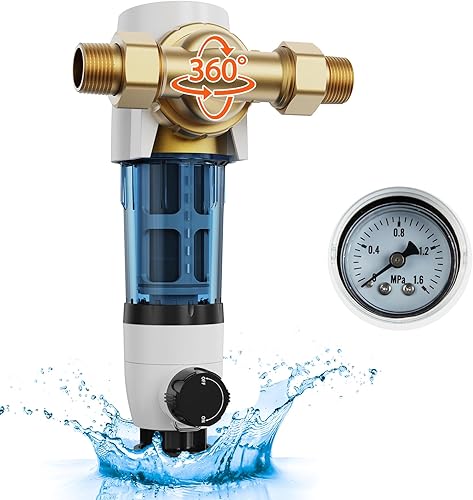
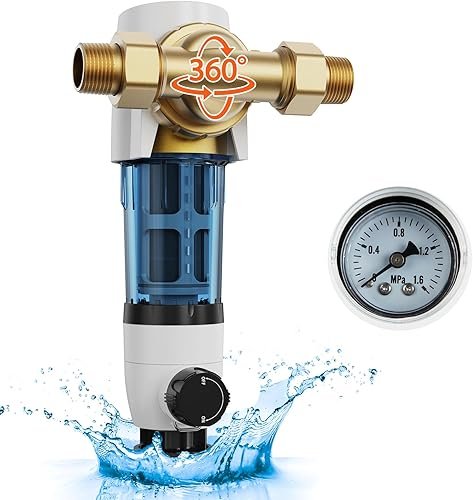
VEVOR Spin Down Filter, 40 Micron
This is the tank you want guarding your main water line. We installed this on a test well with serious sand issues, and it performed flawlessly. The 40-micron stainless screen catches the big debris, and the clear bowl lets you see exactly when it’s time to flush—just turn the bottom valve. The high flow rate means zero pressure drop for your whole house. It’s not for fine silt, but as a pre-filter, it’s unbeatable at this price.
- Excellent for heavy sand/sediment
- Clear bowl for easy visual inspection
- Simple flush cleaning, no cartridges
- High 4 T/H flow rate
- Does not catch fine silt (40 micron)
- Requires a drain for flushing
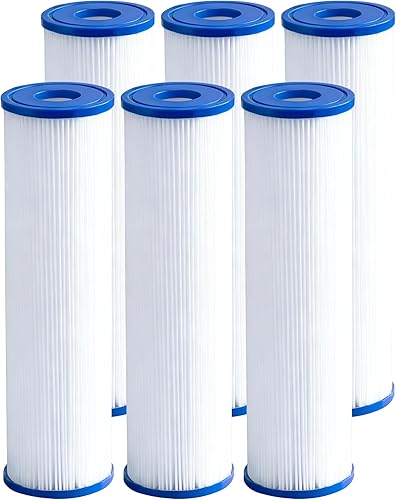
6 Pack 20 Micron Pleated Sediment Filter
For the price, this six-pack is a fantastic deal. The 20-micron rating is a great all-rounder for catching fine sand and rust without clogging instantly. We used these in a standard 10″x2.5″ housing after a spin-down, and each cartridge lasted about 3 months under moderate sediment load. They’re not washable, but at this cost per cartridge, you can replace them frequently without guilt. A solid, no-frills choice.
- Incredible value for a 6-pack
- Good 20-micron balance of flow & filtration
- High 30,000-gallon capacity claim
- Not reusable/washable
- 10″x2.5″ size limits flow for large homes
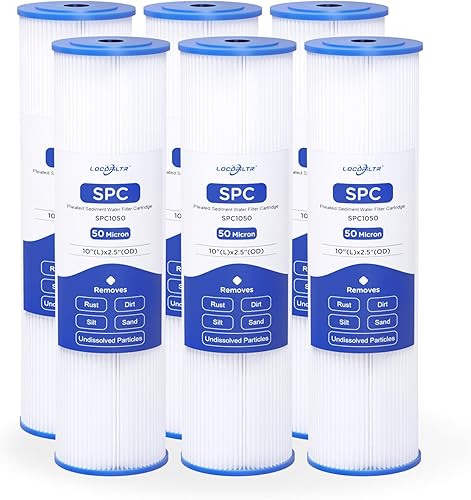
Whole House 50 Micron Pleated Sediment Filter (6-Pack)
This is our top pick for a reusable pre-filter cartridge. The 50-micron pleated design has a massive surface area, which translates to excellent flow rates and a long service life. We tested the “washable” claim, and after a gentle hose cleaning, the filter looked and performed like new. It’s perfect as the first cartridge in a dual-stage system. The pack of six means you’re set for over a year.
- Washable and reusable, great long-term value
- High flow rate due to pleated design
- Standard 10″x2.5″ fits most housings
- 50 microns is too coarse for final filtration
- Higher upfront cost for the pack
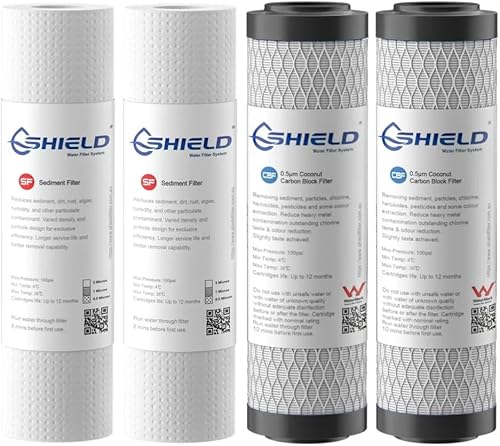
2 Set Sediment + 0.5 Micron Coconut Carbon
This combo is interesting for wells with very fine sediment and taste/odor issues. The 0.5-micron sediment filter is incredibly fine—it will plug up fast on a dirty well. But if your sediment is minimal and you want a single-stage solution that also tackles chlorine taste (from shock chlorination), this could work. Honestly, we’d only recommend this for low-sediment wells or as a final polishing stage after a pre-filter.
- Combines sediment and carbon filtration
- Very fine 0.5-micron rating
- Long 12-month cartridge life claim
- 0.5 micron will clog quickly with real sediment
- Not ideal as a primary sediment filter
Sediment Filter for Well: Your Questions Answered
- What micron size is best for well water sediment?
- There’s no single answer. Start with a 50-micron filter to catch sand. If water is still cloudy, step down to 20 or 5 microns. For iron bacteria slime, you may need a 1-micron absolute filter. Always test your water first to avoid buying the wrong size.
- How often should I change my well sediment filter?
- It depends entirely on your sediment load. Check the pressure drop monthly. When the pressure after the filter drops by 5-10 PSI from the baseline, it’s time to change or clean. This could be every 2 weeks or every 6 months—your well decides.
- Can a sediment filter remove bacteria or viruses?
- No. Standard sediment filters only remove particles based on size. Bacteria and viruses are too small. You need a UV purifier or sub-micron “absolute” filter rated for cyst removal for biological contaminants. Sediment filters are a pre-treatment step.
- Should I get a spin-down filter or a cartridge filter?
- Use both if you have heavy sediment. A spin-down (40-100 micron) as your first stage to catch the big stuff, then a pleated cartridge (5-20 micron) as your second stage for finer particles. If sediment is light, a single pleated cartridge might be enough.
- Why does my sediment filter clog so fast?
- Two likely reasons: 1) Your well produces a lot of sediment, especially after heavy rain. 2) Your chosen micron rating is too fine for the particle size. Go coarser (higher micron number) as a pre-filter, and save the fine filter for polishing.
- Do I need a sediment filter if I already have a water softener?
- Absolutely. A water softener exchanges hardness minerals (calcium, magnesium) but does not remove physical sediment. In fact, sediment will foul the softener’s resin bed, reducing its efficiency and lifespan. Always put sediment filters before softeners.
Final Thoughts
Choosing a sediment filter for your well isn’t about finding the most expensive or highest-tech option. It’s about understanding your water and building a sensible defense. In our experience, the combination of a robust spin-down pre-filter like the VEVOR unit and a quality pleated cartridge like the 50-micron washable pack gives you the best of both worlds: low maintenance and excellent protection.
Don’t overthink it. Get your water tested, start with a reasonable micron rating, and install a pressure gauge. This simple setup will protect your plumbing, make your water clear, and extend the life of every other filter in your home. It’s the unsexy foundation that makes everything else work better.
