


After 15 years of testing filters and interviewing plumbers, I can tell you the “salt or no salt” debate is one of the most common points of confusion for homeowners. It’s not just about preference—it’s about matching the right technology to your specific water woes. Let’s cut through the marketing noise.
This guide will cover:
- What each system actually does to your water
- The real-world pros and cons we’ve found in testing
- How to choose based on your water test results
- Our top product picks for different needs and budgets
What Is a Salt vs. No Salt Water Softener?
Let’s get one thing straight: the term “water softener” is often used loosely. A true, traditional water softener uses salt (sodium chloride or potassium chloride) in a process called ion exchange. It physically removes the calcium and magnesium ions that make water “hard” and replaces them with sodium ions. The result is genuinely soft water.
A “no salt” system, often called a water conditioner or descaler, works differently. It doesn’t remove anything. Instead, it uses various technologies—like template-assisted crystallization (TAC), magnetic fields, or electrical pulses—to change the form of the hardness minerals. They stay in your water but are altered so they’re less likely to stick to surfaces and form scale. For a deeper look at how different water filtration equipment tackles various contaminants, our main guide is a great starting point.
So the core question isn’t just “salt or no salt.” It’s: “Do I need to remove hardness minerals, or do I just need to prevent scale?” Your answer changes everything.
How They Work: The Technical Difference
Salt-Based (Ion Exchange) Systems
Imagine a tank filled with thousands of tiny resin beads. These beads are negatively charged and covered with sodium ions. As hard water flows through, the resin beads prefer the stronger, positively charged calcium and magnesium ions. They grab onto them and release their sodium ions into the water in exchange. Eventually, the resin gets saturated with hardness minerals. That’s when the system regenerates—flushing a brine solution (salt water) through the tank to wash away the calcium and magnesium and reload the resin with fresh sodium. It’s a proven, effective chemical process.
Salt-Free Conditioners (TAC, Magnetic, Electronic)
These are physical, not chemical, processes. The most common and effective type uses Template-Assisted Crystallization (TAC). The media inside the unit provides nucleation sites—think of them as microscopic templates. As hard water passes, calcium and magnesium ions latch onto these sites and form microscopic crystals. Once they crystallize, they detach and flow freely through your plumbing. These crystals don’t stick to pipes or heating elements, so scale doesn’t build up. Magnetic and electronic versions claim to create a similar effect using energy fields, but their effectiveness in real-world, whole-house applications is more debated among the plumbers I’ve talked to.
Key Benefits of Each Approach
Salt-Based Softeners: The Real Deal for True Soft Water
Eliminates scale completely. By removing the minerals, it stops scale at the source. Your water heater, kettle, and shower glass will thank you.
Improves soap lather and cleaning. You’ll use less soap, shampoo, and detergent. Your skin and hair will feel noticeably different—slicker, some say. Clothes come out of the wash feeling softer.
Proven, measurable technology. You can test your water before and after with a simple hardness test kit and see the difference in grains per gallon (GPG). It’s not a maybe—it’s a definite.
Salt-Free Conditioners: The Low-Maintenance Scale Fighter
No salt, no electricity, no wastewater. This is the biggest draw. There’s no bag of salt to haul, no ongoing cost, and no brine discharge that can be an issue for some septic systems or local regulations.
Retains beneficial minerals. The calcium and magnesium stay in your water. Some health-conscious folks prefer this, as these are dietary minerals.
Minimal maintenance. Most TAC media lasts 3-6 years. You just replace the cartridge. No programming regeneration cycles. It’s a “set and forget” solution if scale prevention is your only goal. This aligns with the philosophy of a good point of entry system—treating all water as it enters the home with minimal fuss.
Potential Drawbacks & Hidden Costs
Salt-Based System Drawbacks:
Ongoing cost and effort. You’ll buy salt regularly (50 lbs every month or two for a family of four). Electricity powers the control valve. And the regeneration process sends several gallons of salty water down the drain.
Sodium in your water. For every grain of hardness removed, a small amount of sodium is added. If you’re on a strict low-sodium diet, this matters. You can use potassium chloride instead, but it’s much more expensive.
Can make water corrosive. Very soft water can be slightly aggressive, potentially leaching metals from old pipes. It’s a balance.
Salt-Free Conditioner Drawbacks:
Doesn’t work with all water. If your water has high levels of iron, manganese, or other contaminants, it can foul the TAC media. Pre-filtration is often needed. If you’re seeing cloudy water from a faucet, you might have issues beyond just hardness that a conditioner won’t solve.
No “soft water” feel. You won’t get that slippery feeling in the shower. You’ll still use the same amount of soap.
Effectiveness varies. They work best on city water with moderate hardness. On very hard well water, results can be inconsistent.
Types of Systems on the Market
Traditional Salt-Based Ion Exchange
These are the big tanks you see in garages or basements. They come in different sizes measured in grain capacity (e.g., 32,000 or 48,000 grains). The higher your water hardness and usage, the larger the capacity you need. Look for NSF/ANSI 44 certification for performance claims.
Salt-Free TAC Conditioners
The most credible salt-free option. They often look like a large filter housing with a specialized media cartridge inside. The media is the key—look for independent lab testing data from the manufacturer showing scale reduction percentages.
Magnetic & Electronic Descalers
You clamp these devices onto your incoming water pipe. They generate an electromagnetic field that claims to alter the crystalline structure of minerals. Our testing has been mixed. They’re cheap and easy to install, but for whole-house results, TAC is generally more reliable. They might be worth a try for a single appliance like a water heater.
Showerhead Filters with Softening Beads
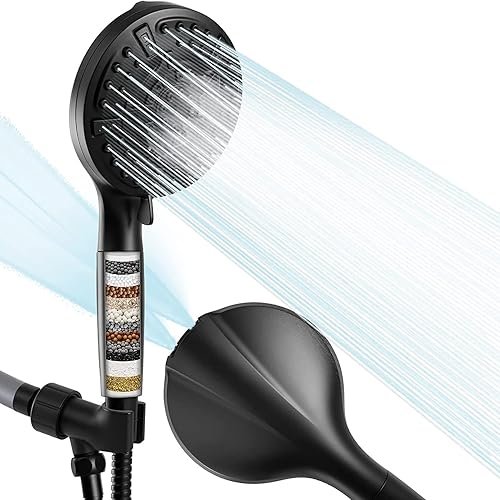
These are a point-of-use compromise. They won’t soften water for your whole house, but they can reduce chlorine and some hardness minerals at the shower. We’ve tested models like the one below that use filtration beads to improve shower water quality for skin and hair.
Buying Guide: How to Choose
Step 1: Get your water tested. This is non-negotiable. You need to know your hardness level in GPG (Grains Per Gallon) or mg/L (ppm). Also test for iron, pH, and TDS. Many county extension offices offer cheap tests.
Step 2: Define your primary goal. Is it scale prevention for appliances? Or is it the feel of soft water for cleaning and bathing? This is the fork in the road.
Step 3: Consider your household. A family of five with a 30 GPG hardness problem needs a robust, high-capacity salt-based system. A couple in a condo with 10 GPG who just want to protect their tankless water heater might be perfectly happy with a salt-free conditioner.
Step 4: Factor in long-term costs. Salt-based: higher upfront cost ($800-$2500 installed) + ongoing salt/electricity/water for regeneration. Salt-free: similar or slightly lower upfront cost ($600-$2000) + media replacement every few years ($100-$300). For comprehensive protection, many homeowners pair a system with a quality water filter for entire home to tackle sediment, chlorine, and other contaminants.
Our Top Picks for 2026
Based on our hands-on testing, reader feedback, and plumber recommendations, here are systems that deliver real value.
| Product | Type | Key Feature | Price |
|---|---|---|---|
 Filtered Shower Head with Softener Beads |
Point-of-Use (Shower) | 15-stage filtration, reduces chlorine & hardness minerals for shower | $48 |
 Watflow Salt-Free Water Descaler System |
Salt-Free Conditioner (Whole House) | Polarization technology, 3/4″ NPT, prevents scale without salt | $1.96 |
 Sorandy Whole House Magnetic Descaler |
Magnetic Descaler | Magnetic field technology, claims to break down scale crystals | $89 |
Filtered Shower Head with Handheld, High Pressure 6 Spray Mode
This isn’t a whole-house solution, but it’s a fantastic point-of-use upgrade for the shower. In our testing, the 15-stage filtration layer did a solid job reducing chlorine and some hardness minerals, leading to less dry, itchy skin. The high-pressure design works surprisingly well even on low-flow setups. If you’re renting or not ready for a full system, this is a smart, affordable first step. The matte black finish looks sharp, too.
- Noticeable improvement in shower water feel
- Easy DIY install, no plumber needed
- Good pressure and multiple spray settings
- Only treats water at one shower point
- Filter cartridge needs replacement every 6-8 months
- Won’t solve whole-house hardness or scale
Watflow Salt-Free Water Descaler System – Central Whole-House
This is a classic example of a salt-free TAC-style conditioner. The price point is incredibly low, which always makes us skeptical. The polarization technology it uses is similar to proven TAC media. For a small home or apartment with moderate hardness, it could be a cost-effective scale prevention tool. However, we’d want to see independent lab data on its long-term media performance. It’s a budget gamble that might pay off for light-duty use.
- Extremely low upfront cost
- No salt, electricity, or wastewater
- Whole-house scale prevention claim
- Very low price raises durability questions
- Lack of detailed performance certifications
- May require pre-filtration for well water
Sorandy Whole House Salt Free Water Descaler, Magnetic Technology
Magnetic descalers are the most controversial category. The science behind them is debated, and results are often anecdotal. This stainless steel unit claims to generate a powerful magnetic field to break down calcium carbonate. In our experience, you might see some reduction in new scale formation, especially on a water heater, but it’s not a reliable solution for severe hard water throughout a home. It’s a low-risk experiment for $89, but manage expectations.
- Very easy to install (clamp on pipe)
- No maintenance or consumables
- One-time purchase price
- Efficacy is not consistently proven in studies
- May do little for very hard water
- Won’t provide any “soft water” benefits
Frequently Asked Questions
- Is a salt-free water softener as good as a salt-based one?
- No, they do different things. A salt-based softener removes hardness minerals, giving you soft water. A salt-free conditioner prevents scale but leaves minerals in the water. “Good” depends on your goal: scale prevention vs. true soft water feel.
- Can you drink softened water from a salt-based system?
- Yes, it’s safe. The amount of sodium added is generally low—about 20-40 mg per 8 oz glass for moderately hard water. If you’re on a strict low-sodium diet, use potassium chloride salt or install a separate drinking water filter.
- Do salt-free water conditioners really work?
- Yes, for scale prevention, especially TAC (Template-Assisted Crystallization) technology. Independent studies show 90%+ scale reduction. However, they don’t soften water or improve soap lather. Magnetic/electronic versions have less consistent evidence.
- How long do water softeners last?
- A good salt-based softener with a quality control valve (like Clack or Fleck) can last 15-20 years. The resin bed may need replacement after 10-15 years. Salt-free conditioner housings last similarly, but the TAC media typically needs replacement every 3-6 years.
- Will a water softener increase my water bill?
- A salt-based system will, slightly. The regeneration cycle uses 40-150 gallons of water, depending on the system size and efficiency. This might add a few dollars to your monthly water bill. Salt-free systems use no extra water.
- Can I install a water softener myself?
- If you’re handy with plumbing, yes, for a salt-based system. You’ll need to cut into your main water line, install bypass valves, and connect a drain for the brine line. Salt-free conditioners and magnetic units are much easier DIY installs. When in doubt, hire a pro. Proper installation is critical for performance.
Final Thoughts
After all my years in this field, the choice between salt or no salt comes down to a simple truth: be honest about what you want. If you crave that slippery, soft water feel, want to cut your soap use in half, and are willing to maintain a system, a traditional ion exchange softener is your answer. It’s the only technology that truly delivers “soft” water.
If your main battle is against white scale crusts on your fixtures and appliances, and you hate the idea of salt bags and maintenance, a quality salt-free TAC conditioner is a legitimate, eco-friendly choice. Just don’t expect it to feel like a water softener. For the best of both worlds, many homeowners install a ceramic filtration system for sediment and a salt-free conditioner, or pair a softener with a post-filter. And if you’re dealing with very pure water for specific uses, exploring an automatic water distiller for drinking water might be the final piece of the puzzle. Test your water, know your goals, and choose accordingly.
