


You’re planning a trip. Or maybe you’re just thinking about your emergency kit. The question hits you: how will you get safe drinking water? Bottled water is heavy and wasteful. Tap water, well, you’re not always sure what’s in it. That’s where a good portable water filter changes the game.
This guide is the result of years of testing filters in the field and under the sink. We’ll cover:
- What a portable filter actually is (and isn’t)
- How the different technologies work
- The real benefits and the honest drawbacks
- How to choose the right one for your needs
- Our hands-on reviews of top models for 2026
What Is a Portable Water Filter?
Forget the bulky systems. A portable water filter is a lightweight, self-contained device designed to purify water on the go. Its core job is simple: make water from rivers, lakes, questionable taps, or hotel rooms safe to drink. We’re talking about removing bacteria, parasites, sediment, and often improving taste.
These aren’t just for hardcore backpackers. We’ve seen them become essential for international travelers, families prepping for storms, and even daily commuters who want better-tasting water from public fountains. The key is the “portable” part—it fits in your bag, glove box, or emergency kit. For a deeper dive into filtration media, our guide on the ceramic water filter is a great starting point.
How Portable Water Filters Work
It’s not magic, but some of the engineering is pretty clever. Most rely on one or a combination of these methods.
Mechanical Filtration: The First Line of Defense
Think of this as a super-fine screen. Water is forced through a membrane with tiny, tiny holes. The size of these holes is measured in microns. A 0.2-micron filter, for example, physically blocks bacteria like E. coli and parasites like Giardia. It’s like a coffee filter, but on a microscopic level.
Adsorption: Grabbing the Unseen
This is where activated carbon shines. It’s incredibly porous, giving it a massive surface area. As water passes, contaminants like chlorine, some volatile organic compounds (VOCs), and bad tastes cling to the carbon’s surface. This is crucial for improving taste and odor, which is why many under-sink systems use a dedicated water filter for chlorine.
Purification: Going the Extra Mile
Some portable filters go beyond bacteria and parasites. They use advanced tech like hollow fiber membranes or even UV light to inactivate viruses, which are much smaller. This is overkill for backcountry streams in most regions but can be critical for international travel in areas with poor sanitation.
Key Benefits of Going Portable
True Independence. You’re no longer tied to bottled water or a functioning tap. A stream, a puddle (in a pinch), a hotel sink—all become potential sources. This freedom is priceless for adventurers and a huge relief in emergencies.
Serious Cost Savings. Do the math. A $40 filter that lasts for 1,000 gallons versus buying bottled water? The filter pays for itself in weeks. It’s a one-time investment for years of clean water.
Environmental Win. This one’s simple. Every time you refill a bottle from a filtered source, that’s one less plastic bottle in a landfill or the ocean. It’s a tangible way to reduce your footprint.
Peace of Mind. Knowing you can handle a boil-water advisory, a broken water main, or a remote camping trip without worry? That’s a benefit you can’t put a price on. It ties directly into your overall drinking water quality strategy.
Potential Drawbacks to Consider
Limited Flow Rate. You won’t get a gushing stream. Sipping through a straw filter or pumping by hand takes time and effort. Gravity filters are faster but less “grab-and-go.”
Maintenance is Mandatory. Filters clog. Cartridges expire. If you don’t backflush or replace them as directed, you could end up with a useless gadget—or worse, a contaminated one. Set a reminder.
Not a Magic Bullet for Chemicals. Most portable filters focus on biological contaminants. Heavy metals, industrial chemicals, and saltwater require more advanced (and often bulkier) systems like reverse osmosis.
Capacity Limits. They’re built for one person or a small group. If you’re trying to supply a family of four for a week, you’ll need a different, larger solution, perhaps with a dedicated filter housing bracket for stability.
Types of Portable Water Filters
Straw & Bottle Filters
The simplest form. You either drink directly through the filter (like a LifeStraw) or screw it onto a water bottle. Ultra-portable and perfect for hiking. The downside? You can’t easily store filtered water.
Pump Filters
A step up in capacity. You pump water from a source through a hose and into a clean container. They’re faster than straws and can filter more water, but they’re heavier and require more effort. A classic choice for group camping.
Gravity Filters
The lazy person’s (or smart person’s) dream. Fill a dirty water bag, hang it, and let gravity do the work. They filter large volumes with zero effort, making them great for base camps. Not as portable for moving around.
Squeeze Filters
A hybrid favorite. You fill a soft pouch, screw on the filter, and squeeze water into your mouth or a clean bottle. Offers a good balance of portability, flow rate, and the ability to store clean water.
UV Purifiers
Not technically a filter, but a purifier. A pen-shaped device uses UV light to scramble the DNA of viruses, bacteria, and protozoa in clear water. Fast and effective, but requires batteries and doesn’t remove sediment. Often paired with a pre-filter.
Buying Guide: What Actually Matters
After testing dozens, here’s what we focus on. Ignore the marketing fluff.
1. Filter Type & Your Use Case. Be honest. Are you a solo day-hiker? A straw filter is perfect. Planning a week-long canoe trip? Look at a pump or gravity system. Daily commute? A bottle filter makes sense.
2. Micron Rating & Certifications. This is non-negotiable. Look for an absolute 0.2-micron or smaller rating for bacteria/parasite removal. Certifications to NSF/ANSI Standards 42 (aesthetic effects) and 53 (health effects) are a huge trust signal. Some filters, like the Waterdrop X8, even carry NSF/ANSI 58 for reverse osmosis.
3. Filter Capacity & Longevity. How many gallons/liters will it clean before you need a new element? 100 gallons is low. 100,000 gallons (like Sawyer claims) is exceptional. Calculate your needs.
4. Weight & Packed Size. Every ounce counts in a backpack. Weigh the filter, plus any hoses, bags, or accessories you need to carry.
5. Ease of Use & Maintenance. Can you clean it in the field? Is backflushing simple? Does it come with a syringe? A complicated filter stays in your drawer.
Our Top Portable Filter Picks for 2026
Based on our hands-on testing, reader feedback, and value for money.
| Product | Key Specs | Best For | Links |
|---|---|---|---|
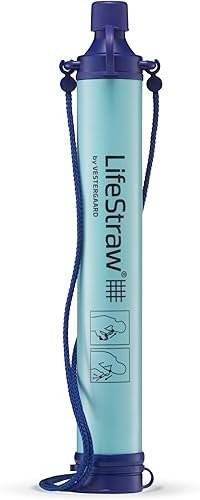
| LifeStraw Personal | 0.2 micron, removes 99.999999% bacteria, 99.999% parasites | Emergency kits, day hikes, simplicity |
Amazon eBay |
| Sawyer Mini | 0.1 micron absolute, inline or squeeze, 100,000 gal claimed | Versatile backpacking, best filtration rating |
Amazon eBay |
| LifeStraw 3-Pack | Same great filtration, ultralight (2 oz each) | Families, group trips, stocking emergency kits |
Amazon eBay |
| Waterdrop X8 RO System | 9-stage, 0.0001μm RO membrane, NSF/ANSI 42&58&372 | Permanent under-sink install, removes PFAS, lead, TDS |
Amazon eBay |
| AliExpress Pump | Mini sump pump with mesh filter | Budget drainage projects (not drinking water) | AliExpress |
| AliExpress Rain Barrel | 53-gallon collapsible collector with spigot & filter | Rainwater collection for gardens, non-potable use | AliExpress |

1. LifeStraw Personal Water Filter
The filter that started a movement. We’ve used the original LifeStraw on three continents. It’s dead simple: uncap, stick in water, and drink. The 0.2-micron hollow fiber membrane is proven tech. The biggest limitation? You can’t store the water you filter. It’s a drink-now tool. For the price, it’s an unbeatable backup or primary for solo day hikes. The 3-pack is a smart buy for families.
- Extremely lightweight and simple
- Proven, lab-tested filtration
- No moving parts to break
- Great value per unit (especially in 3-pack)
- Cannot filter water into a separate container
- Flow rate can slow as it clogs
- Does not improve taste (no carbon)
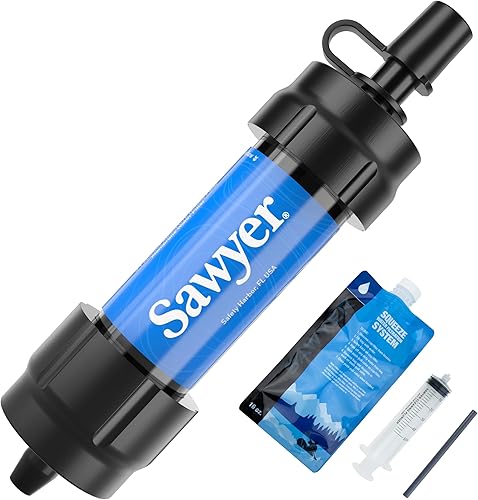
2. Sawyer Products SP128 Mini
This is our top pick for most people, and here’s why: versatility. The 0.1-micron absolute filter is better on paper than the LifeStraw. You can use it as a straw, inline with a hydration pack, or as a squeeze filter with the included pouch. That means you can filter water into any container. We’ve used the same Sawyer element for over two years with regular backflushing. It’s incredible.
- Superior 0.1-micron absolute filtration
- Three ways to use it (straw, inline, squeeze)
- Extremely long filter life (100k gallons claimed)
- Weighs only 2 ounces
- Included pouches are flimsy (buy a CNOC Vecto)
- Backflushing syringe is easy to lose
- Slightly more complex than a LifeStraw

3. LifeStraw Personal Water Filter (3-Pack)
Honestly, most people don’t need a three-pack. But if you’re outfitting a family, a scout troop, or building multiple emergency kits (home, car, office), this is the way to go. You get the same reliable 0.2-micron filtration at a much lower cost per unit. We keep one in each of our go-bags. The peace of mind is worth it.
- Best cost-per-unit for multiple filters
- Ideal for group preparedness
- Same trusted LifeStraw technology
- Ultralight at 2 ounces each
- All have the same limitations (no storage)
- You might end up with spares you don’t need

4. Waterdrop X8 RO System
Okay, this one isn’t portable in the backpacking sense. But if your “portable” need is a high-quality filter you can take when you move apartments, the X8 is fascinating. It’s a tankless, under-sink RO system with a 9-stage process and an 800 GPD flow rate. The 2:1 drain ratio is excellent for water waste. It’s certified against NSF/ANSI 42, 58, and 372. For serious contaminant removal—like PFAS, lead, and TDS—this is the real deal for a permanent but non-invasive install.
- Removes a massive range of contaminants (PFAS, lead, TDS)
- High flow rate (800 GPD) and low waste water
- Strong NSF/ANSI certifications
- Tankless design saves space
- Requires installation under a sink
- Not for hiking or travel
- Higher upfront cost
Frequently Asked Questions
- How long does a portable water filter last?
- It depends entirely on the model and usage. A Sawyer Mini claims 100,000 gallons with proper maintenance. A LifeStraw is rated for about 1,000 gallons. Always check the manufacturer’s capacity and replace the element when it’s reached or if the flow rate becomes painfully slow.
- Can a portable filter remove viruses?
- Most standard portable filters (0.1-0.2 micron) cannot remove viruses, as viruses are much smaller. You need a filter specifically rated for virus removal (often 0.02 micron) or a UV purifier. For most backcountry use in North America, virus removal isn’t necessary.
- What’s the difference between a filter and a purifier?
- In industry terms, a filter removes bacteria and parasites. A purifier also removes or inactivates viruses. The term isn’t always used consistently, so always check the micron rating and what specific claims the manufacturer makes and has tested.
- Can I use a portable filter with my tap water at home?
- Absolutely. Many people use a bottle filter like the Sawyer or a filtered water dispenser pitcher at home to improve taste and reduce chlorine. It’s a great way to test a filter before taking it on a trip. A good ceramic filter can also be excellent for home use.
- Do I need to pre-filter really dirty water?
- Yes, it’s a good idea. If the water has a lot of silt, leaves, or debris, pre-filter it through a bandana or coffee filter first. This will dramatically extend the life of your main filter’s membrane by preventing it from clogging with large particles.
- How do I know if my filter is still working?
- For most hollow fiber filters, a slowdown in flow rate is the first sign it needs cleaning (backflushing). If backflushing doesn’t restore the flow, it’s likely time to replace the element. There’s no built-in “check engine” light, so following the manufacturer’s maintenance schedule is key.
Final Thoughts
After all our testing, the single biggest mistake we see is overcomplicating it. For 90% of people reading this, the choice comes down to two filters. If you want the absolute simplest, foolproof option for emergencies and day trips, get a LifeStraw. It just works.
If you want more versatility—the ability to filter into a pot for cooking or a bottle for later—spend the extra few dollars on the Sawyer Mini. Its 0.1-micron rating and multi-use design make it the most capable and adaptable portable filter on the market for 2026. Either way, you’re making a smart move for your health, your wallet, and the planet.
