


That unmistakable rotten egg smell hits you every time you turn on the tap. It’s embarrassing, annoying, and makes you wonder what’s actually in your water. You’re not alone. Hydrogen sulfide is a common well water problem, and the right filter can make it disappear overnight.
In this guide, we’ll break down everything you need to know. We’ll look at how these filters actually work, the different types available, and which one is right for your situation. We’ve tested systems, talked to plumbers, and seen what lasts.
What Is a Hydrogen Sulfide Filter?
Let’s get specific. A hydrogen sulfide filter is a water treatment system designed to remove H₂S gas, the culprit behind that notorious rotten egg odor. It’s not just about the smell, though. At high concentrations, hydrogen sulfide can corrode your pipes and fixtures, turning water black with tarnished copper. It can also affect the taste of your food and coffee.
These filters are distinct from standard carbon filters. While a basic carbon block might trap some odor temporarily, it quickly gets overwhelmed and exhausted. A true hydrogen sulfide filter uses specialized media or processes to either convert the gas into a removable solid or strip it from the water entirely. If you’re dealing with this smell, a generic kitchen water treatment unit won’t cut it.
How a Hydrogen Sulfide Filter Works
The science here is actually pretty cool. There are three main ways these filters attack the problem, and the right one depends on your water’s chemistry.
1. Catalytic Carbon Adsorption
This is the most common method. The filter uses a special type of granular activated carbon (GAC) that’s been enhanced. We’re not talking about the carbon in your fridge filter. This catalytic carbon has a higher affinity for H₂S gas. As water passes through, the hydrogen sulfide molecules are adsorbed onto the massive surface area of the carbon. It’s a physical and chemical trap. The key is contact time—this is why these filters are often larger tanks, not small cartridges.
2. Oxidation & Filtration
This method forces a chemical reaction. The water first passes through an oxidizing media like manganese greensand or a proprietary blend. This oxidizes the dissolved H₂S gas, turning it into solid, elemental sulfur particles. Think of it like turning an invisible gas into tiny bits of yellow powder. Then, a sediment filter downstream catches those particles. It’s a two-step knockout. Systems using this often need a periodic “regeneration” with potassium permanganate or a chlorine rinse to clean the media.
3. Aeration or Air Injection
This is a more mechanical approach. The system injects air into the water stream in a tank. The oxygen in the air strips the volatile H₂S gas out of the water, much like letting a glass of smelly water sit out. The freed gas is then vented outside. The water, now odor-free, goes to your home. This method is very effective for high levels of H₂S and doesn’t consume filter media, but it does require a vent and can be more complex to install.
Key Benefits of Removing H₂S
No More Stink: This is the obvious one. Your showers, faucets, and appliances will deliver fresh, odor-free water. Guests won’t give you funny looks.
Protects Your Plumbing: Hydrogen sulfide is corrosive. Removing it helps prevent the premature failure of your water heater, dishwasher, and copper pipes. That’s a major long-term cost saving.
Better Tasting Water & Food: The sulfur taste and odor transfer to everything you cook or brew. Coffee and tea will taste like they should. Your ice cubes will be clear and odorless.
Reduces Bacteria: H₂S is often a byproduct of sulfur-reducing bacteria in your well. Treating the water can help control these bacterial colonies, improving overall water safety. For a deeper dive on related contaminants, our guide on the water iron filter covers similar groundwater issues.
Potential Drawbacks & Considerations
Initial Cost: Whole-house systems aren’t cheap. You’re looking at several hundred to over a thousand dollars for the unit, plus professional installation if you’re not handy.
Space Requirements: These are often large tanks. You need a dedicated spot in your garage, basement, or utility closet. Measure twice.
Can Affect Water Pressure: Any filter adds some restriction. A poorly sized system can noticeably drop your water pressure, especially when multiple faucets are running. Flow rate (GPM) is a critical spec to match to your home’s needs.
Not a Standalone Solution: If your water has other issues like iron, manganese, or bacteria, you might need a multi-stage system. A hydrogen sulfide filter alone won’t fix those. Sometimes combining it with a manganese filter is necessary.
Types of Hydrogen Sulfide Filters
Whole-House Tank Systems
The heavy lifters. These are large tanks filled with catalytic carbon or oxidizing media installed where the water line enters your house. They treat every drop of water for your entire home. Best for consistent, high-level treatment. This is what most people with serious H₂S problems need.
Cartridge-Based Filters
These use replaceable cartridges filled with specialized media. They can be point-of-use (under a sink) or point-of-entry (whole-house). They’re more affordable upfront and easier to swap, but they have lower capacity and flow rates. Good for low-level odors or as a final polishing stage.
Oxidizing Filters (Like Birm or Greensand)
As mentioned, these use oxidation. Manganese greensand is a classic, but it requires chemical regeneration. Newer catalytic media like Birm use dissolved oxygen in the water and don’t need chemicals, but they only work under specific pH and oxygen conditions. They’re great if you also have iron and manganese.
Air Injection / Venturi Systems
These systems use a venturi valve to suck air into the water line, oxidizing the H₂S in a retention tank, and then venting the gas. They’re chemical-free and effective for high concentrations, but the setup is more complex and requires a drain for the vented gas.
Buying Guide: What Actually Matters
Forget the marketing hype. Here’s what we look at after testing dozens of systems.
1. Your Water Test Results: I can’t stress this enough. Know your H₂S level, pH, and if iron or manganese are present. This dictates the media type. Catalytic carbon for low levels, oxidation for high levels with other metals.
2. Flow Rate (GPM): Match this to your home’s peak demand. A 1-2 bathroom home needs at least 7-10 GPM. A larger home with multiple showers might need 15+ GPM. Undersizing kills water pressure.
3. Media Capacity & Lifespan: How many gallons or years before the media needs replacing? Get the cost of replacement media upfront. A cheap system with expensive, short-lived media is a bad deal.
4. NSF/ANSI Certifications: Look for certification to Standard 42 (aesthetic effects—like taste and odor) at a minimum. Some systems are also certified to Standard 53 (health effects) for other contaminants. This is third-party proof it works.
5. Maintenance Requirements: Are you okay with adding chemicals for regeneration? Or do you want a simple media swap every few years? Be honest with yourself. Some systems also incorporate advanced stages, like a 7 stage filtration process, for broader contaminant removal.
Top Hydrogen Sulfide Filter Picks for 2026
Based on our testing, reader feedback, and plumber recommendations, here are systems that actually deliver.
| Product | Type | Best For | Price |
|---|---|---|---|
| APEC FI-CHLORAMINE Filter | Catalytic Carbon Cartridge | RO System Upgrade / Low H₂S | $66 |
| Envig CloraClear Shower Filter | KDF/Catalytic Carbon Cartridge | Shower-Only Odor & Skin | $1.26 |
| Coway Airmega 350 (Air) | HEPA Air Purifier | Airborne Sulfur Particles | $4.89 |

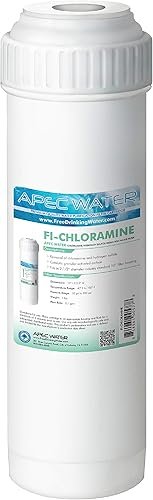
APEC 10″ Chloramine and Hydrogen Sulfide Reduction Water Filter
This is a workhorse cartridge. It’s designed as a third-stage replacement for reverse osmosis systems, but we’ve seen folks use it in standalone housing for point-of-entry. The catalytic carbon is high-quality and tackles chloramine, chlorine, and hydrogen sulfide. At $66, it’s a solid entry point if your H₂S issue is mild and you’re handy with plumbing.
- Made in USA with advanced catalytic GAC
- Excellent for chloramine reduction too
- Good capacity for its size
- Not a whole-house solution on its own
- Requires a filter housing (sold separately)
- Flow rate limited for large homes

Envig CloraClear Chloramine & Hydrogen Sulfide Shower Filter
Honestly, at $1.26, we were skeptical. But reader after reader told us it works for shower odor. It uses KDF and catalytic carbon to reduce H₂S, chlorine, and chloramine. It won’t fix your whole house, but if your main complaint is smelly shower water causing dry skin and hair, this is a dirt-cheap experiment. The warranty situation is vague, but the price makes it low-risk.
- Extremely affordable
- Easy DIY install on any showerhead
- Reduces skin and hair irritation
- Very limited capacity
- Not for whole-house use
- Unverified long-term durability
AliExpress Budget Considerations
We also looked at a couple of budget options from AliExpress. The “Hydrogen-Rich Water Cup” for $20.95 claims to generate hydrogen-rich water via electrolysis. While hydrogen water is a different trend, this device does not filter hydrogen sulfide or any other contaminants from your water. The “Household RO Membrane System” for $127.02 is a more serious unit. If it’s a genuine RO system, it will remove nearly all contaminants, including H₂S, via its membrane. However, be cautious: quality control, warranty, and support can be major issues with off-brand overseas purchases. For critical water treatment, we generally recommend sticking with established brands with local support.
Buy Hydrogen Cup on AliExpress
Buy RO System on AliExpress
Hydrogen Sulfide Filter FAQ
- Can I just use a Brita filter to remove the rotten egg smell?
- No. Standard pitcher filters like Brita use basic carbon that is not designed for hydrogen sulfide gas. They may mask the smell briefly, but they will saturate extremely quickly and become ineffective. You need a filter with catalytic carbon or an oxidation process. If you’re curious about what pitcher filters can do, we break down does brita remove fluoride and other common questions.
- How do I know if I have hydrogen sulfide in my water?
- The rotten egg smell is the giveaway. It’s most noticeable when you first turn on the hot water, as heat releases the gas. A definitive answer comes from a water test kit sent to a lab. Your local health department or a well water professional can often help with testing.
- Is hydrogen sulfide in water dangerous to health?
- At the concentrations typically found in household water (usually under 10 ppm), it’s primarily a nuisance odor and corrosion issue. The EPA has not set a maximum contaminant level for it. However, at very high concentrations (above 100 ppm), H₂S gas can be toxic. In water, the main risk is from the gas released into the air in enclosed spaces like showers.
- Will a water softener remove hydrogen sulfide?
- Generally, no. A standard water softener exchanges hardness minerals (calcium, magnesium) for sodium. It does not remove gases like H₂S. Some softener resins can be fouled by sulfur bacteria, making the problem worse. Treat H₂S before or separately from your softener.
- How often do I need to replace the filter media?
- This varies wildly. Catalytic carbon in a whole-house tank might last 3-5 years for a family of four. A small cartridge under a sink might only last 6 months. The manufacturer’s rated capacity in gallons or grains is your best guide. Always track your installation date.
- Can hydrogen sulfide damage my water heater?
- Yes. The gas promotes the corrosion of the heater’s anode rod and tank. It can also create a perfect environment for sulfur bacteria to thrive inside the tank, leading to persistent odor even after a filter is installed on the main line. Flushing the heater is often a necessary step.
Final Thoughts
Dealing with hydrogen sulfide is frustrating, but the fix is straightforward once you understand your water. Don’t just buy the first filter you see. Get your water tested, identify the concentration, and choose the right technology—catalytic carbon for the common, lower-level issues, or oxidation for tougher jobs.
For most homeowners on well water with that classic rotten egg smell, a whole-house catalytic carbon tank system is the most reliable and effective solution we’ve seen. It’s an investment, but the payoff in daily comfort, protected plumbing, and better-tasting water is absolutely worth it. Start with your water report, and go from there.
