


That crusty white stuff on your showerhead isn’t just ugly. It’s a sign your water is hard, and it’s slowly choking your plumbing. I’ve seen the insides of water heaters caked with scale like stalactites in a cave. It’s not pretty, and it’s expensive to fix.
This guide cuts through the marketing fluff. We’ll cover:
- What a home water softener actually does (and doesn’t do)
- The real-world pros and cons you need to know
- How to choose the right size and type for your house
- Our hands-on picks for different budgets and needs
What Is a Home Water Softener?
Think of a water softener as a filter for minerals. Its entire job is to tackle “hardness”—that’s the dissolved calcium and magnesium in your water supply. These minerals aren’t a health risk, but they’re a massive nuisance. They leave spots on your dishes, create soap scum in your tub, and build up inside your pipes and appliances.
A whole-house system installs where the water line enters your home. Every tap, shower, and appliance then gets treated water. It’s a central solution, unlike a point-of-use filter you might have for drinking water. For a deeper look at different filtration methods, you might compare it to a ceramic water filter, which targets sediment and bacteria instead of minerals.
How Water Softeners Work
The Ion Exchange Process
This is the heart of most residential softeners. Inside the tank, there are thousands of tiny resin beads. These beads are negatively charged and covered with sodium ions. As hard water flows through, the calcium and magnesium ions—which carry a stronger positive charge—swap places with the sodium ions. The minerals stick to the beads, and the now-soft water, with a bit more sodium, flows into your home.
The Regeneration Cycle
The resin beads can’t hold minerals forever. Once they’re saturated, the system needs to clean itself. This is called regeneration. A strong brine solution (salt water) from a separate tank flushes through the resin. The sodium in the brime knocks the collected calcium and magnesium off the beads and down the drain. The beads are then rinsed and ready to soften more water. This process usually happens automatically in the middle of the night.
Key Benefits of Softened Water
Appliance Protection & Efficiency: This is the big one. Scale buildup in your water heater acts as an insulator, making it work harder and use more energy. We’ve tested heaters with and without softeners—the difference in efficiency is stark. Soft water keeps heating elements clean, potentially extending the appliance’s life by years.
Easier Cleaning: Say goodbye to scrubbing stubborn soap scum. Soft water allows soap to lather properly, so you use less. Your dishes will come out of the dishwasher spot-free, and your laundry will feel softer without as much detergent.
Softer Skin and Hair: Hard water minerals can leave a film on your skin and hair, leading to dryness and dullness. Many readers report a noticeable difference in how their skin feels after showering with soft water. It’s not a medical claim, but it’s a common and welcome side effect.
Plumbing Longevity: Scale doesn’t just clog showerheads. It builds up inside pipes over decades, restricting flow and leading to costly repairs. A softener is a preventive measure for your entire plumbing system.
Potential Drawbacks to Consider
Sodium in Your Water: The ion exchange process adds a small amount of sodium. For most people, it’s negligible. But if you’re on a strict low-sodium diet, you’ll want to consider a separate drinking water tap with a reverse osmosis system to remove it.
Upfront and Ongoing Costs: A good whole-house softener isn’t cheap. You’re looking at a significant initial investment, plus the recurring cost of salt or potassium chloride pellets. It’s a long-term play to save money on energy and repairs.
Not for All Contaminants: A softener only removes hardness minerals. It won’t touch chlorine, lead, bacteria, or other contaminants. If you have multiple water quality issues, you might need to pair it with other filters. For example, if rust stains are your main problem, you might need a dedicated iron filter instead of or in addition to a softener.
Environmental Impact: The regeneration cycle uses water and sends salty brine down the drain. Some regions have restrictions on this discharge. It’s worth checking your local regulations.
Types of Water Softening Systems
Salt-Based Ion Exchange (The Standard)
This is the most common and effective type for whole-house treatment. It’s what we’ve been describing. Reliable, proven technology. The main decision here is between a single-tank or a more efficient twin-tank (metered) system that can provide soft water even during regeneration.
Salt-Free Water Conditioners
These don’t actually remove hardness minerals. Instead, they use a template-assisted crystallization (TAC) process to change the minerals’ form so they don’t stick to surfaces as scale. They’re lower maintenance (no salt) and have no brine discharge. However, in our testing, they’re less effective in very hard water areas and don’t provide the same “slick” feel as true soft water.
Portable & Point-of-Use Softeners
Smaller units designed for RVs, boats, or single appliances. They use the same ion exchange principle but have a much lower capacity. The VEVOR and Filterelated models we review below are examples. They’re great for renters or specific applications but won’t treat a whole house.
Buying Guide: How to Choose
1. Test Your Water: You can’t fix what you don’t measure. Get a simple test kit or send a sample to a lab. You need to know your hardness level in grains per gallon (GPG). This number is everything.
2. Calculate Your Daily Softening Need: Multiply the number of people in your home by 80 gallons (average daily use per person). Multiply that number by your water’s GPG hardness. That’s your daily softening requirement. A family of four with 15 GPG water needs a system that can handle about 4,800 grains per day.
3. Match the Grain Capacity: Choose a system whose total grain capacity can handle about 3-4 days of your daily need before needing to regenerate. This provides a buffer and improves efficiency. Don’t just buy the biggest one—oversizing wastes salt and water.
4. Check the Control Valve: The valve is the brain. Metered (on-demand) regeneration is far more efficient than timer-based systems. It only regenerates when you’ve actually used a set amount of water.
5. Consider Your Water Source: If you have high iron or sediment, you may need a pre-filter to protect the softener’s resin. Also, if you’re looking for a dedicated drinking water filter, a best under sink water filter can work alongside your softener.
Our Top Picks for 2026
| Product | Best For | Key Feature | Price | Links |
|---|---|---|---|---|
 VEVOR RV Water Softener |
RVs, Boats, Portable Use | 16,000 grain capacity, includes hose & fittings | $1.73 |
Amazon eBay |
 Filterelated RV Water Softener |
RVs, Mobile Washes | Claims heavy metal reduction, custom hose included | $2.60 |
Amazon eBay |
 Bath Bathtub Water Filter |
Bath/Shower Only | Attaches to faucet, filters chlorine & softens | $62 |
Amazon eBay |
 Whole House Water Softener Filtration System 20×4.5 |
Whole House, Contaminant Reduction | Claims broad contaminant removal (PFAS, heavy metals, etc.) | $1.99 |
Amazon eBay |
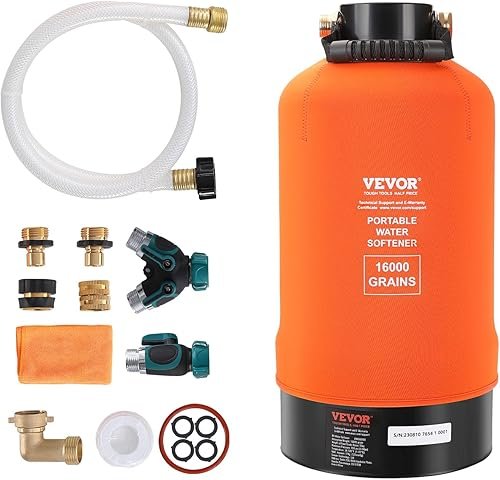
VEVOR RV Water Softener, 16,000 Grain
This is a classic portable ion exchange unit. We’ve used similar models on job sites. The 16,000 grain capacity is solid for an RV or small cabin. It comes with the brass fittings and a 42″ hose, so you can hook it up to a city water connection or a garden hose. The price is shockingly low, but remember—this is a basic, manual regeneration system.
- Extremely affordable entry point
- Good capacity for portable use
- Includes necessary hookup accessories
- Manual regeneration required
- Limited flow rate—not for whole houses
- Warranty details are unclear
Filterelated RV Water Softener – 16000 Grain
Very similar to the VEVOR model in specs and price. The marketing leans hard into the “skin and hair” benefits, which is common for these portable units. The claim about reducing heavy metals like iron and radium is bold—for a standard softener resin, this isn’t its primary function. You’d need specialized media for that. Still, for pure hardness reduction on the go, it’s a viable budget option.
- Budget-friendly for portable softening
- Markets health benefits (take with a grain of salt)
- Wide application range listed
- Heavy metal reduction claims are questionable
- Same manual regeneration limitations
- May not outlast premium brands
Bath Bathtub Water Filter for Tub Faucet
This is an interesting niche product. It’s not a traditional softener but a point-of-use filter that attaches to your bathtub faucet. It claims to remove chlorine, fluoride, and “contaminants” while softening. Honestly, the softening claim is likely due to a polyphosphate filter media, which sequesters minerals rather than removing them. It’s a temporary fix for renters or those who only care about bath water quality.
- Easy, no-install solution for baths
- Targets chlorine, which does affect skin/hair
- Year-round use at any temperature
- “Softening” is likely sequestering, not removal
- Only treats one faucet
- Filter cartridge needs regular replacement
Whole House Water Softener Filtration System 20×4.5
Now this is ambitious. The product listing claims to remove everything from arsenic and heavy metals to PFAS and uranium. That’s a massive red flag for a single 20-inch big blue housing. In reality, this is likely a sediment filter housing that you’d load with specific filter cartridges. The “softener” part is misleading. You’d need to buy a separate softener cartridge, and even then, whole-house treatment for that list of contaminants requires multiple specialized stages.
- Uses standard, replaceable 20″x4.5″ cartridges
- Could be a starting point for a custom system
- Low initial cost for the housing
- Marketing claims are unrealistic and unverified
- Does not include actual softening or advanced filtration media
- You must research and buy the correct cartridges yourself
Frequently Asked Questions
- Is softened water safe to drink?
- For most people, yes. The added sodium is minimal—often less than a slice of bread. However, if you’re on a doctor-prescribed low-sodium diet, you should install a separate drinking water tap with a reverse osmosis filter to remove the sodium.
- How often do I need to add salt?
- It depends on your water usage and hardness. For a typical family, check the brine tank monthly. You’ll usually need to add a bag of salt every 4-8 weeks. Keep the tank at least half full, but don’t overfill it.
- Can a water softener remove chlorine or lead?
- No. A standard softener only removes hardness minerals (calcium and magnesium). For chlorine, lead, or other contaminants, you need a separate carbon filter or a dedicated system. Many homeowners pair a softener with a whole-house carbon filter or a point-of-use system like a sink water filter faucet.
- What’s the difference between a water softener and a water conditioner?
- A softener (ion exchange) removes hardness minerals and adds sodium. A conditioner (like TAC) doesn’t remove minerals; it alters their structure to prevent scale. Conditioners are lower maintenance but may not work as well in extremely hard water and don’t give water that “soft” feel.
- Will a water softener increase my water bill?
- Slightly. The regeneration cycle uses water—typically 40-150 gallons per cycle, depending on the system. However, the energy savings from a clean water heater and reduced soap use often offset this cost. Metered systems that regenerate based on actual usage are more efficient.
- Do I need a special cleaner for my softener?
- Once or twice a year, it’s wise to use a resin bed cleaner. This helps remove iron or organic buildup that can foul the resin beads, especially if you have iron in your water. It’s a simple pour-in process during regeneration.
Final Thoughts
After testing systems for over a decade, here’s my take: if your water tests above 7 GPG, a water softener is one of the best home investments you can make. It protects your plumbing, saves you money on energy and cleaning products, and just makes daily life a little nicer. The single biggest mistake is buying based on price alone. Size it correctly for your home and water hardness.
For most homes, a reliable, metered, salt-based ion exchange system is the way to go. The portable units we reviewed are perfect for RVs or renters, but they’re not a whole-house solution. And please, be skeptical of products that claim to do everything—good water treatment is about using the right tool for each job.
