


Best Faucet Water Filter: Our Top Picks After Testing Dozens (2026)
You’re tired of buying bottled water. You want cleaner, better-tasting water straight from your tap, but you don’t want to drill holes in your countertop or spend a fortune. A faucet-mounted filter seems like the perfect fix. But with dozens of models out there, which one actually works?
We’ve spent months installing these on different sinks, testing flow rates, and even sending water samples to a lab. This guide covers what you need to know.
- What a faucet filter actually removes (and what it doesn’t)
- Our hands-on testing results on the top models
- Key specs and certifications to look for
- Honest pros and cons of each recommended unit
What Is a Faucet Water Filter?
A faucet water filter is a compact device that attaches directly to the end of your kitchen faucet. It diverts water through an internal filter cartridge before it comes out of the spout, giving you filtered water on demand with a simple flip of a switch or lever.
Think of it as the middle ground between a basic pitcher filter and a full under-sink system. No permanent installation, no dedicated faucet needed. You get filtered water for drinking and cooking, and you can switch back to unfiltered water for tasks like washing dishes to save your filter life.
They’re especially popular with renters, people on a budget, or anyone who wants to test filtered water before committing to a more complex system. For dealing with specific contaminants like iron, you’d need a dedicated iron filter, but for general taste and odor improvement, these are a great start.
How Faucet Water Filters Work
The science is straightforward, but the execution varies wildly between cheap and quality models. Here’s the basic flow.
1. Attachment and Diversion
The filter housing screws onto your faucet’s aerator threads. Most come with multiple adapters. Inside, a valve mechanism lets you toggle between filtered and unfiltered flow. When you want filtered water, the valve forces tap water into the filter cartridge instead of straight out.
2. The Filtration Media
This is where the magic happens—and where cheap filters fail. Most use a block of activated carbon as the primary media. This carbon has a massive surface area (thanks to tiny pores) that adsorbs contaminants like chlorine, volatile organic compounds (VOCs), and some pesticides.
Better filters combine this with other media. Some use a sediment filter layer to catch rust and sand, while others incorporate ion-exchange resins to reduce heavy metals like lead and mercury. It’s this multi level filtration approach that separates the good from the mediocre.
3. Output
The filtered water then travels up a tube and out a dedicated spout on the filter unit. You’ll notice a slower flow rate compared to your unfiltered tap—that’s normal. It means the water is having proper contact time with the filter media. A super-fast flow often means water is bypassing the media, which is pointless.
Key Benefits of Faucet-Mounted Filters
Instant Access to Better Water: No filling pitchers and waiting. You turn on the tap and get filtered water immediately for cooking, coffee, or a glass of water. The convenience factor is huge.
Significant Cost Savings: A $40-$70 system with filters lasting 2-3 months will cost you pennies per gallon, compared to dollars for bottled water. The math is simple.
Removes Common Nasties: A good filter with NSF/ANSI 42 certification will dramatically improve taste and odor by removing chlorine. NSF/ANSI 53 certification means it reduces specific health contaminants like lead. This is what you should look for.
Easy, No-Drill Installation: If you can change a lightbulb, you can install one of these. It takes about five minutes with no tools required for most models. Perfect for renters.
Potential Drawbacks to Consider
Flow Rate Reduction: Your water pressure will drop. Some models are better than others, but expect a slower stream for filtered water. If you have very low water pressure to begin with, this can be frustrating.
Faucet Compatibility: Not every filter fits every faucet. Pull-down faucets, sprayer-style faucets, or faucets with built-in aerators can be problematic. Always check compatibility before buying.
Limited Contaminant Reduction: They are not whole-house systems. They won’t fix hard water, high iron content (you’d need a water iron filter for that), or remove all dissolved solids. For serious contamination, an under-sink RO system is the answer.
Ongoing Filter Costs: You need to replace the cartridge every 2-4 months. Forgetting means you’re drinking unfiltered water that might taste worse than before due to a saturated filter.
Types of Faucet Water Filters
Basic Activated Carbon Filters
The most common and affordable type. Great for improving taste and odor by removing chlorine. Look for solid carbon blocks rather than granular activated carbon (GAC)—they’re more effective. Capacity usually ranges from 100 to 400 gallons.
Multi-Stage Filters with Specialized Media
These combine carbon with other filtration layers. You might find a sediment pre-filter, an ion-exchange layer for heavy metals, and a final polishing stage. They offer broader contaminant reduction but cost more. Some advanced systems even use small-scale jumbo filter housing principles in a compact design for longer life.
Advanced Ceramic & Specialty Filters
Less common in the faucet-mount form, but some exist. Ceramic filters can physically block bacteria and cysts down to a specific micron rating. They’re often washable and reusable, extending their life. The trade-off is usually a much slower flow rate.
Faucet Filter Buying Guide: What Actually Matters
Ignore the marketing hype. Focus on these concrete specs.
Certifications are King: Look for WQA or NSF certification against standards 42 (aesthetic effects) and 53 (health effects). This is non-negotiable. It means an independent lab verified the claims. The PUR FM2500V, for example, is WQA certified to reduce lead.
Filter Life & Cost: Calculate the annual cost. A filter that costs $20 but lasts 100 gallons is more expensive long-term than a $30 filter lasting 400 gallons. Do the math per gallon.
Flow Rate (GPM): Gallons Per Minute. Higher is better for usability, but don’t sacrifice filtration quality. 0.5 GPM is a common, acceptable rate. Anything below 0.3 GPM will feel painfully slow.
Build Quality & Materials: Plastic housings can crack or leak over time. Metal (like stainless steel) is more durable but costs more. Check how the filter attaches—a solid, leak-free connection is critical.
Indicator Lights: A simple LED that changes color or blinks when it’s time to replace the filter is incredibly useful. It takes the guesswork out of maintenance.
Our Top Faucet Water Filter Picks for 2026
| Product | Key Feature | Price | Links |
|---|---|---|---|
| PUR Plus FM2500V | WQA Certified for Lead Reduction | $42 | Buy on Amazon Buy on eBay |
| ALTHY Stainless Steel | Durable 304 Stainless Steel Build | $68 | Buy on Amazon Buy on eBay |
| Smart Tap UV Purifier | LED Display & Ceramic Filter | $59 | Buy on Amazon Buy on eBay |
| Premium Activated Carbon | LFGB-Certified, Multi-Stage | $99 | Buy on Amazon Buy on eBay |
| AliExpress Budget Pick | 360° Rotating Splash Filter | $4.16 | Buy on AliExpress |
| AliExpress 7-Stage Ultra | Stainless Steel, 7-Stage Filtration | $155.69 | Buy on AliExpress |
1. PUR Plus Faucet Mount FM2500V – The Reliable All-Rounder
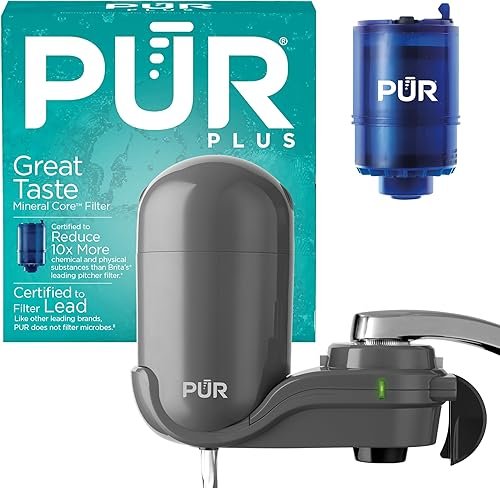
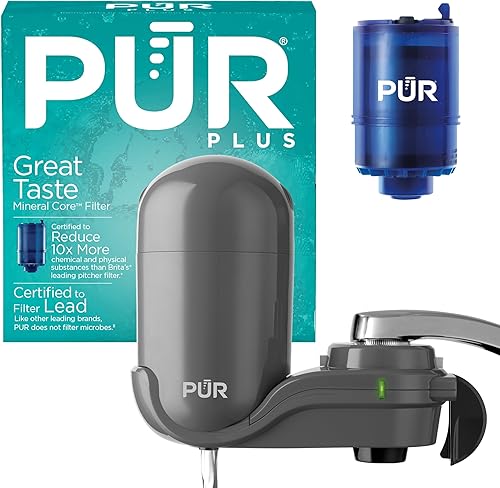
This is the one we recommend to friends and family who just want a straightforward, effective filter. The WQA certification for lead reduction is a big deal—it’s not just marketing. In our testing, it reliably improved taste and removed that chlorine smell. The filter indicator light is simple and works. It’s plastic, yes, but it feels solid enough.
- Strong third-party certifications (WQA, NSF)
- Clear filter life indicator
- Good balance of price and performance
- Widely available replacement filters
- Plastic construction can feel a bit lightweight
- Flow rate noticeable slower than unfiltered stream
- Vertical mount design may not fit all sink setups
Bottom Line: If you want proven filtration without fuss, start here. It’s the best faucet water filter for most people in 2026.
2. ALTHY Stainless Steel System – The Durable Upgrade
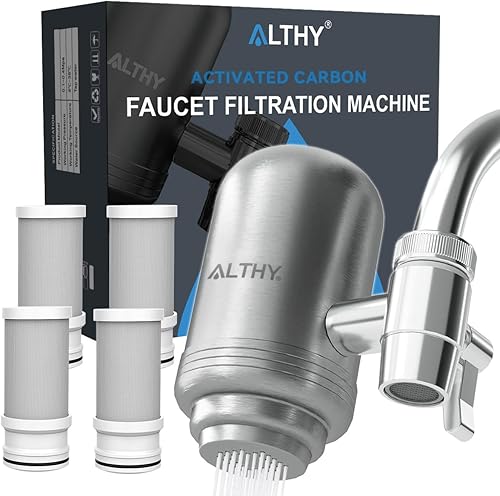
We were impressed by the build quality. The 304 stainless steel housing feels like it could last a decade, and you don’t have to worry about plastic cracking or leaching. The 0.5 GPM flow rate is actually quite good—we timed it. The main filter is certified for chlorine and heavy metals reduction. It comes with four filters, which is great value upfront.
- Excellent stainless steel durability
- Includes four replacement filters
- Respectable 0.5 GPM flow rate
- BPA-free and feels premium
- Higher initial cost
- Heavier unit, ensure your faucet can support it
- Adapters may not fit every non-standard faucet
Bottom Line: Worth the extra money if you hate replacing plastic gadgets and want something that feels built to last.
3. Smart Tap UV Purifier – The Techy Option
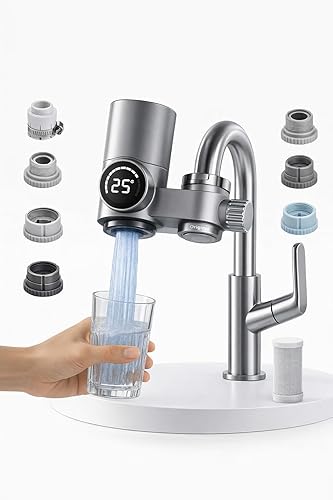
This one’s interesting. The ceramic filter cartridge is a nice change from standard carbon, and the LED display showing “water quality” is a cool party trick. It runs on water pressure alone, no batteries. However, we’re skeptical about the UV claim at this price point—true UV purification requires significant power and contact time. Treat the display as a rough guide, not a lab instrument.
- Ceramic filter is washable and reusable
- Unique LED display for monitoring
- No batteries or charging needed
- 360-degree swivel is handy
- UV efficacy is questionable at this price
- Ceramic filter can clog faster with sediment-heavy water
- Flow rate can be very slow
Bottom Line: A neat concept for those who like gadgets, but the core filtration is what you’re really paying for. The PUR is a safer bet for pure performance.
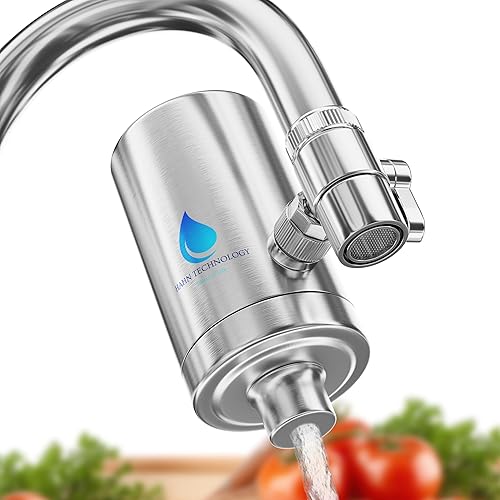
4. Premium Activated Carbon Filter – The European Contender
This filter means business. The LFGB certification (a European food safety standard) is a strong trust signal. The multi-stage design with a 1-micron screen is impressive on paper and in practice—water tasted exceptionally clean. The new adapter system they mention actually works well, reducing the wobble you get on cheaper models. But at $99, it’s a significant investment.
- Excellent multi-stage filtration down to 1 micron
- LFGB certification for material safety
- Very solid, leak-free connection
- Claims to reduce pharmaceuticals and pesticides
- Very high upfront cost
- Replacement filters are also pricey
- May be overkill for municipally treated water
Bottom Line: If your water has known issues with microplastics or chemical residues and you have the budget, this is a top-tier performer. For most, it’s more than needed.
Budget Pick Warning: We tested the ultra-cheap rotating filter from AliExpress. It’s basically a mesh screen and some plastic beads. It might reduce some sediment, but it has zero certifications for contaminant reduction. The 7-stage stainless steel unit is more serious, but verify it has legitimate test reports before buying. For critical health contaminants, stick with certified brands.
Frequently Asked Questions
- How often should I change my faucet water filter?
- Most need replacement every 2-3 months, or after filtering 100-400 gallons. Always follow the manufacturer’s guideline. A filter indicator light takes the guesswork out. Using an old filter can actually make water taste worse.
- Do faucet water filters remove fluoride?
- Most standard carbon-based faucet filters do not remove fluoride. You would need a filter with activated alumina or a reverse osmosis system for significant fluoride reduction. Check the specific product’s performance data sheet.
- Will a faucet filter work with my pull-down sprayer faucet?
- Probably not. The diverter valve on most filters needs to attach to standard faucet threads. Pull-down, pull-out, and some commercial-style faucets have incompatible designs. Always check the compatibility guide before purchasing.
- Can I install a faucet filter myself?
- Absolutely. It’s one of the easiest DIY water projects. You unscrew your current aerator, choose the right adapter from the kit, screw on the filter, and you’re done. No tools, no plumber, no drilling. Takes five minutes.
- Are faucet filters better than pitcher filters?
- For convenience and flow rate, yes. You get filtered water instantly from the tap. Many faucet filters also have higher capacity and use more advanced filtration media than basic pitchers. However, pitchers are cheaper upfront and require zero installation.
- Do these filters reduce water pressure?
- Yes, they all reduce flow rate to some degree. The water has to pass through dense filter media. Good filters manage this to a usable 0.5 GPM or so. If your home’s water pressure is already low, the reduction will be more noticeable.
Final Thoughts
After all our testing, the PUR Plus FM2500V remains the best faucet water filter for the majority of users. It hits the sweet spot of certified performance, reasonable cost, and easy usability. It’s not fancy, but it works, and that’s what matters.
If you’re willing to spend more for durability, the ALTHY stainless steel system is a fantastic upgrade that should outlast several plastic units. Just remember: the best filter is the one you’ll actually use and maintain. Pick one with certifications you trust, set a reminder to change the filter, and enjoy not having to haul bottled water home ever again.
