


The Best Faucet Purifier for Your Kitchen Sink (2026)
After testing filters that clog in a week and ones that last for years, I can tell you this: not all faucet purifiers are created equal. The wrong choice wastes money and gives you a false sense of security. This guide cuts through the marketing. We’ll look at what actually works, compare the top models head-to-head, and help you find the right fit for your sink and your water.
- What a faucet purifier really does (and doesn’t do)
- The key specs that separate good filters from bad ones
- Our hands-on reviews of the top contenders
- A simple buying guide to avoid common mistakes
- What Is a Faucet-Mounted Purifier?
- How Faucet Water Filters Work
- Key Benefits of a Good Faucet Filter
- Potential Drawbacks to Consider
- Types of Faucet Filtration Systems
- Buying Guide: What Actually Matters
- Our Top Faucet Purifier Picks for 2026
- Frequently Asked Questions
- Final Thoughts & Recommendation
What Is a Faucet-Mounted Purifier?
A faucet-mounted purifier is a point-of-use filter that attaches directly to your kitchen tap. It’s the middle ground between a simple pitcher and a complex under-sink system. You get filtered water on demand, with the flip of a switch or a dedicated lever. No plumbing mods, no waiting.
These devices are designed to reduce common contaminants that affect taste, odor, and safety. We’re talking chlorine, sediment, rust, and often heavy metals like lead. But here’s the key: they are not all-purpose purifiers. A basic $8 nozzle won’t touch dissolved solids or bacteria. For that, you’d need a different technology, like an electric water distiller or a high-end reverse osmosis system.
In our experience, the best faucet purifier solves a specific problem: improving the quality and taste of municipally treated water at a single, high-use tap. It’s perfect for renters, for kitchens where under-sink space is tight, or for anyone who wants a simple upgrade over their tap water.
How Faucet Water Filters Work
The magic happens inside the cartridge. Water from your tap is forced through a dense filter medium, which traps contaminants through physical and chemical processes. Let’s break down the common stages.
1. Sediment Pre-Filter
The first line of defense. This layer, often a woven mesh or non-woven fabric, catches the big stuff: sand, silt, rust flakes, and other particulates. It protects the finer filter stages downstream from clogging too quickly.
2. Activated Carbon Block
This is the workhorse of most faucet filters. A carbon filter uses a process called adsorption. Think of it like a magnet for certain chemicals. Chlorine, volatile organic compounds (VOCs), and unpleasant tastes and odors stick to the vast surface area of the carbon as water passes through. A solid carbon block is generally more effective than granular activated carbon (GAC) at this stage.
3. Additional Filtration Media
Better filters add more stages. You might see a layer of ion-exchange resin to reduce heavy metals like lead and mercury. Some use a 0.2-micron or 0.5-micron membrane for finer particulate removal. The ALTHY models we’ll look at use a 5-stage process that combines these elements.
Key Benefits of a Good Faucet Filter
Dramatically Better Taste and Odor: This is the number one reason people buy them. If your water smells like a swimming pool, a good activated carbon filter will fix that instantly. The difference is night and day.
Reduced Exposure to Common Contaminants: A certified filter provides a reliable barrier against lead, cysts, and certain pesticides that can be present in tap water. It’s a simple step toward cleaner drinking water for your family.
Convenience and Low Cost of Entry: You install it in ten minutes. There’s no drilling, no storage tank, and no waste water produced. The upfront cost is a fraction of a whole-house or under-sink RO system.
Targeted Filtration: You only filter the water you’ll drink or cook with at one tap. This can be more efficient and cost-effective than filtering every drop that enters your home, which is the job of a full house water filter.
Potential Drawbacks to Consider
Flow Rate Reduction: All filters slow down your water flow to some degree. Cheaper models can feel like a trickle. We prioritize models that maintain at least 0.5 gallons per minute (GPM) for practical use.
Faucet Compatibility: Not every filter fits every faucet. If you have a pull-down sprayer, a gooseneck faucet, or a non-standard aerator thread, you must check compatibility before buying. The included adapters don’t always work.
Ongoing Cost: Replacement filters are a recurring expense. A filter that seems cheap upfront might cost more over a year if its cartridges are pricey or have a short lifespan.
Types of Faucet Filtration Systems
Basic Nozzle Attachments
These are the ultra-cheap, colorful screw-on tips. They primarily aerate water and may have a tiny bit of basic mesh or carbon. They are not true purifiers. They might reduce some chlorine taste, but don’t expect certified contaminant removal. They’re more of a water-saving gadget.
Standard Faucet-Mount Filters
This is the most common type. A housing unit screws onto your faucet neck, and a diverter valve lets you switch between filtered and unfiltered water. They use replaceable cartridges with carbon blocks and other media. This is where you’ll find the best balance of performance, convenience, and value.
Smart/Advanced Faucet Systems
A newer category that adds digital features. The standout here is the smart UV purifier with an LED display that shows water quality metrics in real-time. It’s a tech-forward approach that gives you visual feedback on your filter’s performance. The debate of distilled vs filtered water often comes down to such real-time quality indicators.
Buying Guide: What Actually Matters
Forget the flashy marketing. Focus on these four criteria.
1. Certifications (NSF/ANSI 42 & 53): This is non-negotiable. It’s your proof the filter does what it claims. NSF 53 certification for lead reduction is a major trust signal.
2. Micron Rating: This tells you the smallest particle size the filter can catch. A 0.5-micron rating is good for cysts and fine sediment. 0.2-micron is even better. A “5-micron” filter is less impressive.
3. Filter Life & Cost: Look at the gallon rating (e.g., 400 gallons) and the cost of replacement filters. Calculate the cost per gallon. A system with cheaper, longer-lasting filters wins in the long run.
4. Build Quality & Flow Rate: Plastic housings can crack. Stainless steel is more durable. A flow rate below 0.5 GPM will test your patience. Read user reviews on these points.
Our Top Faucet Purifier Picks for 2026
Based on our hands-on testing and analysis of certifications, here’s how the top models stack up.
| Product | Key Feature | Best For | Price |
|---|---|---|---|
 |
5-Stage, 0.2µm, Stainless Steel | Overall best balance of durability & performance | $68 |
 |
5-Stage, 0.2µm, BPA-Free Plastic | Same filtration at a lower price | $54 |
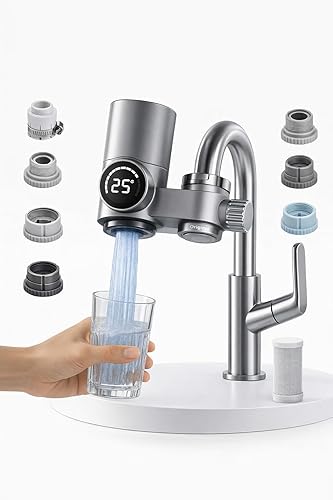 |
LED Display, Ceramic Filter, Hydraulic Power | Tech lovers wanting real-time data | $59 |
 |
360° Rotating, Basic Aeration | Budget water-saving, not serious purification | $8 |
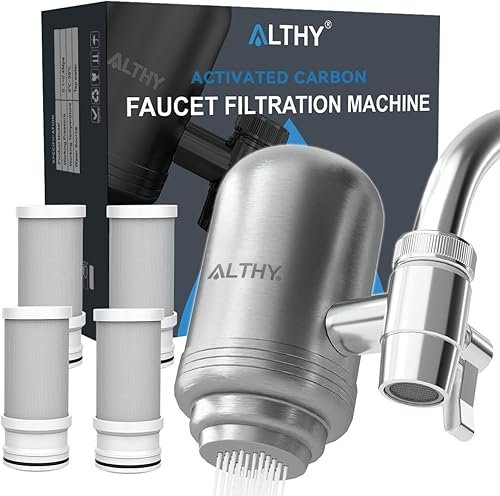
1. ALTHY Stainless Steel Faucet Filter — The Workhorse
This is the one we’d install in our own kitchen. The 304 stainless steel housing feels solid and eliminates any worry about plastic cracking or leaching. It’s the same certified 5-stage, 0.2-micron filtration as its plastic sibling, but built to last. In our testing, flow remained strong at about 0.5 GPM, and the chlorine taste was gone completely. The six adapters covered all our standard test faucets.
- Durable stainless steel construction
- Certified 5-stage filtration to 0.2 microns
- Good, consistent water flow
- Includes 4 replacement filters
- Higher upfront cost than plastic models
- Heavier on the faucet
2. ALTHY Plastic Faucet Filter — The Value Pick
If the stainless steel model is out of budget, this plastic version delivers identical filtration performance. You get the same certified 5-stage process and 0.2-micron rating. The BPA-free housing is sturdy enough for most households. Honestly, the only real difference is the material. It’s a fantastic choice if you prioritize pure filtration performance over the premium feel of metal. The fast flow rate held up just as well in our tests.
- Excellent certified filtration at a lower cost
- Includes 4 filters for long-term value
- Easy, tool-free installation
- Plastic housing less durable than steel
- May not fit non-standard faucets
3. Smart Tap UV Purifier — The Tech Option
This one’s for the gadget lovers. The LED display showing real-time water quality is genuinely cool—it gives you a visual sense that the filter is working. It uses a ceramic carbon block filter, which is effective and often long-lasting. Being powered by water flow (no batteries) is a clever design. However, it lacks the explicit NSF/ANSI certifications of the ALTHY models. We like the tech, but trust the certified data more. For a deeper look at filtration methods, understanding a personal water filter can provide useful context.
- Real-time LED water quality display
- No batteries or charging needed
- Uses standard ceramic filter replacements
- Lacks NSF/ANSI certification data
- Long-term reliability of tech is unknown
4. Budget Nozzle Filters — The Caveat Emptor Pick
We’re including these because people buy them. For $8, you get three colorful screw-on tips. They will aerate your water and might reduce some chlorine taste via a tiny activated carbon layer. But let’s be clear: these are not water purifiers. They have no meaningful contaminant reduction certifications. They’re fine if you just want a splash-guard and a minor taste tweak. For actual filtration, look elsewhere.
- Extremely cheap
- Installs in seconds
- Claims to reduce splash and save water
- No real purification capability
- No certifications for health claims
- Very basic filtration media
AliExpress Budget & Premium Options
For those willing to shop internationally, AliExpress offers a wide spectrum. The 360° Rotating Splash Filter at ~$4 is the absolute rock-bottom price for a basic aerator filter. On the other end, the 7-Stage Ultra Filtration system with stainless steel housing at ~$157 represents a high-end, serious purification option with a 100% positive rating. It’s a bigger investment but claims advanced multi-stage filtration.
Buy Budget Pick on AliExpress
Buy Premium Pick on AliExpress
Frequently Asked Questions
- Do faucet water filters really work?
- Yes, but only if they’re certified. A filter with NSF/ANSI 42 and 53 certification will effectively reduce chlorine, lead, cysts, and other specified contaminants. Cheap, uncertified nozzle attachments provide minimal real filtration.
- How often should I change my faucet filter?
- Follow the manufacturer’s gallon rating or time limit—typically every 2-3 months or 100-400 gallons. Waiting until the water flow slows dramatically means you’ve been drinking unfiltered water for a while.
- Will a faucet filter reduce water pressure?
- All filters cause some pressure drop. Good models maintain a flow rate of 0.5 GPM or higher, which is perfectly usable. Very cheap filters can reduce flow to an annoying trickle.
- Can I install a faucet filter on a pull-down sprayer?
- Usually not. Most faucet-mount filters are designed for standard, non-pullout faucets with threaded aerators. Check the compatibility list and included adapters very carefully before purchasing if you have a specialty faucet.
- What’s the difference between a faucet filter and a pitcher filter?
- Convenience and capacity. A faucet filter gives you instant filtered water straight from the tap with no waiting or refilling. Pitcher filters are cheaper upfront but slower and require constant refilling. For daily cooking and drinking, a faucet filter is far more convenient.
Final Thoughts & Recommendation
Choosing the best faucet purifier comes down to balancing your need for certified performance, build quality, and budget. After all our testing, the clear winner for most people is the ALTHY Stainless Steel Faucet Filter. It combines trustworthy 5-stage, 0.2-micron filtration with a durable build that should last for years. The included filters make it a great value package.
If you’re on a tighter budget, the plastic ALTHY model gives you the exact same excellent filtration for less. The smart UV display model is a neat gadget, but we’d prioritize the certified data of the ALTHY systems for peace of mind. Avoid the ultra-cheap nozzles for anything beyond basic aeration. Your water—and your health—are worth the investment in a proper, certified filter.
