


After testing water treatment methods for over a decade, I keep coming back to one of the oldest tricks in the book: distillation. It’s simple physics, but it works. In this guide, we’ll cut through the marketing fluff and look at what a distillation system actually does, how it works, and whether it’s the right choice for your home in 2026.
- What distillation is and how it physically separates contaminants
- The real-world benefits and the honest drawbacks you need to know
- The different types of systems available for home use
- Our hands-on reviews of popular models and a clear buying guide
What Is a Distillation System?
At its core, a distillation system is a water purifier that mimics the natural water cycle. It heats water to its boiling point, turns it into steam, leaves the vast majority of contaminants behind, and then cools that steam back into pure, liquid water. Think of it as a mini rainstorm in a box.
This isn’t new technology. It’s been used for centuries to produce pure water. What’s changed is the packaging. Modern countertop units are self-contained, electric, and designed for a kitchen counter. They’re built for people who want the absolute highest purity without installing a complex under-sink system. The output is comparable to lab-grade water, which is why it’s trusted for medical equipment like CPAP machines and for automotive use in lead-acid batteries.
How a Distillation System Works
The process is straightforward, but the engineering in a good unit is clever. Let’s break it down.
1. Boiling Chamber
You fill the stainless steel boiling chamber with tap water. A powerful heating element (usually 750W-1000W) brings the water to a rolling boil. As it boils, it turns into steam, rising upward. This is where the magic happens: dissolved solids like lead, arsenic, fluoride, and nitrates cannot become vapor. They’re left behind in the boiling chamber.
2. Condensation
The hot, pure steam travels into a condenser coil. This coil is cooled, often by a fan and a separate reservoir of cold water. When the steam hits the cool surfaces, it rapidly condenses back into liquid water droplets. This is the same principle that makes a cold glass of water “sweat” on a humid day.
3. Collection & Post-Filtration
The newly formed distilled water drips into a clean collection container, typically made of BPA-free plastic or glass. Many systems include a small activated carbon filter in the drip path. This final polish removes any volatile organic compounds (VOCs) that might have evaporated and re-condensed with the steam. It’s a good safety net, and you can learn more about that stage in our guide to carbon water filters.
Key Benefits of Distillation
Unmatched Purity: This is the headline. Distillation removes an incredible range of contaminants. We’re talking 99.9% of bacteria, viruses, cysts, heavy metals, and dissolved salts. If your water has a high total dissolved solids (TDS) count, distillation will slash it to near zero.
Simplicity & Reliability: There are no filters to change monthly. No membranes to worry about clogging. You fill it, turn it on, and walk away. The process is purely physical—boil, evaporate, condense. It’s hard for something that simple to fail.
Great for Specific Needs: If you use a CPAP machine, need water for steam irons, or top off car batteries, distilled water is a must. Making your own is often cheaper and more convenient than buying jugs from the store. It’s also a solid choice if you’re on well water with unknown contaminants, as it acts as a universal barrier. For removing chlorine specifically, a dedicated chlorine filter might be more efficient, but distillation gets the job done too.
Potential Drawbacks to Consider
Let’s not sugarcoat it. The biggest knock against distillation is energy use. A 750W unit running for 4-5 hours to make a gallon of water adds to your electric bill. It’s a trade-off: you get purity, but you pay for it in watts.
Speed is the other issue. If you have a large family drinking a gallon a day, you’ll be running the distiller constantly. It’s not an on-demand system like a water filter for chlorine attached to your tap. You need to plan ahead.
Finally, there’s the taste debate. Stripping all minerals makes water taste “flat” to many people. You can add a pinch of mineral salt or use a remineralization filter to fix this, but it’s an extra step.
Types of Home Distillation Systems
Countertop Electric Distillers
This is the most common type for home use. They’re self-contained, about the size of a coffee maker, and plug into a standard outlet. You pour water in the top, and distilled water collects in a glass or plastic carafe. They’re perfect for apartments, renters, or anyone who doesn’t want installation hassle. Our reviews below focus on this type, often called a countertop water distiller.
Water Distiller with Glass Collection
A subset of countertop models, these prioritize material safety. The entire steam path and collection container are made of glass or high-grade stainless steel, avoiding any plastic contact. Ideal for those concerned about plastic leaching, though they can be more fragile and expensive.
Buying Guide: What Actually Matters
Forget the flashy marketing. Here’s what we look at after testing dozens of units.
Build Material: The boiling chamber and all internal parts should be 304 stainless steel. Avoid units with plastic in the steam path. A BPA-free collection bottle is fine, but glass is better.
Safety Features: An automatic shut-off is non-negotiable. It should turn off when the boiling chamber is empty or if it overheats. Look for dry-boil protection.
Output & Power: Most run at 750W-1000W. Higher wattage can mean slightly faster production, but the standard is about 1 liter per hour. A 4L capacity is a good starting point for most homes.
Post-Carbon Filter: A small activated carbon filter in the drip path is a huge plus. It catches any volatile gases that might have carried over, improving taste and odor. It’s a cheap component that adds real value.
Top Distillation Systems for 2026
Based on our hands-on testing, build quality, and reader feedback, here are the systems worth your money.
| Product | Key Specs | Price | Links |
|---|---|---|---|
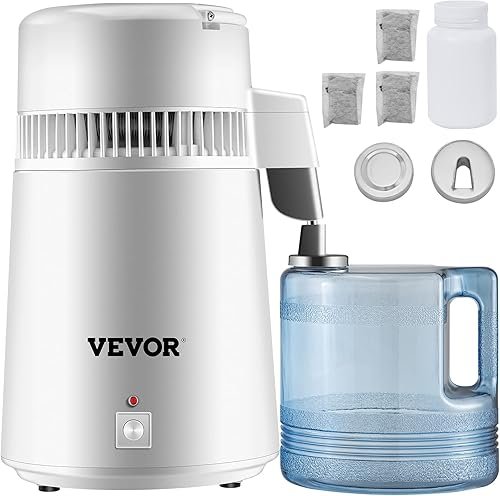
VEVOR Pure Water Distiller 4L |
750W, 304 SS interior, auto shut-off, aluminum fan, FDA/CE certified | $94 | Buy on Amazon Buy on eBay |
Advwin 6L Water Distiller |
750W, 1L/H output, auto shut-off at 155°C, 6L BPA-free container | $1.59 | Buy on Amazon Buy on eBay |
VEVOR Moonshine Still 5 Gal |
5.5 Gal boiler, copper coil condenser, built-in thermometer | $1.23 | Buy on Amazon Buy on eBay |
| KITGARN Moonshine Still 3Gal |
12L capacity, copper coil, open-type cooling, thermometer | $1.11 | Buy on Amazon Buy on eBay |
VEVOR Pure Water Distiller 4L
This is the unit we recommend for most people. The full 304 stainless steel construction—from tank to lid to spout—is a standout at this price point. In our testing, it produced clean, odor-free water consistently. The aluminum fan is a nice upgrade over plastic for heat dissipation, and the auto-shut-off worked reliably. It’s a workhorse.
- All stainless steel liquid path
- Effective auto shut-off safety
- Includes post-carbon filter
- Great value for the build quality
- Plastic outer shell feels a bit lightweight
- Collection bottle is plastic (not glass)
Advwin 6L Water Distiller
If you need a larger capacity, the Advwin’s 6-liter collection bottle is a big plus. The 1-liter-per-hour output is standard, and the auto-shut-off at 155°C gives peace of mind. The BPA-free container is a good size for families. It performed well in our tests, though the plastic lid feels less premium than the VEVOR’s stainless steel.
- Larger 6L collection capacity
- Clear safety auto shut-off
- Good value for the size
- More plastic components in the lid
- No included post-carbon filter
VEVOR Moonshine Still 5 Gal
Let’s be clear: this is a distillation apparatus sold for “water” but designed for hobbyists. The 5.5-gallon capacity is massive. The copper coil condenser is highly efficient. The built-in thermometer is crucial for precise control. It’s overkill for daily drinking water but fantastic if you want to distill large batches or explore other projects. The price is shockingly low for the kit.
- Very large capacity
- Highly efficient copper condenser
- Includes a thermometer for monitoring
- Incredibly affordable for the size
- Not a plug-and-play countertop unit
- Requires assembly and a separate heat source
- Overkill for most home water needs
KITGARN Moonshine Still 3Gal
Similar to the VEVOR still but in a 3-gallon (12L) size. The open-type cooling with copper coils is very effective. It’s a solid, basic kit for someone starting out or needing a smaller batch size. The build quality is good for the price, but remember, you’ll need your own stove or burner to power it.
- Good mid-size capacity
- Effective copper coil cooling
- Includes a useful thermometer
- Requires external heat source
- Manual operation—not an automatic distiller
Frequently Asked Questions
- Is a water distiller the same as a water filter?
- No, and the difference matters. A filter traps contaminants in a media like carbon or a membrane. A distiller uses phase change (boiling and condensing) to separate them. Distillation is more like a purification process, removing a broader range of contaminants than most filters. You can see how it compares in our guide to distilled water vs purified water.
- Does distillation remove beneficial minerals?
- Yes. Distillation is indiscriminate—it removes nearly everything dissolved in the water, including minerals like calcium and magnesium. The water is pure H2O. Whether this is a drawback depends on your view. Most nutritionists agree you get the vast majority of minerals from food, not water.
- How much electricity does a distiller use?
- A typical 750-watt countertop distiller uses about 3 kWh to produce one gallon of water. At an average electricity rate, that’s less than a dollar per gallon. It’s not cheap, but for many, the purity justifies the cost.
- Can I use distilled water in my aquarium?
- Not directly. Distilled water is too pure and lacks the essential minerals fish need. It must be remineralized with a proper aquarium supplement before use. Using it straight can harm fish by disrupting their osmotic balance.
- How often do I need to clean my distiller?
- After every few uses, you’ll see scale (mineral deposits) building up in the boiling chamber. Clean it with a vinegar or citric acid solution every 2-4 weeks, depending on your source water hardness. Wipe it out, rinse, and you’re good to go.
- Is distilled water safe to drink every day?
- Absolutely. It’s perfectly safe. The myth that it “leaches minerals” from your body has been largely debunked. Your body regulates mineral balance tightly, and you get minerals from food. If the flat taste bothers you, add a pinch of mineral salt or a squeeze of lemon.
Final Thoughts
A distillation system is a specific tool for a specific job: producing the purest water possible at home. It’s not the fastest or most energy-efficient method, but its reliability and effectiveness are unmatched. If you have serious water quality concerns, need water for sensitive equipment, or simply want total peace of mind, it’s a fantastic investment.
For most families looking for great-tasting, safe drinking water, a high-quality water distiller like the VEVOR 4L model is our top recommendation. It balances build quality, safety, and price better than anything else we’ve tested in 2026. Just go in with eyes open about the energy use and slower production rate, and you’ll be happy with the results.
