


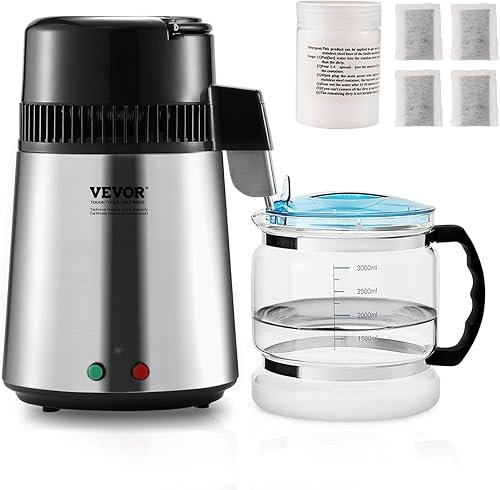
After testing water filters for over a decade, I’ve seen countertop distillers go from niche lab equipment to a popular kitchen gadget. But are they right for your home? This guide cuts through the marketing fluff. We’ll look at what they actually do, their real-world pros and cons, and review some of the most popular models you can buy right now.
- What a countertop distiller is and how it purifies water.
- The honest benefits and drawbacks based on our testing.
- A clear buying guide to choose the right capacity and features.
- Detailed reviews of top VEVOR distillers for 2026.
What Is a Countertop Water Distiller?
Think of it as a mini water cycle in a box. A countertop distiller is an electric appliance that sits on your kitchen counter. It takes regular tap water, boils it into steam, leaves the impurities behind, and then cools that steam back into pure, liquid water. It’s one of the most thorough purification methods available to homeowners.
Unlike filters that trap contaminants, distillation physically separates water from everything else. The result is H2O in its purest form—typically 99.9% free of bacteria, viruses, heavy metals, and dissolved solids. If you’re curious about how this compares to other methods, our breakdown of distilled vs filtered water explains the key differences in outcome and process.
How a Countertop Distiller Works
The process is beautifully simple, which is part of its reliability. Here’s the step-by-step journey your water takes inside the machine.
1. Boiling Chamber
You pour tap water into a stainless steel boiling chamber. A powerful heating element (usually 750W-1000W) brings the water to a rolling boil. This kills most bacteria and viruses right off the bat. As it boils, steam rises, leaving behind scale, heavy metals, and other dissolved solids.
2. Condensation
The pure steam travels into a condenser coil. A fan blows cool air over this coil, causing the steam to condense back into liquid water. This is the critical step—contaminants with a higher boiling point than water never make it into the vapor, so they’re left behind in the boiling chamber.
3. Post-Filtration & Collection
Most distillers include a small carbon filter in the drip path. This is a final polish to remove any volatile organic compounds (VOCs) that might have evaporated with the steam. For a deeper look at this stage, you can explore how a granular activated carbon filter works. The purified water then drips into a glass or BPA-free plastic carafe.
Key Benefits of Using a Distiller
Purity You Can Trust: This is the big one. Distillation removes virtually everything: lead, arsenic, bacteria, viruses, fluoride, nitrates, and salts. If you have well water or questionable municipal supply, this gives you peace of mind. It’s a different approach than, say, an alkaline water treatment, which focuses on changing pH and mineral content rather than removing contaminants.
Simplicity and Low Maintenance: No complicated filter cartridges to change every month. You mainly need to descale the boiling chamber with citric acid every few weeks. The process is foolproof.
Versatility: The pure water is great for more than drinking. Use it in steam irons, CPAP machines, humidifiers, car batteries, and lab experiments to prevent mineral buildup. It’s also the base for making perfect herbal tinctures or baby formula.
Potential Drawbacks to Consider
It’s Slow: A typical 4-liter distiller takes 4-6 hours to process one batch. You can’t use it on-demand like a faucet filter. Plan ahead.
Energy Use: Running a 750W heater for hours adds to your electric bill. It’s not the most energy-efficient method for large volumes of water.
“Flat” Taste & No Minerals: The process removes beneficial minerals like calcium and magnesium, resulting in a flat, “empty” taste. Some people love it; others find it odd. You’re not getting the mineral enhancement an alkaline filtration system would provide.
Not for Whole-House: These are strictly countertop units for drinking/cooking water. They won’t filter shower or laundry water. For chlorine removal at the tap, a dedicated chlorine water filter is more practical.
Types of Countertop Distillers
Most consumer models are similar, but a few key distinctions exist.
Standard Automatic Distillers
This is the type we’re focusing on. They have an auto-shutoff when the boiling chamber is empty. They come with a glass or plastic carafe and a simple carbon post-filter. The VEVOR models below are classic examples.
Distillers with Timers & Displays
A step-up feature. You can set a delay start (e.g., distill overnight) and see the current water temperature. Handy, but not essential for pure water production.
Buying Guide: What Actually Matters
Forget fancy marketing. Based on our testing, here’s what to look for.
Boiling Chamber Material: Insist on 304 stainless steel. It’s durable, easy to clean, and won’t leach anything into your water. Avoid plastic chambers.
Carafe Material: Glass is best—it doesn’t leach and won’t hold odors. High-quality BPA-free plastic (like PBT) is acceptable and more durable.
Wattage & Speed: 750W is the standard. Higher wattage (like 1000W) means faster distillation but higher energy use. For a 4L unit, 750W is a good balance.
Cooling System: Look for upgraded metal fan blades and stainless steel condenser parts. They last longer and dissipate heat better than all-plastic internals.
Capacity: 4 liters (about 1 gallon) is the most common size. It’s enough for a day’s drinking water for 1-2 people. If you have a larger family or high usage, you’ll be running it constantly.
Top Countertop Distiller Picks for 2026
We’ve focused on VEVOR models here because they dominate the affordable countertop distiller market and offer solid performance for the price. Here’s a quick comparison.
| Product | Key Features | Price | Links |
|---|---|---|---|
| VEVOR 4L Distiller (Silver) | 750W, 304 SS interior, glass carafe, aluminum fan blades | $1.33 |
Buy on Amazon Buy on eBay |
| VEVOR 4L Distiller (Black) | 750W, 304 SS interior, PBT plastic carafe, upgraded SS heat tube | $1.06 |
Buy on Amazon Buy on eBay |
| VEVOR 4L Distiller (White, Timer) | 750W, 304 SS, plastic carafe, 0-99H timer, temp display | $1.14 |
Buy on Amazon Buy on eBay |
| VEVOR 4L Distiller (Silver, Glass) | 750W, 304 SS, glass carafe, dual temp display, 1L/H speed | $1.53 |
Buy on Amazon Buy on eBay |
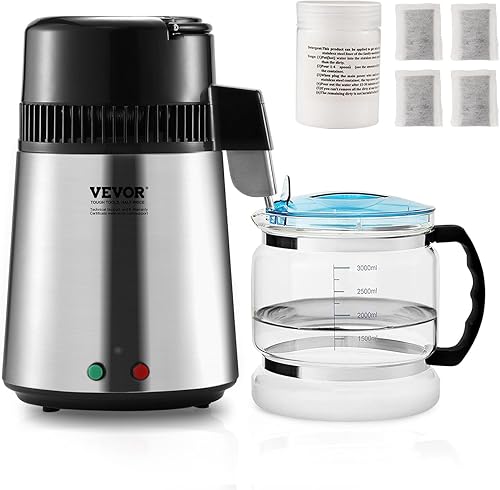
VEVOR 4L Water Distiller (Silver) – The Reliable Workhorse
This is the baseline model, and it’s a solid one. We’ve run this unit for months. The glass carafe is a huge plus—it feels clean and doesn’t retain the faint plastic smell you sometimes get. The 750W heater boils a full 4L batch in about 5 hours. The aluminum fan is a noted upgrade from earlier plastic versions. Honestly, for most people, this is all you need.
- Glass carafe is superior for purity and taste
- 304 stainless steel boiling chamber
- Proven, simple auto-shutoff design
- No timer or digital display
- Basic carbon filter included
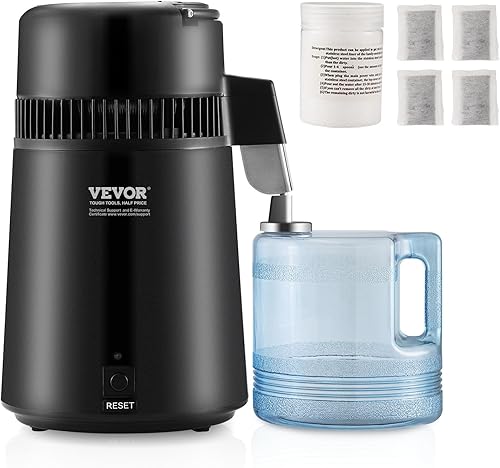
VEVOR 4L Water Distiller (Black) – The Budget Pick
Same core performance as the silver model, but with a PBT plastic carafe to save a few bucks. In our testing, the plastic didn’t affect water purity, but it can absorb odors over time if you don’t clean it promptly. The upgraded stainless steel heat dissipation tube is a nice touch for longevity. A good choice if you’re budget-conscious and don’t mind plastic.
- Most affordable option
- Durable PBT plastic carafe (less breakable)
- Upgraded stainless steel condenser parts
- Plastic carafe can retain odors
- No advanced features
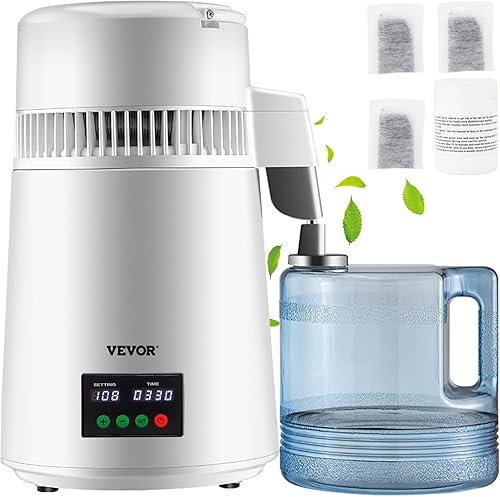
VEVOR 4L Distiller (White, Timer) – The Set-It-Forget-It Model
The main draw here is the 0-99 hour delay timer. Set it up before bed, and wake up to a full carafe of pure water. The temperature display is handy for the curious, but not critical. It still uses a plastic carafe. If your routine benefits from scheduling, this feature is worth the small premium. We found the timer to be reliable.
- Delay timer for scheduled distillation
- Temperature display for monitoring
- Includes cleaning powder and extra carbon packs
- Plastic carafe
- Interface is a bit basic
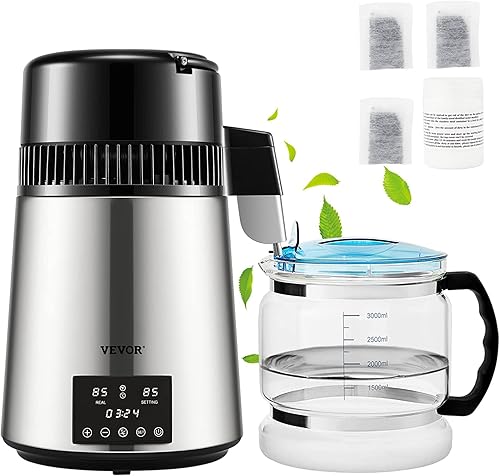
VEVOR 4L Distiller (Silver, Glass) – The Premium Choice
This is our top pick if you can spend a little more. You get the best of both worlds: a glass carafe for purity and the convenience of a dual temperature display. It also boasts a faster 1L/H distillation speed. The build feels a notch above the basic models. For serious users who want pure water and useful features, this is the one to get.
- Glass carafe + digital display combo
- Faster distillation speed (1L/H)
- Includes cleaning powder and carbon packs
- Highest price point
- Glass requires careful handling
Frequently Asked Questions
- Is distilled water safe to drink every day?
- Yes, it’s completely safe. The myth that it “leaches minerals” from your body is overstated—you get most minerals from food. If you’re concerned, add a pinch of high-quality salt to your glass.
- Can a distiller remove chlorine or chloramine?
- Yes, very effectively. The boiling process vaporizes chlorine, and the carbon filter catches any残留. It’s more thorough than many basic filters for chlorine filtration.
- How much electricity does a countertop distiller use?
- A 750W unit running for 5 hours uses about 3.75 kWh. Your cost depends on your electricity rate, but expect roughly $0.50-$1.00 per full batch.
- Why does my distilled water taste flat?
- Because it lacks dissolved minerals like calcium and magnesium that give water its “crisp” taste. It’s not harmful—just pure H2O. Some people get used to it; others add minerals back.
- How often do I need to clean the distiller?
- Descale the boiling chamber every 2-4 weeks, depending on your water hardness. Use citric acid or the provided cleaning powder. Wipe it out after each batch to prevent buildup.
- Can I distill well water or rainwater?
- Absolutely. Distillation is excellent for questionable water sources, as it kills pathogens and removes heavy metals. Just clean the boiling chamber more frequently if the water is very hard.
Final Thoughts
A countertop water distiller isn’t for everyone. If you want fast, mineral-rich water from your tap, a good carbon block or granular activated carbon filter is a better fit. But if your priority is absolute purity—for health reasons, sensitive appliances, or peace of mind—a distiller is hard to beat.
From the models we’ve tested, the VEVOR line offers reliable performance at a fair price. Our recommendation? Go for the VEVOR 4L with Glass Carafe and Display if you want the best experience. If budget is tight, the basic Silver model with glass carafe will serve you well for years. Just remember to factor in the slow process and electricity use. It’s a simple trade-off for water you can truly trust.
