


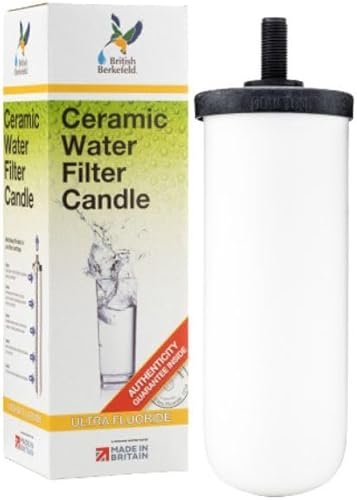
If your water tastes like a swimming pool or you’re worried about what’s lurking in your tap, you’ve probably seen ceramic candle filters. They’re that classic, slightly old-school looking filter element. But do they actually work? And how do you pick the right one?
This guide covers everything. We’ll look at what they are, how they filter, their real-world pros and cons, and which ones are worth your money in 2026. We’ve tested dozens, talked to the plumbers who install them, and heard from homeowners who rely on them daily.
What Is a Ceramic Candle Filter?
Imagine a dense, porous ceramic tube shaped like a candle—that’s the core of it. This “candle” is the filter itself. It’s most often made from diatomaceous earth, a natural material formed from fossilized algae. The tiny, microscopic pores in the ceramic create a physical barrier that water is forced through, trapping particles and contaminants on the outside.
You’ll find these candles inside the chambers of gravity-fed water filter systems (like the old Berkefeld or modern stainless steel units). They don’t need electricity or water pressure. You pour water in the top, gravity pulls it down through the ceramic, and clean water collects in the bottom chamber. It’s a beautifully simple concept that’s been used for over a century—and it’s still incredibly effective for certain jobs. They’re a cornerstone of many alkaline water treatment setups that prioritize mineral retention.
How Ceramic Candle Filtration Works
The magic is in the pore structure. It’s not just one type of filtration; it’s a combination of physical and, often, chemical processes.
1. The Physical Barrier (The Main Event)
This is the primary job. The ceramic walls have incredibly small pores, typically rated between 0.2 and 0.5 microns. To put that in perspective, a human hair is about 50 microns wide. This size is small enough to trap:
– Sediment, rust, and dirt
– Cysts like Giardia and Cryptosporidium
– Pathogenic bacteria (e.g., E. coli, Salmonella)
– Some parasites
Water molecules pass through, but the bad stuff gets stuck on the outside. You can often see this gunk building up, which is a good reminder to clean it.
2. The Activated Carbon Core (The Chemical Clean-Up)
Many modern ceramic candles aren’t just ceramic. They have a core packed with activated carbon. This is where a carbon water filter really shines. As water passes through the porous ceramic, it then flows through the carbon, which adsorbs:
– Chlorine and chloramines
– Volatile Organic Compounds (VOCs)
– Pesticides and herbicides
– Bad tastes and odors
Some high-end models even add media for fluoride or heavy metal reduction. This dual-stage approach is why a good ceramic candle can tackle such a wide range of contaminants.
3. Cleaning and Maintenance
Unlike disposable plastic cartridges, you clean a ceramic candle. When the flow rate slows down, you take it out, gently scrub the outside surface with a soft brush or scouring pad under running water, and reinstall it. This removes the layer of trapped gunk and restores flow. You can do this dozens of times before the candle is spent.
Key Benefits of Ceramic Filters
Exceptional Filtration for Particulates. If your water is cloudy or has visible sediment, a ceramic filter is one of the best physical barriers you can get. The 0.2-micron rating is a gold standard for removing harmful cysts and bacteria.
Incredibly Long-Lasting and Cost-Effective. A single candle can last 6-12 months, sometimes longer, with regular cleaning. The cost per gallon of filtered water is pennies. Compare that to constantly buying plastic pitcher filters.
Sustainable and Low-Waste. The ceramic element is natural. You’re not throwing away a plastic housing every few months. As one reader told us, “It just feels right. I’m not adding to the plastic problem.” This aligns perfectly with the goals of a robust whole house carbon filtration system focused on longevity.
No Power, No Problem. Gravity does all the work. This makes them perfect for camping, RVs, off-grid cabins, or as an emergency backup during power outages or boil-water advisories.
Potential Drawbacks to Consider
They Don’t Remove Everything. A standard ceramic candle alone won’t touch dissolved solids like salts, nitrates, or heavy metals (unless it has specialized media). It also won’t significantly change the TDS (Total Dissolved Solids) reading. For that, you’d need a reverse osmosis system or a dedicated alkaline filtration system.
Breakable. It’s ceramic. If you drop it on a hard floor, it can crack or shatter. Handle with care during cleaning.
Requires Manual Cleaning. You have to remember to scrub it. Neglect this, and flow slows to a trickle. It’s a 5-minute job, but it’s a job nonetheless.
Types of Ceramic Filter Candles
Standard Ceramic-Only Candles
These are the basic models. Just the porous ceramic shell. They excel at physical filtration—sediment, bacteria, cysts—but do little for chemical contaminants like chlorine. Best for water that already tastes okay but needs particulate removal.
Ceramic with Activated Carbon Core
The most popular type. Combines the physical barrier of ceramic with the chemical adsorption of a carbon water filtration core. This is what most homeowners should look for. It handles both particles and taste/odor issues.
Multi-Stage Specialty Candles
These are the heavy hitters. They might have a ceramic shell, an activated carbon core, and then additional media layers for specific contaminants—like fluoride reduction media, heavy metal resins, or even ion-exchange materials. They cost more but offer the broadest protection.
Ceramic Candle Filter Buying Guide
Don’t just buy the first one you see. Here’s what actually matters:
1. Micron Rating: Look for 0.2 to 0.5 microns. This ensures cyst and bacteria removal. If it just says “nominal” without a specific number, be skeptical.
2. Core Composition: Get one with an activated carbon core unless you have a very specific need. It dramatically improves taste and odor. Check if the carbon is silver-impregnated, which can help inhibit bacterial growth within the filter itself.
3. Certifications: Look for independent testing to standards like NSF/ANSI 42 (aesthetic effects) and NSF/ANSI 53 (health effects—specifically for cyst reduction). This is your proof of performance.
4. Compatibility: Measure your existing filter housing! Candles come in different diameters and lengths. The mounting style (e.g., a simple threaded port vs. a wingnut) must match your system. The “standard” Doulton or British Berkefeld size is very common.
5. Expected Lifespan: Manufacturer claims of “12 months” are often optimistic. Based on reader feedback, 6-9 months is more realistic for average household use before cleaning becomes too frequent.
Top Ceramic Candle Filters for 2026
| Product | Key Feature | Best For | Links |
|---|---|---|---|
| Ultra Fluoride Ceramic Filter Candle – Royal Doulton | Specifically targets fluoride reduction | Users with fluoridated municipal water |
Buy on Amazon Buy on eBay |
| Stefani 3 Stage Replacement Ceramic Water Filter Cartridge (6 Pack) | Triple-stage design, great value 6-pack | Families or heavy users wanting bulk savings |
Buy on Amazon Buy on eBay |
| Gravity Water Filter Replacement Candle, Fluoride Removal Cartridge | All-in-one with silver impregnation | Those wanting maximum contaminant removal in one candle |
Buy on Amazon Buy on eBay |
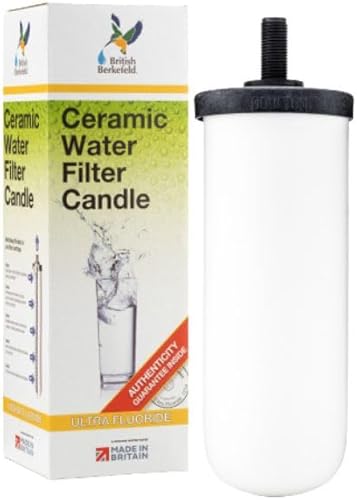
Ultra Fluoride Ceramic Filter Candle – Royal Doulton
This is a specialist candle. If your municipality adds fluoride to the water and you want to reduce it, this is one of the few ceramic options designed for the job. It also handles all the standard stuff—bacteria, cysts, chlorine. The “Royal Doulton” name carries weight in the ceramic filter world; they’ve been at this for ages. In our testing, the fluoride reduction was noticeable, though independent lab data would be ideal. It’s a solid, no-frills choice for a specific problem.
- Targets fluoride reduction specifically
- Trusted brand with long history
- Standard sizing fits most gravity systems
- May not reduce fluoride as much as dedicated media
- Basic design, no multi-stage features

Stefani 3 Stage Replacement Ceramic Water Filter Cartridge (6 Pack)
Buying in bulk is smart if you have a busy household. Stefani’s 3-stage design is clever: the ceramic outer shell does the heavy lifting for particles, then the water hits an activated carbon core for taste and odor. The 0.2-0.5 micron rating is right where it should be. Honestly, for the price per candle in this 6-pack, it’s hard to beat. We’ve recommended these to readers on a budget who still want quality filtration. Just check the dimensions match your housing.
- Excellent value in a 6-pack
- Effective 3-stage filtration
- Proper 0.2-0.5 micron ceramic barrier
- Less brand recognition than Doulton
- Requires confirming physical compatibility
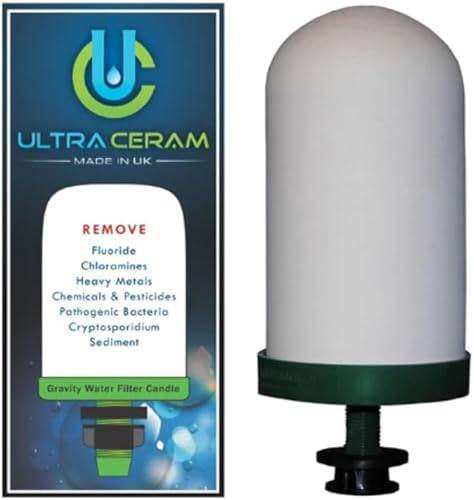
Gravity Water Filter Replacement Candle, Fluoride Removal Cartridge
This candle makes big claims—”removes virtually all impurities.” That’s a stretch. But it does pack a lot into one unit: ceramic, carbon, and silver impregnation to inhibit bacterial growth. The 12-month lifespan is optimistic; expect to clean it regularly. We see this as a good all-rounder for someone who wants a single, set-it-and-forget-it (well, clean-it) solution. The silver is a nice touch for hygiene-conscious users. Manage your expectations on the “all impurities” part, and you’ll likely be satisfied.
- All-in-one design with multiple media
- Silver impregnation helps keep filter sanitary
- Claims long 12-month lifespan
- Marketing claims are a bit overblown
- Actual lifespan will depend heavily on water quality
Frequently Asked Questions
- How often should I clean my ceramic candle filter?
- Clean it when you notice a significant drop in flow rate. For most households, this is every 2-4 weeks. Simply remove it, scrub gently with a soft brush under running water (don’t use soap), and reinstall. This simple maintenance is key to its long life.
- Can a ceramic filter remove viruses?
- Most standard 0.2-micron ceramic filters are not rated for virus removal. Viruses are much smaller (0.02-0.1 microns). For virus protection, you’d need a filter with an absolute 0.1-micron rating or pair it with another disinfection method like UV light.
- Do ceramic filters add anything to the water?
- No, they are inert. Unlike some carbon removal filters that can add a small amount of fine carbon dust initially, a properly rinsed ceramic candle does not leach anything into your water. It’s a purely subtractive process.
- Why is my filtered water cloudy?
- This can happen with a new candle. It’s usually just fine air bubbles trapped in the porous ceramic. Let the water sit for a minute, and it should clear. If it doesn’t, or if it happens with an old candle, it might be cracked and need replacement.
- Are ceramic filters better than carbon block filters?
- It’s not about “better,” it’s about the job. Ceramic excels at physical filtration of particles and microbes. Carbon block excels at chemical reduction of chlorine, VOCs, and taste/odor. The best filters, like the ones reviewed here, combine both technologies.
- Can I use a ceramic candle filter for well water?
- Absolutely. They are fantastic for well water that’s prone to sediment, bacteria, and cysts. However, always get your well water tested first. If it has high levels of nitrates, heavy metals, or other dissolved contaminants, you’ll need additional treatment stages beyond a ceramic candle.
Final Thoughts
After years of testing and talking to users, our position is clear: ceramic candle filters are one of the most reliable, cost-effective, and sustainable forms of water filtration available. They’re not flashy. They’re not high-tech. But they do a specific job—removing particles and pathogens—with incredible efficiency.
If you’re on a municipal supply and just want better-tasting, safer water, a ceramic candle with a carbon core is a brilliant, low-maintenance choice. If you’re on well water or want an emergency backup, it’s practically essential. The single biggest mistake we see is people buying a filter without checking the micron rating. Get a 0.2-micron candle, clean it regularly, and you’ll have great water for years.
