


Carbon Filter Cartridge: The Workhorse of Water Purification (2026)
You’ve probably heard you need a carbon filter. But standing in the aisle or scrolling online, you’re faced with a wall of similar-looking cylinders. What’s actually inside? Does that 1-micron rating matter? After testing dozens of these in our lab and in real homes, we can tell you: the cartridge makes all the difference.
- What a carbon cartridge is and what it’s really doing in your water
- The science of adsorption and why not all carbon is equal
- How to pick the right one for your specific water problems
- Our hands-on reviews of top-selling cartridges in 2026
- What Is a Carbon Filter Cartridge?
- How a Carbon Filter Cartridge Works
- Key Benefits of Using a Carbon Cartridge
- Potential Drawbacks & Limitations
- Types of Carbon Filter Cartridges
- Buying Guide: What Actually Matters
- Our Top Carbon Filter Cartridge Picks for 2026
- Carbon Filter Cartridge FAQ
- Final Thoughts
What Is a Carbon Filter Cartridge?
Think of it as a specialized sponge for impurities. A carbon filter cartridge is a self-contained, cylindrical unit filled with activated carbon—usually in block or granular form. It’s designed to be installed in a housing and replaced periodically. Its primary job is adsorption, a process where contaminants stick to the vast surface area of the carbon.
These cartridges are the unsung heroes in most point-of-use systems. They tackle the problems you can sense: the bleach smell from chlorine, the earthy taste of some organics, and cloudiness. They’re not a silver bullet for everything (like dissolved minerals or heavy metals in high concentrations), but for improving taste and odor, they’re often the most cost-effective solution.
How a Carbon Filter Cartridge Works
The Magic of Adsorption
It’s not absorption—adsorption is key. Contaminant molecules are trapped on the porous surface of the carbon. One pound of activated carbon has the surface area of a football field. That’s a lot of tiny parking spaces for impurities.
Carbon Source & Activation
The carbon is “activated” through a process that creates millions of microscopic pores. Coconut shell carbon is often preferred for its high microporosity, great for removing smaller molecules like chlorine. Coal-based carbon is also common. The source affects performance and taste.
The Role of the Micron Rating
This tells you the physical size of particles the cartridge can block. A 1-micron rating catches finer sediment than a 5-micron rating. But here’s the thing: a tighter rating can reduce water flow. For most city water, a 5-micron carbon block is a great balance. For well water with sediment, you might need a dedicated sediment filter first.
Key Benefits of Using a Carbon Cartridge
Removes Chlorine & Disinfection Byproducts: This is its star quality. It makes tap water taste and smell like water again. It also reduces THMs and other byproducts from chlorination.
Reduces Organic Chemicals: Pesticides, herbicides, and volatile organic compounds (VOCs) can be adsorbed. Check for NSF/ANSI 53 certification for specific claims.
Improves Clarity: By trapping fine sediment and some microplastics, it can clear up cloudy water.
Versatile & Affordable: Fits into countless standard housings. Replacement cartridges are relatively cheap, making ongoing costs low. It’s often the first stage in multi-stage systems, protecting more delicate filters like reverse osmosis membranes.
Potential Drawbacks & Limitations
They have a finite capacity. Once the carbon’s pores are saturated, the cartridge stops working and can even release trapped contaminants. You must replace them on schedule—typically every 6-12 months, depending on water quality and usage.
Channeling can occur in granular carbon filters, where water finds a path of least resistance and bypasses much of the carbon. Carbon blocks resist this better, which is why we generally recommend them.
Types of Carbon Filter Cartridges
Carbon Block (CTO)
Compressed carbon powder into a solid block. Offers excellent contaminant reduction and a precise micron rating. The single best choice for most under-sink and whole-house applications. Stands for Chlorine, Taste, and Odor.
Granular Activated Carbon (GAC)
Loose carbon granules in a cartridge. Can have better flow rates but is prone to channeling. Often found in refrigerator filters and some countertop units. Less effective than block for fine particles.
Catalytic Carbon
An enhanced form that can reduce chloramines (a tougher disinfectant used in some cities) and hydrogen sulfide (rotten egg smell). If your water utility uses chloramine, you need this type. For a deeper dive into how carbon interacts with other filtration methods, explore our guide to ionizing water filters.
Buying Guide: What Actually Matters
Forget the marketing fluff. Here’s what we look at:
1. Certification: Look for NSF/ANSI 42 (aesthetic effects—chlorine, taste, odor) and NSF/ANSI 53 (health effects—lead, VOCs, cysts). This is your proof of performance.
2. Micron Rating: 1 micron is great for cyst reduction. 5 microns is fine for chlorine and taste. Match it to your water report.
3. Capacity: Measured in gallons. A 10,000-gallon cartridge will last longer than a 2,000-gallon one. But capacity drops if your water is heavily contaminated.
4. Dimensions: The standard is 2.5″ x 10″ for under-sink systems. Whole-house cartridges are often 4.5″ x 20″. Measure your housing before you buy!
5. Carbon Type: Coconut shell carbon is generally purer and better for taste. For chloramine, catalytic carbon is non-negotiable. Some advanced systems pair carbon with other media; for instance, you might see it combined in an alkaline filtration system to add minerals back after purification.
Our Top Carbon Filter Cartridge Picks for 2026
| Product | Key Specs | Best For | Price | Links |
|---|---|---|---|---|
 |
1 Micron, CTO Block, 13,000 gal capacity, 3-pack | Whole-house & under-sink, high sediment | $56 |
Buy on Amazon Buy on eBay |
 |
0.5 Micron, Coconut Carbon Block, 12-month life, 2-pack | Under-sink systems wanting finer filtration | $46 |
Buy on Amazon Buy on eBay |
 |
5.3″ x 3.1″, Compatible with Top Fin PF-S, 6-pack | Desktop aquariums & fish tanks | $21 |
Buy on Amazon Buy on eBay |
 |
For Filter 280, 2-pack | Betta tanks & small Aqua One filters | $14 |
Buy on Amazon Buy on eBay |
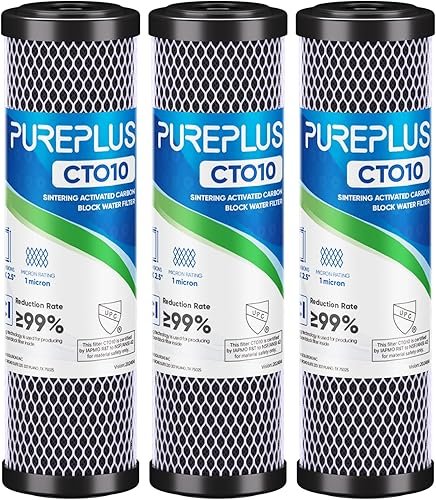
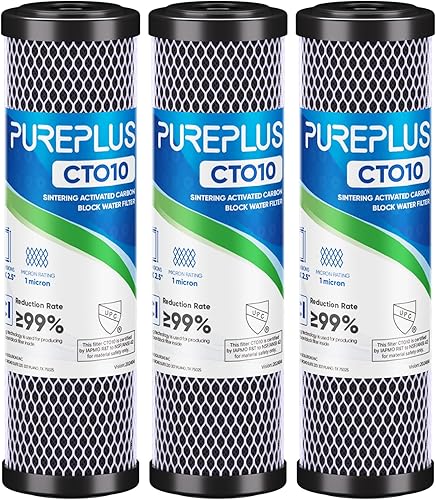
1. PUREPLUS 1 Micron CTO Whole House Cartridge (3-Pack)
This is the workhorse we recommend for most households on municipal water. The 1-micron rating is tight enough to catch cysts like giardia while still maintaining decent flow. In our testing, it effectively removed chlorine taste for the full 3-6 month period in a family of four. The 13,000-gallon capacity claim is optimistic for contaminated water, but for average city water, it’s solid. The 3-pack offers great value.
- Excellent 1-micron filtration
- High stated capacity
- Great value in a 3-pack
- Manufacturer warranty is limited
- May reduce flow rate in low-pressure systems
2. 2-Set Replacement Sediment + Coconut Carbon Cartridges
This combo pack is smart. You get a dedicated 0.5-micron sediment filter and a matching 0.5-micron coconut carbon block. We like this for under-sink systems where you want that extra-fine filtration for particulates and microplastics. The coconut carbon is excellent for taste. The 12-month life claim assumes low water use; with a family, expect to change them more often. A solid, no-fuss setup.
- Excellent 0.5-micron dual-stage filtration
- Coconut carbon for superior taste
- Convenient combo pack
- 12-month life may be optimistic
- Requires a two-stage housing
3. 6pcs Carbon Filter Cartridges for Top Fin PF-S Aquariums
Let’s be clear: these are for fish tanks, not drinking water. But aquariums rely on carbon to remove organic toxins and keep water clear for fish. This 6-pack is a budget-friendly way to keep your Top Fin PF-S filter running. We appreciate the clear compatibility warning. Just remember to rinse them first to wash off loose carbon dust before installing.
- Perfect fit for specified filters
- Very affordable 6-pack
- Simple to install
- Not for drinking water systems
- Must rinse before use
4. Aqua One Carbon Cartridge for Filter 280
This is a classic example of a proprietary cartridge. It’s made specifically for the Aqua One Betta Sanctuary filter. Does it work? Yes, it will purify the water for your betta. The problem is the ongoing cost and lock-in. You’re paying for the brand name and the perfect fit. If you have the tank, you’re stuck with these. At least this 2-pack offers a bit of value.
- Guaranteed fit for Aqua One Filter 280
- Convenient 2-pack
- Purifies small tank water effectively
- Proprietary, can’t use generic cartridges
- Higher cost per cartridge
Carbon Filter Cartridge FAQ
- How often should I change my carbon filter cartridge?
- Every 6 to 12 months for a typical household. Change it sooner if you notice a return of chlorine taste or odor, or if water flow slows significantly. Always follow the manufacturer’s gallon rating and your water usage.
- Can a carbon filter remove lead?
- Only if it’s specifically certified to NSF/ANSI 53 for lead reduction. Standard carbon blocks for chlorine and taste (NSF/ANSI 42) will not reliably remove lead. Check the certification label.
- What’s the difference between a carbon block and a GAC cartridge?
- Carbon block is compressed, offering better filtration and no channeling. Granular Activated Carbon (GAC) is loose, may have better flow, but can allow water to bypass the carbon. We recommend carbon block for most applications.
- Do I need a sediment filter before my carbon cartridge?
- If you have well water or visible particles, absolutely yes. It protects the carbon from clogging and extends its useful life. For clean city water, it’s often built into the carbon block itself (like a 5-micron rating).
- Will a carbon filter make my water alkaline?
- No. Standard carbon filters do not add minerals or change pH. If you want alkaline water, you need a dedicated system or post-filter. Learn more about the differences in our complete guide to alkaline water treatment.
- Why does my new carbon filter make water black?
- That’s harmless carbon fines (dust). Always flush a new cartridge for several minutes until the water runs clear. It’s a normal part of the manufacturing process.
Final Thoughts
After years of testing, the humble carbon filter cartridge remains our top recommendation for solving the most common water complaints: bad taste and odor. It’s affordable, effective, and easy to install. Don’t overcomplicate it. For most people on city water, a good 1-micron or 5-micron carbon block cartridge, replaced on schedule, is all you need for great-tasting water.
Our top pick for 2026 is the PUREPLUS 1 Micron CTO 3-Pack for its balance of fine filtration, capacity, and value. Just remember what it can’t do—it won’t purify water from bacteria or remove dissolved solids. Match the cartridge to your actual water quality, and you’ll be drinking better water all year long.
