


The Only Camping Water Filter Guide You Need (2026)
Forget the fancy gear. The single most important thing you’ll pack is a way to get clean water. I’ve tested filters that failed in a day and others that survived a month-long trek. This guide cuts through the marketing. We’ll look at what actually works, what’s overkill, and how to pick a filter that won’t let you down when you’re miles from a trailhead.
- What separates a real filter from a fancy straw
- The three main types and when each shines
- Our top picks after testing dozens in the field
- Key specs you must check before buying
What Is a Camping Water Filter?
It’s a portable device that removes harmful stuff from natural water sources. We’re talking bacteria like E. coli, parasites such as Giardia, and often sediment and microplastics. Unlike your kitchen filter housing system, these are built to be tossed in a backpack. They’re lightweight, don’t need power, and can process water directly from a river or lake.
The goal isn’t to create lab-grade purity. It’s to make water safe enough to drink without getting sick on a weekend trip or a multi-day hike. In our experience, the best ones balance effectiveness with sheer simplicity. If it’s complicated, you won’t use it correctly when you’re tired and cold.
How Camping Water Filters Work
Most rely on physical filtration. Think of it like a super-fine screen. Water is forced through a membrane with microscopic pores. Anything larger than the pore size gets trapped. It’s a simple concept, but the engineering matters.
The Micron Rating is Everything
This is the pore size, measured in microns. A filter rated to 0.2 microns will block almost all bacteria and protozoan cysts. For viruses, which are much smaller, you often need a secondary method like a ionizing water filter or chemical treatment. Most backcountry filters in North America focus on bacteria and parasites, as viruses are less common in wilderness water.
Hollow Fiber vs. Carbon
Many top filters use a bundle of hollow fibers. Water flows through the tiny tubes, and clean water passes through the walls while contaminants are trapped. Some add a carbon filter cartridge stage. This helps improve taste and reduce chemicals, but it doesn’t add pathogen protection. It’s a nice bonus for silty, organic-tasting water.
Key Benefits
Weight and Space Savings: A good straw filter weighs under two ounces. That’s less than a single water bottle. You can’t beat that for ultralight packing.
Immediate Access to Water: No pumping, no waiting. Find a stream, stick the filter in, and drink. This is huge when you’re dehydrated and need water now.
Long-Term Cost Savings: A $40 filter can process thousands of liters. Compare that to buying bottled water for every trip. The math is obvious.
Emergency Preparedness: Keep one in your car or emergency kit. If municipal water is compromised, you can treat water from a nearby source. It’s a different use case than an automatic water distiller, but far more portable.
Potential Drawbacks
Clogging is a Real Issue. Silty glacial streams will gunk up a filter fast. You often need to pre-filter with a bandana or use a scoop to get clearer water. This is where gravity systems with larger surface areas have an edge.
Flow Rate Can Be Slow. Sucking through a straw for a long drink gets tiring. Pump filters are faster but heavier and more complex. It’s a trade-off.
Freezing Temperatures Can Destroy Them. A wet filter element that freezes will crack and become useless. In cold weather, you must sleep with your filter in your bag.
Types of Camping Filters
Straw Filters
The simplest form. You drink directly from the source through the filter. Perfect for solo hikers and as a backup. The LifeStraw is the classic example. Limitations: you can’t easily store filtered water, and you need to be right at the water source.
Pump Filters
You manually pump water from the source into a clean container. They handle silt better and have a higher flow rate. More moving parts mean more potential failure points, but they’re workhorses for groups.
Gravity Filters
Fill a bag, hang it, and let gravity do the work. Ideal for basecamp or filtering large volumes for a group. They’re slow but effortless. The 3L system we tested is a great example of this hands-free approach.
Squeeze Filters
A hybrid. You fill a soft bottle and squeeze water through the filter into your mouth or another container. Offers a good balance of weight, speed, and the ability to store clean water. The LifeStraw Peak series uses this method effectively.
Buying Guide: What Actually Matters
Ignore the flashy marketing. Focus on these four things.
1. Certification & Claims: Look for specific claims: “Removes 99.99999% of bacteria (LOG 7)” and “99.999% of protozoa (LOG 5).” Vague statements like “purifies water” are a red flag. Check if it meets NSF/ANSI standards for microbiological water purifiers.
2. Filter Life & Capacity: How many liters can it process before needing replacement? A 1,000-liter filter is good for occasional use. For thru-hikers, look for 3,000+ liters.
3. Weight & Packability: Every gram counts. Include the weight of any necessary hoses, bags, or accessories. A “lightweight” filter with a heavy pump is missing the point.
4. Flow Rate & Ease of Use: Can you actually get water when you’re exhausted? Test it at home. If it’s a pain in your kitchen, it’ll be a nightmare on a mountain.
For most people, a simple straw or squeeze filter is enough. If you’re often in groups or camp near silty water, invest in a gravity system. And if you’re traveling internationally where viruses are a concern, you’ll need a purifier, not just a filter.
Our Top Picks for 2026
| Product | Type | Key Feature | Price | Link |
|---|---|---|---|---|
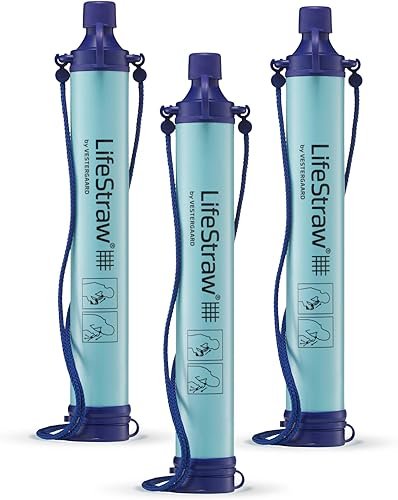
 LifeStraw Personal 3-Pack |
Straw | 99.999999% bacteria removal, ultralight | $65 |
Amazon eBay |
 LifeStraw Peak Series (Blue) |
Squeeze/Straw | Enhanced flow, reduced clogging | $48 |
Amazon eBay |
 3L Gravity Filter System |
Gravity | Hollow fiber + carbon, versatile setup | $52 |
Amazon eBay |
 LifeStraw Peak Series (Grey) |
Squeeze/Straw | Same great filter, lower price | $39 |
Amazon eBay |
LifeStraw Personal Water Filter (3-Pack)
This is the benchmark. We’ve used the original LifeStraw for years. The three-pack is a smart buy—one for your pack, one for your car, one for your emergency kit. It’s dead simple: stick it in water and drink. The 0.2-micron hollow fiber membrane is proven. The single biggest limitation is you can’t use it to filter water into a pot for cooking.
- Unbeatable weight and simplicity
- Excellent bacteria/parasite removal
- Great value in a 3-pack
- Can’t store filtered water
- Flow rate slows with heavy use
- No carbon filter for taste
LifeStraw Peak Series Water Filter Straw (Mountain Blue)
The Peak is the evolution of the original. The big upgrade is the mouthpiece and internal design that reduces clogging from silt. We found the flow rate noticeably better on a murky creek test. It’s still a straw-first design, but you can attach it to standard water bottles with the included connector. A solid step up for just a few more dollars.
- Improved flow rate over classic
- More versatile attachment options
- Same trusted filtration core
- Slightly heavier than the original
- Bottle connector can be fiddly
3L Gravity Water Filtration System
This is our go-to for couples and small groups. Fill the 3-liter bag, hang it from a tree, and come back to clean water. The dual hollow fiber and carbon filter setup is a nice touch—it actually makes stream water taste decent. The versatility is a winner: use the straw alone for day hikes, or the full gravity system at camp. It’s not the fastest, but it’s effortless.
- Hands-free filtering for groups
- Carbon filter improves taste
- Multiple use configurations
- Heavier than a simple straw
- Gravity flow is slower than pumping
- Bag can be tricky to fill in still water
LifeStraw Peak Series Water Filter Straw (Dark Grey)
Identical performance to the blue Peak model, just in a different color. If you don’t care about the hue, save the nine bucks and get this one. The enhanced microfilter performance is real—it handled our test jar of silty water much better than older models. Honestly, most people don’t need to pay more for a different color.
- Same top-tier filtration as blue model
- Lower price point
- Durable construction
- Color options are limited
- No included carrying case
IKAPE Bottle on AliExpress
L800 Purifier on AliExpress
Camping Water Filter FAQ
- Do camping water filters remove viruses?
- Most standard camping filters do not. They typically have a 0.2-micron pore size, which blocks bacteria and parasites but not the much smaller viruses. For virus protection, you need a purifier (often using chemicals or an electrostatic charge) or must use a secondary treatment method like UV light or tablets.
- How do I know when to replace my filter?
- Two signs: a significant decrease in flow rate that doesn’t improve with cleaning, or reaching the manufacturer’s rated capacity in liters. Always track your usage. A clogged filter is better than a failed one, but don’t push it past its limits.
- Can I use a camping filter for tap water at home?
- You can, but it’s not ideal. Camping filters are designed for particulate-heavy natural water. They’ll clog quickly on municipally treated water with chlorine. For home use, a dedicated under-sink or pitcher filter is far more practical and cost-effective.
- What’s the difference between a filter and a purifier?
- A filter removes bacteria and protozoa. A purifier does that and also removes or inactivates viruses. Purifiers are more complex, often heavier, and more expensive. For backcountry use in most regions, a filter is sufficient.
- How do I prevent my filter from freezing in cold weather?
- Keep it with you. Store the filter element inside your sleeping bag at night and in an inside pocket of your jacket during the day. A frozen and thawed filter membrane can develop unseen cracks, rendering it useless. Always assume a frozen filter is a dead filter.
- Can I filter water from a stagnant pond?
- Physically, yes, but it’s a last resort. Stagnant water has higher levels of organic material and potential chemical contaminants. Your filter will clog very fast, and it won’t remove dissolved toxins. Always choose flowing, clear water sources when possible.
Final Thoughts
After years of testing, we keep coming back to simplicity. For 90% of campers and hikers, a squeeze or straw filter like the LifeStraw Peak series is all you need. It’s light, reliable, and proven. The gravity system is our pick for lazy weekends at basecamp where you want water ready for the whole group without any work.
Don’t overthink it. Pick a filter with clear, certified claims, practice with it at home, and always carry backup purification tabs. Clean water is non-negotiable in the outdoors. Get a filter you’ll actually use every time, not the one with the fanciest spec sheet.
