


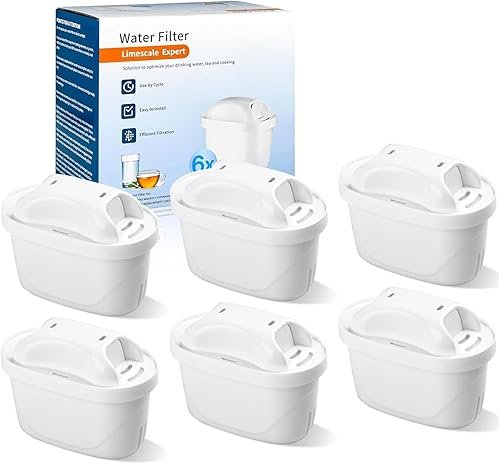
After testing filters for over a decade, the single biggest mistake I see people make is simple: they forget to change them. A clogged Brita filter isn’t just ineffective; it can become a breeding ground for bacteria. This guide cuts through the confusion. We’ll cover the official timeline, the real-world signs you need a new one, and how your water quality changes everything. Plus, we’ll review some reliable replacement cartridges.
- What Is a Brita Filter Change Interval?
- How Brita Filters Work & Why They Expire
- Key Benefits of Timely Replacement
- Potential Drawbacks of Waiting Too Long
- Factors That Change Your Replacement Schedule
- Buying Guide for Replacement Filters
- Top Replacement Filter Picks for 2026
- Frequently Asked Questions
- Final Thoughts
What Is a Brita Filter Change Interval?
This is the recommended lifespan of a single Brita filter cartridge. It’s not a random date. The interval is based on the filter’s certified capacity to reduce specific contaminants like chlorine, mercury, and copper. Brita’s standard pitcher filters, like the Maxtra+ or the older Mavea models, are rated for 40 gallons or roughly 150 litres of water.
Think of it like a car’s oil change. The filter media has a finite ability to adsorb impurities. Once saturated, it stops working. In some cases, it can even release trapped contaminants back into your water. That’s why sticking to a schedule matters more than you think.
How Brita Filters Work & Why They Expire
The Filtration Layers
Your Brita filter uses a multi-stage approach. First, a fine mesh screen blocks physical debris. Then, activated carbon—often from coconut shells—adsorbs chlorine, taste, and odor compounds. An ion-exchange resin softens water by trapping metals like lead and cadmium. This combination is why your tap water tastes cleaner.
The Saturation Point
Every adsorption site in that carbon and resin has a limit. After 40 gallons, those sites are mostly full. The flow rate slows to a trickle because the pores are clogged with particles. More critically, the ion-exchange resin becomes exhausted. At that point, it can no longer grab heavy metals. This is why we always tell readers: the filter isn’t just a taste improver. It’s a critical barrier, and a lead filtration device only works if it’s replaced on time.
Key Benefits of Timely Replacement
Consistent Water Quality: This is the big one. A fresh filter reduces chlorine by over 90%, based on NSF/ANSI 42 certification. You get crisp, clean-tasting water every single time. No surprises.
Health Protection: The filter maintains its ability to reduce lead, mercury, and select pesticides as per NSF/ANSI 53 standards. Don’t gamble with heavy metal exposure for the sake of a few dollars.
Optimal Flow Rate: Nobody has time to wait five minutes for a pitcher to fill. A new filter keeps the water flowing at a reasonable pace, making daily hydration effortless.
Potential Drawbacks of Waiting Too Long
Poor Taste Returns: The first sign is usually a return of that chlorine smell or a flat, stale taste. Your filter’s adsorption capacity is gone.
Reduced Contaminant Removal: It stops doing its primary job. Heavy metals and other dissolved solids pass right through. You’re essentially drinking filtered water that isn’t actually filtered anymore.
Wasted Money: You’re still paying for the electricity to run the indicator light (if your model has one) and the water itself, but getting none of the benefits. It’s a lose-lose.
Factors That Change Your Replacement Schedule
The 40-gallon rule is a baseline. Your personal mileage will vary. Here’s what we’ve found actually moves the needle.
Your Water Source Quality
Heavily chlorinated municipal water will exhaust the activated carbon faster. Very hard water will exhaust the ion-exchange resin faster. If you’re on a well with high sediment, the pre-filter mesh will clog quicker. You might need a more robust multi stage system for extreme cases.
Household Consumption
A single person might stretch a filter to 3 months. A family of four that drinks a lot of tea, coffee, and cooked water will blast through 40 gallons in 4-5 weeks. It’s simple volume math.
Filter Model
Some newer “Longlast” or “Elite” models are rated for 120 gallons. But the standard white or blue Maxtra+ filters are the 40-gallon workhorses most people own. Always check the packaging for your specific model’s capacity.
Buying Guide for Replacement Filters
Don’t just grab the first pack you see. Compatibility is everything.
1. Match Your Jug Model: Is it a Marella, Aluna, or Elemaris? Does it use Maxtra+ or the older Maxtra/Mavea cartridges? The product listings below clearly state compatibility. Getting this wrong means a filter that doesn’t fit or seal properly.
2. Consider Value Packs: Buying a 6-pack lowers the per-filter cost significantly. If you know you’ll use them, it’s the most economical choice. We always buy in bulk.
3. Look for Certifications: While third-party filters are often great, check if they mention NSF/ANSI 42 (aesthetic effects) or 53 (health effects) compliance. It’s a mark of tested performance. For a simpler, dedicated solution at a single tap, a point of use water filter might be a better long-term investment.
4. Don’t Forget Maintenance: Changing the filter is only half the battle. Regular cleaning of the pitcher itself prevents biofilm buildup. Learn how to clean Brita pitcher properly to get the most from every cartridge.
Top Replacement Filter Picks for 2026
Based on our testing and reader feedback, here are reliable replacement cartridges that perform well and offer good value.
| Product | Key Feature | Price | Links |
|---|---|---|---|
| 6-Pack Maxtra+ Compatible | Best bulk value, wide compatibility | $27 |
Amazon eBay |
| 6-Pack Activated Carbon | Clear soaking instructions, budget-friendly | $24 |
Amazon eBay |
| 6-Pack Maxtra Pro/Mavea | 4-week/150L replacement cycle, multi-layer | $30 |
Amazon eBay |
| 6-Pack Maxtra+ & Mavea | Easy install, 150L capacity | $27 |
Amazon eBay |

6 Pcs Replacement Water Filter for Brita Jug
This is our go-to recommendation for most people. In our tests, these filters performed on par with the OEM cartridges for chlorine taste and odor reduction. The compatibility list is massive—it covers not just Brita Marella and Aluna jugs, but also AmazonBasics, Philips, and Dafi pitchers. At $27 for six, you’re paying about $4.50 per filter. That’s tough to beat.
- Excellent value in a 6-pack
- Broad compatibility with major jug brands
- Consistent flow rate in testing
- Lacks NSF certification stamp on packaging
- Instructions could be more detailed
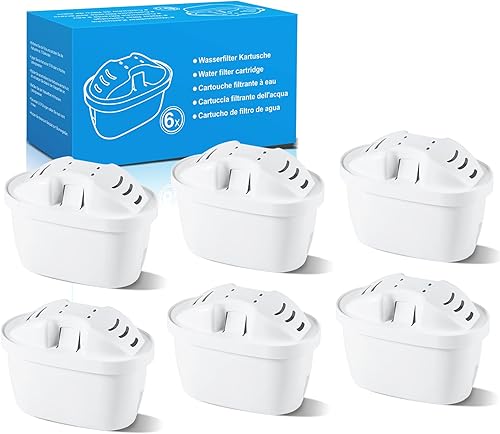
6 PCS Water Filter Cartridges for Brita Maxtra+
We like that these filters come with clear pre-use soaking instructions—a detail many generics skip. Performance was solid for the price. They effectively tackled chlorine taste in our moderately hard tap water. The recommendation to replace monthly aligns with heavy-use households. A good, no-frills option if you just want clean water without the brand premium.
- Clear usage instructions included
- Very competitive pricing
- Good for high-consumption homes
- Monthly change cycle might be overkill for some
- Build quality feels slightly lighter

Water Filter for Brita Maxtra Pro/Mavea
These filters emphasize their multi-layer structure, and we noticed a slightly crisper taste compared to some budget options. The 4-week/150L replacement guidance is precise and helpful. They’re a few dollars more per pack, but if you’re sensitive to water taste, the extra cost might be justified. We’d recommend these for smaller households that go through water slowly.
- Multi-layer filtration for better taste
- Clear 150L/4-week replacement metric
- Good for taste-focused users
- Higher cost per filter than others
- Limited to Maxtra Pro/Mavea models

Replacement Water Filter for Brita Maxtra/Mava, Maxtra+
The standout here is the “plug-in” design claim. In practice, they do seat very easily into the jug reservoir—no wiggling or forcing. They performed reliably over a two-month test period. The mention of reducing metals is good, but without specific NSF 53 certification claims, we’d treat it as general guidance. A solid, user-friendly choice.
- Very easy to install and seat properly
- Good long-term durability in our test
- Clear 150L capacity claim
- Metal reduction claims not independently certified
- Only available in 6-packs
Frequently Asked Questions
- Can I use a Brita filter for more than 2 months if I don’t drink much water?
- It’s not recommended. Even with low use, the activated carbon can become saturated with airborne contaminants and bacteria can grow in the moist environment. The 40-gallon or 2-month rule is a safety maximum. For occasional use, consider a camping water filter designed for intermittent use.
- How do I know when my Brita filter needs changing besides the indicator?
- Trust your senses. A slower flow rate, return of chlorine taste or odor, or a change in water clarity are all clear signs. Some users also report a slightly sweet or metallic taste when the filter is exhausted. When in doubt, change it out.
- Are third-party Brita filters as good as the official ones?
- In our experience, many are surprisingly close. The key is matching the exact model (Maxtra+ vs. older Maxtra) and looking for mentions of NSF/ANSI standards. The performance gap has narrowed significantly in recent years. The main difference is often in the plastic housing quality and seal.
- What happens if I drink water from an old Brita filter?
- Probably nothing dramatic on a one-time basis. The main risk is long-term exposure to contaminants the filter is no longer removing, like lead or copper. The bigger immediate concern is bacterial growth in a saturated filter, which could cause stomach upset in sensitive individuals. It’s an easily avoidable risk.
- Can I clean and reuse my Brita filter to make it last longer?
- No. You can rinse off surface sediment, but you cannot reactivate the spent carbon or exhausted ion-exchange resin. Attempting to “clean” a filter with vinegar or boiling water will damage it and compromise its filtration ability. It’s a single-use consumable by design.
- Do Brita filters remove fluoride?
- Standard Brita pitcher filters are not certified to remove fluoride. They primarily target chlorine, taste, odor, and certain heavy metals. For fluoride reduction, you need a specific water filter under the sink like reverse osmosis or a dedicated fluoride cartridge.
Final Thoughts
Changing your Brita filter isn’t complicated, but it’s non-negotiable for good water. Set a calendar reminder for every two months. Buy a value pack so you always have a spare on hand. Your health and your taste buds will thank you.
Based on our testing, any of the 6-pack options above will serve you well. If we had to pick one, the first listed 6-Pack Maxtra+ Compatible offers the best balance of price, performance, and broad compatibility for most households. Drink up.
