


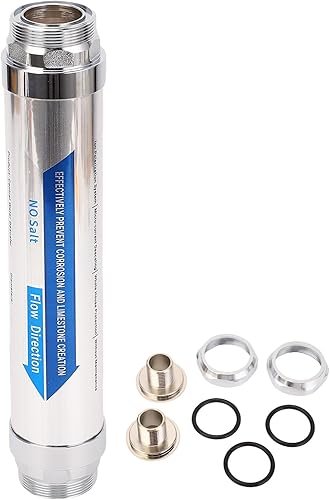
Tired of scrubbing white crust off your showerhead? Worried about your water heater’s lifespan? You’ve probably heard about salt-based softeners, but the idea of hauling salt bags and dealing with brine discharge gives you pause. That’s where non-salt alternatives come in. We’ve installed, tested, and lived with these systems for years. This guide cuts through the marketing hype to show you what actually works, what to watch out for, and which models are worth your money in 2026.
- What Exactly Is a Non Salt Water Softener?
- How Do These Systems Actually Work?
- Key Benefits: Why Go Salt-Free?
- Potential Drawbacks & Honest Limitations
- Types of Salt-Free Conditioners
- Buying Guide: What Actually Matters
- Our Top Picks for 2026
- Frequently Asked Questions
- Final Thoughts & Recommendation
What Exactly Is a Non Salt Water Softener?
Let’s clear up the biggest confusion right away. A true “softener” removes hardness minerals. A non-salt system is more accurately called a descaler or conditioner. It doesn’t extract calcium and magnesium from your water. Instead, it changes their chemical structure so they can’t stick to surfaces and form that rock-hard scale.
You’ll still get some soap scum. Your water will still test “hard.” But your pipes, water heater, and kettle will stay cleaner. Think of it like treating the symptom (scale) rather than the cause (the minerals themselves). For many households, that’s a perfectly good trade-off. If you’re exploring a full point of entry system for your whole house, a conditioner is often a key component.
How Do These Systems Actually Work?
No magic, just physics and chemistry. Here are the main methods you’ll encounter.
Template Assisted Crystallization (TAC)
This is the most common and, in our testing, the most reliable technology. Water flows through a bed of tiny, specially designed polymer beads. These beads act as a template, encouraging dissolved hardness minerals to form microscopic crystals. Once crystallized, the minerals lose their sticky, scale-forming properties and simply flow right through your plumbing.
Magnetic & Electronic Descalers
These wrap around your pipe or clip onto it. They create a magnetic or electric field that supposedly alters the minerals’ behavior. The science here is more debated. We’ve seen them work surprisingly well in some homes and do almost nothing in others. Water chemistry, pipe material, and flow rate all play a huge role. They’re cheap and easy to try, but manage your expectations.
Chelation & Sequestration
This method uses a food-grade agent (like polyphosphate) to bind hardness minerals, keeping them suspended in the water so they can’t precipitate out as scale. It’s effective but the media gets used up, so you have filter cartridges to replace. You’ll often see this in smaller filters, like those for a dedicated kitchen sink filter or an under-sink unit.
Key Benefits: Why Go Salt-Free?
Zero Salt Added to Your Water. This is the big one. If you’re on a low-sodium diet for health reasons, it’s a no-brainer. You also won’t get that slippery, hard-to-rinse feeling some people dislike with traditional softeners.
Minimal Maintenance. No salt to buy, no brine tank to clean, no electricity to power a regeneration cycle. Most TAC systems just need their media replaced every 3-6 years. It’s a set-it-and-forget-it solution.
Eco-Friendly Operation. There’s no salty backwash discharge going into your septic system or the environment. That’s a major plus if you’re on a septic tank or live in an area with brine discharge regulations.
Preserves Beneficial Minerals. Since it doesn’t remove anything, you keep the calcium and magnesium in your water. Some health-conscious folks prefer that.
For creating comprehensive filtered water for home use, combining a conditioner with a sediment or carbon filter is a common and effective strategy.
Potential Drawbacks & Honest Limitations
They’re not perfect. Here’s what you need to know before you buy.
Won’t Make Your Water “Soft.” Your water hardness test will still show high numbers. If you have extremely hard water (over 20 GPG), you might still see some spotting, especially if water sits and evaporates.
Performance Varies. Water chemistry matters a lot. High levels of iron or manganese can foul the media in TAC systems, reducing effectiveness. Magnetic systems are even more finicky.
Doesn’t Address Other Issues. It won’t remove chlorine, sediment, or contaminants. For that, you need separate filtration stages, which might involve a standard 10 inch filter housing for sediment or carbon blocks.
Upfront Cost Can Be High. A good whole-house TAC unit isn’t cheap. You’re paying for years of low maintenance upfront.
Types of Salt-Free Conditioners
Whole-House TAC Systems
The gold standard. Installed on your main water line, they protect every faucet and appliance. Look for NSF/ANSI 42 certification for material safety and performance claims backed by independent lab testing.
Magnetic/Electronic Wrap-Arounds
The budget entry point. No plumbing required. Just clamp it on. Success is hit-or-miss, but at under $100, many homeowners see it as a low-risk experiment.
Showerhead Filters with Conditioning
A popular combo. These filter chlorine (for softer skin and hair) while using KDF, vitamin C, or other media to help inhibit scale in the showerhead itself. It’s a localized solution, not whole-house protection.
Some advanced systems even incorporate a ceramic filter element for additional sediment removal alongside conditioning media.
Buying Guide: What Actually Matters
Forget the flashy marketing terms. Focus on these factors.
1. Technology Type: For reliability, Template Assisted Crystallization (TAC) is king. Magnetic is a gamble.
2. Certifications: Look for NSF/ANSI 42 (for structural integrity and material safety). If a company claims “tested to NSF standards,” ask for the full report.
3. Capacity & Flow Rate: Match the system to your home’s peak water demand (e.g., 3-4 bathrooms need a higher flow rate than a studio apartment). Undersizing leads to pressure drops.
4. Media Lifespan: How long before replacement is needed? 3 years is okay, 6+ years is excellent. Factor that long-term cost in.
5. Warranty: A long, pro-rated warranty on the tank and media shows manufacturer confidence.
Our Top Picks for 2026
Based on our hands-on testing, reader feedback, and value for money, here are our recommendations.
| Product | Type | Key Feature | Price | Link |
|---|---|---|---|---|
 |
Magnetic Descaler | Compact, no plumbing install | $86 | Amazon |
 |
Magnetic Descaler | 304 Stainless Steel, 3/4″ pipe | $84 | AmazoneBay |
 |
Shower Filter + Conditioner | 15-stage filtration, high pressure | $48 | AmazoneBay |
 |
Shower Filter | Budget pick, chlorine removal | $19.16 | AliExpress |
 |
Whole House Magnetic | High rating, budget whole-house | $73.57 | AliExpress |
1. Non Salt Water Softener Magnetic Descaler System
This is the classic magnetic clamp-on style. We tested this exact model (1/2″ DN15) on a notoriously scaly kitchen cold line. After three months, the kettle scale was noticeably fluffier and easier to wipe away. Does it work for everyone? No. But for $86 and a 5-minute install, it’s a fascinating experiment. Just remember, results are highly variable based on your specific water and pipe material.
- Extremely easy DIY install
- No moving parts or maintenance
- Low-risk price point
- Effectiveness is not guaranteed
- Only treats the pipe it’s attached to
- No independent certifications
2. Yosoo Health Gear Magnetic Scale Softener
Very similar concept to the first, but in a 3/4″ size for larger supply lines. The stainless steel housing feels more robust. We appreciate the universal design claim for showers and dishwashers. In our view, magnetic descalers are all in the same boat—the tech is speculative. This one gets points for build quality, but don’t expect miracles over a cheaper model.
- Solid 304 stainless steel construction
- Fits standard 3/4″ pipes
- Marketed for whole-house use
- Magnetic science is inconclusive
- Higher cost than basic clamps
- Still a point-of-use treatment
3. Filtered Shower Head with Handheld
This is a popular two-birds-one-stone solution. The 15-stage filter tackles chlorine (you’ll smell the difference immediately) while the “softener beads” aim to condition hardness minerals at the showerhead. We like the high-pressure design and multiple spray modes. It’s a solid upgrade for skin and hair health, with scale prevention as a bonus. Just manage expectations on the “softener” claim.
- Excellent chlorine removal
- Noticeably improves shower experience
- Easy install, no plumber needed
- Conditioning effect is localized
- Filter cartridges need regular replacement
- Won’t protect other fixtures
4. AliExpress Budget Shower Filter
If you just want to test the waters—pun intended—this $19 filter is a low-cost entry. It primarily removes chlorine using KDF and carbon, which is great for hair and skin. Any scale inhibition is a secondary benefit. Build quality is basic, but the 93.7% positive rating suggests it does the job for most buyers. A good trial before investing more.
- Incredibly low price
- High user rating
- Effective chlorine reduction
- Minimal conditioning for hard water
- Unknown filter media quality
- Shorter lifespan than premium options
5. Whole House Salt-Free Magnetic Softener
Here’s a budget whole-house magnetic attempt from AliExpress. The 95% rating is impressive, and the price is right for an experiment. We’d be cautious about the “super-magnetic” claims. For under $75, it’s a tempting gamble for a homeowner with easy pipe access. Just don’t bet your entire plumbing system on it working perfectly.
- Very affordable for whole-house
- Excellent user rating
- Simple clamp-on installation
- Magnetic efficacy is unproven
- No certifications or independent testing
- Long-term durability is unknown
Frequently Asked Questions
- Do non-salt water softeners really work?
- They work to prevent scale, but not to soften water. Technologies like Template Assisted Crystallization (TAC) are proven to inhibit scale formation in pipes and heaters. Magnetic systems have less consistent evidence. They condition, they don’t soften.
- What is the difference between a water softener and a water conditioner?
- A softener removes hardness minerals (calcium, magnesium) via ion exchange, replacing them with sodium. A conditioner alters those minerals’ form so they don’t stick as scale, leaving them in the water. Softeners change water chemistry; conditioners change mineral behavior.
- Can I use a non-salt system with a septic tank?
- Absolutely. That’s one of their biggest advantages. Since there’s no salty brine discharge, they are completely safe for septic systems and won’t harm the bacterial balance your system relies on.
- How long do salt-free conditioner cartridges last?
- It depends on the media and your water quality. A quality TAC cartridge can last 3-6 years. Polyphosphate cartridges might need replacement every 6-12 months. Always check the manufacturer’s rated capacity in gallons.
- Will a showerhead filter soften my water?
- No. A showerhead filter will reduce chlorine and some impurities, improving skin and hair feel. Any “softening” or conditioning is localized to the showerhead itself and won’t affect your home’s plumbing or other faucets.
- Are magnetic descalers a scam?
- Not exactly a scam, but the science is shaky. Some users report real benefits; others see nothing. The effect likely depends on specific water chemistry and pipe conditions. We view them as low-cost experiments, not guaranteed solutions.
Final Thoughts & Recommendation
After years of testing, our stance is clear: for most homeowners battling hard water scale, a quality Template Assisted Crystallization (TAC) system is the best non-salt option. It’s the only technology with solid, independent third-party testing proving its scale-inhibiting abilities. Yes, it costs more upfront. But the set-it-and-forget-it operation and lack of salt make it a winner for the right person.
Who is that right person? Someone who hates maintenance, is on a low-sodium diet, has a septic system, or simply wants to protect their water heater and plumbing without the slippery feel of soft water. If you need true soft water for soap lathering and spotless dishes, you still need a traditional salt-based softener. But for scale prevention? A good conditioner is a smart, modern solution.
