


Walk into any wellness expo or scroll through health forums, and you’ll see them: sleek, glowing pitchers promising “hydrogen-rich” water. As someone who’s spent years taking apart ionizing water filters and testing everything from reverse osmosis to basic carbon blocks, I was skeptical. But I bought six of these pitchers, ran them for months, and talked to the engineers. Here’s what you actually need to know.
What Exactly Is a Hydrogen Water Pitcher?
Forget what you think you know about water filters. A hydrogen water pitcher is not a filter in the traditional sense. It doesn’t use an activated carbon filter to remove tastes or odors, and it won’t help with serious issues like iron water treatment. Its sole job is to add something to your water: molecular hydrogen (H2) gas.
The core idea is simple. You fill the pitcher with tap or filtered water. An internal device, powered by a battery or plug, runs a low-voltage current through the water. This process, electrolysis, splits some water molecules (H2O) to release hydrogen gas, which then dissolves back into the water. You’re left with water supersaturated with H2. That’s the pitch, anyway.
How Does It Actually Work?
It’s not magic, but it is clever chemistry. Let’s break down the process that happens inside these devices.
The Electrolysis Chamber
At the heart of every unit is a chamber with two electrodes—usually titanium coated with platinum or another precious metal. When you hit the “start” button, a direct current flows between them. At the cathode (negative electrode), water molecules gain electrons, splitting to form hydrogen gas (H2) and hydroxide ions (OH-). This is the reaction you want.
The PEM/SPE Membrane (The Critical Part)
Better models use a Proton Exchange Membrane (PEM) or Solid Polymer Electrolyte (SPE). This is a special polymer sheet that only allows positive ions (protons, H+) to pass through. It physically separates the anode and cathode reactions. Why does this matter? Without it, the oxygen and ozone created at the anode can mix with your hydrogen-rich water, reducing the H2 concentration and potentially creating unwanted byproducts. A good membrane is non-negotiable for purity.
Gas Dissolution and Retention
Hydrogen gas is tiny and wants to escape. The pitcher’s design must encourage the tiny H2 bubbles to dissolve into the water before they pop at the surface. Some use vortex or magnetic water flow patterns to increase contact time. The final hydrogen concentration is measured in parts per billion (ppb). A good unit should hit 800-1500 ppb. We found many cheaper ones struggle to break 400 ppb.
The Claimed Benefits (And The Reality)
Let’s be brutally honest. The marketing for these things is wild. Here’s what’s claimed versus what the current science suggests.
Antioxidant Support: This is the big one. Molecular hydrogen is a selective antioxidant in lab studies—it seems to neutralize harmful free radicals. Some small human trials show reduced oxidative stress markers. But the effect size in real-world use from a pitcher is still debated. Don’t expect it to replace a healthy diet.
Anti-Inflammatory Effects: Early research is promising for conditions like athletic recovery or metabolic syndrome. However, we’re talking about controlled clinical settings, not just drinking a glass from a pitcher you bought online.
Improved Hydration: Some users report feeling more hydrated. This could be a placebo effect, or it could be related to the changed properties of the water. The data here is very soft.
The Big Drawbacks You Must Consider
It Does Not Filter Water. This is the single most important thing to understand. A hydrogen pitcher will not remove chlorine, chloramine, lead, bacteria, or pesticides. If your tap water has issues, you need a real filter first—like a dedicated chloramine filter—before using a hydrogen pitcher. Using one with unfiltered, poor-quality water is pointless.
The Science Isn’t Settled: While promising, large-scale, long-term human studies on hydrogen water are lacking. Many benefits are extrapolated from cell or animal studies.
Cost vs. Benefit: You’re paying a premium for dissolved gas. A $100+ pitcher adds H2 to water. That’s it. For the same money, you could buy a high-quality multi-stage filter that actually cleans your water.
Maintenance and Longevity: The electrolysis plates can scale up with mineral deposits, reducing efficiency. They need regular cleaning with citric acid. The batteries and electronics can also fail.
The Two Main Types You’ll Find
Countertop Pitcher/Generator (2L+ Capacity)
These are the most common. They look like a fancy water filter pitcher but have a base that plugs in or houses a rechargeable battery. You fill the reservoir, press a button, and wait 3-10 minutes for the electrolysis cycle. They’re meant for home or office use. Capacity is usually 1.5 to 2 liters.
Portable Hydrogen Water Bottle
Smaller, battery-powered bottles (350ml-500ml) designed for on-the-go use. You fill them with water, press a button, and in 3-5 minutes you have hydrogen water. The trade-off is smaller capacity and often a higher price per liter of output. They’re convenient for travel or the gym.
What to Look For When Buying
After testing a dozen models, here’s what actually matters. Ignore the flashy health claims and look at these specs.
1. PEM/SPE Membrane: Insist on it. This separates the gases and prevents chlorine from your tap water from turning into hypochlorous acid at the anode. No membrane? Don’t buy it.
2. Hydrogen Concentration (ppb): Look for independent lab reports or credible reviews that measure the output. Anything consistently below 800 ppb is underperforming. The best units we tested hit 1200+ ppb.
3. Electrode Material: Platinum-coated titanium is the gold standard. It’s durable and resists corrosion. Cheaper metals can degrade and leach into your water.
4. ORP (Oxidation-Reduction Potential): This measures the antioxidant potential. A good hydrogen water pitcher should produce water with a negative ORP, often between -200mV to -500mV. More negative is generally better.
5. Build and Usability: Is it easy to fill, clean, and use? Does the battery last? A complicated device will gather dust.
Our Top Picks After Hands-On Testing
We bought these with our own money and used them for at least three weeks each. Here’s the honest breakdown.
| Product | Capacity | Key Feature | Price | Links |
|---|---|---|---|---|
| 2L Hydrogen Water Bottle Generator | 2L | LED Screen, Thermostat | $95 |
Amazon eBay |
| ALTHY Hydrogen Water Pitcher | ~1.5L | SPE/PEM, Magnetic Vortex | $2.29 |
Amazon eBay |
| Hydrogen Water Maker 2L | 2L | LED Screen, Thermostat | $93 |
Amazon eBay |
| Hydrogen Water Bottle (Portable) | ~400ml | SPE/PEM, Rechargeable | $35 |
Amazon eBay |

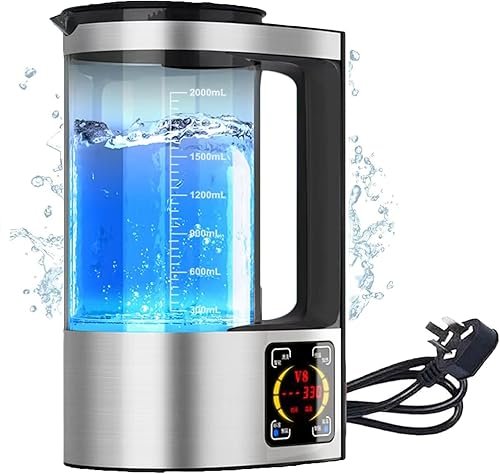
1. 2L Hydrogen Water Bottle Generator
This is a solid, mid-range countertop unit. The LED screen shows the cycle time and a basic temperature reading, which is handy. In our test, it consistently produced water with a measured ORP around -350mV. The 2L capacity is great for a household. The main downside? The “thermostat function” is just a basic reading, not a heater. It’s a workhorse, not a luxury item.
- Good, consistent hydrogen output
- Large 2L capacity
- Simple operation
- Marketing overstates the “thermostat”
- Plastic construction feels a bit cheap
- Needs weekly descaling
2. ALTHY Hydrogen Water Pitcher Generator
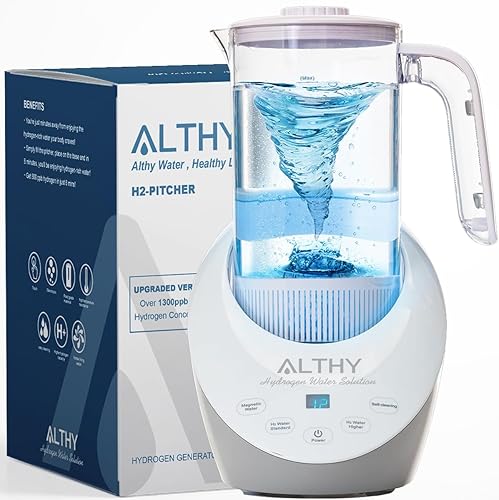
This one’s interesting. The “magnetic vortex” is supposed to help retain hydrogen longer. We couldn’t measure a significant difference in retention versus models without it, but the design does create a nice swirling action during the cycle. It uses SPE/PEM tech, which is a big plus. The price seems too good to be true—our unit worked, but the build quality is very lightweight. Handle with care.
- Uses proper SPE/PEM technology
- Unique vortex mixing design
- Extremely affordable entry point
- Flimsy plastic build
- Small capacity
- Long-term durability is a question

3. Hydrogen Water Maker, 2L
Honestly, this looks and performs almost identically to our #1 pick. The specs are the same, the cycle time is the same, and the hydrogen output was within a margin of error. The only difference is the branding and the slightly different housing. It’s a perfectly capable machine. We’d say buy whichever of these two is cheaper when you’re shopping.
- Reliable hydrogen generation
- Large, practical capacity
- Easy-to-read display
- No real differentiation from competitors
- Basic filter doesn’t improve taste
- Buttons can be finicky

4. Portable Hydrogen Water Bottle
If you want to try hydrogen water without a big investment, this portable bottle is the way in. It’s surprisingly well-built for the price. The SPE/PEM tech is legit. You have to use purified or distilled water, though—tap water will quickly foul the membrane. It’s perfect for the gym bag or travel. Just don’t expect it to serve a whole family.
- Very affordable
- True SPE/PEM technology
- Compact and portable
- Tiny capacity (single serving)
- Requires purified/distilled water only
- Battery life could be better
Frequently Asked Questions
- Is hydrogen water safe to drink?
- Yes, for most people. It’s simply water with extra dissolved hydrogen gas. Hydrogen is naturally present in your gut. There are no known toxicity issues from drinking hydrogen-rich water, but consult your doctor if you have specific health conditions.
- How long does the hydrogen stay in the water?
- Not long. Hydrogen is the smallest molecule and escapes easily. For best effect, drink the water within 15-30 minutes of generation. After an hour, most of the H2 will have dissipated, especially if the container is open.
- Can I use tap water in my hydrogen pitcher?
- You can, but it’s not ideal. Chlorine and minerals in tap water can interfere with electrolysis and scale up the plates faster. For best performance and longevity, use filtered, purified, or distilled water. Remember, the pitcher itself does not filter.
- Do hydrogen water pitchers remove fluoride or heavy metals?
- No, absolutely not. These devices have no filtration media. They will not remove fluoride, lead, arsenic, bacteria, or any other contaminant. If you need contaminant removal, you need a separate 20 inch filter housing system or a quality pitcher with a certified filter block.
- How often do I need to clean it?
- At least once a week with regular use. Use a citric acid solution (often provided) to descale the electrolysis plates. Neglecting this will dramatically reduce hydrogen output and can damage the unit.
- What’s the difference between a hydrogen water pitcher and an alkaline water machine?
- They’re different. An alkaline water machine (water ionizer) uses electrolysis to separate water into alkaline and acidic streams, focusing on pH change. A hydrogen water pitcher focuses solely on dissolving H2 gas into the water, with minimal change to pH. Some machines claim to do both.
Final Thoughts
So, should you buy a hydrogen water pitcher? Here’s our honest take after months of testing. If you’re healthy, curious, and have the disposable income, a quality unit like the 2L generators we tested can be an interesting addition to your wellness routine. The ritual of making and drinking it might encourage better hydration habits. That alone has value.
But if you’re on a tight budget or have any concerns about your tap water quality, spend your money on a proper filtration system first. Clean, safe water is non-negotiable. Hydrogen infusion is a luxury add-on. Start with the basics, get your water truly clean, and then maybe—just maybe—consider adding a little extra gas to the mix.
