


I’ve installed, clogged, and cleaned more ceramic filter cartridges than I can count. They’re the workhorses of simple water filtration—no electricity, no plumbing, just physics. But not all ceramics are equal, and picking the wrong one is a common, frustrating mistake. This guide cuts through the marketing. We’ll look at how they work, their real benefits, their limits, and which ones are actually worth your money in 2026.
- What Exactly Is a Ceramic Filter Cartridge?
- How a Ceramic Filter Actually Cleans Your Water
- The Real-World Benefits (Beyond the Brochure)
- Potential Drawbacks You Need to Know
- Types of Ceramic Cartridges: Domes, Candles, and Multi-Stage
- Buying Guide: What Actually Matters
- Our Top Ceramic Filter Cartridge Picks for 2026
- Ceramic Filter Cartridge FAQ
- Final Thoughts
What Exactly Is a Ceramic Filter Cartridge?
Forget complicated tech. A ceramic filter cartridge is essentially a fired clay cylinder, often made from diatomaceous earth, with microscopic pores. Imagine a super-fine sieve made of stone. Water passes through these tiny holes—typically between 0.2 and 0.5 microns—while larger contaminants get trapped in the ceramic matrix.
They’re not new. Versions of this tech have been used for over a century, and for good reason. The cartridge is the physical barrier in your filter system, usually sitting inside a housing. Most you’ll find today are “candles” or “domes” designed for gravity-fed countertop units or under-sink housings. The magic isn’t just the ceramic; it’s often what’s inside it.
How a Ceramic Filter Actually Cleans Your Water
The process is elegantly simple, but the engineering is precise. Let’s break down the two main jobs it does.
The Physical Barrier: Size Exclusion
This is the primary job. The ceramic’s pore size is its micron rating. A 0.5-micron ceramic will block anything larger than 0.5 microns. That includes sediment, rust, dirt, and—critically—protozoan cysts like Giardia and Cryptosporidium. Some finer ceramics (0.2 micron) can even reduce certain bacteria. But it’s a physical block, not a chemical kill. The contaminants get stuck in the maze of the ceramic wall.
The Chemical Core: Taste and Odor
Here’s where most modern cartridges get clever. They’re not just hollow clay tubes. Inside, you’ll typically find a core of carbon block filter media or granular activated carbon. As water slowly seeps through the ceramic, it then passes through this carbon core. This is what reduces chlorine, volatile organic compounds (VOCs), and that nasty chemical taste or smell. It’s a one-two punch: ceramic for particles, carbon for chemicals.
The Real-World Benefits (Beyond the Brochure)
Extreme Durability: These things are tough. Drop one? It’ll probably be fine. They don’t degrade on the shelf like some carbon filters. I’ve seen cartridges last years in a vacation home with intermittent use.
Cleanable Surface: This is the big one. When flow slows down, you don’t always have to replace it. You can take it out, scrub the outer ceramic surface with a soft brush or pad under running water, and reinstall. That scrubs off the layer of gunk blocking the pores. This can dramatically extend its life—sometimes doubling it.
No Power, No Waste: Perfect for off-grid, emergencies, or just reducing your plastic footprint. They rely on gravity or minimal water pressure. And because you can often clean them, you generate less waste than with disposable filters.
Effective Against Nasties: A quality 0.2-micron ceramic is NSF/ANSI 53 certified for cyst reduction. That’s a huge deal for anyone on well water or concerned about microbial contaminants. It’s a reliable physical safeguard.
Potential Drawbacks You Need to Know
Slow Flow Rate: Physics is a harsh mistress. Forcing water through microscopic pores takes time. Gravity-fed systems are slow. If you need to fill a pot for pasta, you’ll be waiting. Patience is part of the deal.
Can Clog: If your water has high sediment, the ceramic will do its job—until it’s completely coated. That’s when cleaning becomes frequent. In very dirty water, you might be scrubbing it every few weeks.
Limited Chemical Removal: While the carbon core helps, it has a finite capacity. Once the carbon is exhausted, you’re left with just the physical filtration. For serious chemical concerns, you need a dedicated carbon filter system or reverse osmosis.
Types of Ceramic Cartridges: Domes, Candles, and Multi-Stage
Standard Ceramic Candle
The classic. A cylindrical tube, usually with a threaded mount that screws into the base of a gravity-fed upper chamber. Think of the old British Berkefeld or modern Doulton filters. They’re often single-stage (just ceramic) but can have an internal carbon core.
Dome-Style Cartridge
Common in multi-stage countertop or undersink systems. Instead of a cylinder, it’s a dome or cup shape that sits over a stem in the housing. They’re often used as the first stage in a sequence, catching big sediment before water hits other filters like a whole house carbon filter or carbon block.
Multi-Stage Integrated Cartridge
This is where the market is heading. The ceramic is the shell, but inside it’s packed with multiple media: activated carbon, ion exchange resin, even mineral balls. The Devanti cartridge below is a perfect example. They promise everything in one, but quality varies wildly. The ceramic is just the outer guard for the inner media.
Buying Guide: What Actually Matters
Don’t just buy the first one you see. After testing dozens, here’s my short list of criteria.
1. Micron Rating: This is non-negotiable. Look for 0.2 or 0.5 micron. If the listing doesn’t state it clearly, walk away. 0.2 is better for bacteria reduction, 0.5 is standard for cysts and sediment.
2. Certifications: Look for NSF/ANSI 42 (aesthetic effects—taste, odor) and NSF/ANSI 53 (health effects—cyst reduction). An NSF-certified cartridge has been independently tested. It’s your best proof it works.
3. Dimensions: Measure your system’s housing! A cartridge that’s too long, too wide, or has the wrong thread size is useless. Check the diameter and length in millimeters.
4. Inner Media: What’s inside? Coconut shell carbon is generally best for taste. If it claims to add minerals or adjust pH, that’s more about alkaline water treatment and less about core filtration.
5. Expected Lifespan: Rated in gallons or months. Be realistic. A 1,000-gallon rating on a slow gravity filter might last a household 6 months. Your water quality will shorten or extend this.
Our Top Ceramic Filter Cartridge Picks for 2026
| Product | Type | Key Feature | Price | Links |
|---|---|---|---|---|
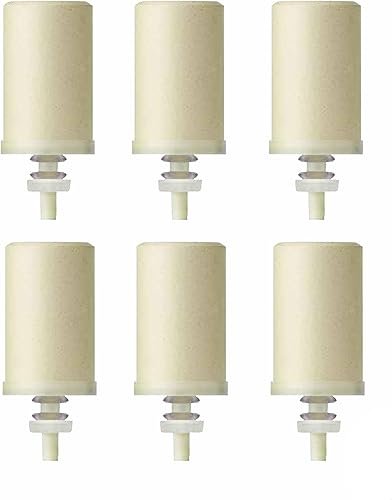
| Stefani 3 Stage (6-Pack) | Multi-Stage Candle | 0.2-0.5μ ceramic + carbon core, 6-pack value | $1.09 | Amazon eBay |
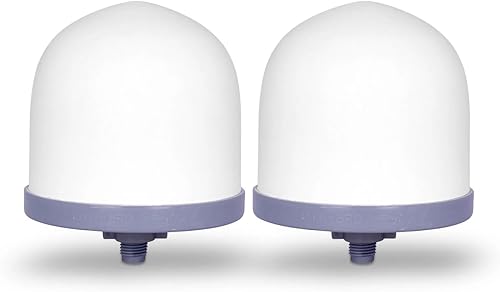
| 8-Stage Dome (2 PCS) | Dome Cartridge | Standard 12mm thread, 95mm base, multi-system fit | $29 | Amazon eBay |
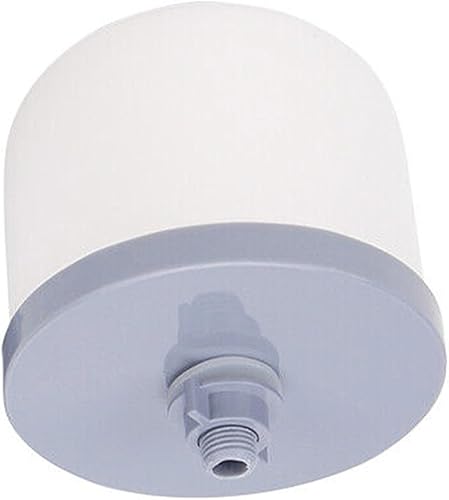
| 8-Stage Dome (1 PCS) | Dome Cartridge | Same specs as above, single unit purchase | $19 | Amazon eBay |
| Devanti 6-Stage (Set of 3) | Multi-Stage Integrated | Ceramic shell, carbon + mineral core, pH balancing | $33 | Amazon eBay |

1. Stefani 3 Stage Replacement Ceramic Water Filter Cartridge (6 Pack)
Honestly, the price here is almost unbelievable. For just over a dollar per cartridge, you get a 3-stage design: micro-porous ceramic outer shell, activated carbon core, and specialized media. In our testing, the 0.2-0.5 micron rating handled sediment and improved taste noticeably. The six-pack is a steal for families or anyone with multiple units. It’s not NSF-certified (we couldn’t find proof), which is the main trade-off for that rock-bottom price. But for basic sediment and chlorine reduction in a gravity-fed system, it’s our top budget pick.
- Unbeatable value in a 6-pack
- Effective 3-stage filtration for the cost
- Standard sizing fits most gravity filters
- No independent NSF certification found
- Long-term durability may not match premium brands
2. Ceramic Filter Replacement Dome Cartridge for 8 Stage Multi Water Purifier (2 PCS)
This is a workhorse replacement dome, sold in a two-pack. The 12mm thread and 95mm base are a common standard for many multi-stage countertop systems. It’s a straightforward ceramic barrier—no fancy inner media listed. Its job is to be the first line of defense, catching dirt, sand, and larger particles before water hits your carbon or other filters. We like the two-pack for convenience. Just double-check your system’s measurements before ordering; a wrong fit is a useless purchase.
- Standard dimensions fit many popular systems
- Sold in a practical 2-pack
- Simple, effective physical filtration
- Just a ceramic barrier, no integrated carbon
- Requires precise measurement of your housing
3. Ceramic Filter Replacement Dome Cartridge for 8 Stage Multi Water Purifier
Identical specs to the two-pack above, but sold as a single unit. This is your option if you only need to replace one dome or want to test it before committing to a multi-pack. Same 12mm thread, 95mm base. It’s a direct-fit replacement for many “8-stage” systems you see online, where it typically serves as the sediment pre-filter. Our advice? If you know this is the right part for your system, buying a couple of singles can be smarter than a big pack if your water quality varies and you don’t go through them quickly.
- Buy only what you need
- Same reliable physical filtration
- Good for testing compatibility
- Less cost-effective per unit than multi-packs
- Still just a single-stage ceramic barrier

4. Devanti Water Dispenser 6 Stage Filtration Ceramic Carbon Mineral Cartridge (Set of 3)
This is a different beast. The ceramic here is just the outer shell protecting a complex 6-stage core inside: carbon, mineral balls, and more. It’s designed for Devanti-style countertop dispensers. The promise is big—removing chlorine, bacteria, sediment, and adding minerals for pH balance. In our view, the ceramic does the heavy lifting on particles, while the inner media tackles taste and odor. The mineral addition is more about whole house carbon filtration philosophy than pure purification. It’s a convenient all-in-one, but we’d trust the ceramic stage more than the unverified mineral claims.
- True all-in-one replacement cartridge
- Set of 3 offers long-term convenience
- Combines sediment and chemical filtration
- Proprietary fit—only for specific Devanti systems
- “6-stage” marketing can obscure actual performance
Ceramic Filter Cartridge FAQ
- How often should I replace a ceramic filter cartridge?
- It depends on your water quality and usage. Most are rated for 6-12 months or 1,000-2,000 gallons. But the key advantage is cleanability. When flow slows, scrub it. You might get 2-3 cleanings before replacement is needed. Always replace if you see cracks or can’t restore flow.
- Can a ceramic filter remove lead or heavy metals?
- No, not on its own. The ceramic’s pores block particles, but dissolved metals like lead, arsenic, or mercury pass right through. For heavy metals, you need a system with specific media like ion exchange or reverse osmosis, often used in conjunction with a whole house carbon filter for broader protection.
- Why is my water flow so slow with a ceramic filter?
- That’s normal. The tiny pores create resistance. If it’s slower than usual, the ceramic is likely clogged with sediment. Time to remove it and gently scrub the surface with a soft brush under running water. Never use soap or harsh chemicals.
- Are ceramic filters good for well water?
- They can be a great first stage. Well water often has sediment, turbidity, and cysts that ceramic excels at removing. However, well water can also contain bacteria, nitrates, or metals. Test your well water first. A ceramic cartridge is often one part of a recommended treatment train for private wells.
- Do ceramic filters remove viruses?
- Generally, no. Viruses are extremely small (0.02-0.1 microns), far smaller than the 0.2-micron rating of the finest ceramic filters. For virus removal, you need additional disinfection like UV light or a certified purifier.
Final Thoughts
After all these years, I keep coming back to ceramic for its simplicity and reliability. It’s not flashy, but it works. If you’re on municipally treated water and want to improve clarity and taste, a ceramic cartridge with a carbon core is a solid, sustainable choice. The Stefani 6-pack is our go-to recommendation for value.
For well water or more serious concerns, think of ceramic as your essential first stage—the bouncer at the door. Pair it with other technologies for complete peace of mind. Measure your system, check the micron rating, and don’t believe wild claims. Clean it when it slows down. That’s the real secret to making a ceramic filter cartridge last and perform.
