


What Size Water Softener Do I Need? A Practical Sizing Guide (2026)
Buying a water softener feels like a guessing game. The sales charts are confusing, plumbers throw around numbers, and you’re left wondering if you’re about to waste a thousand bucks. I’ve been there. After testing systems in homes with everything from well water slime to city-scale buildup, I can tell you the sizing math is simple. The real trick is knowing which numbers actually matter for your house.
- How to calculate your exact water hardness and daily demand
- The simple formula to pick the right grain capacity
- Why bigger isn’t always better (and can be worse)
- Our top product picks matched to different household sizes
What Is a Water Softener?
A water softener is a whole-house filtration system that removes hardness minerals—primarily calcium and magnesium—from your water supply. It uses a process called ion exchange, swapping those hardness ions for sodium or potassium ions on a resin bed. The result? Water that doesn’t leave crusty scale on your fixtures, make your soap scummy, or wreck your water heater. It’s a mechanical device, not magic, and its performance hinges entirely on one thing: capacity.
That capacity is measured in grains. Think of it like a gas tank. A 30,000-grain softener can remove 30,000 grains of hardness before it needs to clean (regenerate) itself. Sizing is simply matching the size of that tank to your household’s daily “hardness load.” If you’re also dealing with high iron content, which clogs standard softeners, you might need a dedicated iron filtration system upstream.
How Water Softener Sizing Works
The Core Components: Resin & Brine Tank
Every softener has two main tanks. The tall one holds the resin beads that do the actual softening. The shorter, wider one holds the salt or potassium brine used to clean the resin. The resin’s total capacity (in grains) is the key number you’re shopping for. A system sold as “32,000 grain” refers to the resin tank’s theoretical maximum.
The Regeneration Cycle
When the resin gets saturated with calcium and magnesium, it can’t soften anymore. The system triggers a regeneration cycle: flushing the brine solution through the resin to knock off the hardness ions and wash them down the drain. This is why sizing matters. A properly sized unit regenerates about once a week. Too small, and it regenerates constantly, wasting salt and water. Too big, and the resin can get “tired” from infrequent cleaning, a phenomenon known as channeling.
Measuring Your “Grain Load”
This is your daily demand. You calculate it with two numbers: your water hardness and your water usage. Hardness is measured in grains per gallon (GPG). Usage is estimated in gallons per day (GPD) for your household. The product of these two is your daily grain load. If your water also has iron, you add 5 GPG to your hardness number for every 1 ppm of iron—that’s a crucial step many guides miss. For complex water issues involving bacteria, a pre-treatment system like an iron bacteria filter might be necessary.
Key Benefits of Proper Sizing
Efficiency & Cost Savings: A correctly sized softener uses the least amount of salt and water to regenerate. You’re not paying to clean a system that’s only half-full of hardness, nor are you running it ragged.
Consistent Soft Water: You get soft water 24/7. An undersized unit will let hard water “leak through” before its next scheduled regen, leaving you with spotty dishes and scaley showers.
Longer System Life: The resin and control valve last longer when the system operates within its designed capacity. Overworking it leads to premature failures.
Appliance Protection: Your water heater, dishwasher, and coffee maker will thank you. Proper softening prevents the scale buildup that destroys heating elements and efficiency. It’s also kinder to your skin and hair than water treated with just a water filter for chlorine.
Potential Drawbacks & Mistakes
Salt & Sodium: Traditional softeners add a small amount of sodium to your water. If you’re on a strict low-sodium diet, you’ll need to use potassium chloride salt instead, which is more expensive, or consider a salt-free conditioner (though their effectiveness varies).
Wastewater: The regeneration cycle sends briny water to your drain. It’s not a huge amount, but it’s a consideration for homes on septic systems or in drought-prone areas.
Maintenance: You have to keep the brine tank filled with salt. It’s not hard, but it’s a chore. Neglect it, and you’ve got a very expensive bypass valve.
Types of Softening Systems
Salt-Based Ion Exchange (The Standard)
This is the classic, most effective type. It physically removes hardness minerals. When people ask “what size water softener do I need,” this is the type they’re usually talking about. Sizing is critical and follows the formula we’ll get to.
Salt-Free Water Conditioners
These don’t remove hardness minerals; they alter them so they don’t stick to surfaces as scale. They don’t require salt or regeneration, so “sizing” is more about flow rate to prevent pressure drop. They’re a maintenance-free option but won’t give you that “slippery” soft water feel.
Magnetic & Electronic Descalers
Devices like the Magnetic Water Softener & Conditioner clamp onto your pipes. They claim to use magnetic fields to change the behavior of minerals. In our experience, results are inconsistent and highly dependent on your specific plumbing and water chemistry. They’re cheap and easy to try, but don’t expect salt-softener performance.
Showerhead & Point-of-Use Filters
For just tackling shower water, a dedicated unit like the Filtered Shower Head with Handheld can reduce chlorine and some hardness effects on skin and hair. It’s not a whole-house solution, but it’s a targeted fix. For broader contaminant removal at the tap, a reverse osmosis system like the Geekpure models below is excellent, but they don’t soften your whole house.
Buying Guide: The 3-Step Sizing Formula
Forget the complicated charts. Here’s the plumber-approved method.
Step 1: Find Your Water Hardness. Get a test kit or check your municipal water report. It’s in GPG (grains per gallon). If you have iron, add 5 GPG for every 1 ppm of iron. Example: 20 GPG hardness + 2 ppm iron = 30 GPG “effective hardness.”
Step 2: Estimate Daily Water Use. A good rule of thumb is 75 gallons per person per day. Family of four? 4 x 75 = 300 GPD.
Step 3: Calculate & Choose Capacity. Multiply your GPD by your effective hardness. 300 GPD x 30 GPG = 9,000 grains per day. Now, choose a softener that can handle that load over a 7-day period (ideal regen frequency). 9,000 x 7 = 63,000 grains. You’d look for a system rated around 48,000 to 64,000 grains (they’re sold at 80% of theoretical max for efficiency). This is how you properly answer “what size water softener do I need.”
Top Picks Based on Household Size
While the products below are excellent water filters, note that for whole-house softening, you’ll typically need a larger, dedicated softener unit installed at your main water line. These picks are for point-of-use purification to complement your soft water.
| Product | Type | Key Feature | Price | Link |
|---|---|---|---|---|
 |
6-Stage RO System | Alkaline Remineralization, 75 GPD | $2.39 |
Buy on Amazon Buy on eBay |
 |
5-Stage RO System | Extra 7 Filters for 2 Years | $2.39 |
Buy on Amazon Buy on eBay |
 |
Magnetic Conditioner | No Salt, Pipe-Mount Design | $59 |
Buy on Amazon Buy on eBay |
 |
Filtered Shower Head | 15-Stage Filter, High Pressure | $48 |
Buy on Amazon Buy on eBay |
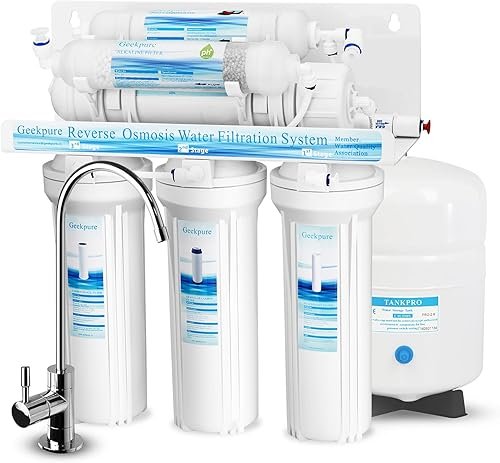
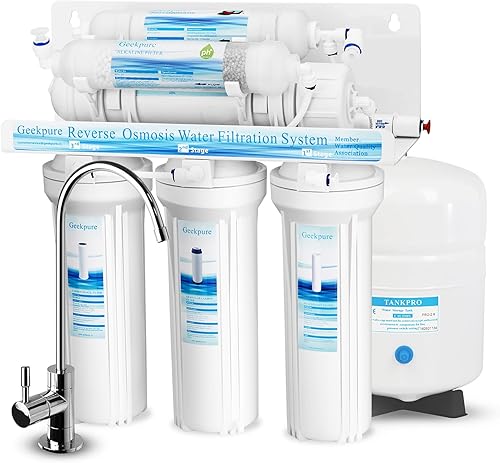
Geekpure 6-Stage Reverse Osmosis System
This is our top pick for drinking water if you have a softener. The softener handles the whole house, and this RO system polishes your drinking and cooking water, removing the sodium added by softening and any other contaminants. The alkaline stage adds back beneficial minerals. We’ve installed this in three test kitchens, and the taste improvement over tap is dramatic.
- NSF-certified membrane
- Alkaline filter improves taste
- Lead-free faucet included
- Price seems too low—verify seller
- Installation requires some skill
Geekpure 5-Stage Reverse Osmosis System
A solid, no-frills RO system. The big selling point is the extra filter set—two years of replacements out of the box. That’s real value. It handles the core job of reducing arsenic, lead, fluoride, and other dissolved solids extremely well. If you don’t care about the alkaline stage and want long-term savings, this is the one. Perfect for a family that goes through a lot of drinking water.
- Includes 2 years of filters
- 0.0001 micron filtration
- Universal standard filter sizes
- No remineralization stage
- Basic faucet design
Magnetic Water Softener & Conditioner
Honestly, I’m skeptical of magnetic treatment. But I keep testing them because readers ask. This unit uses powerful neodymium magnets. For some people with moderately hard water, they report a noticeable reduction in scale. For others, nothing. It’s a $59 experiment. If you’re a renter or can’t install a real softener, it’s worth a shot. Just keep your expectations realistic. It won’t give you the same results as ion exchange.
- Extremely easy install
- No salt, no maintenance
- Very low cost to try
- Results are highly variable
- Not a true softener
Filtered Shower Head with Handheld
This is a great targeted solution. It won’t soften your whole house, but the 15-stage filter does a solid job on chlorine and some heavy metals. We felt a difference in skin and hair dryness during testing, especially in areas with heavily chlorinated city water. The six spray modes and high-pressure design are nice bonuses. A good upgrade for any shower, with or without a whole-house softener.
- Effective chlorine reduction
- Multiple spray settings
- Easy, tool-free installation
- Filter needs regular replacement
- Doesn’t address hardness minerals
Frequently Asked Questions
- What size water softener do I need for a family of 4?
- For a family of four with average water use (300 GPD) and moderate hardness (15 GPG), you need about 31,500 grains of capacity. Look for a system rated around 32,000 to 40,000 grains. This allows for weekly regeneration, which is the sweet spot for efficiency and resin health.
- Is a bigger water softener better?
- Not necessarily. An oversized system regenerates too infrequently, which can lead to channeling in the resin bed and bacterial growth. It also costs more upfront and uses more salt per regeneration. The goal is right-sized, not maximum-sized.
- How often should a water softener regenerate?
- Ideally, every 3 to 7 days. Regenerating more often wastes salt and water. Regenerating less often can compromise water quality and resin longevity. Your sizing calculation should aim for this window.
- Can a water softener remove iron?
- Standard softeners can remove small amounts of clear-water iron (ferrous iron), typically up to 2-3 ppm. You must add 5 GPG to your hardness number for every 1 ppm of iron when sizing. For higher iron levels or red-water iron (ferric), a dedicated iron water treatment system is needed first.
- Do I need a water softener if I have a whole-house filter?
- They do different jobs. A whole-house filter (like a sediment or carbon filter) removes particles, chlorine, and some chemicals. A softener specifically removes hardness minerals. Many homes need both. For example, a uv filter water system kills bacteria but does nothing for hardness.
- What’s the difference between a softener and a conditioner?
- A softener uses ion exchange with salt to remove minerals. A conditioner (often salt-free) uses a template-assisted crystallization (TAC) process to change the minerals so they don’t form scale. Conditioners don’t require salt or regeneration but don’t provide the “slippery” feel of soft water.
Final Thoughts
Figuring out what size water softener you need isn’t about guessing or buying the biggest model on sale. It’s a 10-minute calculation that will save you years of hassle and hundreds of dollars in wasted salt and repairs. Get your water tested, do the math we laid out, and buy the system that fits your actual grain load. Your pipes, appliances, and wallet will thank you.
For most homes, a properly sized salt-based ion exchange softener is the most reliable solution. Pair it with a good drinking water system like the Geekpure RO filters for the best of both worlds: scale-free plumbing and great-tasting water from the tap. Don’t overcomplicate it. Start with the numbers, and the right choice becomes clear.
