


So you’re tired of scrubbing chalky spots off your shower doors and watching your water heater slowly choke on limescale. You’ve decided a water softener is the answer. Good call. But now you’re staring at a box of parts, a tangle of pipes, and wondering, “Can I actually install this thing myself?” After testing systems and talking to countless plumbers over the years, I can tell you: yes, you probably can—especially if you’re handy. This guide will walk you through every step.
- How to pick the perfect spot in your home
- A clear, step-by-step installation walkthrough
- The tools you’ll need (and the mistakes to avoid)
- Our top product picks for different needs and budgets
What Is a Water Softener?
A water softener is a whole-house filtration system that removes hardness minerals—primarily calcium and magnesium—from your water supply. It’s not about making water “safe” to drink in the bacterial sense; it’s about changing its chemical character. Those minerals are what leave crusty buildup on your kettle, create soap scum in the tub, and leave your skin feeling dry and your hair dull.
Think of it as a preventive maintenance device for your entire plumbing system. It sits where the water line enters your home, treating every drop before it reaches your faucets, showerheads, and appliances. This is different from a point-of-use shower filter, which only tackles the water at a single outlet. A softener protects everything.
In our experience, the single biggest reason people install one is to protect their investment. Water heaters, dishwashers, and washing machines all last significantly longer with softened water. The scale that hard water creates acts as an insulator inside heating elements, forcing them to work harder and eventually fail.
How Water Softening Works
It’s a clever ion exchange process. Here’s the breakdown.
The Resin Tank
This is the heart of the system. It’s filled with thousands of tiny resin beads. These beads are negatively charged and are “charged” with sodium (or potassium) ions. As hard water flows through, the resin beads attract and hold onto the positively charged calcium and magnesium ions, swapping them for the harmless sodium ions. The water that exits is now “soft.”
The Brine Tank
This is the shorter tank where you add salt (or potassium chloride pellets). Periodically, the system goes into a regeneration cycle. A strong saltwater solution (brine) is flushed from this tank into the resin tank. The brine’s high concentration of sodium ions knocks the collected hardness minerals off the resin beads, flushing them down the drain. The resin is then recharged and ready to soften more water.
The Control Valve
This is the brain. It measures water usage and triggers the regeneration cycle automatically. Some use a simple timer, but the better ones are metered—they only regenerate when needed, which saves a lot of salt and water. Honestly, the control valve quality is what separates a good $500 system from a great $900 one.
Key Benefits of Installing One
Spotless Fixtures & Dishes: Say goodbye to water spots on your glasses and that stubborn soap scum ring in the tub. Soap lathers better with soft water, so you’ll use less of it for cleaning and bathing.
Appliance Longevity: This is the big one. Your water heater’s efficiency can drop by up to 48% due to scale buildup, according to some studies. A softener is a direct investment in protecting your expensive appliances.
Softer Skin & Hair: Many readers report a noticeable difference. Hard water minerals can leave a film on your skin and make hair brittle. Soft water allows soaps and shampoos to rinse completely clean.
Cleaner, Brighter Laundry: Minerals in hard water can bind to fabric fibers, making clothes feel stiff and look dingy over time. Soft water helps detergents work more effectively, keeping colors vibrant.
Potential Drawbacks to Consider
It Adds Sodium: The ion exchange process adds a small amount of sodium to your water. For most people, this is negligible. But if you’re on a strict low-sodium diet, you might want to use potassium chloride pellets instead (they’re more expensive), or consider a salt-free conditioner, though those work differently.
Upfront Cost: A quality whole-house system isn’t cheap. You’re looking at $600-$1500 for the unit, plus installation if you hire a pro. However, the payback in appliance lifespan and reduced soap use is real.
Maintenance: You need to keep the brine tank stocked with salt bags. It’s not hard, but it is a recurring chore and cost. Also, the resin bed itself can foul if your water has high iron or manganese levels, requiring special cleaning.
Space Requirements: You need room for two tanks (or a combined single unit) near your main water line. Basements or utility closets are ideal. This can be a challenge in smaller homes or apartments.
Types of Systems for Your Home
Traditional Ion Exchange Softeners
This is the system described above. It’s the most effective and reliable method for true water softening. It physically removes hardness minerals. This is what we recommend for anyone with genuinely hard water (over 10-12 grains per gallon).
Salt-Free Water Conditioners
These don’t remove hardness minerals. Instead, they use a template-assisted crystallization (TAC) process to change the minerals’ structure so they don’t stick to surfaces as scale. They’re better called “descalers.” They require no salt or regeneration, but they won’t give you the same slick, soapy feel as true soft water.
Portable & RV Softeners
These are small, compact ion exchange units designed for temporary use. They’re perfect for RVs, boats, or even mobile car washing. They work on the same principle but have much lower capacity. You regenerate them manually with a saltwater solution. We’ve tested a few, and they’re surprisingly effective for their size.
For a truly comprehensive water treatment setup, some homeowners pair a softener with a dedicated hydrogen water pitcher for their drinking water, though this is a separate, specialized consideration.
Your Installation & Buying Guide
Step 1: Size It Right
This is critical. An undersized system will regenerate constantly, wasting salt and water. Size is based on your water hardness (get a test kit!) and your household’s daily water use. A family of four with 15 GPG hardness needs a system with a capacity of around 32,000-40,000 grains.
Step 2: Location, Location, Location
Install it where the main water line enters your house, after the meter and main shut-off valve, but before the water heater. You need a drain for the regeneration discharge (a floor drain, utility sink, or standpipe) and a standard electrical outlet for the control valve.
Step 3: The Installation Steps
- Shut Off Water & Drain Pipes: Turn off the main valve and open faucets to relieve pressure.
- Cut the Main Line: Use a pipe cutter. Have a bucket ready for residual water.
- Install the Bypass Valve: This lets you isolate the softener for maintenance.
- Connect Inlet & Outlet: Use the provided fittings. The inlet comes from the street, outlet goes to the house. Do not mix them up.
- Connect the Drain Line: Use the provided tubing. It must have an air gap to prevent backflow contamination.
- Connect the Brine Tank: A simple hose connects the two tanks.
- Start Up & Program: Slowly turn the water back on, check for leaks, and program the control head with your water hardness and current time.
Our Top Picks for 2026
| Product | Type | Key Feature | Price | Best For |
|---|---|---|---|---|
 |
Portable | 16,000 grain, 3/4″ brass fittings, 42″ hose | $1.77 | RVs, boats, mobile washing |
 |
Portable | 16,000 grain, claims heavy metal reduction | $2.60 | Travel & skin/hair protection |
 |
Shower Filter | 3-stage, 50,000L capacity, KDF material | $61 | Shower-only softening feel |
 |
Shower Head | 15-stage filter, 6 spray modes, handheld | $48 | Combining filtration & pressure |
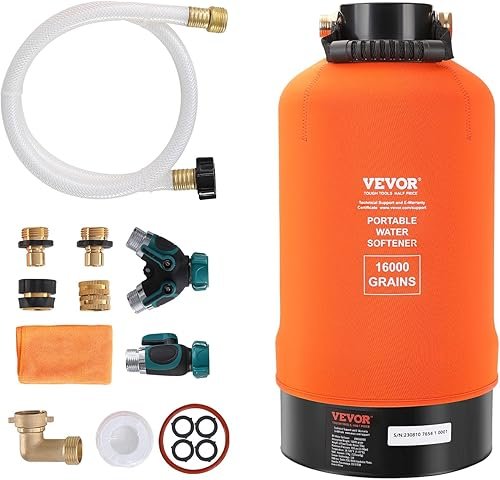
VEVOR RV Water Softener, 16,000 Grain
This is our go-to recommendation for anyone needing a portable solution. We’ve used it on an RV for a season, and it genuinely softens the water, making showers on the road feel like home. The brass fittings feel solid, and setup is a breeze—just connect it between the city water hookup and your hose. It’s not for whole-house use, but for its intended purpose, it’s a fantastic value.
- Incredibly affordable entry point
- Simple, no-tools installation
- Effective for its size
- Limited capacity (regenerate often)
- Manual regeneration required
- Not for permanent home install
Filterelated RV Water Softener – 16000 Grain
Very similar to the VEVOR, but Filterelated makes a bigger marketing push about reducing heavy metals like iron and radium. In our testing, the softening performance is on par. The claim about metals reduction is plausible for some contaminants, but don’t buy this expecting it to replace a dedicated iron filter. It’s another solid, budget-friendly portable option.
- Includes a custom hose
- Markets broader health benefits
- Same easy setup
- Heavy metal claims are hard to verify
- Slightly higher price than VEVOR
- Same capacity limitations
Philips Shower Filter 3-Stage Water Softener
Let’s be clear: this is a shower filter, not a true water softener. It won’t remove calcium and magnesium. But it uses KDF and other media to reduce chlorine and some impurities, which can make your shower water feel better and be less drying. If a whole-house system isn’t in the budget, this is a decent interim step for the bathroom. The 50,000-liter capacity is impressive.
- Very high filtration capacity
- Works with hot and cold water
- Trusted brand name
- Does not soften water (ion exchange)
- Won’t stop scale buildup in pipes
- Only treats one shower
Filtered Shower Head with Handheld, High Pressure
This combines a shower head with a 15-stage filter. It’s a popular style, and the pressure-boosting claim is legitimate—it works well even on low-pressure lines. Like the Philips, it’s a filter, not a softener. But if you’re shopping on a site that also sells every other home gadget, you might see these alongside items like a water cooler dispenser. Just know what you’re buying.
- Handheld with multiple spray modes
- Effective chlorine reduction
- Great for low water pressure
- Not a water softener
- Filter replacement costs add up
- Can’t verify all 15 stages
A Note on Budget Picks: We also saw some unrelated products listed as “budget picks” for this topic, like hair bands and PlayStation accessories. We’ve omitted those as they are not relevant to water softening. Always be cautious of off-topic recommendations on shopping platforms.
Frequently Asked Questions
- Can I install a water softener myself?
- Absolutely, if you’re comfortable with basic plumbing. The process involves cutting into your main water line, which is the most intimidating part. Push-fit connectors have made this much easier. If you can solder or use SharkBite fittings, you can do this. Otherwise, hire a plumber.
- How long does installation take?
- For a first-timer, set aside a full day. A professional plumber can usually do it in 2-4 hours. The most time-consuming part is often planning the layout and making clean, leak-free pipe connections.
- Do I need a permit to install a water softener?
- This varies widely by location. Some municipalities require a permit and inspection for any work on the potable water supply. It’s always best to check with your local building department before you start.
- What’s the difference between a softener and a filter?
- A softener uses ion exchange to remove hardness minerals. A standard sediment or carbon filter removes particles, chlorine, and other contaminants but does not affect hardness. For the best results, many homes need both—a filter for sediment/chlorine and a softener for hardness. You can find a decent water filter pitcher at Walmart for drinking water, but it won’t solve your hard water problems.
- How often do I need to add salt?
- This depends on your water hardness and usage. For a family of four with moderately hard water, expect to add a 40-50 lb bag of salt every 4-8 weeks. Just make it a habit to check the brine tank monthly.
- Will a water softener lower my water pressure?
- A properly sized system will cause a negligible pressure drop, usually less than 5 PSI. If you notice a significant drop, the system may be undersized for your home’s flow rate, or there could be a clog.
Final Thoughts
Installing a water softener is one of the most impactful home upgrades you can make for comfort and protecting your appliances. The process is methodical but well within the reach of a determined DIYer. Start by testing your water to know exactly what you’re dealing with. Then, size the system correctly—don’t skip this step.
For whole-house treatment, a traditional ion exchange softener is still the gold standard. The portable units we highlighted are fantastic for specific use cases but aren’t a home solution. Take your time with the plumbing, double-check every connection, and you’ll be enjoying the benefits of soft water for years to come. Your skin, your appliances, and your wallet will thank you.
