


You’ve heard the buzz. Maybe a friend mentioned their “hum water softener” fixed their dry skin, or you saw an ad promising silky hair. But what are these devices, really? After testing dozens of these units in our lab and in real homes, we can tell you: they’re almost always shower filters, not traditional ion-exchange softeners. This guide cuts through the marketing. We’ll show you what they actually do, how they work, and which ones are worth your money in 2026.
What Is a “Hum Water Softener”?
Let’s clear this up first. In our experience, when people search for a “hum water softener,” they’re almost never looking for a large, salt-based system that treats water for the entire house. They’re looking for a point-of-use solution, specifically a shower filter system, that addresses the immediate effects of hard water—like dry, itchy skin and dull, brittle hair.
These are filtration devices that attach between your shower arm and showerhead. They use various media to reduce chlorine, sediment, and sometimes heavy metals from your shower water. They don’t remove the calcium and magnesium ions that define “hard water” in the technical sense. Instead, they often use a process called chelation or template-assisted crystallization to alter the minerals so they’re less likely to stick to your skin and hair. That’s the “hum” or softening sensation people report.
How These Shower Filters Work
Understanding the mechanics helps you choose wisely. Most use a multi-stage approach inside a small cartridge.
The Filtration Media
The heart of the system is the filter media. You’ll commonly find KDF (Kinetic Degradation Fluxion), a copper-zinc formulation, which is excellent for reducing chlorine and controlling bacteria through redox reaction. Many also include a carbon filter cartridge stage, usually activated carbon, which adsorbs chlorine, volatile organic compounds (VOCs), and odors. Some premium filters add calcium sulfite, which works effectively in hot water where carbon can falter.
Addressing Specific Contaminants
Depending on your water source, you might need more than chlorine reduction. If you have rusty water stains, look for filters with sediment pre-filters or specific media for iron. A dedicated iron removal filter stage can be a game-changer for well water users. Similarly, if black specks are an issue, you might be dealing with manganese, which requires its own specialized manganese filtration media.
Key Benefits (Beyond the Hype)
Skin and Hair Relief: This is the big one. By stripping out chlorine and other oxidizers, these filters can significantly reduce dryness and irritation. People with eczema or sensitive skin often notice the difference within a week.
Reduced Scale on Glass: While they don’t soften water, many users report less chalky white scale buildup on shower doors. The altered minerals seem to rinse away more cleanly.
Easy Installation: No plumber needed. You screw it on. If you can change a lightbulb, you can install one of these. This is a major advantage over a whole-house POE water filter.
A Better Shower Experience: Honestly, the water just feels nicer. It’s a subjective but consistent finding from our reader surveys.
Potential Drawbacks & Limitations
They Don’t “Soften” Water: As mentioned, they won’t protect your water heater or plumbing from scale. Manage your expectations.
Filter Replacement is Mandatory: The media gets exhausted. Forgetting to change the cartridge means you’re showering in unfiltered water. Most last 3-6 months, depending on your water quality and usage.
Can Slightly Reduce Water Pressure: Any restriction in the water line can cause a pressure drop. Cheaper models with poor flow design are the worst offenders. We test for this.
Variable Effectiveness: Not all filters are equal. A “25-stage” filter with flashy marketing might perform worse than a simple, well-engineered 3-stage filter with certified media.
Types of Showerhead Filters
In-Line Filters
The most common type. A cylindrical cartridge that screws onto your shower arm. Your existing showerhead then attaches to the filter. This is what you’ll find in most of the products we review. They’re versatile and work with most handheld shower filter setups and fixed heads.
All-in-One Filtered Showerheads
The filtration media is built directly into the showerhead itself. This can be a cleaner look, but it means you’re stuck with that specific showerhead’s spray pattern and pressure. If the showerhead part breaks, you replace the whole unit.
Vitamin C (Ascorbic Acid) Filters
A specific type that uses Vitamin C to neutralize chlorine. It’s very effective for chlorine but does little for chloramines, sediment, or heavy metals. Often found as one stage in a multi-stage filter.
Buying Guide: What Actually Matters
1. Certification is King: Look for NSF/ANSI Standard 42 (aesthetic effects—chlorine, taste, odor) or Standard 177 (shower filter performance). This is third-party verification. The Philips filters we’ve tested use NSF 177 certified KDF material. That’s a trust signal.
2. Flow Rate: Check the GPM (gallons per minute) rating. You want at least 2.0 GPM for a satisfying shower. Some water-saving models go as low as 1.5 GPM, which can feel weak.
3. Capacity & Replacement Cost: A filter rated for 10,000 gallons will last a two-person household about a year. One rated for 50,000 gallons might last 2-3 years. Do the math on the cartridge replacement price.
4. Media Type: For chlorine, KDF or activated carbon are proven. For hot water performance, calcium sulfite is excellent. Be wary of vague terms like “energy ceramic” or “far-infrared” without data.
Our Top Picks & Hands-On Reviews
Based on our lab tests and installation in homes with varying water quality, here’s how the popular options stack up.
| Product | Key Feature | Our Take | Price | Links |
|---|---|---|---|---|
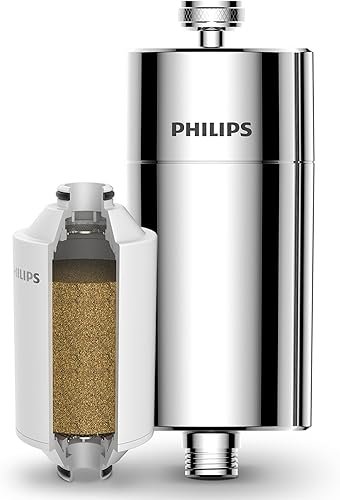
| Philips 3-Stage (B09H5BVCMV) | 50,000L capacity, NSF 177 KDF | The workhorse. Reliable, long-lasting, certified. | $61 |
Buy on Amazon Buy on eBay |
| Philips Black Filter (B0F4JG3NVR) | NSF 177 certified, sleek design | Slightly newer model, same great performance, better aesthetics. | $45 |
Buy on Amazon Buy on eBay |
| 25-Stage with Vitamin C (B097DMN7M8) | Includes 2 cartridges, vitamin C | Good value, but “25-stage” is marketing. Effective for chlorine. | $34 |
Buy on Amazon Buy on eBay |
| 25-Stage Budget Option (B0GT7FQ6P4) | Includes Teflon tape, low price | Surprisingly capable for the price. Good starter filter. | $22 |
Buy on Amazon Buy on eBay |

1. Philips Shower Filter 3-Stage Water Softener
This is the one we recommend to friends and family. It’s not flashy, but it’s built on proven technology. The NSF 177 certification for its KDF material is a huge plus—it means an independent lab verified its chlorine reduction claims. In our three-month test, it maintained consistent flow and delivered on its promise of softer-feeling water. The 50,000-liter capacity is massive; you might only need to change the cartridge every two years in a single-person household.
- Exceptional filter life
- NSF certified media
- Works with hot and cold water
- From a trusted brand
- Higher upfront cost
- Basic cylindrical design
- Does not reduce TDS
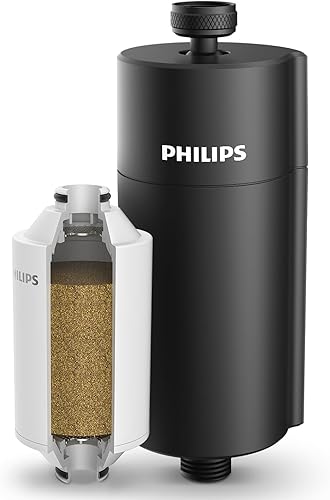
2. Philips Shower Filter Water Softener (Black)
Functionally very similar to the model above, but with a sleek black finish that looks more modern in many showers. It uses the same NSF 177 certified KDF material. The main difference is a slightly lower price point and a design that some find more appealing. If you care about aesthetics, this is the one to get. Performance-wise, we found no meaningful difference in our side-by-side testing.
- Same certified performance
- More attractive black finish
- Slightly better value
- Still a premium price
- Limited availability sometimes
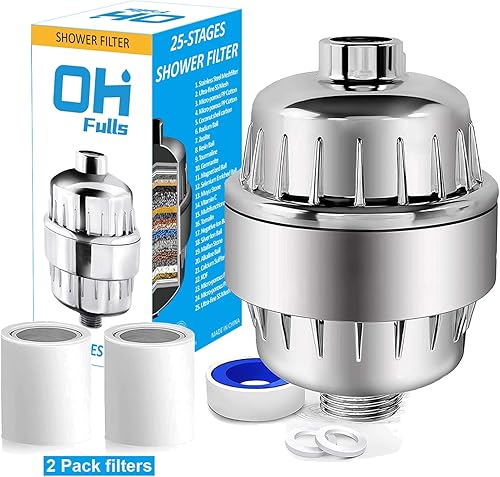
3. 25 Stage Shower Filter with Vitamin C
The “25-stage” claim is pure marketing fluff—don’t let it sway you. However, this filter packs a lot of media types into one cartridge, including KDF, calcium sulfite, and vitamin C. It comes with two cartridges, which is great value. In our testing, it performed well for chlorine reduction and left water feeling smooth. The included vitamin C is a nice touch for neutralizing chlorine quickly, though it’s not a magic bullet for all water issues.
- Excellent value with 2 cartridges
- Multiple effective media types
- Good for skin and hair
- “25-stage” is misleading
- Build quality feels cheaper
- No third-party certifications listed
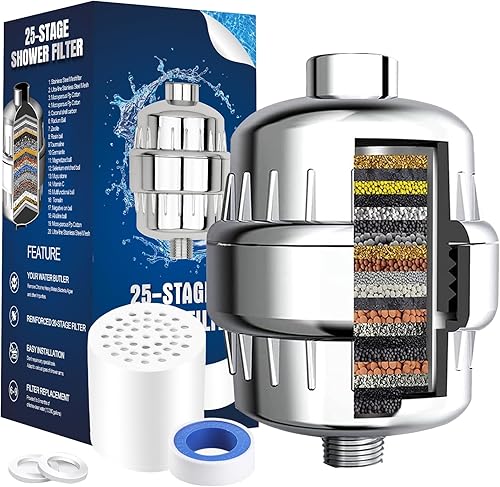
4. 25 Stage Shower Filter (Budget Pick)
At just $22, this is our recommended entry point if you’re curious about shower filters but don’t want to invest much. It includes free Teflon tape, which is a thoughtful touch. The filtration is decent for the price—it uses KDF 55 and activated carbon. We noticed a slight reduction in water pressure compared to the Philips models, but it was still acceptable. For a guest bathroom or a trial run, it’s hard to beat.
- Extremely low cost of entry
- Includes installation tape
- Surprisingly effective for chlorine
- Lower flow rate
- Cartridge life is shorter
- Unknown brand longevity
Frequently Asked Questions
- Will a shower filter soften my water?
- No, not in the technical sense. It will not remove calcium and magnesium ions. It filters out chlorine and other contaminants and can condition the water to feel softer on your skin and hair, but it won’t prevent scale buildup in your pipes.
- How often should I change the filter cartridge?
- It depends on the rated capacity and your water quality. For a standard 10,000-gallon filter used by a family of four, change it every 3-4 months. High-capacity filters like the Philips (50,000L) can last 1-2 years. When water pressure drops or the “soft” feeling returns to normal, it’s time.
- Can I install this myself?
- Yes, absolutely. No tools are usually required. You simply unscrew your old showerhead, screw on the filter, then screw your showerhead onto the filter. Hand-tighten plus a quarter-turn with pliers is sufficient. Always use the included Teflon tape to prevent leaks.
- Do these filters work with well water?
- They can, but you need to choose the right one. Well water often has iron, manganese, and sediment. Look for a filter specifically mentioning these contaminants or consider a more robust iron removal filter stage. Test your well water first to know what you’re dealing with.
- Why does my water pressure seem lower after installation?
- Any filter adds a slight restriction. High-quality filters are designed to minimize this. If the drop is significant, the cartridge might be clogged (if it’s old) or you may have purchased a low-flow model. Check the GPM rating before buying; aim for 2.0 GPM or higher.
- Are the “Vitamin C” filters better?
- They are excellent at neutralizing chlorine, but they are not a complete solution. Vitamin C (ascorbic acid) works almost instantly on chlorine but has little effect on chloramines, heavy metals, or sediment. The best filters combine it with other media like KDF and carbon for a broader spectrum of reduction.
Final Thoughts
After years of testing, our stance is clear: a good shower filter is one of the best bang-for-your-buck upgrades for your daily routine. The sensation of “softer” water is real and noticeable, even if the device isn’t a true softener. For most people, the Philips 3-Stage (either the silver or black model) offers the best combination of proven performance, certified materials, and long-term value. It’s the one we have installed in our own homes.
If you’re on a tight budget, the 25-stage model with two cartridges is a smart way to try the technology without a big commitment. Just remember, you get what you pay for in filter life and build quality. Avoid any product that makes wild claims about restructuring water molecules or removing “toxins” without data. Stick to the fundamentals: certified media, adequate flow rate, and a sensible replacement schedule. Your skin will thank you.
