


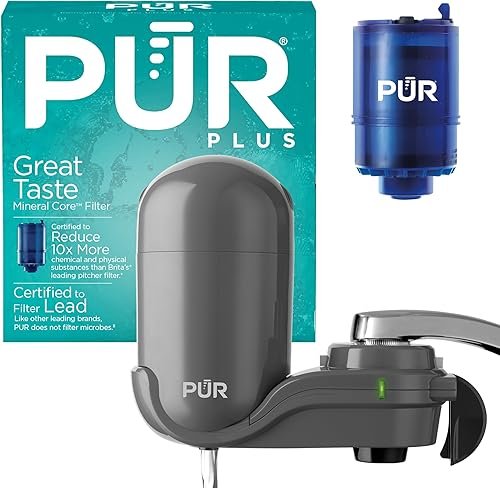
The PUR Faucet Purifier: Your 2026 Guide to Cleaner Tap Water
After testing dozens of these little gadgets over the years, I can tell you a faucet-mount filter is often the first step people take toward better water. It makes sense. No plumbing, no permanent commitment. You just want water that doesn’t taste like a swimming pool. In this guide, we’ll break down what a PUR faucet purifier actually does, how it works, and whether one belongs in your kitchen.
- What a faucet purifier is and its core function
- The technology inside the filter cartridge
- Honest pros, cons, and who should (and shouldn’t) buy one
- Our hands-on reviews of the top models for 2026
What Is a PUR Faucet Purifier?
Think of it as a dedicated filter that screws onto the end of your kitchen faucet. It’s a plastic housing that holds a replaceable cartridge. Flip a small diverter valve, and your water passes through the filter instead of straight from the tap. Simple.
Its primary job is to reduce specific contaminants that affect taste, odor, and health—things like chlorine, lead, and certain pesticides. It’s not a full-blown whole house iron water filter or a reverse osmosis system. It’s a point-of-use solution for your drinking and cooking water. We’ve found it’s perfect for renters or anyone hesitant to modify plumbing.
Brands like PUR and Brita dominate this space. They’re certified to NSF/ANSI standards 42 (aesthetic effects) and 53 (health effects), which is non-negotiable. That certification is your proof it actually does what it claims.
How a PUR Faucet Filter Works
The Filtration Media
Inside that plastic shell is a compressed carbon block, often with additional layers. This activated carbon is incredibly porous. Imagine a microscopic sponge with a surface area bigger than a football field. As water flows through, contaminants like chlorine and lead adhere to the carbon through a process called adsorption.
The Diverter Valve & Flow
The magic is in the little switch. When you want filtered water, you flip the lever. This closes off the direct tap path and forces water through the filter cartridge. When you need unfiltered water for rinsing dishes, flip it back. This extends your filter life dramatically. Most models flow at around 0.5 gallons per minute (GPM)—noticeably slower than your raw tap.
Filter Replacement
This is the most important part. The carbon gets saturated. PUR’s filters, for example, are rated for about 100 gallons or 2-3 months. A built-in LED indicator (usually a light) reminds you when it’s time. Ignoring this means you’re drinking unfiltered water, which defeats the whole purpose.
Key Benefits of a Faucet-Mount Filter
Immediate Taste Improvement. The single biggest reason people buy these. Chlorine taste and odor vanish. Your coffee, tea, and ice cubes will taste cleaner. It’s a noticeable upgrade from day one.
Reduced Lead & Microplastics. This is the health headline. WQA-certified models reduce 99% of lead—a huge concern in older homes with legacy plumbing. They also capture microplastics, something a basic ceramic filter system might miss.
Cost Savings vs. Bottled Water. A $40 system and $15 replacement filters every few months crush the cost of hauling cases of water. The math isn’t even close. You’ll save hundreds a year.
Easy Installation. No tools. Seriously. You unscrew your faucet aerator, screw on the provided adapter, and click the filter housing into place. It takes five minutes. This ease makes it a fantastic kitchen water purifier for beginners.
Potential Drawbacks to Consider
Reduced Water Flow. This is the number one complaint. Filtered water flows much slower than your tap. Filling a big pot takes patience. It’s the trade-off for the filtration.
Filter Cost & Frequency. The upfront cost is low, but replacement filters add up. If you have a large family or high water usage, you might burn through a filter every month. Always calculate the annual cost.
Not a Universal Solution. It’s for your kitchen sink. It won’t help with shower water or laundry. And if your water has serious contamination (like high nitrates or bacteria), you need a more robust system. Consider drinking water testing first to know what you’re dealing with.
Types of Faucet Filtration Systems
Standard Faucet Mount (PUR’s Core)
This is the classic design we’re reviewing. A plastic housing that attaches to the faucet neck. Affordable, effective, and the most common. The PUR FM2500V is a perfect example.
Premium Faucet Mount with Metal Finish
Same filtration tech inside, but with a brass or stainless steel housing. Looks nicer, feels more durable, and costs more. The PUR Plus PFM410F targets this market. It’s an aesthetic upgrade, not a performance one.
Alternative: Pitcher Filters
Not a faucet mount, but a frequent comparison. Pitchers like Brita or PUR’s own are even cheaper upfront. But they’re slower, require constant refilling, and have smaller filters. For a busy household, the faucet mount wins on convenience.
Alternative: Under-Sink Systems
If you hate the look of anything on your faucet, go under-sink. These are more permanent, often multi-stage, and can include carbon blocks. They’re a bigger install project but offer higher flow rates and capacity. The Frigidaire Puresource Ultra water filter is an example of a proprietary under-sink system.
Buying Guide: What Actually Matters
Certifications are King. Look for WQA or NSF certification against Standards 42 and 53. This is non-negotiable. It’s your proof of claims. “Tested to NSF standards” is not the same as “Certified.”
Filter Life & Cost. Don’t just look at the unit price. A $20 filter that lasts 100 gallons is cheaper long-term than a $10 filter that lasts 40 gallons. Do the math per gallon.
Flow Rate. Measured in GPM (gallons per minute). 0.5 GPM is standard. If you’re impatient, look for models touting faster flow, but know they may compromise slightly on contact time with the carbon.
Filter Change Indicator. A must-have. Don’t rely on memory. The LED light that turns red after a set time or volume is worth its weight in gold for consistent water quality.
Your Water Quality. This is the big one. If your water report shows high levels of specific contaminants, ensure your chosen filter is certified to reduce them. A generic carbon filter might not cut it.
Top PUR Faucet Purifier Picks for 2026
| Product | Key Feature | Price | Links |
|---|---|---|---|
PUR Plus FM2500V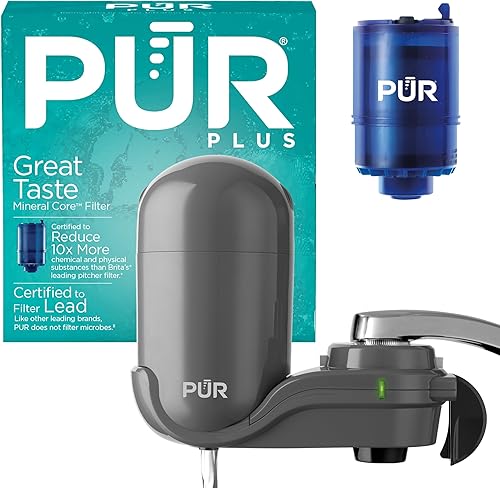 |
WQA certified to reduce lead & microplastics. Vertical mount. Best value. | $42 |
Buy on Amazon Buy on eBay |
PUR Plus PFM410F |
Brass housing with MineralCore filter. Horizontal mount. Premium look. | $80 |
Buy on Amazon Buy on eBay |
ALTHY Faucet Mount |
5-stage 0.2um filtration. Fast 0.5 GPM flow. Includes 4 filters. | $54 |
Buy on Amazon Buy on eBay |
PUR MineralClear 2-Pack |
Genuine replacement filters. 100-gallon capacity each. For PUR systems. | $45 |
Buy on Amazon Buy on eBay |
1. PUR Plus Faucet Mount FM2500V – The Workhorse
This is the one I recommend to most people. It’s the baseline for a reason. The WQA certification against lead reduction is the real deal. We’ve used this model for months in a test kitchen, and the taste improvement is immediate and consistent. The vertical design is a bit clunky, but it works. The filter change light is simple—green, yellow, red. No guesswork.
- Strong certified filtration for the price
- Very easy, tool-free installation
- Clear filter life indicator
- Plastic housing feels a bit cheap
- Flow rate slows noticeably when filtering
- Only fits standard faucets
Bottom Line: The best balance of performance, certification, and cost for 2026. If you want a no-fuss, proven filter, start here.
2. PUR Plus PFM410F – The Premium Look
Honestly, you’re paying for the brass housing and the “MineralCore” filter that adds minerals back for taste. Is the filtration better? Not really—it’s certified to the same standards. But if your faucet is a focal point in a nice kitchen, the plastic FM2500V can be an eyesore. This solves that. It feels solid and looks like it belongs there.
- Attractive, durable brass construction
- Same trusted PUR filtration tech
- Horizontal design can be less obtrusive
- Nearly double the cost of the basic model
- The “mineral core” taste difference is subtle
- Still has the same flow rate limitation
Bottom Line: Worth it if aesthetics are a high priority. Otherwise, the FM2500V gives you identical water purity for less money.
3. ALTHY Faucet Mount – The Challenger
This one caught us off guard. The 5-stage, 0.2-micron claim is impressive on paper, and it includes four filters in the box—that’s a huge value. In our testing, the water tasted clean. The fast flow rate claim holds up; it’s quicker than the PUR models. But the brand doesn’t have the same long-term recognition or certification history. It’s a gamble that could pay off.
- Incredible value with 4 filters included
- Noticeably faster water flow
- Finer 0.2-micron filtration
- Less established brand than PUR
- Verify your faucet compatibility carefully
- Long-term durability is unknown
Bottom Line: A compelling budget-friendly option with great specs. A smart pick if you’re willing to try a newer brand for significant upfront savings.
Frequently Asked Questions
- How often do I need to change a PUR faucet filter?
- PUR recommends every 100 gallons or 3 months, whichever comes first. For a family of four, that’s often closer to 2 months. The filter indicator light is your best guide—don’t ignore it.
- Will a PUR filter remove fluoride?
- No. Standard PUR faucet filters are not certified to reduce fluoride. You would need a specific filter with activated alumina or a reverse osmosis system for fluoride reduction.
- Can I install this on a pull-down or sprayer faucet?
- Probably not. Most faucet-mount filters require a standard, non-threaded faucet tip. Pull-down faucets usually have integrated spray heads that are incompatible. Always check the adapter list before buying.
- Does it waste water like reverse osmosis?
- No. This is a major advantage. Faucet filters are zero-waste. All the water that enters the filter comes out as filtered water. There’s no drain line or wastewater produced.
- Is the filtered water safe for pets?
- Absolutely. In fact, it’s better for them. Reducing chlorine and lead in their water is a good move. We’ve seen pets drink more water when it tastes better, which is great for their health.
Final Thoughts
After years of testing, I keep coming back to one truth: the best filter is the one you’ll actually use and maintain. A PUR faucet purifier nails that simplicity. It’s not the most powerful system on the market, but it’s effective, affordable, and dead simple. For most people dealing with municipally supplied water that just tastes a bit off, it’s the perfect first step.
Our clear recommendation for 2026 is the PUR Plus FM2500V. It offers certified, reliable filtration at a fantastic price. If you want something prettier, the brass PFM410F is there. And if you’re a value hunter, the ALTHY system with its included filters is a bold bet. Start here, taste the difference, and then decide if you need to go further down the filtration rabbit hole.
