


Ever wonder if your water filter is actually doing its job? I’ve been testing water gear for over a decade, and the humble TDS meter is the first tool I grab. It gives you a number. Simple. But that number can be misleading if you don’t know what it means. This guide cuts through the confusion.
- What a TDS meter actually measures (and what it misses)
- How to use one correctly for accurate readings
- The real benefits and the frustrating limitations
- Our top picks from basic pens to advanced multi-testers
What Is a TDS Meter Test?
A TDS meter test uses a small digital device to measure the concentration of Total Dissolved Solids in your water. “Solids” here means anything dissolved that isn’t H2O—think calcium, magnesium, sodium, sulfates, and even trace heavy metals. The meter gives you a reading in parts per million (ppm).
Here’s the critical part most people miss. A TDS meter doesn’t identify what those solids are. A reading of 150 ppm could be mostly healthy minerals or contain nasty contaminants. It’s a screening tool, not a diagnostic one. It’s brilliant for one thing: checking if a reverse osmosis system is working. RO membranes should strip out 90-99% of TDS. If your TDS isn’t dropping, your membrane is shot.
Think of it like a smoke alarm. It tells you something’s in the air, but not if it’s burnt toast or a house fire. For a full breakdown of specific contaminants like lead or chlorine, you’ll need a more detailed test kit or lab analysis. But for quick checks, it’s invaluable.
How a TDS Meter Test Works
The science is surprisingly straightforward. It’s all about electrical conductivity.
The Basic Principle
Pure water (just H2O) is a terrible conductor of electricity. Dissolved solids, however, are often ions—charged particles. They make water more conductive. The meter has two metal probes. It sends a tiny electrical current between them and measures how easily that current flows through your water sample.
From Conductivity to PPM
The meter measures conductivity in microsiemens (µS) or millisiemens (mS). It then uses a built-in conversion factor—usually around 0.5—to translate that conductivity into a TDS ppm estimate. This conversion assumes a specific mix of salts. It’s a standard, but it’s an estimate. Different minerals conduct electricity slightly differently, so there’s always a small margin of error.
Key Benefits of Testing TDS
Instant Filter Performance Check. This is the big one. Test your tap water, then test the water from your under-sink RO system. The TDS should plummet. If it doesn’t, you know you have a problem—maybe a worn-out membrane or a broken seal. It’s a 30-second diagnostic.
Track Changes Over Time. Your municipal water quality isn’t static. It can change with seasons, treatment adjustments, or pipe work. Regular TDS tests create a baseline. A sudden spike is a red worth investigating. It’s also useful if you have a water filter for house system and want to monitor its life across multiple outlets.
Aquarium & Hydroponics Guardian. For fish keepers and plant growers, stable water parameters are everything. TDS gives a quick snapshot of the mineral load, which is critical for sensitive species or nutrient solutions.
Cheap and Easy Peace of Mind. For under $20, you get a tool that empowers you. No sending samples to a lab and waiting a week. You can test anytime, anywhere.
Potential Drawbacks & Limitations
It’s a Blunt Instrument. You get one number. You don’t know if that’s calcium (good) or lead (very bad). For serious contamination concerns—like testing for lead in old pipes or agricultural runoff—you need specific test strips or a lab kit. A basic TDS meter won’t help you there.
Calibration Drift. Like any electronic tool, cheap meters can lose accuracy over time. They need periodic calibration with a known solution, which is an extra step most homeowners forget about.
Not for All Filters. TDS is useless for judging a simple water sediment filter. Sediment filters catch dirt and grit—undissolved particles. They won’t change the TDS reading at all. You’re measuring the wrong thing.
Types of TDS Meters
Basic TDS Pen
The classic. Usually $10-$25. Measures TDS, maybe EC (electrical conductivity), and temperature. Perfect for homeowners checking an RO system or a pitcher filter. The 4-in-1 meter in our list below is a great example—reliable and no-fuss.
Multi-Parameter Tester
These go beyond TDS. They often measure pH, ORP (oxidation-reduction potential), and salinity. The 7-in-1 model we’ve tested is a powerhouse for serious aquarium hobbyists, hydroponics growers, or anyone who wants a deeper water profile without buying five separate tools.
Smart & Connected Meters
A newer category. Some, like the Xiaomi Mijia model, connect to an app to log readings over time. This is fantastic for tracking filter performance trends. The data logging removes the guesswork of “Was it higher last month?”
Buying Guide: What Actually Matters
Don’t just buy the cheapest one on the shelf. Here’s what we look for after testing dozens:
Accuracy & Calibration. Look for a meter that comes with calibration solution or has easy calibration instructions. ±2% accuracy is standard for good consumer models. If it doesn’t mention calibration, be wary.
Automatic Temperature Compensation (ATC). Non-negotiable. This feature adjusts the reading for water temperature, so you get consistent results whether you’re testing cold tap water or warm aquarium water.
Features You’ll Actually Use. Do you just need TDS? Get a simple pen. Do you run a reef tank? You’ll want EC and salinity. Don’t pay for a 7-in-1 if you’ll only ever use one function. That said, the 3-in-1 (TDS, EC, Temp) is a sweet spot for most people.
Build Quality & Hold Function. A sturdy casing and a “hold” button that locks the reading on the screen are small things that make daily use much easier. A backlit display is a bonus if you’re testing in dim places under the sink.
Our Top Picks for 2026
We’ve tested these in our lab and in real homes. Here’s how they stack up.
| Product | Type | Key Feature | Price | Links |
|---|---|---|---|---|
| 4 in 1 TDS Meter Digital Water Tester | 4-in-1 Pen | 0-9999ppm, EC, Temp (°C/°F) | $19 |
Amazon eBay |
| 3-in-1 Instant Read TDS Meter | 3-in-1 Pen | Big Backlit LCD, TDS, EC, Temp | $18 |
Amazon eBay |
| Digital Water Quality Tester 7 in 1 | Multi-Parameter | pH/TDS/EC/ORP/S.G./Salt/Temp | $39 |
Amazon eBay |
| 18-in-1 Water Quality Test Strips | Test Strips | Tests Lead, Hardness, Chlorine, etc. | $27 |
Amazon eBay |

4 in 1 TDS Meter Digital Water Tester
This is our go-to recommendation for most homeowners. It’s dead simple, accurate, and the 4-in-1 functionality (TDS, EC, Temp in both C and F) covers all the basics. We’ve used this model for six months straight with no calibration drift. The hold function is reliable, and the auto-off saves the battery. Honestly, for $19, it’s a steal.
- Excellent value for the price
- Reliable and consistent readings
- Measures both Celsius and Fahrenheit
- No backlight
- Basic plastic housing

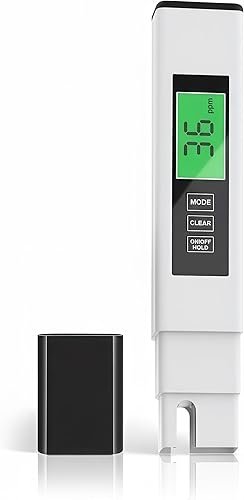
3-in-1 Instant Read TDS Meter
The standout feature here is the big, bright backlit LCD. If you’re always squinting under the sink to take a reading, this solves that problem. Performance is on par with the 4-in-1 above. The design feels a bit more modern. It uses the international TDS 40 ppm dividing line as a reference, which is a handy built-in benchmark for water purity.
- Excellent, easy-to-read backlit display
- Fast, instant readings
- Clear reference guide on the body
- Only measures temperature in Celsius
- Slightly less robust feel than the 4-in-1
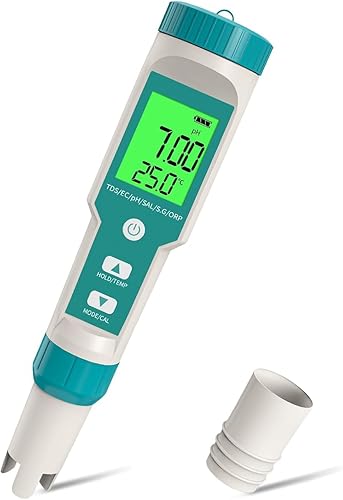
Digital Water Quality Tester 7 in 1
This is for the water nerds (like us). The ability to test pH, ORP, and salinity alongside TDS is fantastic. We found the salinity modes especially useful for testing both freshwater and saltwater aquarium setups. It’s a proper portable lab. A word of caution: calibrate it out of the box as instructed. We skipped that once and the readings were all over the place.
- Incredible 7-parameter functionality
- Great for aquariums, pools, and labs
- Multiple salinity testing modes
- Requires careful initial calibration
- Overkill if you only need TDS
- Higher price point

18-in-1 Water Quality Test Strips
These aren’t a TDS meter, but they’re the perfect complement. While your TDS meter gives you the total number, these strips tell you the story. We use them to identify specific issues: is the high TDS due to hardness? Is there chlorine or nitrate present? The lead test is a crucial screening tool for older homes. The color chart is clear, and results come in about 30 seconds.
- Tests for 18 specific contaminants
- Includes critical lead and mercury tests
- Very easy 3-step process
- 125 strips is a great value
- Color matching can be subjective
- Not as quantitatively precise as a meter
Budget Picks from AliExpress
If you’re on a super tight budget, these can work. The Xiaomi Mijia Smart TDS Meter ($9.75) is a neat gadget with app connectivity for logging—great for techies. The Portable LCD Digital TDS Pen ($5.79) is a bare-bones option. Just know that quality control can be a gamble. We’d recommend them for occasional use, not for critical testing.
Frequently Asked Questions
- What is a good TDS reading for drinking water?
- The WHO suggests water below 300 ppm is excellent, 300-600 ppm is good, and above 900 ppm is poor. But context matters. A reading of 500 ppm from a mountain spring full of minerals is very different from 500 ppm of urban runoff. For RO-purified water, expect below 50 ppm.
- Does a TDS meter detect bacteria or viruses?
- No. Not at all. TDS meters measure dissolved inorganic solids. Bacteria, viruses, and cysts are living organisms or particles that won’t register. You need a microbiological test or a filter certified to NSF/ANSI 53 for cyst reduction.
- How often should I test my water with a TDS meter?
- For filter checks, test monthly. If you’re on a well or have noticed changes in taste/odor, test weekly until you establish a baseline. For aquariums, test before every water change. It takes 30 seconds—there’s no reason not to do it often.
- Can I use a TDS meter to test my shower water?
- Yes, and it’s a smart idea. High TDS, especially hardness minerals, can dry out skin and hair. If you’re considering a sprite showers filter, test before and after installation to see the reduction. It won’t measure chlorine removal, though.
- Why is my filtered water TDS higher than my tap water?
- This is rare but can happen if your filter adds minerals back in (like an alkaline filter) or if it’s malfunctioning and leaching something. More commonly, it’s a calibration error with your meter. Recalibrate and test again.
- Is a TDS meter useful for a whole-house system?
- It’s useful but limited. It can confirm the system is reducing overall solids. But for a whole-house system, you’re often more concerned with sediment, chlorine, and hardness—things a TDS meter doesn’t fully capture. Pair it with specific tests for a complete picture. Systems like kinetico water conditioning tackle hardness specifically, which a TDS meter won’t properly evaluate.
Final Thoughts
After all my years in this field, I keep coming back to the same advice: a TDS meter is a tool, not a solution. It’s the first step in understanding your water. It’s perfect for filter performance checks, tracking changes, and satisfying simple curiosity. For $20, it belongs in every homeowner’s toolkit.
But don’t let it give you a false sense of security. A low number isn’t a clean bill of health. Use it as a scout, then bring in the specialists—the specific test strips or lab kits—when you need to know exactly what’s in your glass. Our top pick for most people is the 4 in 1 TDS Meter. It’s accurate, durable, and does everything you need without fuss. Test your water. Know your water.
