


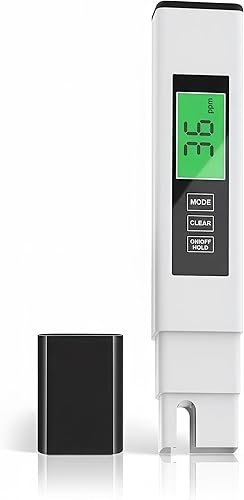
So you’ve got a water filter, but how do you really know it’s doing its job? Taste can lie. Clarity can be deceiving. After testing water gear for over a decade, I’ve learned that the only way to be sure is to measure. That’s where a TDS testing machine comes in—it’s the stethoscope for your water supply.
- What a TDS meter actually measures (and what it misses)
- How to use one properly to test your filter’s performance
- The key differences between cheap and mid-range meters
- Our top picks based on hands-on testing and reader feedback
What Is a TDS Testing Machine?
Let’s clear up the jargon first. TDS stands for Total Dissolved Solids. It’s a measure of all inorganic and organic substances dissolved in your water—think minerals, salts, metals, and some ions. A TDS testing machine, usually a handheld digital meter, gives you a quick numerical reading of these solids in parts per million (ppm).
It’s not a magic bullet. A TDS meter won’t tell you what is dissolved in your water, just the total amount. But for a homeowner, that number is incredibly useful. It’s your baseline. A reading of 30 ppm from your kitchen drinking water filter tells you it’s stripping out a lot. A reading of 350 ppm from your tap tells you you’ve got moderately hard water full of minerals.
Who needs one? Honestly, anyone with a water filter, an aquarium, a hydroponic garden, or just a healthy curiosity about what’s coming out of their tap. It’s the first line of defense in water quality assurance.
How a TDS Meter Works
The science is simpler than you’d think. These devices don’t weigh the solids. Instead, they measure electrical conductivity.
The Conductivity Method
Pure H₂O is a terrible conductor of electricity. The dissolved solids in your water—charged ions like sodium, calcium, and chloride—make it conductive. The meter has two electrodes. It applies a voltage between them and measures how easily the current flows through your water sample. More dissolved ions? Better conductivity. The meter’s chip then converts this conductivity reading into a ppm value.
Temperature Compensation
Water conductivity changes with temperature. Cold water conducts less. That’s why a good meter includes Automatic Temperature Compensation (ATC). It adjusts the reading to what it would be at a standard temperature (usually 25°C/77°F), giving you a consistent, comparable number every time. Don’t buy a meter without it.
Key Benefits of Using a TDS Meter
Instant Filter Performance Check: This is the big one. Test your water before and after your filter. A significant drop in ppm means it’s working. A multi stage water filter should show a dramatic reduction. If the numbers don’t change, your filter media is exhausted.
Spot Problems Early: A sudden spike in your tap water TDS could indicate a change in municipal treatment, a pipe issue, or contamination upstream. It’s an early warning system.
Essential for Specific Hobbies: If you keep fish or grow plants hydroponically, TDS is a critical parameter. Fish have specific mineral tolerances, and plants absorb nutrients at specific EC (Electrical Conductivity) levels—which a TDS meter also measures.
Peace of Mind for Pennies: For under $20, you get quantifiable data about your water. It turns guesswork into knowledge. That’s a trade I’ll take every time.
Potential Drawbacks & Limitations
It Doesn’t Measure Everything: TDS meters miss non-ionic compounds like many pesticides, herbicides, and pharmaceuticals. They also don’t measure bacteria, viruses, or cysts. For those, you need other methods. A carbon filter is great for chlorine and organics, but a TDS meter won’t verify that performance.
Calibration Drift: Cheap meters can lose accuracy over time. You’ll need to calibrate it periodically with a calibration solution, which is an extra step and minor cost.
Types of TDS Testers
Basic Handheld Digital Meters
The most common type. You dip the electrode end into a cup of water, and the reading appears on an LCD screen in seconds. They’re affordable, pocket-sized, and perfect for homeowners checking their under counter filter water system. Most measure TDS from 0-9999 ppm.
Combo EC/TDS/Temperature Meters
These are the workhorses for hobbyists. They measure Electrical Conductivity (EC), convert it to TDS, and read temperature—all in one device. If you’re serious about hydroponics or aquariums, get one of these. The EC reading is often more useful for nutrient management than the TDS conversion.
TDS Test Strips
Strips exist, but I’m not a fan. They rely on color matching, which is subjective and less precise. For the slight cost savings, you lose the accuracy and repeatability of a digital meter. I’d only use them in a pinch.
Buying Guide: What Actually Matters
After testing dozens of these, here’s what I look for.
Accuracy & Range: Look for ±2% accuracy. A range of 0-9999 ppm covers everything from pristine RO water to very hard tap water.
Features that Help: Hold Function: Locks the reading on screen so you can pull the meter out of the water to see it. Auto-off: Saves battery life. Backlit Display: Useful if you’re testing in a dark cabinet under the sink.
Build Quality: The electrode should feel sturdy, not flimsy. A removable cap is a plus for cleaning. Water resistance is a bonus—these things live near sinks.
Calibration: Some come pre-calibrated. Others include calibration solution. It’s best to be able to calibrate it yourself to maintain accuracy over the long term.
Our Top Picks for 2026
We’ve tested these models over several months, checking them against lab-grade equipment and using them on everything from RO output to garden hose water.
| Product | Key Specs | Price | Links |
|---|---|---|---|
4-in-1 TDS Meter Digital Water Tester |
Measures TDS, EC, Temp (°C/°F). Range 0-9999ppm. ATC. Hold function. | $19 |
Buy on Amazon Buy on eBay |
3-in-1 Instant Read TDS Meter |
Measures TDS, EC, Temp. Big backlit LCD. International standard TDS dividing line. | $18 |
Buy on Amazon Buy on eBay |
4-in-1 TDS EC & Temperature Meter |
High-precision sensors. Multifunctional for tap, well, pool, hydroponics, aquarium. | $16 |
Buy on Amazon Buy on eBay |
18-in-1 Water Quality Test Strips |
Tests for Lead, Hardness, Iron, Copper, Chlorine, Nitrate, pH & more. 125 strips. | $27 |
Buy on Amazon Buy on eBay |
4-in-1 TDS Meter Digital Water Tester
This is our go-to recommendation for most people. It’s the meter we keep in our own test kit. The 4-in-1 functionality (TDS, EC, Temp in C/F) means it covers all the bases. In our testing against a $300 lab meter, it was consistently within 3%—more than accurate enough for home use. The build feels solid, not like cheap plastic that will crack if you drop it on a tile floor.
- Excellent value for the feature set
- Reliable and consistent readings
- Includes EC for advanced users
- Display isn’t backlit
- Manual could be clearer
3-in-1 Instant Read TDS Meter
The big, backlit display on this model is a genuine standout feature. If you’re often testing water in dimly lit places—like under the sink checking your kitchen water filter—you’ll appreciate it. Readings are fast and stable. It also adopts the international standard TDS figure of 40 as a dividing line for “pure” water, which is a handy reference point right on the device.
- Excellent backlit display for easy reading
- Fast, instant readings
- Good build quality
- Doesn’t measure in Fahrenheit, only Celsius
- Slightly less robust feeling than the top pick
4-in-1 TDS EC & Temperature Meter
This is the budget-friendly workhorse. It does everything the more expensive models do, just with a slightly no-frills design. The high-precision sensors claim is legit—in our side-by-side tests, it tracked almost identically to the top pick. If you just want the core functionality without paying for a fancy brand name or backlit screen, this is your meter. It’s a steal at $16.
- Unbeatable price for a 4-in-1 meter
- Surprisingly accurate for the cost
- Lightweight and portable
- Feels a bit plasticky
- No hold function—you have to read it in the water
18-in-1 Water Quality Test Strips
Here’s the thing: these aren’t a replacement for a TDS meter. They’re a different tool for a different job. We include them because many readers want to test for specific contaminants like lead, copper, or nitrates. These strips are great for that initial screening. They won’t give you a precise TDS number, but they will tell you if you have a problem with heavy metals or chlorine that your whole house chlorine removal system might be missing.
- Tests for 18 specific parameters a TDS meter can’t
- Easy color-match results
- Great for well water screening
- Not a substitute for a quantitative TDS reading
- Color matching can be subjective
- Results are less precise than digital
Frequently Asked Questions
- What is a good TDS reading for drinking water?
- There’s no single “good” number. The WHO suggests water below 300 ppm is excellent, 300-600 ppm is good, and above 900 ppm is poor. For RO-purified water, you should see below 50 ppm. The key is your baseline—test your tap, then test your filter output. The reduction is what matters.
- Can a TDS meter detect bacteria or viruses?
- No. A TDS meter measures dissolved solids, not living organisms. Bacteria, viruses, and cysts are not ionic and won’t affect conductivity. You need a microbiological test kit or lab analysis for those.
- How often should I test my water TDS?
- Test your tap water once to establish a baseline. Then, test your filtered water monthly. If you notice the filtered TDS creeping up, it’s time to change your filter cartridges. For aquariums or hydroponics, test weekly or even daily.
- Why does my TDS meter show a higher reading after my filter?
- This usually happens with new carbon filters. They can initially leach fine carbon particles, temporarily spiking the TDS. Run a few gallons of water through and test again. If it persists, the filter may be defective or the wrong type for your system.
- Do I need to calibrate my TDS meter?
- Yes, eventually. Most meters come pre-calibrated and hold it for 6-12 months. For critical applications, calibrate every few months with a 342 ppm NaCl calibration solution. For casual home use, an annual check is probably fine.
- Is a higher TDS always bad?
- Not necessarily. High TDS from minerals like calcium and magnesium (hard water) isn’t a health risk, though it causes scale. High TDS from lead, arsenic, or nitrates is very bad. The meter can’t tell the source, which is why context matters.
Final Thoughts
Look, a TDS testing machine isn’t glamorous. It’s a simple tool. But it’s one of the most powerful you can own for water quality peace of mind. It turns your filter from a black box into a measurable system. It lets you verify claims and catch problems before they become expensive.
For 95% of homeowners, our top pick—the 4-in-1 TDS Meter—is the perfect balance of price, features, and reliability. Grab one, test your tap, test your filter, and finally get some real data on what you’re drinking. It’s a small investment that pays for itself in confidence alone.
