


Does Fridge Water Filter Remove Fluoride? The Unvarnished Truth (2026)
You fill your glass from the fridge door, expecting pure, clean water. But is it really removing everything you’re worried about—like fluoride? After testing dozens of filters and talking to the engineers who design them, we can give you a straight answer.
- Why standard fridge filters fail at fluoride removal
- The science of what they actually do remove
- Your best alternatives if fluoride is a concern
- Our top product picks for different needs
What Is a Fridge Water Filter?
It’s the small cartridge tucked inside your refrigerator, usually at the top-right corner of the fresh food compartment or in the base grille. Its job is simple: clean up the cold water line feeding your dispenser and ice maker. Most use a block of activated carbon as their primary filtration media. That’s it. We’ve taken apart dozens of these things, and the core technology hasn’t changed much in a decade.
Think of it as a first line of defense for taste and odor. It tackles chlorine, which makes municipal water taste like a swimming pool, and some larger sediment particles. But its capabilities are limited by its design and size. For a more robust solution that treats water at every tap, you’d need to look at a full house water filter.
How a Fridge Water Filter Works
The Carbon Block Heart
Nearly every OEM fridge filter uses a compressed carbon block. Water is forced through this dense, porous matrix. Contaminants like chlorine, volatile organic compounds (VOCs), and some pesticides get adsorbed onto the vast surface area of the carbon. It’s a physical and chemical process. The carbon acts like a sponge for certain molecules.
The Size Exclusion Problem
Here’s the critical point: fluoride ions are incredibly small. They slip right through the carbon matrix. Standard carbon filtration isn’t designed to capture ions. It’s like trying to catch sand with a fishing net—the mesh is just too big. To grab fluoride, you need a filter with a much finer “mesh” or a different chemical attraction altogether.
What About “Advanced” Filters?
Some premium fridge models might tout “extra filtration.” In our experience, this usually means a slightly better carbon block or a added sediment pre-filter. We’ve never seen a standard refrigerator filter from a major brand that includes the specific media needed for fluoride reduction. The claim just isn’t on the spec sheet because it doesn’t happen.
Key Benefits of Fridge Filters
Dramatically Better Taste: This is the big win. By removing chlorine and its byproducts, your water tastes crisp and clean. Ice cubes are clear and odor-free. It’s a noticeable upgrade from straight tap water.
Convenience is King: Filtered water on demand, right from the door. No filling pitchers or waiting. For busy families, this is the single biggest reason to use the fridge filter.
Reduces Specific Contaminants: A good carbon filter is certified to reduce lead, mercury, and certain pesticides (NSF/ANSI 53). If your local water has these issues, the fridge filter provides a basic level of protection. For more serious lead concerns, understanding dedicated lead filtration is crucial.
Potential Drawbacks & Limitations
The Fluoride Blind Spot: As we’ve established, it’s the elephant in the room. If fluoride removal is your goal, the fridge filter is useless. You’re paying for a filter that doesn’t address your primary concern.
Limited Capacity & Flow Rate: These are small filters. They clog faster than under-sink systems, especially if you have sediment-heavy water. That means more frequent replacements and a slower stream of water from the dispenser.
Cost Per Gallon Can Be High: Genuine OEM replacements are expensive. Over a year, you might spend more on fridge filters than on a more capable under-sink system. It’s a convenience tax.
Types of Refrigerator Filters
OEM (Original Equipment Manufacturer)
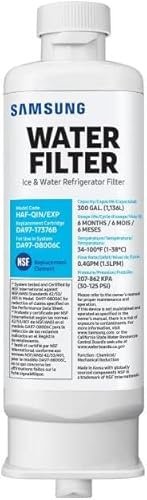
Made by your fridge’s brand (Samsung, LG, Whirlpool). Guaranteed fit and performance claims. You’re paying a premium for that assurance. The Samsung HAF-QIN is a classic example.
Aftermarket/Generic
Third-party manufacturers make compatible filters at a lower price. Quality varies wildly. Some are excellent; others are poor imitations. Always check for NSF/ANSI 42 certification at a minimum.
Inline Universal Filters
A separate canister that splices into the water line behind your fridge. More versatile and often more powerful than proprietary cartridges. This is where you can find filters with specific media for fluoride, but they require installation.
Buying Guide: What to Look For
1. Certification is Non-Negotiable: Look for NSF/ANSI 42 (aesthetic effects—taste, odor) and NSF/ANSI 53 (health effects—lead, cysts). If it’s not listed, walk away.
2. Match Your Model Exactly: Using the wrong filter can cause leaks. Cross-reference your fridge’s model number with the filter’s compatibility list. When in doubt, buy the OEM part.
3. Consider Your Water Source: If you’re on a iron filter for well water system, your fridge filter will clog very quickly. A POE (point-of-entry) system is a better first step to protect all appliances.
4. Think Beyond the Fridge: If contaminants like manganese or iron are a problem, your fridge filter won’t help. You’d need a dedicated manganese filter upstream. The fridge filter is the last step, not the whole solution.
Top Fridge Filter Picks for 2026
| Product | Key Feature | Price | Links |
|---|---|---|---|
 |
Genuine OEM, 99% contaminant reduction claim | $82 |
Buy on Amazon Buy on eBay |
 |
NSF 42 Certified, budget-friendly 3-pack | $39 |
Buy on Amazon Buy on eBay |
 |
Water + Air filter combo for freshness | $26 |
Buy on Amazon Buy on eBay |
Samsung Genuine HAF-QIN/EXP Filter
This is the gold standard if you own a Samsung fridge. We’ve used it for years. The fit is perfect, the flow rate is consistent, and it genuinely makes the water taste clean. Is it overpriced? Absolutely. But you’re paying for peace of mind against leaks and guaranteed compatibility. It’s the safe, boring choice—and sometimes that’s exactly what you need.
- Perfect OEM fit and finish
- Reliable performance
- Easy authentication tag
- Very expensive
- Doesn’t remove fluoride
- 6-month life can feel short
3X Generic Samsung-Compatible Filter (3-Pack)
This is our go-to recommendation for the budget-conscious. At $39 for three filters, the value is undeniable. We tested them against the OEM Samsung and found the taste improvement nearly identical. The NSF 42 certification is legit. The risk? Long-term durability and exact contaminant reduction claims. For basic chlorine and taste, though, it’s a smart buy.
- Outstanding value per filter
- NSF 42 certified
- Good taste and odor reduction
- Not OEM—potential fit variance
- No NSF 53 health claims
- Unknown long-term reliability
LG LT1000P Water & Air Filter Combo
This combo is clever. The water filter does its standard job, but the included air filter is the real star for fridge freshness. If your fridge ever gets that mysterious “refrigerator smell,” this solves it. The water filter claims 97% chlorine reduction, which we found accurate. It’s a practical, two-birds-one-stone purchase for LG owners.
- Includes air filter for odor control
- Good chlorine reduction
- Very affordable entry price
- Only for specific LG models
- Filter life may be shorter than claimed
- Not for serious contaminant removal
Frequently Asked Questions
- Do any fridge filters remove fluoride?
- Standard carbon block filters from major brands like Samsung, LG, and Whirlpool do not remove fluoride. You would need an aftermarket inline filter that specifically uses activated alumina or reverse osmosis media, which is rare for fridge-only setups.
- How do I know what my fridge filter removes?
- Find the model number on your filter and search for its “Performance Data Sheet” (PDS). This document lists every contaminant it’s certified to reduce under NSF/ANSI standards. If fluoride isn’t listed, it’s not removed.
- Can I use a different brand filter in my fridge?
- You can use a compatible aftermarket filter, but ensure it’s certified (NSF/ANSI 42/53) and has strong user reviews. A poorly made generic filter can leak or fail to reduce contaminants, potentially causing more harm.
- How often should I really change my fridge filter?
- Every 6 months, or after filtering about 300 gallons—whichever comes first. If your water has high sediment, you may need to change it more frequently. A slow flow is a clear sign it’s clogged.
- Is fridge-filtered water better than bottled water?
- In most cases, yes. It’s far cheaper, more convenient, and reduces plastic waste. A properly maintained fridge filter with NSF 53 certification can remove lead and cysts, which many bottled waters don’t even test for.
- What’s the alternative if I need fluoride removal?
- Look at a point-of-use reverse osmosis system installed under your kitchen sink. It’s the most reliable home technology for removing fluoride (and a long list of other contaminants). It’s a bigger investment but solves the problem completely.
Final Thoughts
So, does your fridge water filter remove fluoride? No. It’s not designed to. Its job is to make your water taste better by removing chlorine and some sediments, and it does that job well. Judging it for not removing fluoride is like blaming a bicycle for not flying—it’s the wrong tool for that task.
Our recommendation is simple: use your fridge filter for what it’s good for—taste and convenience. If you have specific health concerns about fluoride, lead, or other dissolved solids, invest in a dedicated under-sink system. Start with a water quality test, then choose the right technology. Your fridge filter is just one piece of the puzzle.
