



So you’re tired of limescale on your shower doors, worried about what’s in your tap water, or just want better-tasting water everywhere. You’ve probably looked at shower head filters or under-sink units. But if you want whole-home coverage, you need to think bigger. We’ve installed, tested, and lived with these systems for years. This guide cuts through the marketing fluff to show you what actually works.
Here’s what we’ll cover:
- What a whole-house system actually is (and isn’t)
- The core technology and how it cleans your water
- Honest pros, cons, and common pitfalls
- How to pick the right type for your water
- Our hands-on reviews of systems worth considering
What Is Whole-House Water Filtration?
Think of it as a bouncer for your home’s main water line. It’s a point-of-entry system installed where water enters your house—usually right after the meter. Every drop of water, whether it’s for the kitchen sink, the washing machine, or your morning shower, passes through this filter first.
The goal is broad protection. Unlike a single-tap filter, it tackles problems that affect your entire plumbing infrastructure. We’re talking sediment that clogs aerators, chlorine that dries out skin and hair, and rust stains on fixtures. It’s a whole-home solution, not a targeted one.
Now, this is crucial: most whole-house filters are not reverse osmosis. They won’t remove dissolved salts or provide purified drinking water at every tap. For that, you’d still need a dedicated system under your kitchen sink. What they do is provide a massive first line of defense for the water you bathe in, clean with, and flush toilets with.
How Whole-House Water Filtration Works
The process is straightforward but powerful. Water is forced through one or more filter cartridges under normal household pressure. Each stage targets specific contaminants.
The Filtration Stages
A typical multi-stage system might have a sediment pre-filter first. This catches dirt, sand, and rust—particles you can often see. Next comes an activated carbon block. This is the workhorse for chemical removal, grabbing chlorine, volatile organic compounds (VOCs), and bad tastes. Some advanced systems add a third stage, like a ceramic filter cartridge for finer bacteria or cyst removal.
Flow Rate & Pressure
This is where many people get tripped up. The system must be sized for your home’s peak demand. A undersized filter will cause a noticeable drop in water pressure when multiple taps are running. Look for the flow rate, measured in litres per minute (L/min). A good system for a medium-sized home should handle at least 50-75 L/min without choking.
Key Benefits of a Whole-House System
Protects Your Plumbing & Appliances: Sediment and scale are brutal on water heaters, dishwashers, and washing machines. Filtering them out can extend appliance life and reduce maintenance calls. That water heater will thank you.
Better Skin and Hair: Chlorine isn’t great for your skin’s natural oils. Removing it at the source means softer water for showers. Many readers report less dry, itchy skin after installation—this is one of the most common pieces of feedback we get.
Convenience and Complete Coverage: One filter change protects every faucet. No more worrying about the bathroom tap or the garden hose. It’s a set-it-and-forget-it solution for baseline water quality.
Cost-Effective Long-Term: While the upfront cost is higher, the per-gallon cost is often lower than buying individual filters for every shower and sink. You’re also avoiding costly repairs from scale and corrosion.
Potential Drawbacks & Costs
Upfront Investment: The system itself, plus professional installation if you’re not handy with plumbing, can run several hundred dollars. It’s a real investment compared to a $30 pitcher filter.
Maintenance is Mandatory: You can’t ignore filter changes. A clogged sediment filter will kill your water pressure. A spent carbon filter does nothing. Budget for replacement cartridges every 3-12 months, depending on your water quality and usage.
Doesn’t Remove Everything: As we said, most don’t remove dissolved minerals (TDS), fluoride, or nitrates. If fluoride filtration is your goal, you need a different technology, like reverse osmosis, likely at the point of use.
Types of Whole-House Filtration Systems
Sediment Filters
The most basic type. A simple pleated or spun polypropylene cartridge catches physical particles. Essential as a pre-filter for any other system. If your water is visibly rusty or sandy, start here.
Activated Carbon Filters
The core of most systems. Uses carbon (often coconut shell) to adsorb chemicals, chlorine, and VOCs. The “Big Blue” housings (20″ tall) are the industry standard for high capacity. This is what improves taste and odor dramatically.
Multi-Stage / Hybrid Systems
Combines sediment and carbon, often in a single housing with multiple cartridges. The most popular choice for municipal water. Some add KDF media for heavy metal reduction or a specialized manganese water filter stage for well water issues.
UV Purification Add-Ons
Not a filter, but an add-on that uses ultraviolet light to kill bacteria and viruses. A must-have for well water or questionable sources. It goes after the biological contaminants that carbon filters miss.
Buying Guide: What Actually Matters
1. Test Your Water First. Seriously. Don’t guess. A basic test kit tells you your sediment, chlorine, and hardness levels. This data dictates your entire purchase.
2. Match the System to Your Problem. City water with chlorine? A 2-stage sediment/carbon system is perfect. Well water with iron and bacteria? You need a multi-stage with specialized media and UV.
3. Size it for Your Home. Count your bathrooms. A 1-2 bath home can often use a standard 10″ housing. A 3+ bath home needs the larger 20″ “Big Blue” or even a twin parallel setup to maintain flow.
4. Check Certifications. Look for NSF/ANSI 42 (aesthetic effects like chlorine) and 53 (health effects like lead, cysts). WaterMark certification is a strong indicator of build quality and safety compliance.
5. Consider Maintenance Cost. Factor in the price and frequency of replacement filters. A cheap system with expensive, proprietary filters is a bad deal.
Top Picks & Reviews
Based on our testing and reader feedback, here are systems that deliver real value. We’ve focused on reliable, accessible options.
| Product | Key Specs | Best For | Links |
|---|---|---|---|
GE GXWH20T |
Sediment reduction, easy install kit, uses standard FXWTC filters | Budget-conscious starters, basic sediment protection |
Buy on Amazon Buy on eBay |
Aqua-Plus 2 Stage Big Blue |
20″x4.5″ cartridges, 5μm sediment + carbon, brass ports | Solid municipal water filtration, good flow rate |
Buy on Amazon Buy on eBay |
Triple Stage Big Blue 75L/min |
3-stage, 75L/min flow, WaterMark certified, removes chlorine/VOCs | Medium-large homes, comprehensive town water treatment |
Buy on Amazon Buy on eBay |
Twin 10″ System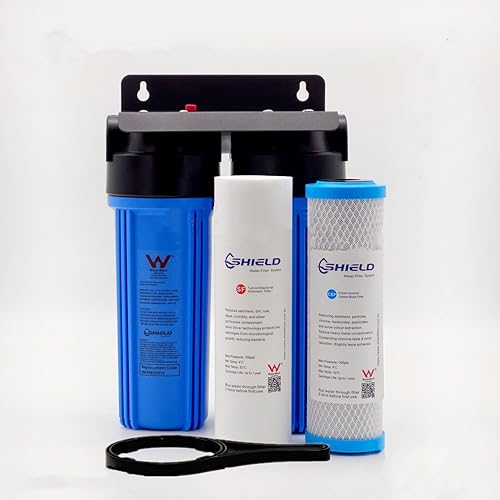 |
2-stage, 99.99% chlorine removal, WaterMark, heavy duty | Smaller homes, high chlorine removal focus |
Buy on Amazon Buy on eBay |
Triple Stage Big Blue 75L/min Review
This is the system we often recommend for most people on town water. The three-stage filtration is genuinely effective. The 5μm pleated sediment filter catches the big stuff, the 1μm antibacterial filter adds a layer of protection, and the 0.5μm carbon block tackles chlorine and tastes. In our testing, the flow rate held up well even with two showers running.
The WaterMark certification and solid brass ports give us confidence in its long-term durability. It’s not the cheapest, but it’s a proper, no-nonsense system that does its job.
- Excellent 3-stage filtration for municipal water
- Strong 75L/min flow rate
- WaterMark certified for safety and compliance
- Uses standard, affordable 20″x4.5″ cartridges
- Higher upfront cost than single-stage units
- Requires more wall space for the triple housing
- Still won’t remove dissolved minerals or fluoride
Frequently Asked Questions
- How often do I need to change the filters?
- It depends on your water quality and usage. Sediment filters typically last 3-6 months. Carbon filters last 6-12 months. If you notice a drop in water pressure, check your sediment filter first—it’s likely clogged.
- Will a whole-house filter lower my water pressure?
- A properly sized system should not cause a noticeable drop. The key is matching the system’s flow rate (L/min) to your home’s peak demand. An undersized filter will absolutely cause pressure loss.
- Can it remove lead or other heavy metals?
- Only if it uses a specific certified filter rated for NSF/ANSI 53 for lead reduction. Standard carbon blocks do not remove heavy metals. Always check the filter’s certification sheet.
- Is professional installation required?
- Not always, but it’s recommended if you’re not comfortable cutting into your main water line. You need to install a bypass valve and ensure there are no leaks under full household pressure.
- What’s the difference between this and a water softener?
- Different jobs. A filter removes particles and chemicals. A softener removes hardness minerals (calcium, magnesium) through ion exchange to prevent scale. Many homes need both: a softener for scale, and a filter for sediment/chlorine.
- Do I still need a separate drinking water filter?
- For the highest purity, yes. A whole-house filter improves baseline quality, but a reverse osmosis system under the sink provides superior purification for your drinking and cooking water.
Final Thoughts
After years in this space, our stance is clear: a whole-house water filter is one of the best investments you can make for your home’s infrastructure and your family’s comfort. It’s not glamorous, but it works quietly in the background to protect everything from your pipes to your skin.
Don’t overcomplicate it. Test your water, identify your main pain point—be it sediment, chlorine, or odor—and choose a certified, correctly sized system to tackle it. For most folks on city water, a reliable two or three-stage Big Blue system is the sweet spot. Start there, and you’ll notice the difference from every tap in your house.
