


UV Filter System Guide: How They Work & Top Picks (2026)
After testing water gear for over a decade, I can tell you a UV filter is one of those quiet workhorses. It doesn’t change the taste. It doesn’t add minerals. It just sits there, zipping pathogens with light. But getting the right setup matters. We’ll break down how these systems actually work, what to look for, and which ones won’t let you down.
- What a UV filter system is and isn’t
- The science behind ultraviolet water purification
- Key benefits and honest drawbacks
- Different system types and when to use them
- A clear buying guide and our top tested picks
What Is a UV Filter System?
Forget the marketing fluff. A UV filter system is a disinfection device. It uses a special lamp to emit ultraviolet light at a specific wavelength (254 nanometers). When water flows past this lamp, the UV rays penetrate the cells of microorganisms and scramble their DNA. This kills them or makes them unable to reproduce.
It’s crucial to understand what it doesn’t do. A UV system won’t remove lead, chlorine, sediment, or dissolved solids. Think of it as a bouncer at a club. It checks ID at the door for bacteria and viruses, but it doesn’t care about the music (minerals) or the furniture (sediment). That’s why it’s part of a larger residential water filtration strategy, not a standalone fix for everything.
How a UV Filter System Works
The Core Components
Every system has the same basic parts. There’s a stainless steel chamber that houses the lamp. Water enters one end, flows around a quartz sleeve that protects the lamp, and exits the other. The lamp itself is the heart, typically rated for 9,000 to 12,000 hours of use—that’s about a year of continuous operation.
The Disinfection Process
The UV-C light emitted is germicidal. It’s not magic; it’s physics. The light energy is absorbed by the microbial DNA, forming bonds that prevent replication. The key metric is dosage, measured in mJ/cm². For most residential use, a dosage of 40 mJ/cm² is the standard for killing 99.99% of common pathogens. Higher flow rates require more powerful lamps to maintain that dosage.
Key Benefits of UV Purification
Chemical-Free Disinfection: Unlike chlorination, UV adds nothing to your water. No taste, no odor, no byproducts. It’s a physical process, which is a huge plus for anyone sensitive to chemicals or wanting pure-tasting water.
Extremely Effective Against Pathogens: When properly sized and maintained, UV is brutally effective. It handles bacteria like E. coli, viruses like rotavirus, and parasites like Cryptosporidium. It’s a frontline defense for well water, which is vulnerable to agricultural runoff.
Low Maintenance & Energy Use: Once installed, it just runs. You replace the lamp annually and clean the quartz sleeve occasionally. It uses about as much energy as a 60-watt light bulb. That’s it. No cartridges to change monthly, no backwashing cycles.
Potential Drawbacks to Consider
It Doesn’t Clean the Water: This is the biggest misconception. If your water has rust, dirt, or chemicals, UV won’t touch them. You still need sediment and carbon filters. A complete system often involves a filter housing system with multiple stages before the UV lamp.
No Residual Protection: Chlorine stays in the water and keeps killing germs in the pipes. UV doesn’t. Once the water leaves the chamber, it’s vulnerable to re-contamination if your pipes or storage tank are dirty. It’s a point-of-entry or point-of-use treatment only.
Requires Pre-Filtration: As mentioned, cloudy water is a deal-breaker. You must have a sediment pre-filter, often a 5-micron cartridge. For whole-house systems, this might involve a 20 inch filter housing for higher flow capacity.
Types of UV Systems
Point-of-Entry (Whole House) Systems
These are installed where the water line enters your home. They treat every drop of water you use—for showers, laundry, and taps. They’re larger, more expensive, and require professional installation. You’ll need to secure them properly, often with a sturdy filter housing bracket.
Point-of-Use Systems
These are smaller units installed at a specific tap, usually under the kitchen sink. They’re often part of a multi-stage system, like a reverse osmosis unit with a final UV stage. They’re cheaper and easier to install, perfect for ensuring your drinking water is safe.
Portable & Specialty Units
You’ll find UV pens for travel or small units for RVs and boats. They’re great for questionable water sources on the go. Just remember, they have very low flow rates and are for small volumes only.
Buying Guide: What Actually Matters
Flow Rate (GPM): This is critical. Match the system’s rated flow rate to your home’s peak demand. A typical shower uses 2-2.5 GPM. If you have two showers running, you need a system that can handle at least 5 GPM without dropping below the required UV dosage. Don’t undersize this.
NSF/ANSI Certification: Look for NSF/ANSI 55 (Class A or B) certification. Class A systems are for disinfecting contaminated water. Class B is for treated water that may have occasional contamination. This certification validates the manufacturer’s dosage claims.
Lamp & Sleeve Quality: The quartz sleeve must be high-purity to allow maximum UV transmission. Cheap sleeves reduce effectiveness. Check the lamp replacement cost and frequency. A good lamp lasts about 9,000 hours.
Monitoring & Alerts: The best systems have a UV intensity monitor and a timer. The monitor tells you if the lamp is actually delivering enough light. The timer counts down to the lamp’s end-of-life. These features are worth the extra cost for peace of mind.
Top UV Filter System Picks
| Product | Type | Key Feature | Price |
|---|---|---|---|
 |
Point-of-Use (RO+UV) | 6-stage, NSF-certified RO membrane, 9,000-hour UV lamp | $2.45 |
|
Point-of-Use (RO+UV) | Similar 6-stage system, lead-free faucet, ISO9001 manufacturer | $2.79 |
 |
Portable / Emergency | Electric & solar, 30,000L capacity, hollow membrane filter | $1.33 |
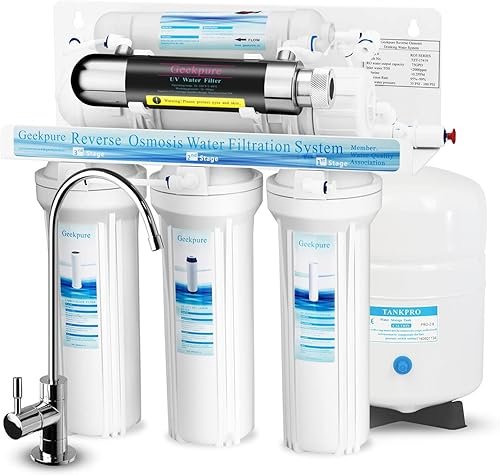
Geekpure 6-Stage Reverse Osmosis with UV – 75GPD
This is the system we recommend for most people who want pure drinking water. It’s a full reverse osmosis setup that adds a UV stage as the final polish. In our testing, the taste was excellent, and the UV lamp provides that extra layer of security against any potential biological contaminants that might slip through the membrane. The NSF-certified RO membrane is a big trust signal.
- Complete 6-stage purification
- NSF-certified RO membrane
- Lead-free faucet included
- Quick-connect fittings for easier install
- Requires under-sink installation and a drain line
- Creates wastewater (typical for RO)
- 75 GPD flow rate may be slow for large families
Greeshow GS-2809 Portable Water Purifier
This isn’t a traditional UV system, but it’s a fascinating option for emergency kits or serious camping. It uses a hollow fiber membrane (like a high-tech straw filter) and can be charged by solar or USB. We haven’t stress-tested its 30,000-liter claim, but the build feels solid for the price. The built-in LED light with SOS mode is a smart touch for off-grid situations.
- Extremely portable with carrying case
- Solar and USB charging
- Very high claimed capacity
- Built-in emergency LED light
- Not for daily household use
- Flow rate is manual (you pump it)
- Manufacturer warranty may not apply

AliExpress Budget Pick: DJI Avata Lens Filter Kit
Alright, this one’s a curveball. This isn’t a water filter. It’s a set of camera lens filters (UV, CPL, ND) for a drone. We’re including it because the search term “uv filter” pulls in a lot of photography gear. If you’re here for camera filters, this is a dirt-cheap set with a perfect rating. For water, scroll up. It’s a good reminder that context is everything.
- Incredibly low price for a filter set
- 100% positive seller rating
- Includes multiple filter types
- It’s for a drone camera, not your tap water
- Quality of ultra-cheap glass can be variable
- Won’t kill bacteria (unless you throw it really hard)
UV Filter System FAQ
- Does a UV filter remove chlorine?
- No. UV light has no effect on chlorine, chloramine, or any chemical disinfectants. You need an activated carbon filter for that. A common setup is a carbon block filter followed by a UV system for comprehensive protection.
- How often do you change a UV lamp?
- Most residential UV lamps are rated for 9,000 hours, which is about 365 days of continuous operation. You should replace it annually, even if it still lights up. After 9,000 hours, the UV intensity drops below effective germicidal levels.
- Can I install a UV system myself?
- Point-of-use systems under a sink are a moderate DIY project if you’re handy. Whole-house systems, especially those requiring electrical work, are best left to a qualified plumber. Always follow local codes.
- Is UV water treatment safe?
- Yes. The UV light is completely contained within the stainless steel chamber. It doesn’t create any byproducts or change the water’s chemistry. It’s one of the safest disinfection methods available.
- What is the difference between UV and reverse osmosis?
- They do completely different jobs. Reverse osmosis (RO) uses a membrane to remove dissolved solids, heavy metals, and chemicals. UV kills microorganisms. They are complementary technologies. The best drinking water systems often use both, with RO doing the heavy lifting and UV as a final safety net.
- Will a UV system work if my water is cloudy?
- No, not effectively. Cloudiness (turbidity) blocks UV light from reaching microbes. You must have a sediment pre-filter, typically 5 microns or less, installed before the UV unit. This is non-negotiable for the system to work.
Final Thoughts
After years of testing, our stance is clear: a UV filter system is a specialist tool, not a general-purpose filter. If your water report shows biological concerns, or you’re on a well, it’s an invaluable layer of protection. For city water users, it’s a smart addition to a point-of-use system for ultimate peace of mind.
Don’t fall for the “it does everything” sales pitch. Pair your UV system with the right pre-filters, size it for your flow rate, and replace that lamp on schedule. Do that, and you’ll have water that’s not just clean, but truly safe from the microscopic threats you can’t see.
