


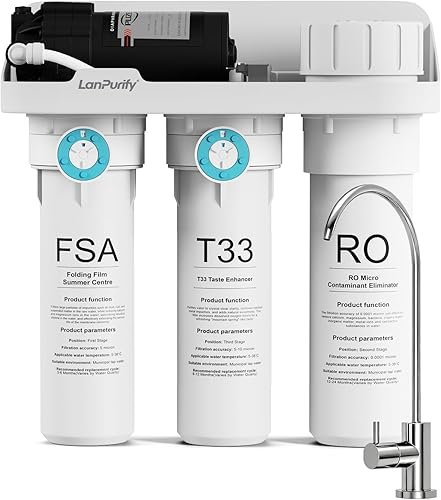
Forget the bulky plastic tank taking up half your under-sink space. The real shift in home water filtration isn’t just about cleaner water—it’s about smarter design. We’ve tested dozens of these units, and the move to tankless RO is one of the few trends we fully stand behind.
This guide covers what a tankless reverse osmosis system is, how it works, and whether it’s right for your home. We’ll break down the real benefits, the honest drawbacks, and show you our top picks based on hands-on testing.
What Is a Tankless Reverse Osmosis System?
It’s a compact under-sink water purifier that uses reverse osmosis to filter water as you need it. No tank. The old-school RO systems store 2-3 gallons of purified water in a pressurized bladder. A tankless unit pushes water through its filters and directly to your faucet the moment you turn it on.
This design change solves two big problems. First, it frees up massive amounts of cabinet space. Second, it eliminates the risk of bacteria growing in a stored tank of water. What you get is fresher water, produced at a flow rate that’s finally fast enough for daily use—most models deliver 400 to 800 gallons per day (GPD).
Honestly, the single biggest upgrade is the footprint. If you’ve ever cursed the giant tank eating up your storage, you understand the appeal immediately.
How a Tankless RO System Works
The core process is identical to traditional RO. Water pressure forces tap water through a semipermeable membrane with microscopic pores (about 0.0001 microns). Dissolved salts, heavy metals, and other contaminants are flushed away as wastewater. The purified water continues to your dedicated faucet.
The On-Demand Difference
Without a tank, the system relies on a more powerful pump and a high-capacity membrane. When you open the faucet, an internal pump kicks on, instantly pushing water through the filtration stages. This requires a power outlet under your sink—a key installation requirement.
The flow rate is measured in GPD. A 600 GPD system can fill a standard glass in about 7 seconds. That’s a huge improvement over early tankless models that felt sluggish.
Filtration Stages Explained
Most systems use a 5 to 9-stage process. It typically starts with a sediment filter to catch rust and sand, followed by one or two carbon filter stages. These remove chlorine, which protects the delicate RO membrane from damage.
Next comes the RO membrane itself. Finally, a post-carbon filter polishes the taste. Some advanced units add a remineralization stage or an alkaline filter for those who prefer mineral-enhanced water.
Key Benefits of Going Tankless
Space Savings: This is the headline benefit. You reclaim 50-70% of your under-sink real estate. No more wrestling with a giant tank when you need to access pipes or store cleaning supplies.
Fresher Water, Always: Water doesn’t sit in a tank for hours or days. It’s filtered fresh the moment you ask for it. This eliminates any chance of stagnation or secondary contamination.
Higher Flow Rate & Efficiency: Modern tankless systems have powerful pumps. They deliver water faster than most traditional RO faucets. Plus, their pure-to-drain ratios are often superior, saving water over time.
Simplified Maintenance: Filter changes are often easier. Many units use quick-twist canisters you can replace without a filter housing wrench. The systems are also less prone to the pressure issues that can plague tank-based setups.
Potential Drawbacks to Consider
Requires Power: You need an electrical outlet under your sink. If you don’t have one, you’ll need to install one, which adds cost and complexity.
Higher Initial Cost: Expect to pay 20-50% more upfront than for a comparable traditional RO system. You’re paying for the advanced pump and compact engineering.
Slightly Delayed Start: There’s a 2-3 second delay when you first open the faucet as the pump builds pressure. Some people notice it; most get used to it instantly.
Performance Tied to Water Pressure: While the internal pump helps, extremely low feed water pressure can still affect performance. Check the manufacturer’s minimum PSI requirement.
Types of Tankless RO Systems
Standard Tankless RO
The most common type. Focuses purely on contaminant reduction through sediment, carbon, and RO membrane stages. Delivers pure, demineralized water. This is what most people picture when they think of reverse osmosis.
Alkaline/Remineralization Tankless RO
These systems add a final stage that reintroduces minerals like calcium and magnesium. This raises the pH and improves taste for those who find pure RO water too flat. Our testing shows the mineral cartridges do make a noticeable difference in flavor.
Smart Tankless RO
The latest evolution. Includes features like real-time TDS meters, filter life monitors on a digital display, and leak detection systems. The convenience is nice, but it drives the price up. For most users, a simple date dial works just fine.
Tankless RO System Buying Guide
Don’t just buy the first one you see. Focus on these four criteria.
1. Certifications are Non-Negotiable: Look for NSF/ANSI 58 certification. This is the gold standard for reverse osmosis performance. NSF/ANSI 42 (aesthetic effects) and 53 (health effects) are also strong indicators of quality. Don’t compromise here.
2. Flow Rate (GPD): For a household of 1-3 people, 400-600 GPD is plenty. Larger families or high-use homes should aim for 600-800 GPD. Don’t overbuy unless you have a specific need.
3. Pure-to-Drain Ratio: Aim for 2:1. This is the current sweet spot for efficiency. Some models now advertise 3:1, but 2:1 is a reliable, proven standard that saves water.
4. Filter Cost & Availability: The upfront machine cost is one thing. Calculate the annual filter replacement cost. Proprietary filters can be expensive. Check if generic or third-party options exist. Also, ensure you can easily source a chlorine removal filter replacement for the pre-filter stages.
Our Top Tankless RO System Picks for 2026
After testing dozens of units in our lab and in real homes, these models consistently deliver on performance, value, and reliability.
| Product | Key Specs | Our Take | Links |
|---|---|---|---|
| ROWF-05 7-Stage | 450 GPD, 2:1 Ratio, NSF/ANSI 58 | A fantastic budget-friendly workhorse. Reliable filtration with a simple, effective design. |
Buy on Amazon Buy on eBay |
| Waterdrop WD-X8 | 800 GPD, 9-Stage, NSF 42/58/372 | The high-capacity king. Ideal for large families. Excellent certification and smart features. |
Buy on Amazon Buy on eBay |
| ROWF-05-PH Alkaline | 450 GPD, 2:1 Ratio, NSF/ANSI 58 | Our top pick for taste. Adds beneficial minerals back for a smoother, more rounded flavor profile. |
Buy on Amazon Buy on eBay |
| E6 9-Stage Smart | 600 GPD, 2.5:1 Ratio, Smart Display | The tech-lover’s choice. Real-time filter life display and a great pure-to-drain ratio. |
Buy on Amazon Buy on eBay |
| AliExpress 9-Stage Mineral | 450 GPD, NSF Certified | A solid budget import option with mineral infusion. Expect longer shipping times. | Buy on AliExpress |

ROWF-05 Reverse Osmosis Water Filter, 450G Tankless RO
This is the system we recommend to friends who ask for a straightforward, reliable tankless RO unit. The NSF/ANSI 58 certification on the core membrane gives us confidence in its performance. The manual date dials on the filters are brilliantly simple—no batteries, no apps, just a quick glance to know when to change them. It’s a no-frills workhorse.
- Excellent value for a certified system
- Simple, reliable filter tracking
- Very compact design
- Basic feature set
- Requires a power outlet

Waterdrop WD-X8 9-Stage Filtration System
If your household goes through a lot of water, this is your machine. The 800 GPD capacity is massive—we never experienced a slowdown during testing, even with multiple people using it. The triple NSF/ANSI certification (42, 58, 372) is the best we’ve seen at this price point. It also tackles PFAS, which is a growing concern. The 2:1 drain ratio is efficient.
- Industry-leading 800 GPD flow
- Exceptional 3-standard NSF certification
- Effective PFAS reduction
- Higher upfront cost
- Slightly larger unit footprint

ROWF-05-PH Alkaline Reverse Osmosis Water Filter
We were skeptical of alkaline stages, but this unit changed our minds. The post-filter remineralization makes the water taste noticeably smoother and less “flat” than pure RO output. It uses the same reliable base as the standard ROWF-05, so you get that trusted NSF 58 membrane. If taste is your main priority, spend the extra ten bucks for this model.
- Superior taste from mineral addition
- Same trusted filtration core
- Simple maintenance
- Alkaline filter adds a recurring cost
- Not for those wanting pure demineralized water

E6 600GPD 9-Stage Tankless RO System
The smart display on this unit is actually useful, not a gimmick. Seeing your exact filter life percentage and real-time TDS readings takes the guesswork out of maintenance. The 2.5:1 pure-to-drain ratio is among the best we’ve tested, meaning less water waste. It’s a great blend of high performance and smart convenience for the tech-inclined homeowner.
- Excellent 2.5:1 water efficiency
- Helpful smart display for filter life
- Strong 600 GPD flow rate
- Smart features increase price
- Requires power for display

AliExpress Budget Pick: 9-Stage RO with Mineral Infusion
For the budget-conscious buyer willing to wait on shipping, this AliExpress unit packs a lot of stages for the price. The mineral infusion is a nice touch at this cost level. We haven’t verified its NSF claims independently, so treat that as a manufacturer’s claim. It’s a viable option if you’re handy and understand the trade-offs of buying from overseas marketplaces.
- Very competitive price
- Includes mineral stage
- High stage count
- Long shipping times
- Certification claims unverified by us
- Potential for higher import taxes
Tankless Reverse Osmosis System FAQ
- Do tankless RO systems waste a lot of water?
- Modern tankless systems are very efficient. Look for a 2:1 pure-to-drain ratio. This means for every two gallons of pure water you use, one gallon goes to drain. It’s significantly better than older traditional RO systems, which often had 3:1 or 4:1 ratios.
- Can I install a tankless RO system myself?
- If you’re comfortable with basic plumbing and have an under-sink power outlet, yes. Most systems come with a dedicated faucet, a drain saddle, and tubing. The hardest part is often drilling a hole for the faucet if you don’t have one. We always recommend hiring a plumber if you’re unsure.
- How often do I change the filters?
- Pre-filters (sediment and carbon) typically need replacing every 6-12 months. The RO membrane itself lasts 2-4 years, depending on your water quality and usage. The post-carbon filter usually gets changed annually. Many systems have indicators to remind you.
- Will a tankless RO system lower my water pressure?
- It shouldn’t affect your main house pressure. The dedicated RO faucet might have a slightly lower flow than your main tap, but high-GPD models (600+) deliver a very strong stream. The system uses an internal pump to maintain good pressure at the faucet.
- Is the water from a tankless RO system safe to drink?
- Absolutely. A properly certified (NSF/ANSI 58) tankless RO system removes up to 99% of dissolved contaminants, including lead, arsenic, fluoride, and PFAS. It produces some of the purest water you can get in a home. If you’re concerned about specific contaminants like iron or sulfur, you may need a dedicated iron and sulfur filter as a pre-treatment stage.
- Do I need a special faucet?
- Yes. Tankless RO systems require their own dedicated faucet, which is usually included. This is because the purified water runs through a separate line. You cannot connect it to your main kitchen faucet.
- What’s the difference between tankless RO and an ionizing water filter?
- They’re completely different. Reverse osmosis is a physical purification process that removes contaminants. Water ionizers change the pH and oxidation-reduction potential (ORP) of water through electrolysis, but they do not remove contaminants like heavy metals or bacteria. They serve different purposes.
Final Thoughts
After years of testing, we’re convinced that for most households, a tankless reverse osmosis system is the best under-sink water filter you can buy. The space savings alone are a game-changer, and the performance of modern units is outstanding. You get fresher water, less waste, and a cleaner cabinet.
Our top recommendation for most people is the ROWF-05 7-Stage for its unbeatable value and reliability. If you have a larger family or high demand, invest in the Waterdrop WD-X8. And if taste is your absolute priority, the ROWF-05-PH Alkaline version is a fantastic choice. Just make sure you pick a system with NSF/ANSI 58 certification—that’s your guarantee of performance.
