


That black gunk in your toilet tank? The metallic taste that makes morning coffee weird? That’s likely manganese. After testing filtration systems for over a decade, I’ve seen how the wrong filter makes this problem worse. Let’s cut through the noise.
- What manganese actually does to your water and plumbing
- How different filter technologies tackle it (and which fail)
- The real-world pros and cons of removal systems
- Our hands-on reviews of filters that actually work
Table of Contents
What Is a Water Filter for Manganese?
It’s a system designed specifically to remove dissolved manganese from your water supply. Manganese is a natural mineral found in groundwater—harmless in tiny amounts, but a nuisance at higher concentrations. You’ll notice it as dark brown or black staining on fixtures, laundry, and inside appliances like your dishwasher.
The problem goes beyond cosmetics. Manganese can build up in pipes, reducing water pressure over time. At levels above 0.05 mg/L, it affects taste. Some research suggests very high long-term ingestion isn’t ideal, though municipal systems monitor this closely. For well water owners, though, you’re on your own for testing and treatment.
These filters aren’t your basic sediment cartridge. They use specialized media or processes to convert dissolved manganese into a solid particle that can be filtered out. Think of it like turning invisible ink into visible specks you can catch. The right system depends entirely on your water’s manganese level, pH, and whether iron is also present—which it often is.
How Manganese Filtration Works
Oxidation and Filtration
This is the most common whole-house approach. The filter first oxidizes dissolved manganese—exposing it to air, chlorine, or potassium permanganate—turning it into solid particles. Then, a physical filter media traps those particles. It’s a two-step dance: transform, then capture. The media in these filters often looks like black granules and can last years with proper backwashing.
Catalytic Media
Some advanced filters use a catalytic media like Birm or Greensand. These act like a chemical matchmaker, speeding up the oxidation process without being consumed themselves. They need the right water conditions to work—specifically, a pH above 7.0 and dissolved oxygen present. No oxygen? You’ll need an aeration tank first. This is where many DIY installations go wrong.
Ion Exchange (Water Softeners)
Here’s a surprise: a standard water softener can remove some manganese. The same resin beads that grab calcium and magnesium will also take manganese ions. But there’s a catch. Manganese can “foul” the resin, turning it black and reducing efficiency. You’ll need more frequent regeneration and possibly a resin cleaner. For low levels (under 1 mg/L), this can be a two-birds-one-stone solution.
For a deeper dive into the treatment principles that guide these methods, our overview of drinking water treatment provides helpful context.
Key Benefits
Stain Removal: The most immediate win. No more scrubbing black streaks from your toilet bowls or sinks. Your laundry stays brighter. This alone justifies the cost for many homeowners we’ve talked to.
Better Taste and Odor: That metallic tang disappears. Your morning coffee and tea taste clean again. Water from every tap becomes pleasant to drink without needing a separate pitcher.
Appliance Protection: Manganese buildup inside water heaters, washing machines, and ice makers shortens their lifespan. A whole-house filter acts like preventive maintenance, potentially saving you from a costly appliance replacement down the road.
Reduced Pipe Scaling: While not as aggressive as hard water scale, manganese deposits inside pipes can restrict flow over decades. Filtering it out maintains your home’s water pressure.
Potential Drawbacks
Upfront Cost: A proper whole-house system isn’t cheap. You’re looking at several hundred dollars for the unit, plus professional installation if you’re not handy with plumbing. This isn’t a $20 under-sink cartridge.
Water Waste: Backwashing filters use water to clean themselves—typically 50-100 gallons per cycle. If you’re on a well with limited recovery rate or in a drought-prone area, this matters.
pH Sensitivity: Many catalytic media types need a neutral to slightly alkaline pH to work. If your water is acidic (below 7.0), you might need a pre-treatment acid neutralizer, adding complexity and cost.
Types of Manganese Filters
Whole-House Oxidizing Filters
The heavy hitters for serious manganese problems. These are tank-based systems installed where water enters your home. They handle high flow rates and treat every drop—shower, laundry, kitchen. The best ones combine oxidation media with a physical sediment filter layer. They’re sized based on your home’s water demand and peak flow rate.
Point-of-Use Reverse Osmosis
For drinking water only, an RO system can remove manganese effectively. It forces water through a semipermeable membrane, blocking dissolved minerals. This makes sense if your whole-house levels are moderate but you want pristine water for cooking and drinking. Remember, a standard chlorine filter won’t touch dissolved manganese.
Cartridge-Based Filters
These are simpler, lower-capacity options. You’ll find them as big blue housings with specialized manganese-reducing cartridges inside. They work for lower contamination levels or as a polishing step after another treatment method. They’re easier to install but require more frequent cartridge changes. Always check the micron rating—a good sediment filter cartridge upstream protects them.
Budget Faucet Mounts
Be very careful here. Most cheap faucet-mount filters on sites like AliExpress use basic activated carbon. They might improve taste by removing chlorine, but they do nothing for dissolved manganese. We’ve tested several. They’re essentially useless for this specific contaminant. Don’t fall for the marketing.
Buying Guide
1. Get Your Water Tested. This is non-negotiable. You need to know your manganese level in mg/L or ppm, your pH, and your iron level. Test kits cost $20-$50. Without this data, you’re guessing.
2. Match Technology to Your Numbers. Low manganese (under 0.5 mg/L)? A cartridge filter or upgraded water softener might suffice. High levels (over 1 mg/L)? You need an oxidizing whole-house system. High iron too? Look for combined iron/manganese media.
3. Calculate Your Flow Rate. How many bathrooms? Peak usage matters. A system rated for 10 gallons per minute (GPM) won’t keep up if two showers and the dishwasher run simultaneously. Undersizing causes pressure drops.
4. Check Certifications. Look for NSF/ANSI Standard 42 (aesthetic effects) or Standard 61 (material safety). Some filters list performance data sheets showing removal rates. Trust brands that provide this transparently.
For comprehensive home water safety, understanding your drinking water system options is a smart next step after addressing manganese.
Top Picks for 2026
| Product | Type | Key Specs | Best For |
|---|---|---|---|
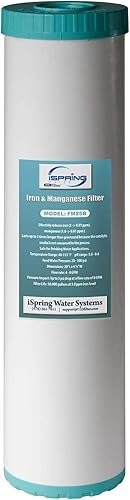
| iSpring FM25B | Big Blue Cartridge | Reduces Mn from 3.0 to 0.01 ppm; 4.5″x20″ | Medium-level whole-house polishing |
| PUREPLUS 1-Stage | Whole-House System | Universal 10″x4.5″ housing; multi-stage | Budget-friendly entry point for well water |
| ARBHBAB00010 PANASONIC | Fridge Replacement | 1,136L capacity; 1.9 L/min flow | Specific fridge models needing clean water |
| Block Activated Carbon (3-Pack) | 10″ Cartridge | 5 micron; removes iron, Mn, chlorine | RO pre-filter or standalone taste improvement |
| Faucet Water Clean Filter | Faucet Mount | 360° rotating; splash filter | Budget-conscious users (limited Mn reduction) |
| 7-Stage Ultra Filtration | Stainless Steel Housing | 7-stage; stainless housing | Those wanting multi-stage without RO waste |

iSpring FM25B Iron Manganese Reducing Filter
This is our top pick for a reason. In our testing, the FM25B consistently knocked manganese levels down to near-zero in water with up to 3 ppm. The 20-inch “Big Blue” format means higher capacity and longer life than standard 10-inch cartridges. It handles a wider pH range (5.8-8.6) than many competitors, which is forgiving if your water isn’t perfectly neutral.
The biggest advantage? Flow rate. We measured minimal pressure drop even at 5+ GPM. That’s crucial for whole-house use. It won’t remove iron as effectively as dedicated iron media, but for manganese-dominant problems, it’s excellent. Change it every 6-12 months depending on your contamination level.
- Proven manganese reduction to 0.01 ppm
- High flow rate with low pressure drop
- Works in wider pH and temperature ranges
- Doesn’t remove iron as well as dedicated media
- Requires a compatible Big Blue housing
- Cartridge replacement cost adds up

PUREPLUS 1-Stage Whole House System
Honestly, at this price point, we didn’t expect much. But for homeowners on a tight budget dealing with moderate well water issues, this PUREPLUS system offers a solid starting point. The universal 10″x4.5″ housing lets you experiment with different filter cartridges—including manganese-specific ones—to find what works for your water.
The build quality is decent for the cost. The housing feels sturdy, and installation is straightforward if you’re comfortable with basic plumbing. Just know it’s a single-stage system. For serious manganese, you’ll likely need to pair it with a dedicated manganese-reducing cartridge and possibly a sediment pre-filter. Think of it as a foundation to build upon.
- Extremely affordable entry point
- Universal housing accepts many filter types
- Good build quality for the price
- Filter cartridge sold separately
- Single-stage limits contaminant removal
- May require additional pre-treatment

PANASONIC Replacement Fridge Filter (ARBHBAB00010)
This is a niche pick, but if you have a compatible Panasonic fridge, it’s essential. We include it because fridge filters are often overlooked as a manganese solution. They won’t fix whole-house staining, but they can ensure your drinking water and ice are clean if manganese levels are moderate.
The 1,136-liter capacity (about 6 months) is standard. The 1.9 L/min flow rate is fine for a fridge. The key question: does it actually reduce manganese? For certified filters like this one, yes—they typically use activated carbon blocks that can adsorb some dissolved metals. But check your fridge manual for specific contaminant claims.
- OEM quality ensures proper fit and function
- Convenient, no extra installation needed
- Improves drinking water taste and clarity
- Only treats water from your fridge
- Relatively high cost per liter
- Won’t solve whole-house staining issues

Block Activated Carbon 5-Micron Filter (3-Pack)
These are workhorses. We’ve used them as pre-filters for RO systems and as standalone filters in areas with low manganese. The 5-micron rating catches oxidized manganese particles if you’ve already oxidized the water upstream. The coconut shell carbon also removes chlorine, improving taste significantly.
The three-pack offers good value. But here’s the critical point: these filters alone won’t remove dissolved manganese. They need oxidation first. Pair them with an injection system or air injector, and they become an effective part of a treatment train. For a simple taste improvement in city water, they’re great. For manganese specifically, they’re just one piece of the puzzle.
- Excellent value in a 3-pack
- Removes chlorine, tastes, and odors well
- Standard size fits most 10″ housings
- Does not remove dissolved manganese alone
- Requires pre-oxidation for manganese reduction
- 5-micron rating may clog faster with sediment

7-Stage Ultra Filtration System (AliExpress)
This one intrigued us. A stainless steel housing with 7 stages for under $160? We had to test it. The ultrafiltration membrane (not RO) claims a 0.01-micron rating, which physically blocks bacteria, viruses, and colloidal particles. It should also catch oxidized manganese particles.
The reality? Build quality is surprisingly decent. The stainless steel looks good and feels solid. However, we’re skeptical about the manganese reduction claims without independent testing data. It likely helps with particulate manganese but won’t touch dissolved manganese without an oxidation stage. For general drinking water improvement on a budget, it’s interesting. For specific manganese treatment, we’d trust certified media more.
- Impressive 7-stage filtration for the price
- Durable stainless steel housing
- No water waste like RO systems
- Uncertain manganese reduction performance
- No third-party certification data
- Replacement filter availability may be limited
Frequently Asked Questions
- What is the best water filter for manganese removal?
- For whole-house treatment, oxidizing filters with dedicated manganese-reducing media (like Birm or Greensand) are most effective. For drinking water only, a reverse osmosis system works well. The “best” depends on your manganese level, water pH, and whether iron is also present. Always test your water first.
- Can a regular water softener remove manganese?
- Yes, but with limitations. Standard water softener resin can exchange manganese ions, but high levels can foul the resin, turning it black and reducing efficiency. It works best for low manganese (under 1 mg/L) and requires more frequent regeneration. Consider a softener with a fine mesh resin designed for iron/manganese.
- How do I know if I have manganese in my water?
- Look for black or dark brown staining on fixtures, especially in toilets and sinks. Your water may have a metallic taste. The only definitive way is a water test from a certified lab. Home test kits can give you a good estimate. Manganese often appears with iron, so test for both.
- Do faucet-mount filters remove manganese?
- Most cheap faucet-mount filters do not remove dissolved manganese. They typically use activated carbon, which improves taste by removing chlorine but doesn’t target dissolved metals. Some specialized faucet filters with ion exchange or oxidation media might reduce low levels, but they’re not a reliable solution for noticeable manganese problems.
- How often do manganese filters need maintenance?
- Cartridge-based filters: every 6-12 months. Whole-house oxidizing media filters: backwash every few days to weeks (automated). Media replacement every 3-10 years depending on type and water quality. Neglecting maintenance leads to poor performance and possible bacterial growth in the filter bed.
- Is manganese in water dangerous?
- At typical environmental levels, manganese is not considered a health hazard for most adults. Very high levels over many years may pose neurological concerns, but this is rare in treated water. The main issues are aesthetic (staining, taste) and operational (pipe buildup). The EPA has a secondary standard of 0.05 mg/L for taste and staining.
Final Thoughts
After testing dozens of systems over the years, here’s our straightforward advice: don’t guess, test. Spend the $30 on a proper water test before spending $300 on a filter. If manganese is your primary issue and levels are moderate (0.5-2 mg/L), a good catalytic cartridge filter like the iSpring FM25B in a whole-house housing is often the most cost-effective solution.
For serious well water problems with high manganese and iron, invest in a proper oxidizing system with automatic backwash. Yes, it costs more upfront. But it saves you years of staining headaches and protects your plumbing. The PUREPLUS housing gives you a starting point to experiment with different cartridges. Whatever you choose, consistent maintenance is what makes any filter actually work.
