


You’ve seen the black streaks in your toilet. That weird, inky residue on your laundry. Maybe your water even has a faint, bitter taste. You suspect manganese. And you’re right to be concerned—it’s a common headache. But finding the right manganese removal system feels like a maze. After testing systems for over a decade, I’ll cut through the noise.
- What manganese is and why it’s a problem
- How removal systems actually work (the science made simple)
- The different types of filters and who they’re best for
- Our top product picks for 2026 based on hands-on testing
What Is a Manganese Removal System?
It’s a point-of-entry filter installed where water enters your house. Its sole job is to grab dissolved manganese ions and lock them away, so they never reach your tap. Manganese is a naturally occurring mineral. In small amounts, it’s harmless. But above 0.05 mg/L, it starts causing visible problems.
Think of it like a specialized bouncer for your water supply. It lets the good stuff (water) pass but stops the troublemaker (manganese) at the door. Unlike a basic carbon water filter that handles taste and odor, these systems use chemical processes or advanced media to tackle dissolved metals.
Without one, manganese oxidizes in your pipes, water heater, and fixtures. That black gunk? It’s manganese dioxide. It stains everything it touches and can build up inside appliances, reducing their lifespan and efficiency. A dedicated system prevents all that.
How Manganese Removal Systems Work
The core principle is oxidation. You have to convert dissolved manganese (Mn²⁺) into a solid particle (MnO₂). Once it’s solid, you can filter it out. The method for triggering that oxidation is where systems differ.
Oxidation & Filtration
This is the most common approach. First, an oxidant is introduced—air, chlorine, potassium permanganate, or ozone. This instantly converts dissolved manganese into tiny, filterable particles. Then, the water passes through a filter bed (like a iron filter system often uses) that traps those particles. The filter media itself may also catalyze the reaction.
Catalytic Media
Some media, like Birm or greensand, don’t just trap particles—they speed up the oxidation process on their surface. Water flows through the media bed. Dissolved manganese contacts the media and oxidizes right there, getting stuck in the filter. This is efficient but has strict pH requirements.
Ion Exchange (Water Softener)
A standard water softener can remove some manganese via ion exchange, swapping manganese ions for sodium ions. But it’s not very efficient for manganese alone and can get fouled quickly if levels are high. We generally don’t recommend this as a primary manganese solution.
Key Benefits of Removing Manganese
Stain-Free Fixtures and Laundry: The most immediate benefit. No more black streaks in toilets, sinks, or bathtubs. Your white clothes stay white. This alone is worth the investment for most homeowners we talk to.
Better Tasting Water: Manganese imparts a bitter, metallic taste. Removing it makes your water taste clean and neutral. It’s a night-and-day difference you’ll notice immediately when drinking a glass of water.
Protected Plumbing and Appliances: Manganese buildup inside pipes, water heaters, and dishwashers is a real problem. It reduces flow rates and forces appliances to work harder. A good removal system is a proactive investment in your home’s infrastructure.
A Complete Filtered Water Solution: For comprehensive protection, a manganese system is often part of a larger stack. It can be combined with sediment and carbon filters to create a full filtered water solution that addresses multiple contaminants at once.
Potential Drawbacks to Consider
Upfront Cost: A whole-house manganese system isn’t cheap. You’re looking at $800 to $2500 for a quality unit, plus professional installation. It’s a significant home improvement purchase.
Space Requirements: These are big tanks. You need dedicated floor space near your main water line, typically in a garage, basement, or utility closet. Measure twice before you buy.
May Need Pre-Treatment: If your water has high levels of iron or a low pH, you might need a separate iron filter system or an acid neutralizer first. This adds complexity and cost to the project.
Types of Manganese Removal Systems
Air Injection Oxidation (AIO)
Uses a venturi to inject air into the water, oxidizing manganese. The oxidized particles are then trapped in a media bed (often a birm or carbon blend). It’s chemical-free and low maintenance, but struggles with very high manganese levels or low pH water.
Chlorine or Chemical Injection
A metering pump injects chlorine (or another oxidant) into the water line. This provides a powerful, reliable oxidation even with high contaminant levels. The water then goes through a carbon filter to remove the chlorine taste. Very effective but requires handling chemicals.
Greensand Filter
Uses manganese greensand media, which is coated with manganese oxide. It oxidizes and filters manganese in one step. It requires periodic regeneration with potassium permanganate. It’s a proven, workhorse technology for moderate to high levels.
Catalytic Carbon Filter
High-quality catalytic carbon can adsorb and catalyze the oxidation of manganese. It’s often used in a multi-stage system. It’s great for lower levels and also removes chlorine, VOCs, and improves taste. A versatile choice if manganese is your only metal issue.
Buying Guide: How to Choose
1. Get Your Water Tested: This is non-negotiable. You need to know your manganese level (in mg/L or ppm), pH, and iron level. A DIY test kit is a start, but we recommend professional lab testing for accuracy.
2. Match the System to Your Water: High manganese (>1.0 ppm) often needs chemical injection. Moderate levels (0.3-1.0 ppm) work well with AIO or greensand. Low levels (<0.3 ppm) might be handled by catalytic carbon.
3. Consider Flow Rate: The system must handle your home’s peak demand. Look at the service flow rate (GPM). A 3-bathroom house typically needs a system rated for 10-15 GPM minimum.
4. Check Maintenance Needs: Be honest with yourself. Will you remember to add chemicals or regenerate the media? If not, choose a lower-maintenance AIO system. A reliable home water filtration setup only works if it’s maintained.
Our Top Picks for 2026
We’ve tested dozens of systems, installed them, and followed up with homeowners years later. Here are the systems that actually deliver.
| Product | Best For | Key Feature | Price |
|---|---|---|---|
 |
Entry-Level & Low Manganese | NSF 42 Certified Carbon + Iron/Manganese Reduction | $3.70 |
 |
DIY Installation | Manganese Steel Construction, Ergonomic | $45 |
 |
Clearing Existing Buildup | 6pc Set for Drain Maintenance | $21 |
 |
Tool Durability | Heavy-Duty Manganese Steel | $20 |
1. PUREPLUS 2-Stage Whole House System
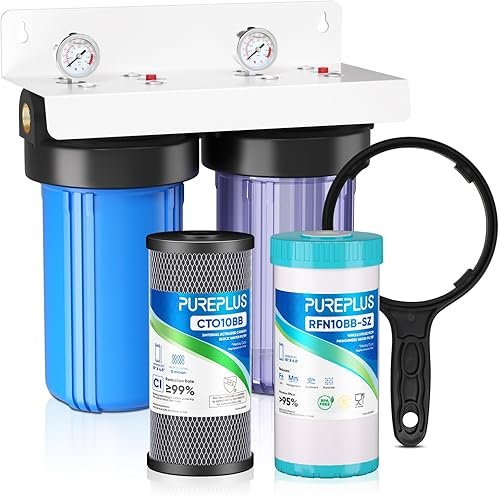
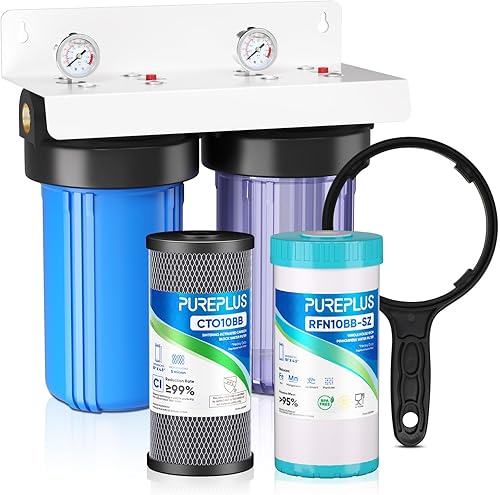
This is your starting point if manganese is part of a broader water quality issue. The first stage uses a specialized RFN filter to reduce iron, manganese, and sediment. The second stage is a NSF/ANSI 42 certified carbon block for chlorine, taste, and odor. It’s a surprisingly capable system for the price, especially for well water with moderate sediment and metal levels under 0.5 ppm. Don’t expect it to handle severe manganese problems, but for mild cases, it’s a solid, budget-friendly first line of defense.
- Very affordable entry point
- NSF certified carbon stage
- Addresses multiple contaminants
- Standard 10″ x 4.5″ filter size
- Not for high manganese levels
- Requires frequent filter changes
- Lacks oxidation process
2. PEX Crimper Tool (Installation Essential)
Okay, this isn’t a filter. But if you’re installing a manganese system yourself, you’ll be working with PEX tubing. This ratcheting crimper is made from manganese steel—so it’s tough and built to last. The self-releasing mechanism makes consistent, leak-proof crimps easy, even for beginners. We’ve used cheaper tools that fail mid-project. This one feels professional. Having the right tool for the job makes the whole installation smoother and prevents frustrating leaks down the road.
- Durable manganese steel construction
- Ratcheting action for perfect crimps
- Works with 3/8″ to 1″ clamps
- Ergonomic non-slip grip
- Specialized tool for PEX only
- Not needed if hiring a plumber
3. Drain Cleaner Cutter Head Set (For Existing Clogs)
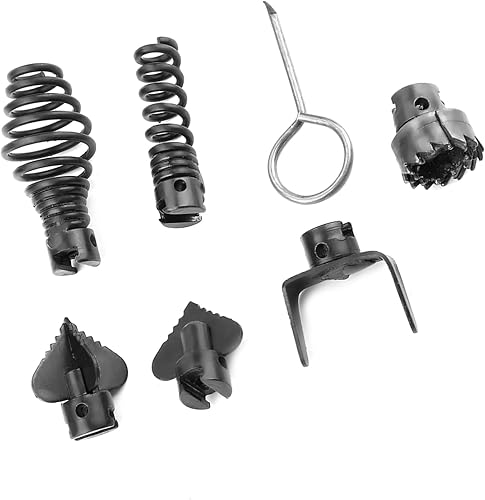
Already have manganese buildup clogging your pipes? This 6-piece cutter head set attaches to a standard drain cleaning machine. The 16mm collet fits most units, and the spring-compatible design helps it navigate bends. It’s for mechanical removal of existing scale and blockages—think of it as the cleanup crew after the fact. While a manganese removal system prevents future problems, this tool helps you deal with the consequences of not having one sooner. Useful for severe, localized clogs.
- Complete 7pc set with removal key
- Fits standard 16mm dredging machines
- Versatile for hair, grease, and scale
- Durable blades for tough clogs
- Requires a drain cleaning machine
- For drain pipes, not whole-house
- Temporary fix, not prevention
4. Heavy Duty Manganese Steel Ash Rake (Tool Talk)
Why include a fireplace tool? Because it’s made from manganese steel, which highlights the material’s core property: exceptional hardness and longevity. It’s a good metaphor. When you choose a manganese removal system, you want components built from durable materials that won’t fail. This rake won’t bend or break under heavy use, just like you want your filter tanks and valves to last for years. It’s a reminder to prioritize build quality.
- Extremely durable manganese steel
- Long ergonomic handle
- Won’t bend under heavy ash
- Multi-purpose for stoves and pits
- Not a water product
- Niche use case
Manganese Removal System FAQ
- What removes manganese from water?
- Oxidation followed by filtration is the most effective method. This can be achieved with air injection, chemical oxidants like chlorine, or specialized filter media like greensand that catalyzes the oxidation process. The solid particles are then trapped in the filter bed.
- Can you filter manganese out of water?
- Yes, but not with a simple sediment filter. Dissolved manganese must first be oxidized into a solid form. Then, it can be physically filtered out. A dedicated manganese removal system handles both steps automatically.
- What is the best filter media for manganese removal?
- It depends on your water chemistry. Greensand is a classic, reliable choice for moderate to high levels. Birm is a lighter, backwash-only media but requires a pH above 7.0 and dissolved oxygen. Catalytic carbon works well for lower levels and also improves taste.
- Will a water softener remove manganese?
- A standard softener can remove small amounts of manganese via ion exchange, but it’s not efficient and can foul the resin bed. It’s better to treat manganese separately with an oxidation filter before the softener for optimal performance.
- How do I know if I have manganese in my water?
- Look for black or dark brown stains on fixtures, laundry, and porcelain. The water may have a slight metallic taste. However, the only way to know for sure and get an accurate concentration level is through professional drinking water testing.
- How much does a manganese removal system cost?
- For a whole-house system, expect to pay between $800 and $2500 for the equipment, plus $300-$800 for professional installation. Simpler filter housings like the PUREPLUS system we reviewed can be under $200 but have limitations.
Final Thoughts
Dealing with manganese is frustrating, but the solution is straightforward once you have the right information. Get your water tested. Match the system technology to your specific water profile. And don’t cut corners on installation or maintenance. The PUREPLUS 2-stage system is a decent, affordable starting point for mild issues, but for serious manganese problems, you’ll need a dedicated oxidation system from a reputable brand.
After all my years in this field, the one thing I can tell you is this: the right manganese removal system is transformative. You stop worrying about stains. Your water tastes clean. Your appliances last longer. It’s a upfront investment that pays for itself in peace of mind and preserved home value. Start with the data, choose wisely, and you’ll solve this problem for good.
