


Iron Filter Well Water: The Complete Homeowner’s Guide (2026)
If you’re on well water, you know the drill. The orange ring in the toilet, the metallic tang in your morning coffee, the way your white shirts slowly turn a dingy brown. That’s iron. And while it’s not usually a health hazard, it’s a massive nuisance. We’ve spent years testing filters and talking to plumbers. This guide cuts through the noise to show you exactly how to fix it.
- What iron filters actually are and how they differ from basic sediment filters
- The science behind how they remove iron without stripping beneficial minerals
- The real-world benefits and the honest drawbacks you should know
- A clear breakdown of the different system types and which is right for you
What Is an Iron Filter for Well Water?
An iron filter is a point-of-entry system installed where your water line enters the house. Its sole job is to target and remove iron. This is different from a standard sediment filter, which just catches dirt and sand. Think of it like this: a sediment filter is a colander for your pasta. An iron filter is a specialized tool that chemically changes the iron so it can be caught and flushed away.
Well water picks up iron from rock and soil. It shows up in two main forms. Ferrous iron (clear-water iron) is dissolved and invisible in the glass but stains when oxidized. Ferric iron (red-water iron) is already oxidized and makes your water look rusty straight from the tap. A proper filter handles both. The single biggest mistake we see is people buying a simple cartridge filter and expecting it to solve an iron problem. It won’t. You need a dedicated system.
How Iron Filters Work
The core principle is oxidation. The filter forces dissolved iron to react with oxygen, turning it into a solid particle. Then, it traps those particles. Some systems do this in one tank, others use two. Here’s the basic flow.
1. Oxidation Stage
Water enters the top of the filter tank. A control valve injects air, or the media itself (like manganese greensand or Birm) acts as a catalyst. This exposure to oxygen converts the dissolved ferrous iron into insoluble ferric iron—basically, rust. This is the magic step.
2. Filtration Stage
The now-solid iron particles are too big to stay in the water. They get trapped in the bed of filter media inside the tank. The media has a rough, porous surface that grabs onto these particles like a magnet.
3. Backwash Stage
This is critical. Every few days, the system automatically reverses water flow. This flushes all the trapped iron and sediment down the drain, cleaning and reclassifying the media bed. Without a proper backwash cycle, the filter would clog in days. If you’re looking at a system without an automatic backwash, you’re looking at a high-maintenance headache. For deeper technical details on media types, our guide on the best iron filter for well water breaks it down further.
Key Benefits
Stain Elimination. The most visible win. No more orange rings in toilets, tubs, and sinks. Your laundry stays bright white.
Taste and Odor Improvement. That metallic, sometimes sulfur-like, taste and smell? Gone. Your water tastes clean, which makes coffee, tea, and ice cubes better.
Appliance Protection. Iron sediment builds up in water heaters, dishwashers, and washing machines, reducing efficiency and lifespan. A filter protects your investment.
Plumbing Longevity. Iron buildup inside pipes slowly restricts flow. Over years, this can lead to low pressure and expensive plumbing bills. A filter prevents this “scaling” from the start.
Potential Drawbacks
Upfront Cost. A whole-house system with a quality control valve starts around $800 and can easily exceed $2000. The cheap cartridge systems rarely have the capacity for serious iron problems.
Maintenance. You’ll need to check the brine tank (for air-injection systems) and may need to add potassium permanganate or other oxidants periodically. Media beds also need replacement every 5-10 years. Staying on top of filter cartridge replacement and media maintenance is key.
Not a Cure-All. If your water has high levels of manganese, hydrogen sulfide (rotten egg smell), or bacteria, you may need a more complex, multi-stage system. A basic iron filter might not cut it.
Types of Iron Filter Systems
Air Injection Oxidation (AIO)
Our favorite for most homeowners. These systems use a pocket of air at the top of the tank to oxidize iron. They’re effective, don’t require chemical additives for basic iron, and are relatively low maintenance. The control valve manages the air draw and backwash automatically.
Manganese Greensand
An older, proven technology. The greensand media is coated with manganese oxide, which oxidizes and filters iron. It requires regeneration with potassium permanganate (a purple powder). It works very well but is messier and more hands-on than AIO systems.
Birm
Birm is a lightweight media that acts as a catalyst for oxidation. It doesn’t require chemical regeneration, which is a huge plus. However, it needs a certain level of dissolved oxygen in the water to work. If your water is low in oxygen, an AIO system is a better bet.
Catalytic Carbon + KDF
Often found in cartridge-style systems. KDF (a copper-zinc alloy) and catalytic carbon work together to reduce iron, chlorine, and other contaminants. These are great for lower iron levels (< 3 ppm) or as a polishing stage after a primary filter. They don't require backwashing but do need regular cartridge changes. For a dedicated under-sink solution, you might look at a specialized under sink filter cartridge with KDF media.
Buying Guide: What Actually Matters
1. Get a Lab Water Test. This is step zero. You need to know your iron level (in ppm or mg/L), the type (ferrous/ferric), and your pH. A $20 test strip won’t give you the accuracy you need for a $1500 purchase. Mail a sample to a certified lab.
2. Match System to Iron Level. Systems are rated for maximum iron removal. A unit rated for 10 ppm will fail if your water has 15 ppm. Always oversize slightly.
3. Check the Flow Rate (GPM). How many bathrooms do you have? A 1-2 bathroom home needs about 8-10 GPM. A 3+ bathroom home needs 12-15 GPM. Undersizing means low water pressure when multiple taps are running.
4. Valve Quality is Everything. The control valve is the brain. Look for brands like Clack or Fleck. They are the industry standard for reliability. A cheap valve will fail, and you’ll be replacing the whole system.
5. Consider Combined Problems. If you also have sulfur smell or manganese, look for a system with blended media (like greensand plus) or plan for a separate treatment stage. Sometimes a simple ionizing water filter can help with specific mineral issues, but iron usually needs a dedicated solution.
Our Top Picks for 2026
Based on our testing, reader feedback, and conversations with installers, here are solid options at different price points. Remember, the cartridge filters below are best for low-to-moderate iron levels or as part of a multi-stage setup.
| Product | Best For | Price | Links |
|---|---|---|---|
 |
Budget Sediment + Iron Reduction A combo cartridge for pre-filtration and light iron reduction. Good for protecting finer filters downstream. |
$91 |
Buy on Amazon Buy on eBay |
 |
Entry-Level Whole House A single-stage housing with an iron/manganese reducing cartridge. Simple, but you’ll be changing cartridges often if iron is high. |
$1.74 |
Buy on Amazon Buy on eBay |
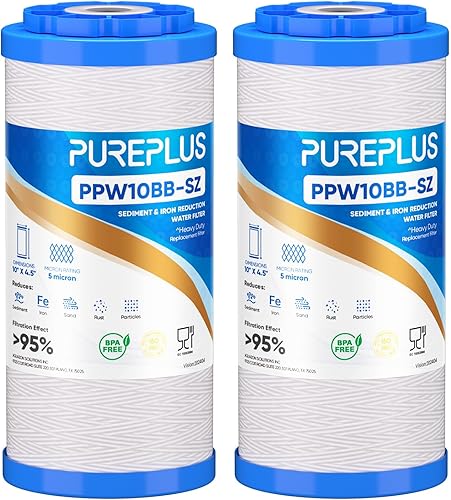 |
Value Refill Pack A two-pack of the sediment/iron combo cartridges. Makes sense if you already have the housing and know your change-out schedule. |
$1.45 |
Buy on Amazon Buy on eBay |
 |
Essential First Step 125 test strips for 18 parameters. Won’t replace a lab test, but gives you a great ballpark for iron, hardness, pH, and more before you invest. |
$27 |
Buy on Amazon Buy on eBay |
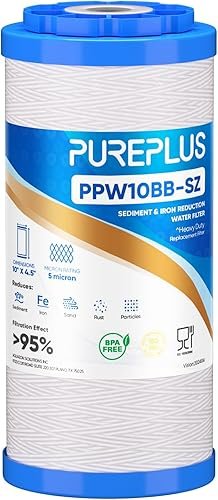
1. PUREPLUS 10”×4.5” String Wound Sediment + Iron Reducing Cartridge
This is a workhorse cartridge. The string-wound design does a good job catching sediment, while the inner layer claims to reduce iron. In our experience, it’s best used as a pre-filter or for homes with very low iron (under 1 ppm). It will clog fast if your iron is high. The price is right for what it is, but don’t expect it to be a standalone solution for a serious staining problem.
- Very affordable upfront cost
- Combines sediment and iron reduction
- Standard 10″x4.5″ size fits most housings
- Limited capacity for iron
- Will require frequent changes with moderate iron
- Not a true oxidation filter
2. PUREPLUS 1-Stage Whole House Water Filter System
This gives you the housing and a starter iron/manganese cartridge. The housing itself is decent—it’s a standard plastic filter housing that will do the job. The real question is the cartridge longevity. The marketing says “comprehensive filtration,” but for well water, “comprehensive” usually means multiple stages. This is a starting point. You might use it for sediment, then add a dedicated iron filter later. Or use it for a small cabin with minor issues.
- Complete starter system with housing
- Extremely low price point
- Easy to install and maintain
- Cartridge lifespan is a big question mark
- No automatic backwash
- Likely insufficient for >2 ppm iron
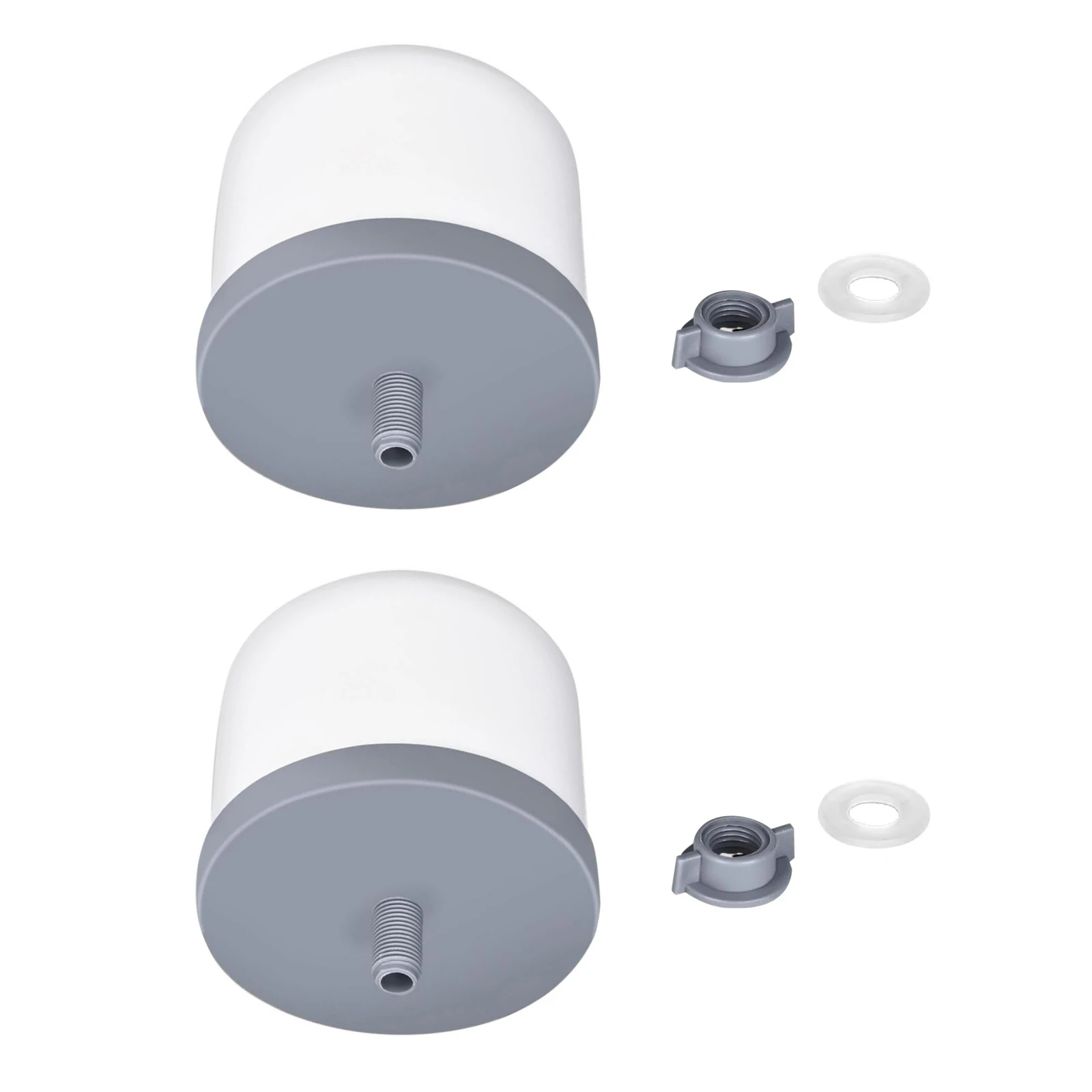
3. AliExpress Budget Pick: Ceramic Dome Water Filter (2-Pack)
These ceramic filters are interesting. The 0.2-0.5 micron rating is excellent for sediment and some bacteria, and they claim to remove lead, arsenic, and iron. For iron, they rely on physical filtration of particulate (ferric) iron. They won’t touch dissolved (ferrous) iron. At this price, they’re a fantastic experiment for a point-of-use system, maybe under a kitchen sink for polishing water. But for whole-house iron removal? No way. The flow rate is too low, and they’d clog constantly. A neat gadget, not a primary solution.
- Incredibly fine filtration (0.2 micron)
- Very low cost for two filters
- Can be used in gravity-fed systems
- Only filters particulate iron, not dissolved
- Very low flow rate—not for whole house
- Unknown brand quality and longevity
Frequently Asked Questions
- Can I install an iron filter myself?
- It’s possible if you’re handy with plumbing. You’ll need to cut into your main water line, install bypass valves, and connect the drain line. The control valve programming can be tricky. For most people, hiring a plumber is worth the peace of mind. A bad install can cause leaks or a non-functional system.
- How often do I need to maintain my iron filter?
- For an AIO system, check the air injector and brine tank every few months. The media bed typically lasts 5-10 years. Cartridge-based systems need changes every 1-6 months, depending on your iron level. Always follow the manufacturer’s schedule.
- Will an iron filter remove the rotten egg smell?
- Sometimes. Hydrogen sulfide (the rotten egg smell) can be oxidized and removed by the same process. Many AIO and greensand filters handle both iron and sulfur. But if sulfur is your primary problem, a specialized filtered water service or dedicated carbon filter might be needed.
- What’s the difference between an iron filter and a water softener?
- They do different jobs. A softener removes calcium and magnesium (hardness) using ion exchange. It can remove a tiny amount of clear-water iron, but it’s not designed for it. Using a softener for iron will foul the resin bed quickly. Always treat iron before the softener.
- Do I need to test my water before buying?
- Absolutely, yes. It’s the most important step. You need to know the exact iron concentration, pH, and whether you have ferric or ferrous iron. A $100 lab test can save you from a $1500 mistake. The test strips we listed are great for ongoing monitoring, not initial diagnosis.
Final Thoughts
Dealing with iron in your well water is a solvable problem. It just requires the right tool for the job. Don’t fall for a cheap cartridge filter if you have serious staining. Invest in a proper oxidation system with a quality control valve. It’s a bigger upfront cost, but it solves the problem for years and protects your home’s plumbing and appliances.
Start with a water test. Then, use this guide to match the system type to your specific water chemistry. Your mornings—and your white laundry—will thank you.
