


You see the orange rings in your toilet. You taste the metal in your morning coffee. Your water softener is struggling. Sound familiar? You’re dealing with iron, and it’s a stubborn problem. After testing systems for over a decade, I can tell you the right iron filtration system changes everything. This guide cuts through the noise. We’ll cover what these filters actually do, how to choose one, and which models we’d install in our own homes.
What Is an Iron Filtration System?
An iron filtration system is a point-of-entry water treatment device designed specifically to remove iron. It’s installed where water enters your house. Unlike a standard sediment filter that just catches particles, an iron filter targets dissolved (ferrous) iron and oxidized (ferric) iron. Think of it as a specialist. A carbon water filter might handle chlorine taste, but it won’t touch your iron problem.
These systems use various media—like manganese greensand, Birm, or catalytic carbon—to convert dissolved iron into solid particles. Then they trap and flush them away. The result? Water that doesn’t stain your laundry, fixtures, or driveway. It’s a targeted solution for a very specific, very annoying water quality issue.
How an Iron Filtration System Works
The magic is in the oxidation and filtration process. It’s a two-step dance that happens inside the tank.
Step 1: Oxidation
Dissolved iron in your water is invisible. To remove it, you have to change its form. The filter media acts as a catalyst, causing the dissolved iron to react with oxygen in the water. This turns it into solid, rust-colored particles—just like iron left out in the rain. Some systems use an air injector or a chemical like potassium permanganate to boost this oxidation step.
Step 2: Filtration & Backwash
Now that the iron is a solid, it’s easy to catch. The water flows through the filter media bed, which traps these particles. But the tank can’t hold them forever. Periodically—usually in the middle of the night—the system automatically goes into a backwash cycle. It reverses water flow to flush the trapped iron particles down the drain, cleaning the media for the next cycle. It’s self-cleaning, which is a huge plus.
Key Benefits of Installing One
No more stains. This is the big one. Say goodbye to orange-brown rings in toilets, rusty streaks on siding, and stained laundry. Your sinks and tubs will stay clean.
Better tasting water. That metallic, bitter tang in your drinking water disappears. Your coffee and ice cubes will taste pure again.
Protects your plumbing and appliances. Iron buildup clogs pipes, water heaters, and washing machine valves. A good filter is cheap insurance against expensive repairs. It also helps your drinking water solution, like a faucet filter, last longer by removing the gunk that clogs it.
Works with water softeners. A softener handles hardness (calcium, magnesium). An iron filter handles iron. They’re a perfect team. In fact, removing iron first extends the life of your softener’s resin bed.
Potential Drawbacks to Consider
Upfront cost. A whole-house iron filter is a significant investment, often $500 to $2,000+ for the unit, plus professional installation. It’s not a cheap under-sink gadget.
Not a cure-all. If your water has bacteria (like iron bacteria), sulfur smell, or other contaminants, you’ll need additional treatment. An iron filter is one piece of the puzzle. For the most complex water, a multi-stage approach or a full water distillation unit might be necessary.
Space requirements. These are big tanks. You need a dry, accessible area near your main water line, with a power outlet and a nearby drain.
Types of Iron Filtration Systems
Oxidizing Filters (Manganese Greensand, Birm)
The classic workhorses. Manganese greensand uses potassium permanganate to regenerate, while Birm uses dissolved oxygen. Greensand is great for higher levels of iron and manganese. Birm is more economical but needs sufficient oxygen in the water to work.
Catalytic Carbon Filters
A fantastic dual-purpose option. High-quality catalytic carbon oxidizes and filters iron while also removing chlorine, volatile organic compounds (VOCs), and bad tastes/odors. It’s a popular choice for city water with moderate iron issues. It’s also the heart of a good carbon removal filter.
Air Injection Oxidization (AIO) Filters
These systems inject a pocket of air into the top of the tank. The air oxidizes the iron as water passes through, and the media bed filters it out. They’re chemical-free and very effective for moderate to high iron levels. A favorite among well water homeowners.
Buying Guide: How to Choose
Forget brand hype. Start with your water test results.
1. Know Your Iron Level & Type. Get a professional lab test. Is it dissolved (clear water that turns orange) or particulate (comes out of the tap rusty)? How many ppm (parts per million)? Systems are rated for specific capacities.
2. Check Flow Rate (GPM). How many bathrooms do you have? A 1-2 bathroom home needs about 8-10 GPM. A 3+ bathroom home needs 12-15 GPM. Undersizing causes pressure drops when multiple taps run.
3. Consider Other Contaminants. Just iron? Or iron plus hardness, sulfur, or sediment? You might need a multi-stage system. Always remember that you’ll eventually need a replacement filter cartridge or media bed, so factor in long-term costs.
4. Look for Certifications. NSF/ANSI Standard 42 (aesthetic effects) or 61 (health effects) certification is a mark of a reputable system. It means it’s been independently tested.
Our Top Picks for 2026
| Product | Best For | Key Feature | Price |
|---|---|---|---|
 |
Most homeowners with iron & odor | 2-stage: RFN iron filter + NSF 42 certified carbon block | $3.70 |
 |
Ultimate purification (iron, lead, PFAS, TDS) | 9-stage RO, 800 GPD, NSF 42/58/372 certified | $7.19 |
 |
First-line sediment defense | Valve-in-head bypass, filter life timer, easy install | $1.65 |
 |
Campers, RVs, portable use | Heavy metal & iron reduction, brass hose fittings | $5.18 |
1. PUREPLUS 2-Stage Whole House System
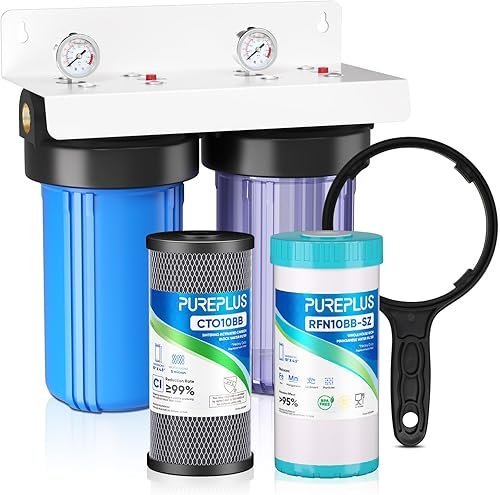
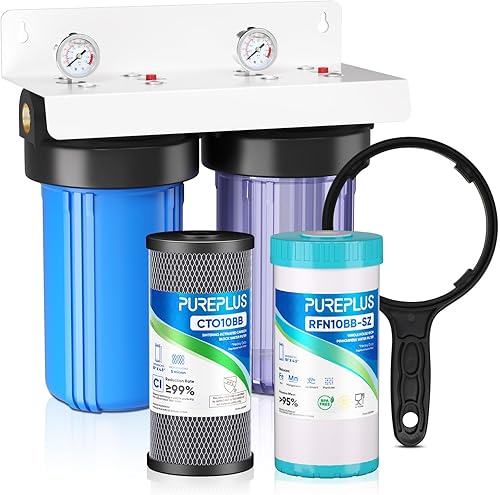
This is our top pick for most folks dealing with iron and that rotten-egg or metallic smell. It’s a smart, two-punch design. The first stage RFN filter tackles iron, manganese, and sediment. The second stage is a high-quality coconut shell carbon block, NSF/ANSI 42 certified to remove chlorine, tastes, and odors. We like that it’s a complete solution in one compact package. The 1-inch inlet/outlet won’t restrict your home’s flow rate either.
- Targets iron and bad tastes/odors in one system
- NSF 42 certified carbon filter
- Large 10″ x 4.5″ cartridges for longer life
- Very competitive price point
- Not for extreme iron levels (over 5-7 ppm)
- Requires periodic cartridge changes
2. Waterdrop WD-X8 Reverse Osmosis System
Honestly, most people don’t need an RO system just for iron. But if your water report is scary—high TDS, lead, PFAS, chloride, and iron—this is the nuclear option. The 9-stage filtration with a 0.0001-micron RO membrane removes virtually everything. The 800 GPD capacity means no waiting for a tank to fill, and the 2:1 pure-to-drain ratio is impressively efficient. It’s certified against NSF/ANSI 42, 58, and 372. Overkill for iron alone? Maybe. But for total peace of mind, it’s unbeatable.
- Removes 99%+ of contaminants, including iron
- High flow rate (800 GPD) with low waste water
- Multiple NSF certifications
- Sleek, tankless design saves space
- Significantly more expensive upfront
- Requires under-sink installation and a drain line
- Wastes some water (though less than older RO systems)
3. Culligan WH-S200-C Sediment Filter
Let’s be clear: this is a sediment filter, not a dedicated iron filter. But it’s a crucial first step. If your water has particulate iron (rust), sand, or silt, this Culligan catches it before it can stain or clog downstream appliances. The valve-in-head bypass is genius for easy cartridge changes. We’ve installed dozens of these. It’s reliable, well-built with a stainless steel reinforced rim, and includes a filter life timer. Pair it with an iron-specific filter for a complete setup.
- Excellent for removing sediment and particulate iron
- Very easy to install and maintain
- Valve-in-head bypass simplifies cartridge changes
- Trusted brand with good support
- Does NOT remove dissolved iron
- You will still need another system for clear-water iron
4. Essential Portable RV Water Filter
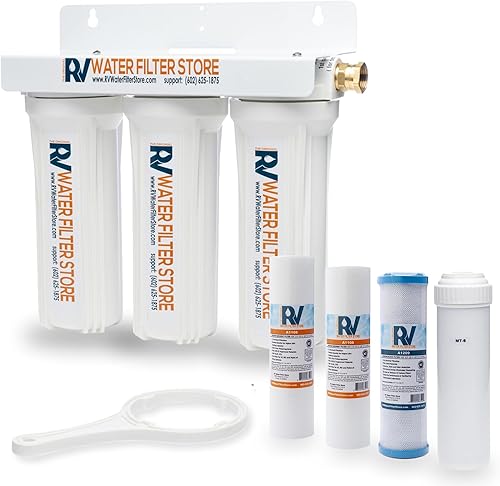
This isn’t a whole-house solution. It’s a brilliant little gadget for travelers. If you’re hooking up an RV or camper to a campground spigot with questionable water, this filters out iron, heavy metals, and sediment. The brass hose fittings are durable, and the 3-4 GPM flow rate is plenty for on-the-go use. We keep one in our camping kit. It’s also handy for washing the car or watering plants with hose water that has high iron content.
- Extremely affordable and portable
- Easy hose connection, no tools needed
- Reduces iron and heavy metals
- Good flow rate for its size
- Not for whole-house use
- Filter life is limited (depends on water quality)
Frequently Asked Questions
- How do I know if I need an iron filter?
- Look for orange/brown stains in sinks, toilets, and laundry. A metallic taste in your water is a dead giveaway. The only sure way is a water test. If your water tests above 0.3 ppm of iron, you’ll likely see problems and benefit from a filter.
- Can a water softener remove iron?
- Some can, in small amounts (usually under 2-3 ppm). But it’s hard on the softener resin and reduces its efficiency for removing hardness. We strongly recommend a separate iron filter. It does the job better and protects your softener investment.
- How often do I need to maintain my iron filter?
- It varies. Check the air injector (on AIO systems) monthly. Most systems automatically backwash. You’ll need to replace the filter media every 3 to 10 years, depending on the type and your water quality. Cartridge-based systems need new filters every 6-12 months.
- What’s the difference between an iron filter and a home water distiller?
- An iron filter removes iron and maybe manganese. A distiller boils water, catches the steam, and condenses it, removing nearly all contaminants—iron, bacteria, heavy metals, salts. Distillers are for drinking water only and are slow. Iron filters treat the whole house.
- Will an iron filter remove the rotten egg smell?
- Maybe, but not always. That smell is usually hydrogen sulfide gas. Some oxidizing filters (like greensand) can handle it if the level is low. For strong sulfur smells, you often need a dedicated sulfur filter or an air injection system designed for it.
- Can I install an iron filter myself?
- If you’re handy with plumbing, maybe. You need to cut into your main water line, have a drain for backwash, and a power outlet. For most people, we recommend professional installation to ensure it’s done right and the warranty is valid.
Final Thoughts
Dealing with iron in your water is frustrating, but the fix is straightforward. Don’t just buy the first filter you see. Test your water, understand your specific problem, and match it to the right technology. For the vast majority of homes with iron and odor issues, the PUREPLUS 2-Stage system offers the best balance of performance, certification, and value. It’s the one we’d recommend to a friend.
If your water tests are clean for iron but you’re still worried about other contaminants, a dedicated carbon removal filter or a full RO system might be a better use of your money. Get the data, then choose. Your pipes, your laundry, and your taste buds will thank you.
