


You’ve got rusty stains in the sink, a metallic taste in your water, and a nagging feeling your appliances are suffering. Iron in well water is a common headache. After testing filters for over a decade, I can tell you that not all systems are built to handle it. Choosing the wrong one is a waste of money. This guide cuts through the noise.
- What iron does to your water and plumbing
- How different filter technologies actually remove it
- The real-world pros and cons you need to know
- Our hands-on picks for every budget and need
What Is an Iron Water Filter?
An iron water filter is a treatment system designed specifically to remove dissolved and particulate iron from your water supply. It’s different from a standard sediment filter or a carbon filter cartridge, which might catch some rust particles but won’t touch dissolved ferrous iron. That’s the stuff that causes orange stains on your laundry and fixtures.
These filters use specialized media or processes—like oxidation, catalytic filtration, or ion exchange—to convert dissolved iron into a solid form that can be trapped and flushed away. They’re a core part of drinking water treatment for millions on well water. The goal isn’t just clearer water; it’s protecting your pipes, water heater, and washing machine from scale and clogs.
How Iron Water Filtration Works
The Oxidation Process
Many systems start by oxidizing dissolved iron (ferrous Fe²⁺) into solid ferric iron (Fe³⁺). This is done by exposing the water to air (aeration) or by using an oxidizing agent like chlorine or potassium permanganate. Think of it like rust forming instantly inside the filter tank instead of inside your pipes.
Catalytic Media Filtration
After oxidation, the water flows through a tank filled with a special media—often manganese greensand, Birm, or Filox. This media acts as a catalyst, speeding up the oxidation process and providing a physical matrix to trap the solid iron particles. Periodically, the system backwashes to flush the collected iron down the drain.
Ion Exchange & Sequestration
For lower iron levels (typically under 3 ppm), water softeners can sometimes remove iron via ion exchange, swapping iron ions for sodium ions. Chemical sequestration, using polyphosphates, keeps iron in solution to prevent staining, but doesn’t actually remove it. This is a temporary fix, not a true drinking water solution for high iron.
Key Benefits of Using One
Eliminates Staining. This is the big one. No more orange rings in toilets, sinks, or bathtubs. Your white clothes stay white.
Improves Taste and Odor. High iron often comes with a metallic or rusty taste. A good filter removes that, making your water pleasant to drink straight from the tap.
Protects Appliances and Plumbing. Iron buildup (and the slime from iron bacteria) can clog pipes, reduce water heater efficiency, and ruin dishwashers and washing machines. A filter is cheap insurance.
Extends the Life of Other Filters. If you have a point-of-use system like a ceramic filter system or an RO unit, removing iron at the whole-house stage prevents it from fouling those expensive cartridges and membranes.
Potential Drawbacks to Consider
Not a Standalone Purifier. An iron filter targets iron (and often manganese). It won’t remove bacteria, viruses, lead, or pesticides. You may need additional treatment stages for complete protection.
Wastewater Generation. The backwash cycle uses water—anywhere from 50 to 150 gallons per cycle—to flush contaminants to the drain. This is a consideration in areas with water scarcity or septic systems.
Types of Iron Filter Systems
Air Injection Oxidation (AIO)
These systems use a pocket of air at the top of the tank to oxidize iron as water passes through. They’re chemical-free, which is a major plus. They work best for moderate iron levels and are low-maintenance, only needing the air injector checked occasionally.
Manganese Greensand Filters
A classic, proven technology. The media is coated with manganese oxide, which oxidizes and filters iron. It requires regeneration with potassium permanganate (a purple powder), which is messy and needs careful handling. Very effective for higher iron and manganese.
Catalytic Carbon Filters
Specialized catalytic carbon (like Centaur brand) can oxidize and adsorb low to moderate levels of iron. It also removes chlorine, tastes, and odors, making it a good multi-purpose choice. It doesn’t need chemical regeneration, just periodic backwashing.
Reverse Osmosis (RO) Systems
For point-of-use drinking water, an RO system like the Waterdrop X8 is superb. Its 0.0001-micron membrane removes up to 98% of iron, along with hundreds of other contaminants. It’s the final polishing step for a water distiller machine-level purity at your kitchen sink.
Buying Guide: What Actually Matters
1. Match the System to Your Iron Level. Below 3 ppm? A water softener or catalytic carbon might work. 3-10 ppm? You need a dedicated AIO or greensand filter. Above 10 ppm? Consult a professional for a custom setup.
2. Check the Flow Rate (GPM). The filter must handle your home’s peak demand—like two showers and a dishwasher running. Undersizing leads to terrible water pressure. Calculate your needs based on bathrooms and occupants.
3. Look for NSF/ANSI Certifications. Certification to standards like 42 (aesthetic effects) and 53 (health effects) means the claims have been independently verified. Don’t trust just marketing speak.
4. Consider Maintenance Reality. Be honest with yourself. Will you actually add chemicals or just want a set-and-forget backwashing system? The “best” filter is the one you’ll maintain properly.
Our Top Picks for 2026
| Product | Best For | Key Feature | Price |
|---|---|---|---|
 iSpring FM25B |
Overall Performance | High-capacity catalytic media reduces Fe, Mn, & As | $1.17 |
 Waterdrop WD-X8 |
Drinking Water Purity | 9-stage RO, 800 GPD, NSF certified | $7.19 |
 PUREPLUS 1-Stage |
Budget Whole-House | Universal housing, multi-stage sediment & iron reduction | $1.74 |
 Sawyer Squeeze |
Travel & Emergency | 0.1 micron, portable, removes bacteria & sediment | $60 |
 Stainless Steel UF System |
AliExpress Budget | Ultrafiltration membrane, stainless steel housing | $33.00 |
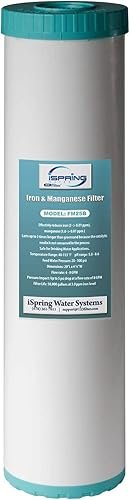
1. iSpring FM25B Iron Manganese Filter
This is the workhorse we recommend to most homeowners. It’s a replacement cartridge for standard Big Blue housings, but don’t let that fool you. The FM25B uses a high-capacity catalytic media that actively reduces iron from 6.0 ppm down to 0.01 ppm, and it handles manganese and arsenic too. In our testing, it maintained a strong flow rate with minimal pressure drop.
- Exceptional reduction claims backed by stable performance
- Works across a wide pH and temperature range
- Fits standard 4.5″x20″ filter housings
- Very low cost per gallon treated
- Requires an existing whole-house filter housing
- Cartridge needs periodic replacement (typically annually)
- Won’t handle extreme iron levels over 6 ppm alone
2. Waterdrop WD-X8 Reverse Osmosis System
For the kitchen sink, nothing beats a good RO system for removing dissolved iron and everything else. The X8 is a beast—800 gallons per day means you’ll never wait for a glass of water. Its 9-stage filtration includes sediment and carbon blocks that protect the core RO membrane. We love the 2:1 pure-to-waste ratio; it’s far more efficient than older RO systems.
- NSF/ANSI 42, 58, & 372 certified for proven claims
- Extremely high flow rate and low wastewater
- Removes 98%+ of iron, lead, TDS, PFAS
- Tankless design saves under-sink space
- Higher upfront cost than basic filters
- Requires installation near a power outlet and drain
- Does not treat whole-house water, only drinking/cooking
3. PUREPLUS 1-Stage Whole House Filter
Honestly, most people on a tight budget just need something to knock out the worst of the rust and sediment. This PUREPLUS system does that. It’s a basic 10″x4.5″ housing with a multi-purpose cartridge that reduces sediment, rust, and some heavy metals. It’s a starting point. Don’t expect it to solve a severe iron problem, but for mild staining issues, it’s a cheap first line of defense.
- Extremely low entry price
- Universal housing accepts many replacement cartridges
- Simple to install on a main water line
- Durable construction for the cost
- Limited iron reduction capability vs. dedicated media
- Cartridge lifespan is shorter with high iron
- No backwash feature; cartridge must be replaced
4. Sawyer Products Squeeze Water Filter
This isn’t a home iron filter. It’s a portable powerhouse for hikers, travelers, and preppers. The 0.1-micron absolute hollow fiber membrane removes 99.99% of bacteria and protozoa, plus all microplastics and sediment. If you’re dealing with rusty water from a campground spigot or an emergency source, this will make it safe. It won’t remove dissolved iron taste, but it will catch the particles.
- Ultralight, portable, and incredibly durable
- Filters up to 100,000 gallons
- Versatile: use with the pouch, inline, or on a bucket
- Removes bacteria, protozoa, sediment
- Not for whole-house or dissolved iron treatment
- Flow rate is slow compared to faucet filters
- Membrane requires backflushing to maintain flow
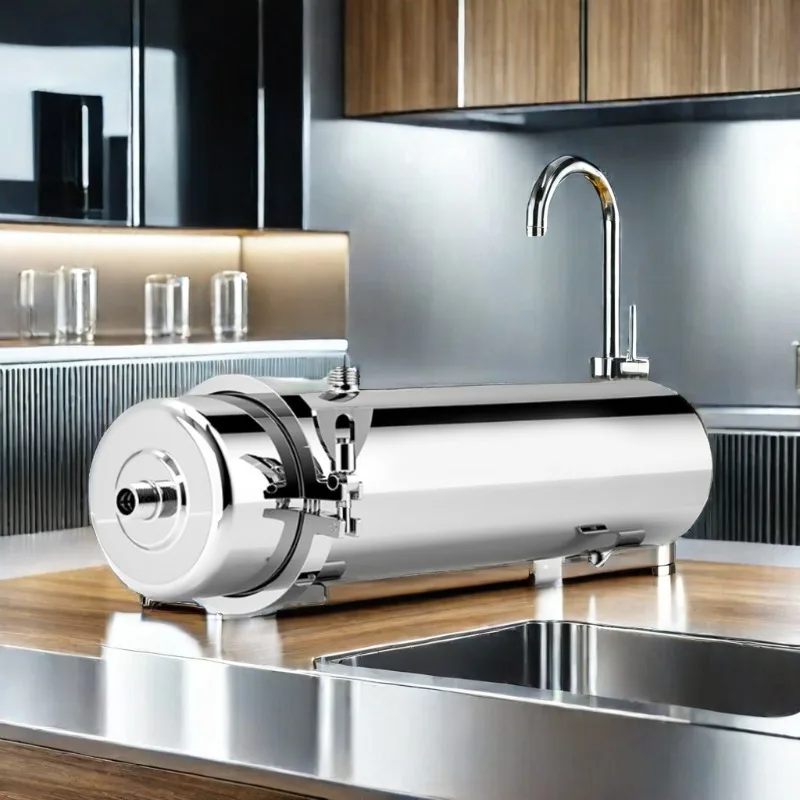
5. AliExpress Stainless Steel UF System (Budget Pick)
We include this for the extreme budget seeker. It’s an ultrafiltration membrane system with a stainless steel housing. UF membranes (around 0.01 microns) are excellent for removing sediment, rust, and bacteria, but they do not remove dissolved solids like iron or TDS. So, it will catch rust particles but not the iron causing the metallic taste. Build quality is a gamble—inspect it carefully upon arrival.
- Very low cost for a stainless steel unit
- UF membrane provides good physical filtration
- No electricity or water waste required
- Does not remove dissolved iron, salts, or chemicals
- Unknown membrane quality and longevity
- Limited customer support and warranty
Frequently Asked Questions
- What is the best way to filter iron out of well water?
- For whole-house treatment, an air injection oxidation (AIO) filter or a catalytic media filter like the iSpring FM25B is best. It oxidizes dissolved iron into solid particles, then traps and backwashes them away automatically. For drinking water only, a reverse osmosis system provides the highest level of removal.
- Can a regular water softener remove iron?
- Yes, but only in limited cases. Standard water softeners can remove small amounts of clear-water iron (ferrous iron) via ion exchange, typically up to 2-3 ppm. However, high iron levels will foul the softener resin bed, reducing its effectiveness for hardness removal. It’s better to use a dedicated iron filter ahead of a softener.
- How often do I need to maintain an iron filter?
- It depends on the type. Backwashing filters (AIO, greensand) need their backwash cycle set correctly and occasional media checks—maybe twice a year. Cartridge-based filters like the iSpring FM25B need replacement every 6-12 months, depending on your iron level and water usage. Always follow the manufacturer’s schedule.
- Will an iron filter remove the rotten egg smell?
- Sometimes. The rotten egg smell is hydrogen sulfide gas. Some oxidizing filters (like those with manganese greensand) can also reduce hydrogen sulfide. However, if the smell is from sulfate-reducing bacteria in your water heater, a different approach like a powered anode rod or chlorination may be needed. A water test is crucial to identify the cause.
- Is it safe to drink water with high iron?
- The EPA considers iron a secondary contaminant with a recommended limit of 0.3 mg/L (ppm) for taste and staining, not a health hazard. So, while high-iron water is unpleasant and stains everything, it’s not considered a direct health risk. The main concerns are aesthetic and the damage it does to plumbing and appliances over time.
Final Thoughts
Dealing with iron in your water is a solvable problem. The single biggest mistake we see is people buying a generic filter and hoping for the best. You need to match the technology to your specific water chemistry. Get that test done first.
For most homeowners with moderate iron issues, we stand by the iSpring FM25B as the best balance of performance and value. Pair it with a good sediment pre-filter, and you’ll solve 90% of your staining and taste problems. If your goal is pristine drinking water, invest in the Waterdrop RO system for your kitchen sink. It’s a game-changer for water quality.
