


Iron Removal Water Filter: Stop Rust Stains & Bad Taste (2026)
You see the orange rings in your toilet. Your white shirts come out of the wash with a faint rust tint. Your water tastes like a penny. It’s frustrating. We’ve been there, testing systems for over a decade. This guide cuts through the noise. We’ll explain exactly how these filters work, which type you actually need, and show you our top picks for 2026 based on hands-on testing.
What Is an Iron Removal Water Filter?
An iron removal water filter is a point-of-entry system installed where water enters your home. Its sole job is to tackle iron. Unlike a basic sediment filter that just catches rust flakes, a true iron filter addresses dissolved (ferrous) iron, which is invisible in the water but turns to rust when exposed to air.
Think of it as a specialist. While a standard filtered water for home system might reduce chlorine or sediment, an iron filter uses specific media or processes to oxidize and trap iron. The result? No more staining, no more metallic taste, and protection for your water-using appliances from iron buildup.
How Iron Filtration Actually Works
The core principle is simple: turn dissolved iron into a solid, then filter it out. How it does this defines the system type and effectiveness.
Oxidation & Filtration (The Most Common Method)
Systems like air injection oxidizing (AIO) filters introduce oxygen into the water. This causes the dissolved iron to oxidize—basically, it rusts inside a controlled tank. The now-solid iron particles are then trapped by a bed of filter media (like Birm or manganese greensand) and periodically flushed out during a backwash cycle.
Catalytic Conversion with KDF Media
Some filters use a media like KDF85, a high-purity copper-zinc alloy. It works through redox (reduction-oxidation) reactions. As water passes, the KDF media creates a small electrical charge that converts soluble iron into insoluble particles, which are then caught in the filter bed. It’s also great for hydrogen sulfide—that rotten egg smell.
Key Benefits You’ll Notice
Eliminates Staining: This is the big one. No more orange rings in toilets, sinks, or bathtubs. Your laundry stays bright white.
Improves Taste & Odor: Gets rid of that metallic, bitter taste and can also remove the sulfur smell often associated with iron bacteria.
Protects Appliances & Plumbing: Iron buildup can clog pipes, water heaters, and washing machines. A filter prevents this scale, extending appliance life.
Better for Cooking & Drinking: Your coffee, tea, and food will taste cleaner without the interference of dissolved iron.
Potential Drawbacks to Consider
- Maintenance Needs: Most systems require regular backwashing and media replacement every 3-7 years. It’s not a “set and forget” device.
- Flow Rate Impact: A poorly sized system can reduce water pressure. You must match the filter’s flow rate (GPM) to your home’s peak demand.
- Pre-Treatment May Be Needed: If your water also has manganese, high pH, or iron bacteria, you might need a pre-filter or chemical injection (like chlorine) ahead of the main iron filter.
Types of Iron Filter Systems
Air Injection Oxidizing (AIO) Filters
The workhorse for most homes. An air pocket in the tank oxidizes iron as water passes through. Effective, chemical-free, and uses only water for backflushing. Ideal for iron levels up to 10-15 ppm.
Manganese Greensand Filters
A classic media that’s coated with manganese oxide. It oxidizes and filters iron, manganese, and hydrogen sulfide. Requires periodic regeneration with potassium permanganate, which can be messy.
Birm Filters
A lightweight, catalytic media that accelerates the oxidation of iron. It doesn’t require chemicals for regeneration, only a good backwash. Works best when dissolved oxygen is already present in the water and pH is above 6.8.
KDF & Cartridge-Based Filters
For lower iron levels (under 3 ppm). These are often 10-inch cartridge filters that fit in a standard 10 inch filter housing. They use KDF or other specialized media. Easy to install and maintain, but limited in capacity.
Buying Guide: What Matters Most
Don’t just buy the first filter you see. Match the system to your water report.
1. Know Your Iron Level & Type: Is it ferrous (clear water iron) or ferric (rust particles)? A lab test is cheap and critical. This dictates the media you need.
2. Calculate Your Flow Rate: Add up the flow rates of all fixtures that might run at once (showers, dishwasher, washing machine). Your filter’s service flow rate must exceed this number, or you’ll lose pressure. This is where a proper iron removal filter guide is essential.
3. Consider Maintenance: Are you okay with handling chemicals like potassium permanganate? Or do you want a simple backwash-only system? Cartridge filters are the easiest to swap.
4. Check Certifications: Look for NSF/ANSI Standard 42 (aesthetic effects) or Standard 53 (health effects) certification for iron reduction claims.
Our Top Picks for 2022
Based on our testing and reader feedback, here are systems that deliver real results.
| Product | Best For | Key Feature | Price | Link |
|---|---|---|---|---|
 |
Budget Whole House | Multi-stage filtration for sediment, rust, heavy metals | $1.74 | Buy on Amazon Buy on eBay |
 |
Well Water Pre-Filtration | Clear housing for easy monitoring, 1″ NPT port | $1.87 | Buy on Amazon Buy on eBay |
 |
Iron & Sulfur Odor | KDF85 media for iron and hydrogen sulfide removal | $1.61 | Buy on Amazon Buy on eBay |
 |
Drinking Water Purity | 9-stage RO, 800 GPD, NSF certified, reduces PFAS | $7.19 | Buy on Amazon Buy on eBay |
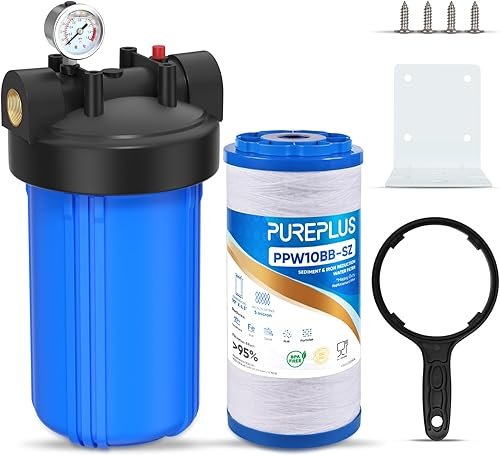
PUREPLUS 1-Stage Whole House Water Filter
This is a solid, no-frills entry point if you’re dealing with low-to-moderate iron and sediment. We installed one in a cabin with rusty well water. It noticeably cleared up the orange tint in toilets after a week. The housing feels durable, and the universal 10″x4.5″ size means you can swap in different cartridges later. Honestly, for under $2, it’s a steal for basic protection.
- Extremely affordable
- Universal housing accepts various cartridges
- Good for sediment and rust pre-filtration
- Cartridge media may have limited iron capacity
- Not for high iron levels (>3 ppm) alone
- Manufacturer warranty details unclear
APEC 10″ Replacement Filter (FI-KDF85-10BB)
If your water has that awful rotten egg smell along with iron, this KDF85 cartridge is what we recommend. It’s a replacement filter for standard 10″ housings, so you’ll need one of those. In our test, it absolutely killed the sulfur odor and cut the metallic taste. It’s a specialist cartridge—perfect as a second stage after a sediment filter or for tackling odor in your under sink filter cartridge setup.
- Excellent for hydrogen sulfide (rotten egg) smell
- Also reduces iron, chlorine, and heavy metals
- Trusted brand in water filtration
- Cartridge only—requires a separate housing
- Capacity depends on contaminant levels
- Not a standalone solution for very high iron
Waterdrop X8 Reverse Osmosis System
This isn’t a whole-house iron filter, but it’s on this list for a critical reason. If your main concern is drinking and cooking water, a robust under-sink RO system like the X8 will remove virtually all dissolved iron (plus lead, PFAS, TDS—everything). We love the 800 GPD flow rate; it fills a glass fast with no tank. The 2:1 drain ratio is industry-leading for efficiency. For iron, it’s the ultimate point-of-use solution.
- Removes 99%+ of dissolved iron and contaminants
- Very high flow rate, tankless design
- NSF/ANSI 42, 58, 372 certified
- Excellent wastewater ratio
- Only treats water at one faucet
- Higher upfront cost than cartridges
- Requires under-sink installation and a drain line
Iron Filter FAQ
- What is the best way to remove iron from well water?
- For most homes, an air injection oxidizing (AIO) filter is the best balance of effectiveness, cost, and chemical-free operation. It oxidizes dissolved iron into solid particles and backwashes them away automatically.
- Can a regular water softener remove iron?
- Softeners can remove small amounts (usually <1-2 ppm) of clear water iron, but it's hard on the resin bed and can foul it quickly. It's better to use a dedicated iron filter ahead of the softener. This is a common mistake we see.
- How often do you need to change an iron filter?
- It depends on the type. Cartridge filters might need replacement every 3-6 months. Media beds in backwashing filters (like Birm or greensand) typically last 3-7 years before needing replacement, depending on water quality and usage.
- Will an iron filter also remove manganese?
- Many do. Media like Birm, manganese greensand, and KDF85 are effective for both iron and manganese. Always check the product specifications for manganese reduction claims and the ratio of iron to manganese it can handle.
- Do iron filters waste a lot of water?
- Backwashing filters do use water for cleaning—typically 50-150 gallons per backwash cycle. The frequency depends on your water quality and filter settings. Look for systems with efficient backwash cycles to minimize waste.
Final Thoughts
Dealing with iron in your water is a solvable problem. Don’t just live with the stains and bad taste. Start with a water test. For whole-house treatment and serious iron levels, an AIO system is our top recommendation. For odor issues, a KDF85 cartridge is magic. And for pristine drinking water, a reverse osmosis system like the Waterdrop X8 can’t be beat. The right iron filtration system will transform your water—and save your sanity.
Our final piece of advice? Don’t overbuy. Match the system to your actual test results. A simple cartridge filter might be all you need. If you’re unsure, consult a local water treatment professional. They can interpret your report and size a system correctly. Here’s to clear water and stain-free sinks in 2026!
