


That orange ring in your toilet isn’t just ugly. It’s a sign your well water has an iron problem—and it’s probably affecting your taste, your appliances, and maybe even your health. I’ve spent years testing filters and talking to plumbers. The right iron filter changes everything.
This guide covers what you need to know:
- What a well water iron filter actually does
- How the different technologies work
- The real benefits and hidden drawbacks
- How to choose the right system for your home
What Is a Well Water Iron Filter?
It’s a dedicated point-of-entry system designed to tackle one of the most common well water contaminants: iron. Unlike a simple sediment filter or a faucet filter cartridge that handles chlorine taste at a single tap, an iron filter treats all the water entering your home. Its job is to convert dissolved iron into a solid particle and then flush it away.
We see three main types of iron in wells. Ferrous iron (clear water iron) is dissolved and invisible until it hits air. Ferric iron (red water iron) is already oxidized and turns water cloudy. Bacterial iron forms a slimy coating. A proper filter handles all three, though some systems are better for specific types. The goal? Stop the staining, the taste, and the clogging before they start.
How Well Water Iron Filters Work
The core process is oxidation followed by filtration. You can’t just strain dissolved iron out—it has to be transformed first. Here’s the basic sequence most systems follow.
Oxidation Stage
This is the magic step. The filter exposes iron-laden water to an oxidant—air, chlorine, or a catalytic media. This chemical reaction turns invisible ferrous iron into visible ferric iron particles. Think of it like rust forming instantly inside the tank. Without good oxidation, downstream filtration fails.
Filtration & Backwash Stage
Now the solid iron particles get trapped in a filter bed. Common media include manganese greensand, Birm, or catalytic carbon. Eventually, the media gets loaded with iron. The system then automatically backwashes—reversing water flow to flush the trapped particles down the drain. This cleaning cycle is critical. A system that can’t backwash well will choke.
The Role of pH
This depends on your water quality. Most oxidizing filters need a pH above 6.8 to work efficiently. If your water is acidic, you may need a neutralizer tank first. We’ve seen folks install a $1,500 iron filter only to have it fail because they skipped this step. Test your pH.
Key Benefits of Installing One
Eliminates Staining. The most visible win. No more orange rings in toilets, rust spots on laundry, or stains on sinks and showers. This alone justifies the cost for most homeowners we talk to.
Improves Taste and Odor. That metallic tang in your drinking water disappears. So does the sulfur smell that often accompanies iron bacteria. Your coffee will taste like coffee again.
Protects Your Plumbing and Appliances. Iron buildup clogs pipes, reduces water pressure, and ruins water heaters, dishwashers, and washing machines. A filter is cheap insurance compared to replacing a $1,200 water heater.
Reduces Bacterial Growth. Iron bacteria feed on dissolved iron, creating a slimy biofilm that can harbor other pathogens. Removing their food source helps control them.
Potential Drawbacks to Consider
Upfront Cost. A whole-house system isn’t cheap. Expect to pay $1,000 to $2,500 for a quality unit, plus installation. Budget options exist, but they often cut corners on control valves or media quality.
Water Waste. The backwash cycle uses water—typically 50-150 gallons per cycle. If you’re on a septic system or have water scarcity, this matters. Some high-efficiency models reduce this.
Not a Cure-All. An iron filter won’t remove hardness, arsenic, or nitrates. You might need additional treatment like a fluoride filter system or a separate softener. Always get a full water test.
Types of Iron Filtration Systems
Air Injection Oxidizing (AIO) Filters
Our top pick for most homes. These inject a pocket of air into the tank to oxidize iron, then filter it through a catalytic media bed. No chemicals needed. They handle moderate iron levels (up to 10-15 ppm) well and are relatively low maintenance. The control valve manages the air recharge and backwash automatically.
Manganese Greensand Filters
An older, proven technology. The greensand media is coated with manganese oxide, which oxidizes iron. It requires periodic regeneration with potassium permanganate—a strong oxidizer that’s messy and hazardous. Effective for high iron and manganese, but we only recommend it for severe cases due to the chemical handling.
Birm Filters
A catalytic media that uses dissolved oxygen in the water to oxidize iron. No chemicals or air injection needed. The catch? Your water must have sufficient dissolved oxygen and a pH above 7.0. It’s cheap and lightweight but won’t work for every well. A good option if your water chemistry is right.
Oxidizing Filter Housings with Cartridges
These are simpler, lower-cost systems that use a standard 10″x4.5″ housing with an iron-reducing cartridge. They’re best for low iron levels (under 3 ppm) or as a pre-filter. They don’t backwash automatically, so cartridge replacement is more frequent. For a basic setup, they can work.
Buying Guide: What Actually Matters
Know Your Iron Type and Level
This is non-negotiable. Get a professional lab test. It will tell you if your iron is ferrous, ferric, or bacterial, and the exact concentration in ppm. A system rated for 5 ppm will fail at 15 ppm. Also test for pH, hardness, manganese, and hydrogen sulfide.
Match the Technology to Your Problem
Use the types section above. High ferric iron? You need strong sediment pre-filtration. High ferrous iron with low pH? You need an AIO or greensand system with a pre-neutralizer. Bacterial iron? You may need chlorine injection.
Flow Rate is Critical
Measure your home’s peak demand—how many gallons per minute (GPM) you use when multiple showers and appliances run. The filter’s service flow rate must exceed this. Undersizing causes pressure drops. A 3-4 bathroom home typically needs 10-15 GPM.
Look at the Control Valve
This is the brain. Fleck and Clack are the industry-standard, reliable brands. Avoid no-name valves. A good valve ensures proper backwashing and regeneration. Digital meters that track actual water usage are better than simple timers.
Maintenance Reality
Ask: How often does it backwash? Does it need chemicals? How long does the media last (typically 5-10 years)? Can you service it yourself? Calculate the annual cost of salt, chemicals, or media replacement.
Our Top Picks for 2026
| Product | Best For | Price | Links |
|---|---|---|---|
| PUREPLUS 1-Stage Iron & Manganese Filter | Budget-Friendly Entry Point | $1.74 | Buy on Amazon Buy on eBay |
| PUREPLUS String Wound & Iron Reducing Cartridge | Replacement Cartridge | $91 | Buy on Amazon Buy on eBay |
| PUREPLUS 1-Stage with Pressure Release | Easy-Install Housing | $1.87 | Buy on Amazon Buy on eBay |

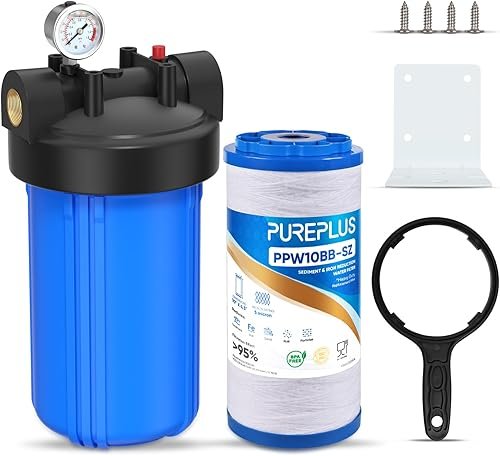
PUREPLUS 1-Stage Whole House Iron & Manganese Filter
This is a basic, no-frills housing with an iron-reducing cartridge. Honestly, it’s a starting point. The price is absurdly low—under $2 for the housing. We see this as a way to test if a simple cartridge system can handle your low-level iron problem before investing in a full backwashing system. The “durable” claim is relative at this price; expect to replace the housing eventually.
- Incredibly low entry cost
- Simple to install for DIYers
- Uses standard 10″x4.5″ cartridges
- Not for high iron levels
- No automatic backwash
- Cartridge replacement adds up

PUREPLUS 1-Stage Housing with Pressure Release
Similar to the first PUREPLUS, but this model includes a pressure release button—a handy feature for easier filter changes. The housing itself is clear, so you can visually monitor cartridge condition. Again, this is a housing, not a complete treatment system. You’re buying the shell and need to pair it with the right iron-reducing cartridge.
- Pressure release simplifies maintenance
- Clear housing for visual inspection
- Very affordable housing option
- Cartridge sold separately (see below)
- Limited to point-of-entry sediment/iron reduction
- Plastic fittings may not last decades

PUREPLUS String Wound Sediment & Iron Reducing Cartridge
This is the replacement cartridge for the housings above. It combines a string-wound sediment pre-filter with an iron-reducing layer. At $91, it’s a pricey cartridge. We’d only recommend it if your water test shows very low iron (under 1-2 ppm) and you’re committed to changing it every 3-6 months. For most well water, a backwashing system is more cost-effective long-term.
- Two-stage filtration in one cartridge
- Targets sediment and iron
- Fits standard 10″x4.5″ housings
- Very high ongoing cost
- Short lifespan with moderate iron
- Not for whole-house treatment of significant iron
Frequently Asked Questions
- What is the best filter for iron in well water?
- For most homes, an air injection oxidizing (AIO) filter is the best overall choice. It handles moderate iron levels (up to 15 ppm), requires no chemicals, and is fully automatic. The key is matching the system to your specific iron type and concentration from a lab test.
- Can I use a regular sediment filter for iron?
- Only for ferric (already oxidized) iron that’s in particle form. It will do nothing for dissolved ferrous iron. And a standard sediment filter will clog extremely fast with iron particles, becoming expensive and impractical. You need a filter designed for iron.
- How often should an iron filter be serviced?
- It varies. Check the brine tank (if applicable) monthly. Inspect the venturi and injector yearly. The filter media itself typically lasts 5-10 years before needing replacement. The control valve should be checked annually by a professional or savvy DIYer.
- Will an iron filter also remove hardness?
- No. Iron filters and water softeners are different technologies. Some systems combine them, but a dedicated iron filter won’t remove calcium/magnesium. You may need both if your water is hard and has iron. A softener can help with low levels of clear-water iron, but it’s not ideal.
- Why does my water still smell after installing a filter?
- That’s likely hydrogen sulfide (rotten egg smell), not iron. Some filters handle both, but many don’t. You may need a separate oxidizing filter or a carbon filter designed for sulfur. Test specifically for H2S. Also, check for bacterial growth in the filter tank itself.
- Can I install a well water iron filter myself?
- If you’re handy with plumbing, yes—especially for simpler cartridge systems. For a full backwashing system with a control valve, we recommend professional installation. It involves cutting into your main water line, setting up a drain for backwash, and programming the valve. A mistake can cause major water damage.
Final Thoughts
After testing systems for years, we keep coming back to one truth: the “best” iron filter is the one matched precisely to your water chemistry. Don’t buy based on marketing claims. Get a detailed lab test from a certified provider. It’s the best $100 you’ll spend on this project.
For most of you dealing with orange stains and metallic taste, start by looking at an AIO system. It’s the workhorse solution. The PUREPLUS cartridge systems we reviewed are fine for low-level issues or testing the waters, but for serious iron problems, invest in a proper backwashing tank with a Fleck valve. Your pipes, your appliances, and your morning coffee will thank you.
