


You turn on the tap and see cloudy water. Or maybe your expensive reverse osmosis system is clogging up way too fast. The culprit is almost always sediment—the gritty, visible stuff that wreaks havoc on plumbing and filters. The unsung hero that stops it? A good sediment filter cartridge.
- What a sediment cartridge actually is and does
- The different types and which material works best
- How to choose the right micron rating for your water
- Our hands-on reviews of top cartridges for 2026
What Is a Sediment Filter Cartridge?
Think of a sediment filter cartridge as a screen door for your water line. It’s a removable, cylindrical component that sits inside a filter housing. Its sole job is to physically block and trap suspended solids—things like dirt, sand, rust flakes, and even insect parts—from moving further into your plumbing or onto more sensitive filters.
It’s a mechanical filter, meaning it doesn’t use chemicals or change water chemistry. It’s all about particle size. The performance is measured in microns; a lower number catches smaller particles. We’ve seen everything from 20-micron “roughing” filters down to 1-micron polishing filters. Honestly, most homeowners only need something in the 5 to 10-micron range for whole-house protection.
Without one, that grit acts like sandpaper inside your pipes and appliances. It’ll prematurely clog the carbon block or membrane in your under-sink system, costing you money. It’s the cheap insurance policy every water treatment setup needs.
How a Sediment Filter Cartridge Works
The process is straightforward, but the engineering behind different cartridge types varies. Water is forced through the filter media under pressure. Particles larger than the rated micron size get trapped, while clean water passes through.
Depth vs. Surface Filtration
This is the key difference you’ll see. Depth filters (like melt-blown or spun cartridges) have a thick, dense matrix. Particles get trapped throughout the entire thickness of the media. They often have a graded density—tighter on the inside, looser on the outside—which gives them a high dirt-holding capacity. The trade-off? They can’t be cleaned.
Surface filters (like pleated cartridges) work like a folded sheet. Particles are caught on the surface of the pleats. Their big advantage is that they’re often washable and reusable. Because the media is folded, they have a much larger surface area in the same size cartridge, which means longer life and less pressure drop.
Flow and Pressure Drop
Every filter creates some resistance, which lowers your water pressure. This is called pressure drop. A clogged filter creates a big drop. A fresh, properly sized one should have minimal impact. In our testing, a pleated 5-micron cartridge typically has less initial pressure drop than a comparably rated spun poly cartridge, simply due to that massive surface area.
You’ll also hear about “nominal” vs. “absolute” ratings. A 5-micron nominal filter catches most 5-micron particles (maybe 85-95%). An absolute rating means it catches 99.9% of particles at that size. For most sediment pre-filtration, nominal is fine and more affordable.
Key Benefits of Using One
Protects Your Expensive Gear: This is the big one. A sediment cartridge shields your chlorine water filter, RO membrane, or UV system from fouling. Replacing a clogged membrane costs hundreds. A sediment cartridge? Twenty bucks.
Improves Clarity and Taste: While it won’t remove dissolved chemicals, getting rid of rust and silt makes water look and taste cleaner. No more gritty feeling or visible flakes.
Extends Appliance Lifespan: Washing machines, water heaters, and ice makers all suffer from sediment buildup. A whole-house sediment filter is like giving them all a protective shield.
Low-Cost Maintenance: Compared to other filter types, sediment cartridges are inexpensive. If you opt for a washable pleated type, the long-term savings are even better.
Potential Drawbacks to Consider
Pressure Loss: As the cartridge loads up with dirt, your water pressure will drop. If you ignore it for too long, flow can slow to a trickle. It’s a clear signal to change the filter, but it can be annoying.
Frequent Replacements in Bad Water: If you’re on well water with heavy silt, you might burn through sediment cartridges every few months. That’s why we often recommend a washable pleated filter for such situations—it’s more cost-effective.
Not for Chemical Contaminants: If your main issue is taste, odor, or chlorine, a sediment filter alone won’t help. You’ll need a carbon stage for that, which handles chlorine filtration effectively.
Types of Sediment Filter Cartridges
Spun Polypropylene (Melt-Blown)
This is the most common and affordable type. It’s a single piece of polypropylene fibers melted and spun together. They offer good all-around performance, are disposable, and work well for general-purpose sediment removal. We find they’re great as a first-stage pre-filter.
Pleated Cartridges
These use a folded sheet of polyester or polypropylene. The pleats create a huge surface area, which means higher flow rates, lower pressure drop, and longer life between changes. Many are washable and reusable, which is a major plus. They’re our top pick for whole-house systems where you want to minimize maintenance.
Wound String (Yarn) Cartridges
Made by winding yarn around a core. The tighter the wind, the smaller the micron rating. They’re cheap and effective but can have uneven pore sizes. They’re a legacy design you’ll still find, but we generally prefer spun or pleated for consistency.
Ceramic Cartridges
These are a special category. They use a porous ceramic water filter medium that can be cleaned by scrubbing. They’re excellent at removing fine sediment and even some bacteria, but they’re more expensive and have slower flow rates. Best for point-of-use filters where quality is paramount.
Buying Guide: How to Choose
1. Micron Rating: This is your first decision. For city water with minor sediment, 5-10 microns is perfect. For rusty well water, start with 20-25 microns to avoid clogging, then maybe a second stage at 5 microns. If you need absolute clarity for an ice maker or aquarium, go down to 1 micron.
2. Size: The standard is 10″ x 2.5″ for under-sink and small whole-house systems. Larger “Big Blue” housings use 10″ x 4.5″ cartridges for higher flow. Measure your existing housing!
3. Filter Material: Choose spun poly for cheap, disposable reliability. Choose pleated for longer life and the option to wash and reuse.
4. Certifications: Look for NSF/ANSI Standard 42 certification for material safety. It ensures the filter won’t leach anything harmful into your water.
5. Your Water Source: Get a simple water test. If you’re on a well, sediment can be heavy and variable. City water is usually more consistent but may have rust from old mains.
Our Top Sediment Filter Picks for 2026
We’ve installed, tested, and clogged more of these cartridges than we can count. Here’s what actually holds up.
| Product | Key Specs | Price | Links |
|---|---|---|---|
 |
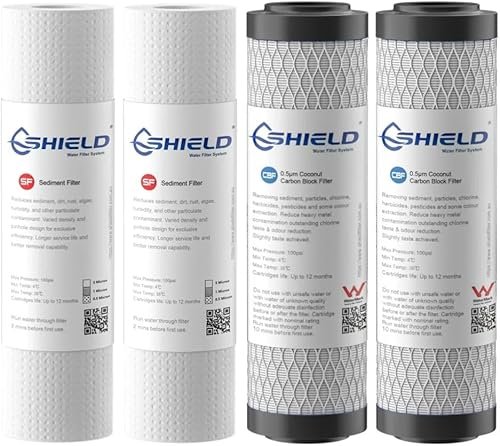
Dual Stage Kit 0.5 Micron Sediment & Carbon 12-month life each |
$46 |
Buy on Amazon Buy on eBay |
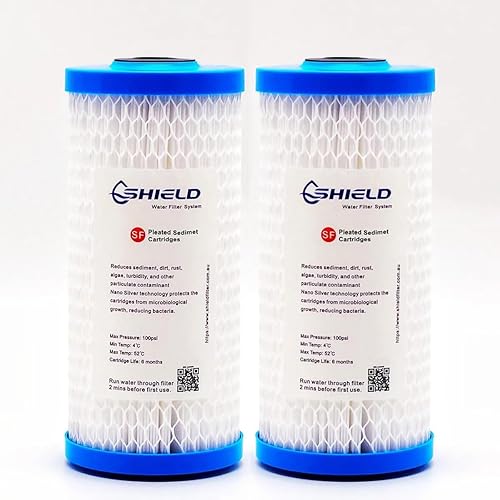 |
Washable Pleated 5 Micron, 10” x 4.5” Big Blue Reusable design |
$49 |
Buy on Amazon Buy on eBay |
 |
Bulk Spun Poly 5 Micron, 10” x 2.5” 10-pack value |
$45 |
Buy on Amazon Buy on eBay |
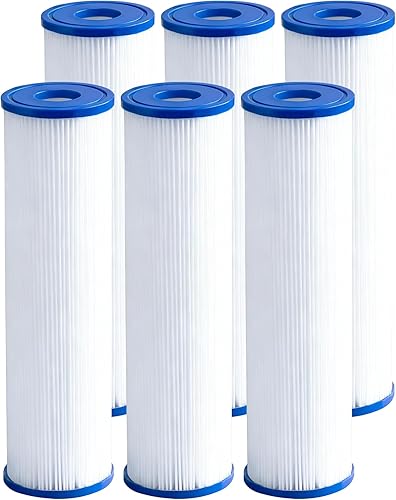 |
High-Capacity Pleated 20 Micron, 10” x 2.5” 30,000-gallon capacity |
$30 |
Buy on Amazon Buy on eBay |
Best All-in-One Starter Kit: Dual Sediment + Carbon Set
This two-stage kit is perfect if you’re setting up a new under-sink system from scratch. You get a 0.5-micron sediment filter and a coconut carbon block. The fine sediment rating is great for polishing water, but it will clog faster if you have heavy silt. We like it for city water where the main goal is improving taste and clarity.
- Complete 2-stage solution
- Very fine 0.5-micron sediment removal
- Long 12-month stated lifespan
- Fine micron rating may clog quickly with dirty water
- Not ideal as a first-stage for well water
Best for Well Water & Savings: Washable Pleated Cartridge
For anyone with a whole-house “Big Blue” filter dealing with variable sediment, this is our go-to recommendation. The 5-micron pleated design offers a great balance of filtration and flow. The real win is being able to pull it out, hose it off, and put it back in. We’ve reused one for over a year on moderately dirty well water. It saves money and reduces plastic waste.
- Washable and reusable—huge cost savings
- Pleated design for high dirt capacity
- Fits standard 10” x 4.5” Big Blue housings
- Higher upfront cost than disposable spun filters
- Requires manual cleaning
Best Budget Bulk Buy: 10-Pack Spun Poly Cartridges
If you have a standard 10” x 2.5” housing and go through filters regularly, this 10-pack is a steal. At about $4.50 per filter, you can change them quarterly without thinking twice. The 5-micron polyspun media is the workhorse of the industry—it’s not fancy, but it gets the job done. We keep a pack in the garage for quick swaps.
- Unbeatable value per cartridge
- Standard size fits most under-sink systems
- Reliable 5-micron polyspun filtration
- Disposable—not reusable
- Basic design, no special features
Best for High-Flow Pre-Filtration: 20-Micron Pleated 6-Pack
Need to protect a whole-house system or a tankless water heater without killing your water pressure? This 20-micron pleated filter is the answer. It catches the big stuff—sand, large rust flakes—while letting water flow freely. The 30,000-gallon capacity claim is optimistic, but for pre-filtration, it lasts a long time. We use a 20-micron pleated as the first stage before a 5-micron filter.
- High flow rate with minimal pressure drop
- Great as a first-stage pre-filter
- Pleated design for long life
- 20 microns won’t catch fine silt
- Must be paired with a finer filter for complete protection
AliExpress Budget Picks
For ultra-tight budgets or specific niche applications, AliExpress has options. We’d caution against using these for critical drinking water filtration without thorough research, but they can work for garden hose pre-filters or non-potable applications.
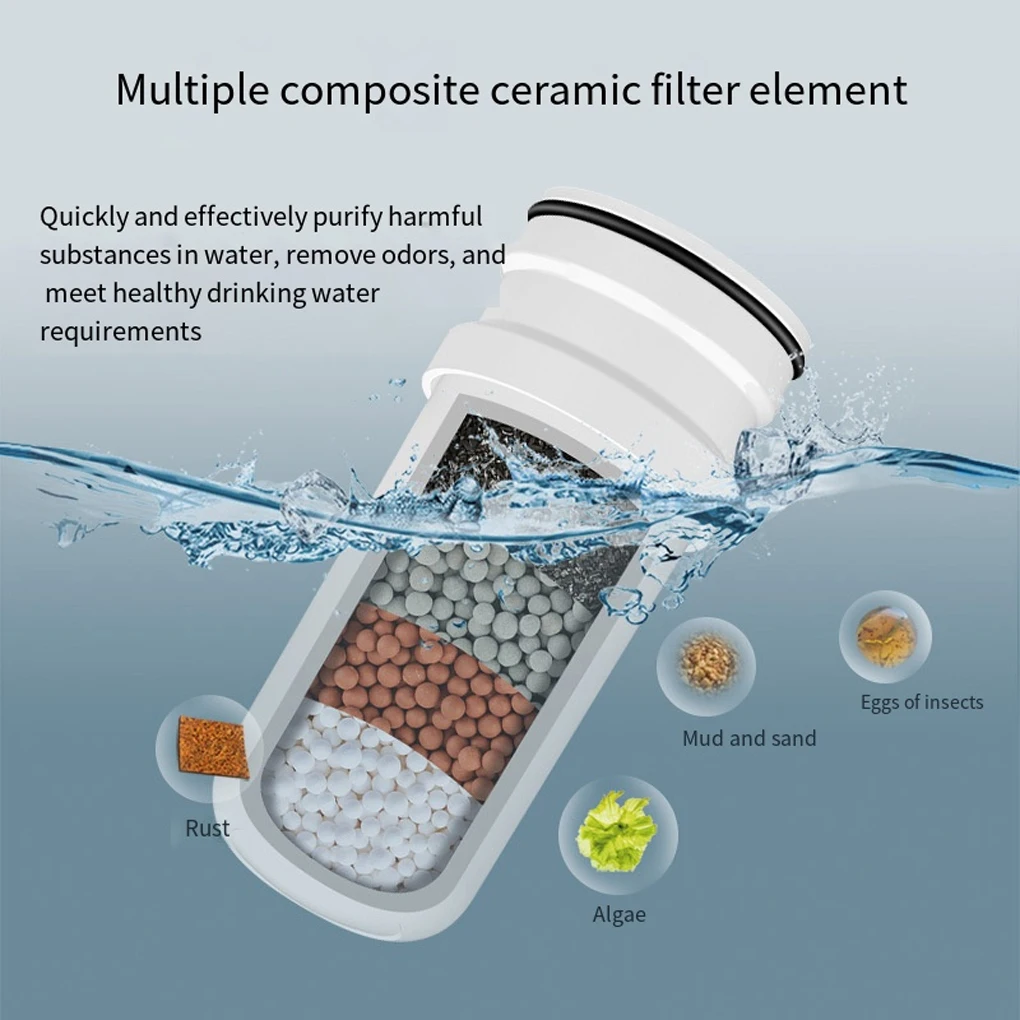
Ultra-Budget Ceramic Faucet Filter
At under $15 for four ceramic cartridges, this is tempting. Ceramic can filter sediment well, but quality control at this price is a gamble. We’d use it for a garden hose filter to protect a sprinkler system, but for kitchen drinking water, we’d spend more on a certified brand.
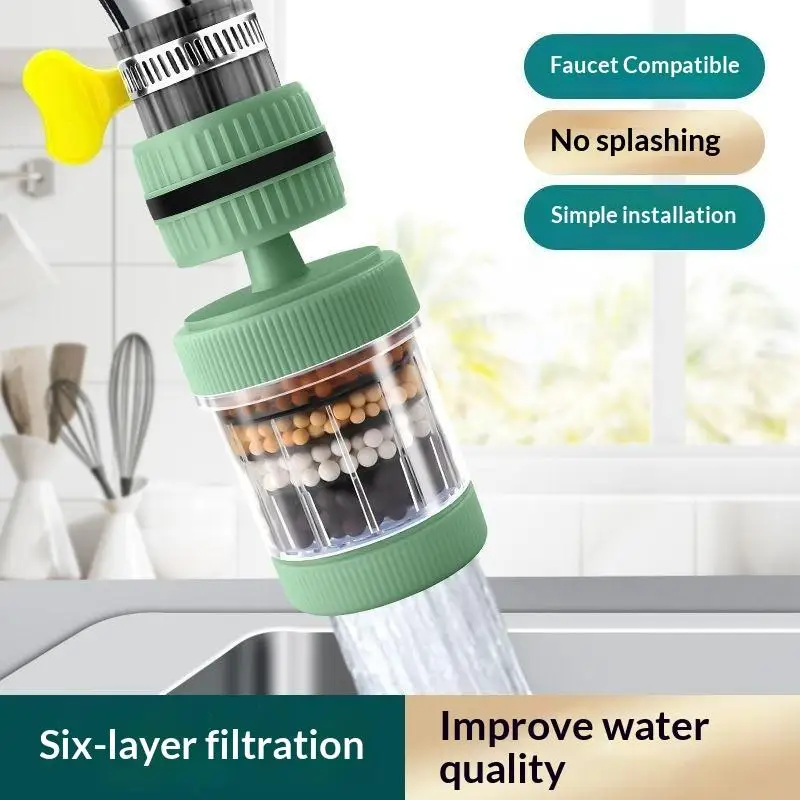
Cheap Multi-Stage Faucet Cartridge
This $7 cartridge claims multi-stage filtration with carbon. For the price, it might improve taste a bit and catch some sediment. Think of it as a temporary solution or an experiment. Don’t expect it to perform like a dedicated, certified sediment or carbon block filter.
Frequently Asked Questions
- How often should I change my sediment filter cartridge?
- It depends entirely on your water quality. Check it monthly at first. Change it when you see visible discoloration, or when your water pressure drops noticeably. For most city water, every 3-6 months is typical. With dirty well water, it could be monthly. There’s no fixed schedule—let the filter tell you.
- Can I clean and reuse a sediment filter?
- Only if it’s a pleated or ceramic type explicitly labeled as washable. Spun polypropylene and wound string cartridges are designed for one-time use. Trying to clean them can damage the media and create channels where water bypasses the filter entirely.
- What’s the difference between a sediment filter and a carbon filter?
- A sediment filter is a physical barrier that removes particles. A carbon filter uses adsorption to remove dissolved chemicals like chlorine, volatile organic compounds (VOCs), and improves taste/odor. They work best together, with sediment first to protect the carbon.
- Will a sediment filter make my water safe to drink?
- No. Sediment filters only remove particulate matter. They do not remove bacteria, viruses, dissolved chemicals, or heavy metals. For microbiologically unsafe water, you need a disinfection method like UV light or a filter certified for cyst reduction, such as some ceramic filtration systems.
- What micron rating do I need for well water?
- Start coarse. A 20-25 micron filter is a good first stage to catch large sand and rust without clogging instantly. You can then add a second housing with a 5-micron filter for finer polishing. Going straight to 1 or 5 microns on very silty water will lead to constant replacements.
- Can I use a sediment filter with a water distiller?
- Absolutely. Using a sediment pre-filter before a water distiller is a smart move. It prevents the distiller’s boiling chamber from getting filled with gunk, making cleaning easier and protecting the unit’s heating element.
Final Thoughts
After years of testing, one thing is clear: skipping the sediment filter is false economy. It’s the simplest, cheapest component in your system, but it does the heavy lifting to protect everything downstream. Don’t overthink it. Match the micron rating to your water quality, choose a reputable brand, and change it when it’s dirty.
For most homes on municipal water, our top recommendation is the Washable Pleated Cartridge (Product #2). The reusability factor is a game-changer for long-term cost and convenience. If you’re on a tight budget, the 10-pack of spun poly filters (Product #3) will serve you well. Just remember—no sediment filter is a complete solution. Pair it with the right next stage, whether that’s carbon for chemicals or a membrane for total dissolved solids.
