


.oi-article{font-family:system-ui,-apple-system,sans-serif;color:#1a1a1a;line-height:1.8;max-width:820px;margin:0 auto}
.oi-article h2{color:#0e4a6e;border-bottom:2px solid #0e4a6e;padding-bottom:8px;margin-top:35px;font-size:1.6em}
.oi-article h3{color:#1a6b8a;margin-top:25px;font-size:1.3em}
.oi-toc{background:#f0f7fb;border-left:4px solid #0e4a6e;padding:20px 25px;margin:25px 0;border-radius:6px}
.oi-toc ul{list-style:none;padding:0;margin:0}.oi-toc li{padding:5px 0}
.oi-toc a{color:#0e4a6e;text-decoration:none;font-weight:500}.oi-toc a:hover{text-decoration:underline}
.oi-tip{background:#e8f5e9;border-left:4px solid #2e7d32;padding:15px 20px;margin:20px 0;border-radius:6px}
.oi-warn{background:#fff3e0;border-left:4px solid #ef6c00;padding:15px 20px;margin:20px 0;border-radius:6px}
.oi-tldr{background:#e3f2fd;border-left:4px solid #1565c0;padding:15px 20px;margin:20px 0;border-radius:6px;font-size:1.05em}
.oi-cmp-table{width:100%;border-collapse:collapse;margin:25px 0;font-size:0.95em}
.oi-cmp-table th{background:#0e4a6e;color:#fff;padding:12px 10px;text-align:left}
.oi-cmp-table td{padding:10px;border-bottom:1px solid #e0e0e0;vertical-align:middle}
.oi-cmp-table tr:hover{background:#f5f5f5}
.oi-cmp-table img{max-width:80px;height:auto;border-radius:6px}
.oi-btn{display:inline-block;padding:8px 16px;border-radius:5px;color:#fff!important;text-decoration:none;font-size:0.85em;font-weight:600;margin:3px 4px 3px 0}
.oi-btn-amz{background:#f0960a}.oi-btn-amz:hover{background:#d4840a}
.oi-btn-ebay{background:#0654ba}.oi-btn-ebay:hover{background:#044a9e}
.oi-btn-ali{background:#e43225}.oi-btn-ali:hover{background:#c42a1f}
.oi-review{overflow:hidden;margin:25px 0;padding:20px;background:#fafafa;border-radius:8px;border:1px solid #e8e8e8}
.oi-review img{float:right;max-width:140px;margin:0 0 15px 20px;border-radius:8px}
.oi-pros-cons{display:flex;gap:20px;margin:10px 0}.oi-pros,.oi-cons{flex:1}
.oi-pros li{color:#2e7d32}.oi-cons li{color:#c62828}
.oi-faq dt{font-weight:700;color:#0e4a6e;margin-top:18px}.oi-faq dd{margin:5px 0 0 0}
.oi-disclosure{background:#f5f5f5;padding:15px 20px;margin-top:35px;border-radius:6px;font-size:0.9em;color:#555}
You’ve seen the jugs at the store. Maybe you use it in your iron or CPAP machine. But the question lingers: is that perfectly clear, flat-tasting water actually good for you? We’ve spent years testing filtration systems, from simple granular activated carbon filters to full-blown reverse osmosis setups, and distilled water always sparks debate. Let’s cut through the noise.
This guide covers what distilled water really is, how it’s made, and its real-world pros and cons. We’ll look at who should use it, who might want to avoid it, and how to pick the right product for your needs.
What Is Distilled Water?
Distilled water is water that has been boiled into vapor and then condensed back into liquid in a separate container. Think of it as the reset button for H2O. This process removes an impressive array of contaminants—heavy metals like lead, dissolved salts, bacteria, viruses, and most chemicals. What you’re left with is essentially just water molecules.
It’s fundamentally different from what you get from a standard carbon water filter. While a good filter targets specific impurities like chlorine or pesticides, distillation is a brute-force method that strips almost everything out. That’s why it’s the gold standard for purity in labs, hospitals, and automotive applications.
How Distillation Works
The science is simple, but the execution matters. Understanding the process helps you appreciate what you’re buying.
The Basic Principle
Water is heated to its boiling point (100°C or 212°F) in a chamber. As it turns to steam, it leaves behind virtually all dissolved solids, metals, and microorganisms. This steam travels into a condenser, cools down, and reverts to liquid form in a clean collection container. The gunk left behind? That’s all the stuff you don’t want in your body or your steam iron.
What It Removes (And What It Might Not)
Distillation is incredibly effective against:
- Heavy Metals: Lead, mercury, arsenic.
- Dissolved Solids: Sodium, fluoride, nitrates.
- Microorganisms: Bacteria, viruses, cysts.
- Most Organic Chemicals: Pesticides, herbicides.
However, some volatile organic compounds (VOCs) with boiling points lower than water can vaporize and re-condense with the steam. A quality chlorine filter system or a carbon post-filter on a distiller catches these, which is why we recommend units with that extra stage.
Key Benefits
Unmatched Purity. This is the big one. If your tap water has concerning levels of lead, nitrates, or other dissolved solids, distillation provides peace of mind that few other methods can match. It’s a known quantity.
Appliance Lifespan. Using distilled water in steam irons, humidifiers, and CPAP machines prevents mineral scale buildup. That white, crusty stuff? It’s gone. Your appliances will run more efficiently and last years longer. We’ve seen the insides of kettles used with hard tap water—it’s not pretty.
Consistency. Unlike tap water quality, which can vary by season and municipal treatment, a jug of distilled water is the same every single time. This is critical for medical applications, laboratory work, and even some aquariums.
Potential Drawbacks
Taste. Let’s be honest: it tastes flat. Some describe it as “empty.” The minerals in regular water contribute to its flavor profile. You can get used to it, or add a pinch of mineral salt to your glass.
Energy and Time. If you’re using a home distillation system, it’s not instant. It uses more electricity than a simple pitcher filter and takes hours to produce a gallon. Buying it pre-distilled means recurring cost and plastic jugs.
Types of Distilled Water Products
Commercially Bottled Distilled Water
The most convenient option. You’ll find it in grocery stores and online. It’s ready to use, consistently pure, and comes in various sizes. The downside is the ongoing cost and environmental impact of single-use plastic.
Home Distillation Units
Countertop or larger systems that let you make your own. They’re an investment upfront but can save money over time if you use a lot. Look for models with activated carbon post-filters for the cleanest output.
Demineralized Water
Often sold alongside distilled. It’s produced through methods like deionization or reverse osmosis, not distillation. While very pure, it may not remove bacteria or viruses unless combined with other methods like a chlorine removal system or UV light. Always check the label for the purification method.
Buying Guide
Check the PPM. Total Dissolved Solids (TDS) is your key metric. Good distilled water should be below 10 PPM, with the best under 5 PPM. Glendale’s product, for example, boasts <5 PPM.
Container Matters. For jugs, look for food-grade HDPE plastic (recycle code #2). Glass is ideal but rare and heavy for large volumes. Ensure the seal is intact.
Consider Your Volume Needs. Are you topping up a CPAP humidifier (needs ~500ml daily) or running a workshop that uses gallons? Buying a 20L drum is far more economical per liter than multiple 2L bottles.
Top Picks for 2026
| Product | Key Spec | Best For | Price |
|---|---|---|---|
| Livingstone Steam Distilled 5L | Built-in tap | Daily appliance use | $12 |
| Livingstone 2-Pack (10L total) | Bulk value | High-volume users | $25 |
| Glendale Distilled 2L | <5 PPM TDS | Maximum purity needs | $28 |
| Glendale 20L Drum | Best per-liter cost | Workshops & labs | $1.10/L |

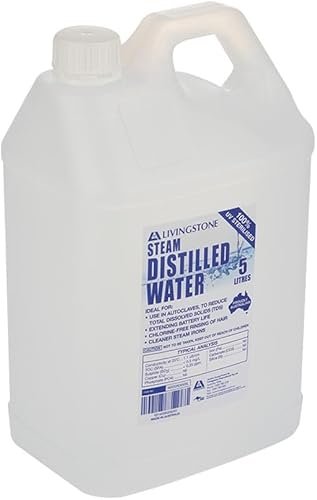
Livingstone Steam Distilled Water 5 Litre
This is our go-to recommendation for most households. The built-in tap under the cap is a small feature that makes a huge difference—no more awkward pouring or spills when filling a small appliance reservoir. The purity is reliable for all common uses.
- Extremely convenient dispensing tap
- Consistent quality
- Good size for weekly use
- Plastic jug (recyclable)
- Can be hard to find in local stores

Livingstone Distilled Demineralised Water 5 Litre (Pack of 2)
If you know you’ll use it, buying the two-pack just makes sense. It saves you a reorder in a week or two and cuts down on shipping waste. The water is identical to the single jug—pure, demineralized, and ready for your iron, steamer, or car battery.
- Better value per litre
- Reduces order frequency
- Same trusted purity
- Higher upfront cost
- Requires storage space

Glendale Distilled Water 2 Litre
Glendale is the choice when purity is non-negotiable. Their vacuum MVR distillation process is energy-efficient and produces water with less than 5 PPM TDS. That’s lab-grade. We recommend this for sensitive medical devices, high-end steam appliances, or if you’re just really particular.
- Exceptionally low TDS (<5 PPM)
- Energy-efficient production
- Ideal for critical applications
- Smaller bottle size
- Premium price point
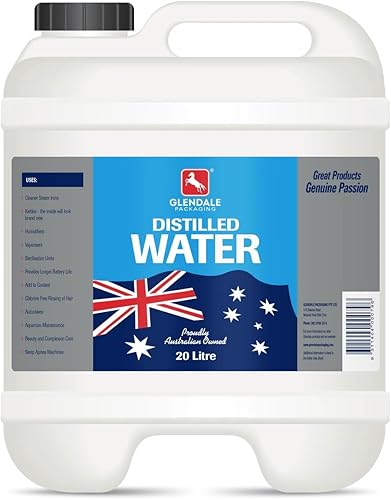
Distilled Water 20L (Glendale)
This is the workhorse. A 20-litre drum is what you buy for a serious workshop, a fleet of steam cleaners, or if you’re filling lead-acid batteries regularly. The per-litre cost is unbeatable. It’s not glamorous, but it’s incredibly practical for high-consumption scenarios.
- Outstanding value for volume
- Reduces packaging waste
- Perfect for commercial/industrial use
- Heavy and bulky to handle
- Requires a separate dispenser
Frequently Asked Questions
- Is it safe to drink distilled water every day?
- Absolutely. It’s safe. The myth that it “leaches minerals” from your body is overstated. Your body gets minerals from food, not water. If you eat a reasonably balanced diet, drinking distilled water poses no health risk and can be a smart choice if your tap water quality is questionable.
- Does distilled water go bad?
- Not really. Sealed, commercially bottled distilled water has an indefinite shelf life if stored properly. Once opened, it can absorb carbon dioxide from the air, making it slightly more acidic and affecting taste over weeks. For appliance use, this is irrelevant. For drinking, use it within a few weeks of opening.
- What’s the difference between distilled and purified water?
- “Purified” is a broad term that can include water treated by distillation, reverse osmosis, deionization, or other methods. “Distilled” specifies the exact method. All distilled water is purified, but not all purified water is distilled. Distillation is generally considered the most thorough single method.
- Can I use distilled water in my fish tank?
- Not by itself. Fish need certain minerals for osmoregulation and health. Distilled water is too pure and can be harmful. However, aquarists often use it as a base, remineralizing it to the exact specifications needed for their particular species. It’s a tool, not a complete solution.
- Why does distilled water taste flat?
- Taste comes from dissolved minerals and gases. Distillation removes the minerals that contribute to mouthfeel and flavor. The flatness is simply the taste of pure H2O. Some people add a tiny pinch of high-quality salt to a glass to improve the taste.
- Is boiled water the same as distilled?
- No, and this is a common mistake. Boiling kills microbes but leaves all dissolved solids, metals, and chemicals behind. In fact, boiling can concentrate them as water evaporates. Distillation captures the pure steam, leaving the contaminants behind. Boiled tap water is safer from bugs, but not purer.
Final Thoughts
After testing countless filtration methods, we see distilled water as a specialist tool, not a universal replacement for tap water. Its safety is unquestionable. The real question is about your needs. If you’re protecting a CPAP machine, a high-end garment steamer, or a sensitive laboratory instrument, it’s the best choice you can make. If you’re looking for a daily drinking water source, a high-quality carbon block or reverse osmosis filter might offer a better balance of purity, taste, and mineral content.
For appliance use, you can’t go wrong with the convenience of the Livingstone 5L with its tap. For serious, high-volume needs, the Glendale 20L drum is the most economical pick. The safety of distilled water isn’t the issue—it’s the practicality and cost for your specific situation.
